26 May 2026
E marketing PDF guide for Australian business owners
Unlock the secrets of effective e marketing with our comprehensive e marketing PDF. Transform your Australian business today!
TL;DR:
- Effective e-marketing in 2026 integrates AI-powered SEO, machine learning paid search, social media amplification, and data analytics into a unified system. Businesses that combine channels, track meaningful metrics, and continuously optimize their campaigns gain higher ROI and genuine customer trust. Success relies on strategic testing, consistent effort, and building authority through authentic community engagement.
E-marketing is no longer about posting on social media and hoping someone clicks. In 2026, any useful e marketing pdf worth reading covers AI-powered SEO, machine learning paid search, social media amplification, and data analytics working together as one system. Yet most business owners still treat these as separate tools. That disconnect costs real money. This guide breaks down exactly what modern e-marketing looks like, what the research actually says about what works, and how you can build a system that reliably attracts and converts clients online.
Table of Contents
- Key takeaways
- What an e marketing PDF should actually cover
- Traditional vs e-marketing: the real difference
- Building your e-marketing plan step by step
- Advanced strategies from real 2026 case studies
- Common e-marketing mistakes that kill your ROI
- My honest take on what actually works
- Take your e-marketing further with expert guidance
- FAQ
Key takeaways
| Point | Details |
|---|---|
| AI transforms paid search | Machine learning in SEM delivered 42% global subscriber growth while cutting cost per acquisition. |
| Integration beats isolation | Combining SEO, paid ads, content, and social media outperforms any single channel used alone. |
| Transparency wins trust | Brands using radical honesty in social campaigns, like Dove on Reddit, generated over a billion impressions. |
| Measure what matters | Vanity metrics like follower counts obscure real business outcomes. Track leads, conversions, and revenue instead. |
| Automation scales campaigns | XML feed-driven SEM models free up team capacity and capture early-funnel intent at scale. |
What an e marketing PDF should actually cover
Most digital marketing guides skim the surface. The ones worth your time treat e-marketing as an ecosystem, not a checklist. Here is what every serious framework addresses in 2026.
AI-powered SEO and search intent
Search engine optimisation has moved well beyond keywords and backlinks. AI now interprets search intent at a granular level, which means your content needs to answer the question behind the question. For Australian service businesses, this means structuring pages around what your ideal client is actually trying to achieve, not just what they typed. Beyond traditional SEO, GEO (Generative Engine Optimisation) is now a real priority. Getting your brand mentioned in AI tools like ChatGPT and Google Gemini requires building genuine topical authority across multiple content formats and earning citations from credible sources.
Pro Tip: Build content clusters around a core service page, with supporting articles that each answer a specific related question. This signals depth of expertise to both search engines and AI language models.
Content marketing, paid advertising, and social media
Content marketing builds the trust that converts a stranger into a client. But content without distribution is invisible. That is where paid advertising on Google Ads, Meta platforms, and LinkedIn comes in. Each channel serves a different stage of awareness, and the strongest campaigns treat them as interconnected, not competing.
- Google Ads: Captures high-intent search traffic from people ready to buy now
- Meta advertising: Builds awareness and retargets warm audiences across Facebook and Instagram
- LinkedIn: Reaches B2B decision-makers with precision targeting by job title and industry
- SEO and organic content: Builds long-term authority and reduces reliance on paid spend over time
- Email marketing: Nurtures leads through the decision process with personalised sequences
- Social media communities: Creates belonging and drives word-of-mouth through genuine engagement
Modern digital marketing works as a psychological ecosystem where each channel reinforces the others. Data analytics ties it all together. Without tracking meaningful metrics across every channel, you are spending money in the dark.
Traditional vs e-marketing: the real difference

There is still a persistent belief among some business owners that traditional marketing, think print ads, radio spots, and flyers, carries more credibility than digital. That belief is expensive.
| Factor | Traditional marketing | E-marketing |
|---|---|---|
| Reach | Local or broad but untargeted | Hyper-targeted by location, interest, behaviour |
| Measurability | Difficult to track ROI | Real-time data on every click and conversion |
| Cost | High upfront with limited flexibility | Scalable budgets with daily adjustments |
| Speed | Weeks to produce and distribute | Live in hours, tested and optimised daily |
| Personalisation | Minimal | Deep personalisation via automation and AI |
| Feedback loop | Slow and anecdotal | Immediate and data-driven |
As outlined in the digital marketing comparison, digital channels offer a level of targeting, testability, and measurability that no print campaign can replicate.
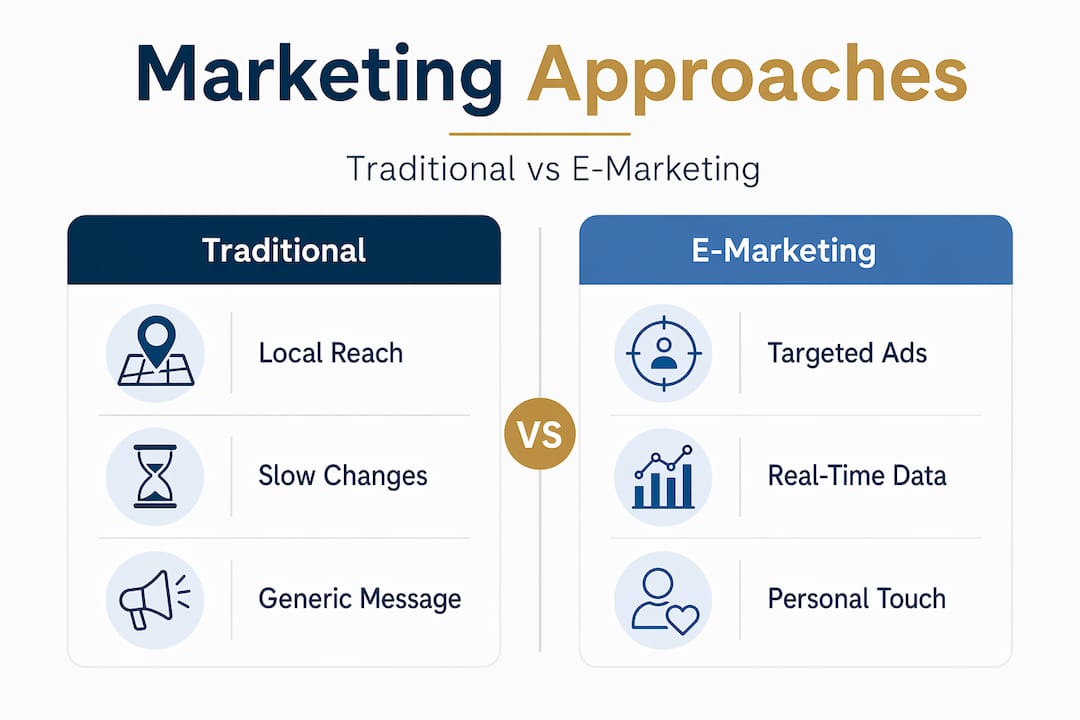
The scalability advantage is significant. A Google Ads campaign can be paused, adjusted, and relaunched within minutes based on performance data. A newspaper ad cannot. For service businesses operating in competitive Australian markets, that flexibility is the difference between wasting budget and compounding returns.
Pro Tip: Run a small paid search test with $20 per day before committing to a larger budget. The data you collect in the first two weeks is worth more than any marketing plan written without it.
A common misconception is that e-marketing is cheaper than traditional. It can be, but the real advantage is not cost. It is the ability to know precisely what is working and double down on it. That feedback loop is what digital marketing success in 2026 hinges on.
Building your e-marketing plan step by step
A solid e-marketing plan is not a document you write once and file away. It is a living system you test and improve continuously. Here is the framework that actually works.
-
Audit your current position. Review your website traffic, current rankings, social media engagement, and lead volume. Identify where clients are coming from today and where the gaps are. Use Google Analytics, Search Console, and your CRM data.
-
Define specific, measurable goals. “More leads” is not a goal. “Generate 30 qualified enquiries per month from Google search within 90 days” is. Align your goals to real business outcomes, not marketing vanity metrics.
-
Choose your channels based on your audience. A med spa targeting women aged 35 to 50 in Perth needs Meta ads and local SEO. A B2B software firm needs LinkedIn and content marketing. Match channels to where your ideal client spends time and makes decisions.
-
Build your content and campaign infrastructure. This includes your website, landing pages, email sequences, ad creatives, and social content. AI tools now accelerate content production significantly, but quality control remains your responsibility.
-
Set up tracking before you spend a dollar. Install conversion tracking on every form, phone call, and purchase. Connect your ad accounts to your CRM. Without this, you cannot attribute revenue to specific campaigns.
-
Use automation to scale. XML feed-driven campaigns allow SEM programmes to scale dynamically without manual work for every product or service variation. Email automation nurtures leads while you focus on delivery.
-
Test, measure, and optimise in cycles. Run your campaigns for at least four weeks before drawing conclusions. Test one variable at a time, ad copy, audience, landing page, bidding strategy. Use data to make every iteration smarter.
-
Build client acquisition funnels, not just campaigns. The goal is not a click. It is a converted client. Map the full journey from first touchpoint to signed contract and optimise every step. For practical steps on measurable growth online, a structured framework makes this far less overwhelming.
Advanced strategies from real 2026 case studies
Theory only takes you so far. Here is what the data from actual 2026 campaigns shows.
AI-enhanced big data analytics improved customer satisfaction by 21% and increased promotional campaign reliability by 0.36 points for e-commerce firms. That is not a marginal gain. It represents a fundamental shift in how well businesses can predict and serve customer needs.
The Baileys seasonal launch case study is one of the most instructive e marketing examples from this year. By combining commerce media integration with targeted product sampling at key retail touchpoints, the campaign delivered a 233% online sales uplift with 70% of buyers being new to the brand. Critically, authentic reviews were seeded before launch using platforms like Amazon Vine, which lifted paid media conversion rates by over 40%.
| Campaign | Strategy used | Key result |
|---|---|---|
| Xero SEM | ML-driven paid search with XML feeds | 42% global subscriber growth, 7% cost reduction |
| Baileys launch | Commerce media plus targeted sampling | 233% sales uplift, 70% new shoppers |
| Dove on Reddit | Radical transparency, unfiltered reviews | 1 billion+ impressions, increased sales |
“Radical transparency and community engagement via social platforms boost authenticity and trust, which drives modern campaign success.” Unilever 2026
Dove’s Reddit campaign is a masterclass in social media marketing done differently. Rather than crafting polished brand messages, Dove used real, unfiltered customer reviews from Reddit to build creative. The result was over 1 billion impressions and genuine category growth. For Australian businesses, the lesson is clear. Authenticity at scale beats perfection in isolation.
For internet marketing in Australia, these global case studies translate directly. The principles of AI, automation, and authentic community building apply whether you run a med spa in Melbourne or a law firm in Brisbane.
Common e-marketing mistakes that kill your ROI
Most businesses do not fail at digital marketing because they chose the wrong platform. They fail because of predictable, avoidable errors.
- Single-channel dependence. Relying entirely on Facebook ads or only on SEO leaves your business exposed when algorithms change or costs spike. Spread your acquisition across at least three channels.
- Ignoring data privacy. In 2026, consent requirements under Australian Privacy Act obligations are non-negotiable. Non-compliance damages trust and can trigger regulatory action.
- Chasing vanity metrics. Follower counts, impressions, and reach tell you nothing about revenue. Ignoring meaningful measurement is one of the fastest ways to burn through a marketing budget with nothing to show for it.
- Inconsistent content. Publishing three posts in one week and then nothing for a month destroys the trust and momentum you have built. Consistency matters more than volume.
- Poor message-to-market fit. Running ads to a broad audience with a generic message wastes spend. Your messaging must speak directly to the specific problem your ideal client is experiencing right now.
Pro Tip: Before launching any new campaign, write down the specific problem it solves for a specific person. If you cannot describe that person in one sentence, your targeting needs work first.
For businesses using paid advertising, the most effective approach balances digital advertising strategy across paid and organic channels. Paid drives immediate traffic. Organic builds compounding returns. Neither alone is a complete strategy.
My honest take on what actually works
I have worked with enough businesses across Australia to see the same pattern repeat. The ones who grow consistently are not the ones with the biggest budgets. They are the ones who commit to learning what their data is telling them and keep showing up.
What I have found is that most business owners want a shortcut. They want the one ad, the one funnel, the one tactic that will fix everything. That is not how this works. What actually builds a client acquisition machine is the unglamorous work of testing, measuring, and improving every element of your marketing over months, not weeks.
AI and machine learning are genuinely useful, not just hype. I have seen campaigns where AI in paid search delivered results that no human bidding strategy could match at scale. But AI amplifies a good strategy. It does not replace one. If your offer is weak, your targeting is off, or your landing page does not convert, AI will just help you lose money faster.
The uncomfortable truth about trends is this: chasing every new platform or tactic is how businesses end up scattered and exhausted with nothing to show for it. The businesses I see winning in 2026 are the ones who picked three to four channels, got genuinely good at them, and built real authority in their market. Start. Iterate. Stay consistent. That is the whole game.
, Business Warriors | Digital Marketing Agency
Take your e-marketing further with expert guidance
If this guide has clarified what is possible with a properly structured e-marketing system, the next step is getting help building one that fits your specific business.
Jarrodharman has helped service businesses across Australia move from scattered digital activity to integrated, measurable client acquisition systems. Whether you need proven online client acquisition strategies or a full digital marketing plan for growth, the resources and expertise are there to get you moving faster. For businesses ready to go deeper on strategy, planning digital campaigns for organic growth is a strong complementary resource. The market in 2026 rewards those who act with a system behind them.
FAQ
What is e-marketing and how does it differ from digital marketing?
E-marketing refers to promoting products and services through electronic channels including the internet, email, and mobile platforms. Digital marketing is the broader term that encompasses e-marketing as well as all forms of digital communication, including digital TV and radio.
What should a good e marketing PDF guide include?
A quality e marketing pdf should cover SEO strategy, paid advertising on Google and Meta platforms, email marketing, social media marketing, data analytics, and how these channels integrate into a single client acquisition system.
How does AI improve e-marketing results?
AI improves targeting precision, automates bid management in paid search, personalises content delivery, and analyses large data sets to improve campaign reliability. Research shows AI-driven analytics lifted customer satisfaction by 21% and improved campaign reliability for e-commerce businesses.
What are the best e-marketing practices for Australian service businesses?
The best e marketing practices combine local SEO, Google Ads for high-intent traffic, Meta advertising for awareness and retargeting, consistent content marketing, and email nurture sequences. Tracking every lead source and conversion is non-negotiable.
How much should I budget for e-marketing as a small business?
A minimum daily budget of $50 across paid channels is a practical starting point for testing. What matters more than the total budget is allocating it across multiple channels and measuring results at every stage to inform where to increase spend.
Recommended
- Online advertising guide for Australian service businesses – Jarrod Harman
- Content marketing guide for Australian service businesses 2026 – Jarrod Harman
- Content marketing tips to grow your Australian service business – Jarrod Harman
- Internet marketing for Australian service businesses in 2026 – Jarrod Harman