


Scrolling through Instagram or checking Google reviews can feel like a daily ritual, but truly understanding what your clients want takes more than reading a few comments. For female service-based business owners across Australia, harnessing the power of social media listening means picking up on trends and conversations that shape client decisions well before your competitors do. This approach gives you practical insight to refine your marketing and attract the right clients, consistently growing your sales.
Table of Contents
- Defining Social Media Listening And Key Concepts
- Types Of Social Media Listening Techniques
- How Social Media Listening Works In Practice
- Benefits For Client Acquisition And Brand Growth
- Common Mistakes And Legal Considerations
- Selecting Effective Social Listening Tools
Key Takeaways
| Point | Details |
|---|---|
| Importance of Social Media Listening | Social media listening is crucial for understanding client needs and refining marketing strategies based on real-time conversations. |
| Proactive vs Reactive | Unlike social media monitoring, which is reactive, social media listening proactively gathers insights to inform decision-making and advertising strategies. |
| Combining Techniques | Using a mix of automated tools and human judgement enhances the effectiveness of social media listening, capturing both data and nuanced insights. |
| Legal and Ethical Considerations | Businesses must adhere to privacy laws and ethical standards when collecting and utilising client data to avoid potential legal repercussions. |
Defining Social Media Listening and Key Concepts
Social media listening is far more than simply reading comments on your Instagram posts or skimming replies on LinkedIn. It’s the systematic process of monitoring social media channels for mentions, trends, and conversations relevant to your business, your industry, and your target clients. For service-based business owners in Australia, this means tracking what potential customers are saying about your industry, your competitors, and the problems you solve across Facebook, Instagram, Google reviews, TikTok, and beyond.
At its core, social media listening involves three essential activities. First, you track conversations happening in real-time across social platforms. Second, you analyse these conversations to extract meaningful insights about customer sentiment, emerging needs, and what’s resonating with your audience. Third, you synthesise this information to inform your marketing strategy, content creation, and even your service offerings. Unlike social media monitoring, which is reactive (responding to comments on your own posts), listening is proactive intelligence gathering about the broader conversation space where your ideal clients spend their time.
Understanding the distinction between related concepts strengthens your approach. Sentiment analysis examines whether conversations about your industry or business are positive, negative, or neutral. Trend identification spots patterns emerging across conversations—for instance, if fifty conversations this week mention concerns about skin sensitivity in beauty treatments, that’s a trend you should know about. Brand mentions track when your business name appears online, while competitor intelligence reveals what people are saying about rival businesses. When you combine these elements with SEO strategy and AI-powered content optimisation, you create a comprehensive picture of where your market is heading. Data from tracking and analysing community inputs shows that businesses using this integrated approach identify societal conversations and client needs much earlier than competitors relying on traditional market research alone.
The practical value becomes clear when you consider how social media listening informs your paid advertising strategy. When you run Google Ads or Meta advertising campaigns, you’re betting real marketing dollars on assumptions about what your audience wants. Social listening removes the guesswork. You discover exactly which problems your audience talks about most, which language they use to describe those problems, and which solutions they’re already considering. This intelligence transforms your ad copy, your landing pages, and your overall client acquisition strategy into something far more targeted and effective. Your messaging aligns with actual client conversations rather than your assumptions about those conversations.
Here’s a comparison of social media monitoring versus social media listening for Australian service businesses:
| Criteria | Social Media Monitoring | Social Media Listening |
|---|---|---|
| Approach | Reactive to comments | Proactive intelligence gathering |
| Focus | Own posts and replies | Industry-wide conversations |
| Insights Depth | Surface-level feedback | Sentiment, trends, competitor info |
| Impact on Strategy | Limits marketing tweaks | Drives targeted campaign decisions |
| Use in Advertising | Adjusts based on direct feedback | Informs language and targeting across channels |
Pro tip: Start a simple spreadsheet today tracking mentions of three to five key phrases related to your service over the next two weeks—this baseline data will show you which conversations matter most to your ideal clients before you invest in formal listening tools or paid social media advertising campaigns.
Types of Social Media Listening Techniques
There are several distinct approaches to social media listening, and the best ones combine automated systems with human judgement. Keyword tracking is the foundational technique where you monitor specific words, phrases, or hashtags across platforms. For a beauty business owner, this might mean tracking mentions of “anti-ageing facial” or “sensitive skin treatment” across Instagram, Facebook, TikTok, and Google reviews. Sentiment analysis goes deeper by evaluating whether those conversations are positive, negative, or neutral. When someone mentions your service type online, are they expressing frustration, excitement, or indifference? This distinction matters enormously when you’re refining your Google Ads messaging or deciding which content to prioritise on your social channels. Influencer and community leader identification reveals who holds influence within conversations relevant to your industry. These aren’t necessarily famous people, but rather clients or peers whose opinions shape what others think about your service category.
Another critical approach involves monitoring multiple platforms simultaneously to triangulate insights across channels. Your ideal clients might express concerns about one issue on Instagram, ask questions about pricing on Facebook, and leave reviews mentioning service quality on Google. Each platform reveals different facets of the same conversation. Real-time tracking captures these conversations as they happen, allowing you to respond quickly when someone asks a question or expresses a problem your business solves. This is particularly valuable when managing paid advertising campaigns, as you can adjust your targeting or messaging immediately based on what’s being discussed. Trend spotting identifies patterns emerging across conversations—if five separate potential clients mention the same concern within a week, that’s a trend worth addressing in your next blog post, email marketing sequence, or video content.
The combination of automated tools and human analysis creates the most powerful approach. Automated systems excel at collecting vast amounts of data, tracking keywords, and flagging sentiment patterns across thousands of conversations. However, they miss context, nuance, and the real story behind what people are saying. A person might write “I can’t believe how much this costs” with either frustration or amazement, and a machine might misclassify the sentiment. This is where your human understanding of your market becomes invaluable. When you review what automated systems flag, you’re applying industry knowledge, understanding client psychology, and catching the misinformation and rumours that automated tools might miss. Your analysis informs everything from SEO strategy and AI-powered content optimisation to your paid advertising approach and email marketing campaigns. The data you gather through these techniques directly shapes which keywords you bid on in Google Ads, which audiences you target in Meta advertising, and what messaging resonates across all your client acquisition channels.
Pro tip: Set up free Google Alerts for five key phrases related to your service, then dedicate fifteen minutes each morning reviewing what appeared overnight—this simple, zero-cost approach gives you real-time awareness of conversations before you invest in paid tools or more sophisticated listening platforms.
How Social Media Listening Works in Practice
Social media listening in practice starts with platform selection. You don’t monitor everywhere equally. Your ideal clients spend time on specific platforms, and you need to focus your listening efforts there. A beauty business owner might prioritise Instagram and TikTok for lifestyle content discussions, Facebook for local community conversations and reviews, and Google for service-related searches and review sites. Once you’ve chosen your platforms, you set up systematic monitoring. This means creating keyword alerts, following relevant hashtags, and subscribing to conversations about your industry, competitors, and target audience problems. When someone posts about “best dermatologist Perth” or “affordable skin treatments near me,” your listening captures that conversation. You’re not participating yet—you’re observing and collecting intelligence.

The next phase involves synthesising data across multiple sources to spot patterns and triangulate accuracy. This means cross-referencing what you’re hearing on Instagram against what appears on Facebook reviews and Google feedback. If ten people mention “painless treatments” on Instagram but nobody mentions it on Google, that tells you something about how different audiences express their priorities across platforms. You’re looking for the true client needs beneath surface-level comments. This triangulation also helps you identify misinformation or complaints that need immediate addressing before they damage your reputation. You document themes: what problems come up repeatedly, which language your ideal clients use to describe those problems, and what solutions they’re already considering. This intelligence directly feeds into your Google Ads keyword strategy, your Meta advertising audience targeting, and your content planning.
The practical application happens in your decision-making across all marketing channels. When you discover through listening that “sensitive skin” appears in 47 conversations this month compared to 12 last month, you recognise a growing concern. You might adjust your Google Ads to bid on “sensitive skin treatment” keywords, create a new Instagram Reel addressing this concern, write an email to your list about product recommendations for sensitive skin, or develop a blog post optimised for SEO around this topic. Your social media engagement improves because you’re responding to what your audience actually cares about rather than what you assume they want. This requires cross-department collaboration—your content creators need to know what listening has revealed, your paid advertising team needs those insights for campaign refinement, and your customer service team benefits from understanding emerging concerns before clients arrive with complaints.
What makes this practical is continuous iteration. You don’t listen once and implement forever. You monitor results from the changes you make based on listening insights. When your Google Ads perform better using language from client conversations, you double down on that messaging. When an Instagram post addressing a discovered concern gets high engagement, you create more content in that direction. You’re creating feedback loops where listening informs strategy, strategy drives action, results inform the next listening cycle, and the whole system gets more refined over time.
Pro tip: Create a simple one-page listening report each week documenting the top three to five themes you’ve noticed across platforms, then share it with your team—this ensures everyone making marketing decisions has current intelligence about what your ideal clients are actually discussing.
Benefits for Client Acquisition and Brand Growth
Social media listening delivers tangible results across your entire client acquisition funnel. The most immediate benefit is understanding what your ideal clients actually want before you spend marketing budget trying to reach them. Traditional marketing approaches involve guessing—you make assumptions about client needs, create messaging around those assumptions, and hope your Google Ads and Meta advertising campaigns resonate. Social listening removes that guesswork entirely. When you know that 70 percent of your target audience checks social platforms before making service decisions, and you understand exactly what concerns drive those decisions, your messaging becomes laser-focused. You stop creating generic beauty or wellness service ads and start creating ads that address the specific problems your listening has revealed. Your conversion rates improve because your message matches reality rather than assumption.
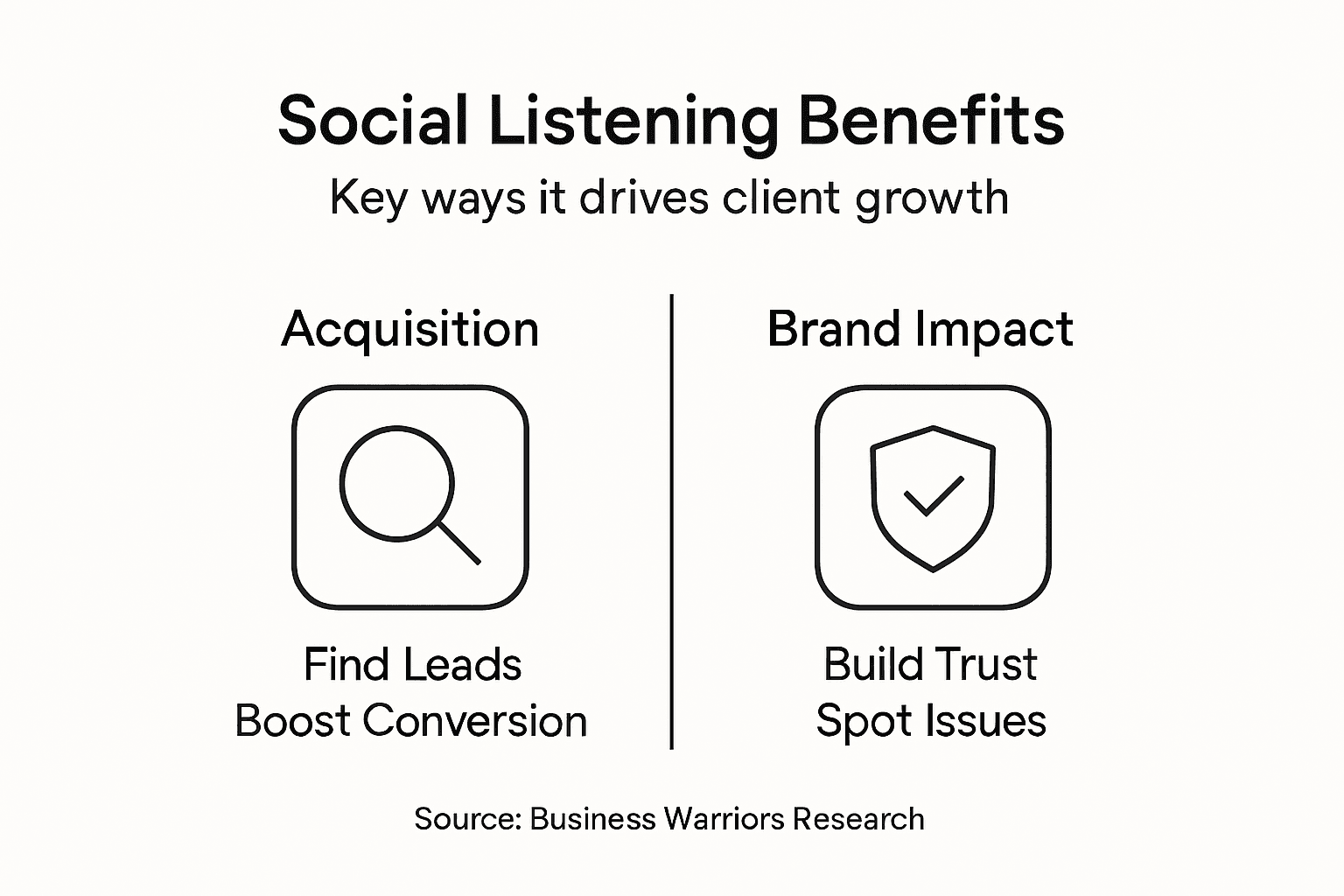
Brand loyalty emerges naturally from listening-informed strategies. When you consistently address the problems your audience discusses, when your content responds to their actual concerns, and when you engage with them using language they use, you’re demonstrating that you understand them. This builds trust and authenticity, the foundations of lasting client relationships. A client who feels truly understood becomes a client who recommends you to friends, leaves positive reviews, and returns for repeat services. The listening data also reveals which clients are most engaged with your content and most likely to convert—these become your warmest leads, the ones where your sales process becomes simpler because they’re already convinced you understand their needs.
The brand growth angle operates across multiple channels simultaneously. When you integrate listening insights into your SEO strategy, you’re targeting keywords your audience actually uses when searching for solutions. Your blog posts address questions you’ve heard asked directly in social conversations. Your email marketing sequences respond to objections you’ve heard expressed repeatedly. Your Google Ads copy uses language from client conversations. Your Meta advertising targets audiences based on problems you’ve identified through listening. This integrated approach, where every channel reinforces the same core insights, accelerates growth significantly faster than siloed marketing efforts. The data shows that facilitating two-way communication between your business and clients through responsive, listening-informed strategies leads to higher customer satisfaction and retention. Existing clients stay longer, spend more across additional services, and actively refer new clients because their experience consistently exceeds expectations.
There’s also a defensive benefit often overlooked. Social listening catches problems early. When misinformation about your service category emerges, you spot it before it spreads. When competitors make claims your ideal clients are questioning, you know to address those questions proactively. When service issues frustrate multiple clients, you identify patterns before they become reputation damage. This early warning system protects your brand whilst simultaneously showing you opportunities to differentiate yourself from competitors who aren’t listening.
Pro tip: Track one key metric weekly: the conversion rate from leads acquired through channels informed by listening insights versus leads from generic campaigns—within four weeks, this comparison will show you exactly how much social listening impacts your bottom line, which justifies continued investment.
Common Mistakes and Legal Considerations
Most service-based business owners approach social media listening with genuine intentions but stumble on preventable mistakes that undermine their strategy. The most costly error is failing to triangulate data across sources. You hear one person mention a concern on Instagram and assume it’s widespread, then restructure your entire Google Ads strategy around that single comment. This leads you down wrong paths, wasting marketing budget on problems that matter to one person, not your broader audience. Instead, look for patterns—if the same concern surfaces across Instagram, Facebook, Google reviews, and TikTok, that’s actionable. If it appears only once, flag it as a possibility but don’t pivot your strategy. Another common mistake involves misinterpreting what you hear. When someone says your service is “expensive,” are they saying the price is genuinely too high, or are they questioning the value proposition? Context matters enormously. A person with a small budget might call anything expensive, whilst someone with disposable income might use the same word to describe something they found surprisingly good. You need to read surrounding conversations to understand true meaning.
Ignoring offline conversations creates blind spots in your understanding. Your ideal clients discuss your service category in real life—at coffee with friends, at the hairdresser, in conversations with family. Social media captures only part of the conversation landscape. When you listen exclusively to what’s posted online, you miss the nuance of face-to-face discussions where people express concerns they might not broadcast publicly. This is why the best listening strategies incorporate client conversations from your team—what do clients ask when they call? What hesitations do they express during consultations? What problems do they describe when they’re sitting in front of you? Combining online listening with offline insights creates comprehensive understanding.
On the legal and ethical side, respecting privacy laws requires understanding which regulations apply to your business and how you’re collecting, storing, and using data about client conversations. In Australia, the Privacy Act 1988 governs how you handle personal information. When you capture conversations from public social media posts, you’re generally on solid ground—the information is publicly available. However, once you collect that data, you must handle it responsibly. Don’t repurpose it in ways that violate consent. If someone mentions a health concern publicly, you don’t use that information to target them with medical advertisements without explicit permission. If a conversation reveals personal information, you secure that data appropriately and don’t share it with third parties without consent. Ethical decision-making includes weighing social constraints and respecting user consent in how you use what you learn.
Another critical consideration involves not amplifying misinformation or disinformation you discover through listening. If you hear false information about your industry circulating, address it factually and transparently rather than ignoring it or worse, spreading it further to reach more people. Your responsibility is to contribute to accurate conversations, not to manipulate them. When you identify complaints or concerns through listening, respond directly and professionally to the person who raised them rather than using their private frustration as marketing ammunition. This transparent, ethical approach builds genuine trust with your audience and protects your business from reputational damage that arises from being perceived as manipulative.
Pro tip: Before implementing any strategy based on social listening insights, ask yourself three questions: Is this information public or private? Have I verified this pattern across multiple sources? Would I want my business discussed this way? If you answer no to any of these, pause and reconsider your approach.
Selecting Effective Social Listening Tools
Not all social listening tools are created equal, and choosing the wrong one wastes time and money. Start by evaluating what you actually need to listen to. A beauty clinic owner in Perth needs different capabilities than an e-commerce retailer selling nationally. Your tool must integrate data across multiple channels, capturing conversations from Instagram, Facebook, TikTok, Google reviews, Twitter, and potentially LinkedIn depending on where your ideal clients congregate. A tool that only monitors Instagram misses the full picture. Beyond channel coverage, look for real-time monitoring capabilities. You need to see conversations as they happen, not review them in yesterday’s report. When someone posts a complaint about your service today, you want to know today, not next week. The analytics dashboard should present data in a way that actually makes sense to you—if you can’t quickly understand what the data shows, you won’t use it consistently. Many tools provide sentiment analysis, attempting to classify conversations as positive, negative, or neutral. Test these features carefully. Automated sentiment analysis is improving with AI and machine learning integration, but it still misses nuance. A sarcastic comment might be classified as positive when it’s actually criticism.
When evaluating specific tools, assess their data accuracy and verification methods. Some tools rely on APIs from social platforms, giving you direct access to official data. Others use scraping, which can be less reliable and sometimes violates platform terms of service. Ask potential vendors how they collect data and verify its accuracy. Consider ease of use as well. You’ll only use a tool consistently if it doesn’t require a computer science degree to operate. Many service-based business owners are busy running their services. A tool with an intuitive interface that takes five minutes to review daily reports wins over a powerful tool requiring thirty minutes of navigation. Price matters, obviously, but evaluate it against what you actually need. A free or cheap tool that doesn’t deliver accurate insights wastes more than an expensive tool that provides actionable intelligence. Your listening insights inform decisions about Google Ads budgets, Meta advertising targeting, content strategy, and email marketing sequences. If your tool helps you capture one conversation type correctly that leads to three additional client bookings monthly, that tool has paid for itself many times over.
Privacy compliance features are non-negotiable. Selecting tools requires assessing platform capabilities and privacy compliance to ensure you’re operating within legal boundaries. The tool should allow you to configure what data you’re capturing and how long you’re storing it. Some businesses need to comply with specific regulations about client data handling. Your tool should make compliance straightforward, not complicated. Finally, test before committing to annual contracts. Most legitimate tools offer free trials or freemium versions. Spend a week actually using the tool, not just reviewing its marketing materials. Can you set up the keywords and platforms you want to monitor without frustration? Does the dashboard show you what you need? When you run a report, does it answer your actual questions? After testing, you’ll know whether a tool is worth your investment.
Below is a summary of essential features to consider when selecting a social listening tool:
| Feature | Importance | Business Impact |
|---|---|---|
| Multi-platform coverage | High | Full market insight across channels |
| Real-time alerts | Vital | Rapid response to client concerns |
| Sentiment analysis | Useful | Gauges audience mood accurately |
| Data accuracy | Critical | Informs reliable decision-making |
| Privacy compliance | Mandatory | Protects business from legal risks |
| Ease of use | Important | Ensures consistent daily utilisation |
Pro tip: Start with free tools like Google Alerts and native platform features before investing in paid software—after two weeks of consistent use, you’ll understand exactly what capabilities matter for your business, making your eventual tool selection far more effective.
Transform Your Social Media Listening into Real Client Growth Today
Understanding the true voice of your ideal clients through social media listening is vital yet challenging. This article highlights common pitfalls such as missing out on triangulating conversations across platforms, interpreting sentiment accurately, and responding proactively to emerging client trends. If you are a service-based business owner struggling to convert social insights into targeted adverts or effective marketing campaigns, these challenges are familiar. You need more than surface-level data to craft messaging that resonates and attracts consistent clients.
At Business Warriors, we specialise in turning this complex intelligence into action with our proven Marketing Vortex Method. Our approach integrates SEO, Google Ads, Meta advertising, and content creation into one seamless system designed for service industries like yours. Whether your pain points are inconsistent lead flow, unclear audience targeting, or ineffective ad spend, our tailored strategies will help you leverage real-time social listening insights to optimise every client touchpoint.
Elevate your marketing with expert guidance and measurable results. Explore how Jarrod Harman’s expert consulting and our agency’s scalable systems have helped businesses like yours outpace competitors by using data-driven insights. Start by visiting our Uncategorized Archives – Jarrod Harman for strategic tips or connect directly through our landing page to begin your journey. Don’t let guesswork slow your growth when proven methods are within reach.
Ready to stop guessing and start growing your client base with social media listening insights? Visit https://jarrodharman.com now and discover how to convert conversations into conversions with precision marketing that works.
Frequently Asked Questions
What is social media listening?
Social media listening is the systematic process of monitoring social media channels for mentions, trends, and conversations relevant to your business and its target audience. It involves tracking real-time conversations, analysing sentiment, and synthesising this information to inform your marketing strategy.
How can social media listening benefit my marketing strategy?
Social media listening helps you understand what your ideal clients want by revealing their true concerns, language, and behaviours. This intelligence allows you to create more targeted ads, optimise your content, and align your messaging with actual client conversations rather than assumptions.
What are the key techniques used in social media listening?
Key techniques include keyword tracking, sentiment analysis, influencer and community leader identification, and trend spotting. Combining automated systems with human judgement enhances your understanding of client needs and allows for more informed decision-making in your marketing efforts.
What tools should I consider for social media listening?
Look for tools that offer multi-platform coverage, real-time alerts, reliable sentiment analysis, data accuracy, and privacy compliance. It’s also important to choose a tool that is user-friendly and allows for easy integration of insights across your marketing channels.
Recommended
- Why Social Media Advertising Boosts Business Growth – Jarrod Harman
- 7 Types of Social Media Marketing Strategies You Need – Jarrod Harman
- Understanding What is Social Media Engagement – Jarrod Harman
- Complete Guide to Social Media Engagement – Jarrod Harman
- Understanding Music Marketing Analytics Explained – Blog – Music24.com
- 8 Examples of Digital Marketing to Boost Your Business – Paul Baguley