5 February 2026
Stage Content Marketing: Driving Sales Growth
Stage content marketing for Australian service businesses—learn funnel stages, strategy, best formats, and common pitfalls to maximise client acquisition.
Struggling to turn website visitors into loyal clients can leave even the most ambitious business owner feeling stuck. For many Australian women running service-based businesses, knowing exactly what to say at each stage of the customer journey is the missing piece. By focusing on stage content marketing, you can personalise your message to match where prospects are in their decision-making process, helping you build trust and guide them smoothly from first discovery to a committed partnership.
Table of Contents
- Defining Stage Content Marketing
- Understanding Funnel Stages And Audiences
- Choosing Content Formats For Each Stage
- Mapping Strategy And Buyer Journeys
- Measuring Impact And Avoiding Pitfalls
Key Takeaways
| Point | Details |
|---|---|
| Stage Content Marketing | Tailors content to the buyer’s journey stages: awareness, consideration, and decision, addressing specific needs and challenges. |
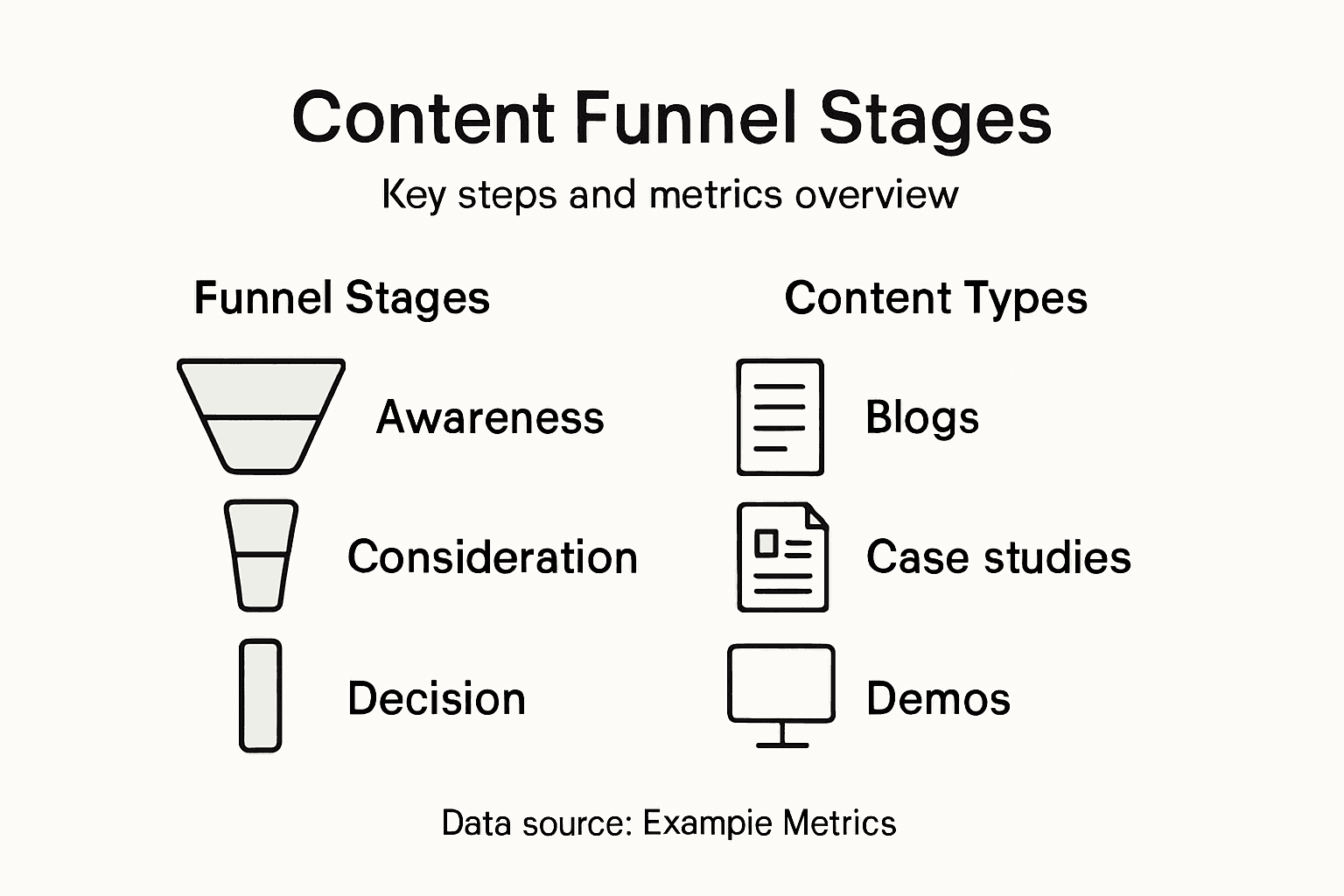
| Funnel Stages | Understand the three key funnel stages to tailor marketing strategies: educate at the top, nurture in the middle, and convert at the bottom. |
| Content Formats | Use appropriate content formats for each stage, such as blogs for awareness and product demos for decision-making, to effectively engage customers. |
| Measurement Strategies | Implement a multi-dimensional measurement framework to connect content performance to broader business objectives and avoid common pitfalls like focusing solely on vanity metrics. |
Defining Stage Content Marketing
Stage content marketing is a strategic approach to creating and distributing targeted content that matches specific stages of a customer’s buying journey. At its core, this method involves developing strategically aligned content that speaks directly to potential customers’ evolving needs and challenges.
The concept revolves around understanding that buyers progress through distinct stages – awareness, consideration, decision – and require different types of content at each phase. Unlike traditional marketing which broadcasts generic messages, stage content marketing personalises communication to address precise customer pain points and information requirements.
Key characteristics of stage content marketing include:
- Tailoring content specifically to buyer journey stages
- Understanding customer psychology and information needs
- Developing targeted messaging that resonates with specific audience segments
- Creating content that guides prospects through purchasing decisions
- Measuring engagement and effectiveness at each stage
Marketing professionals using this approach transform content from a broadcast medium into a precision instrument for guiding potential customers. By mapping content strategically, businesses can build trust, demonstrate expertise, and create meaningful connections that ultimately drive sales growth.
Here’s how stage content marketing differs from traditional marketing in guiding customer journeys:
| Approach | Traditional Marketing | Stage Content Marketing |
|---|---|---|
| Message Personalisation | Generic, broad messages | Tailored to customer journey stage |
| Customer Engagement | Limited, one-way communication | Interactive, builds relationships |
| Content Objective | Promote brand or offer | Guide and educate through journey |
| Measurement Focus | Impressions and reach | Stage-specific engagement metrics |
Pro tip: Conduct thorough audience research to understand precisely what information customers seek at each buying stage and develop content that directly addresses those specific needs.
Understanding Funnel Stages and Audiences
Marketing funnels transform complex customer journeys into systematic stages, enabling businesses to develop targeted engagement strategies. These strategic frameworks help organisations understand and anticipate customer needs throughout their decision-making process.
Traditionally, marketing funnels are divided into three primary stages: top, middle, and bottom. Each stage represents a distinct phase of customer interaction and requires unique content and communication approaches. At the top of the funnel, marketers focus on generating broad awareness and attracting potential customers. The middle funnel involves nurturing prospects by providing detailed information and building credibility. The bottom funnel concentrates on converting interested prospects into actual customers.
Key audience characteristics across funnel stages include:
-
Top of Funnel (Awareness Stage)
- Broad audience seeking general information
- Low commitment and initial interest
- Primarily educational content needs
-
Middle of Funnel (Consideration Stage)
- Narrower, more engaged audience
- Seeking comparative information
- Evaluating potential solutions
-
Bottom of Funnel (Decision Stage)
- Highly targeted, purchase-ready audience
- Seeking specific product/service details
- Requiring personalised conversion content
Successful marketers recognise that each stage demands a nuanced approach. By mapping content precisely to audience psychology and information requirements, businesses can create more meaningful connections and dramatically improve conversion rates.
Pro tip: Develop comprehensive audience personas for each funnel stage to ensure your content speaks directly to their specific needs and pain points.
Choosing Content Formats for Each Stage
Content marketing requires strategic format selection across buyer journeys. Different stages demand unique content approaches that effectively communicate with potential customers and guide them through their decision-making process.
Understanding the nuanced requirements of each funnel stage is crucial for developing targeted content strategies. Marketers must craft content that resonates with audience needs, addresses specific pain points, and provides value at every interaction point. This approach transforms content from a generic communication tool into a precise instrument for customer engagement and conversion.
Content format recommendations for each funnel stage include:
-
Top of Funnel (Awareness Stage)
- Blog articles
- Social media posts
- Infographics
- Short educational videos
- Podcast episodes
-
Middle of Funnel (Consideration Stage)
- Detailed whitepapers
- Webinars
- Comparison guides
- Expert interviews
- In-depth case studies
-
Bottom of Funnel (Decision Stage)
- Product demos
- Customer testimonials
- Pricing guides
- Free trials
- Consultation offers
Successful content marketers understand that format selection is not one-size-fits-all. By aligning content types with specific audience needs and journey stages, businesses can create more compelling and effective marketing communications.
Pro tip: Continuously track content performance metrics to refine and optimise your content format strategy across different funnel stages.
Mapping Strategy and Buyer Journeys
Successful content marketing hinges on strategic alignment with buyer journeys. By understanding the psychological and informational needs of potential customers at each stage, businesses can craft targeted strategies that effectively guide prospects through their decision-making process.

The buyer journey is not a linear progression but a nuanced pathway where customers move between stages, gathering information and evaluating options. Marketers must develop flexible strategies that accommodate these complex decision-making processes, creating content that anticipates and addresses potential customer questions and concerns.
Key strategy mapping principles include:
-
Awareness Stage Strategy
- Identify customer pain points
- Generate broad, educational content
- Build initial brand recognition
- Create low-barrier engagement opportunities
- Focus on problem definition
-
Consideration Stage Strategy
- Provide comparative insights
- Demonstrate industry expertise
- Develop solution-oriented content
- Address potential objections
- Showcase unique value propositions
-
Decision Stage Strategy
- Offer definitive proof of effectiveness
- Create low-risk conversion pathways
- Provide social proof and testimonials
- Highlight specific product/service benefits
- Simplify decision-making process
Effective buyer journey mapping transforms marketing from a transactional approach to a strategic, customer-centric process. By deeply understanding audience needs and crafting precisely targeted content, businesses can create meaningful connections that drive engagement and conversion.
Pro tip: Develop detailed customer personas for each funnel stage to ensure your content strategy speaks directly to specific audience motivations and challenges.
Measuring Impact and Avoiding Pitfalls
Content marketing requires robust measurement strategies for meaningful insights. Understanding true performance means moving beyond surface-level metrics to analyse genuine business impact and strategic effectiveness.
Successful measurement demands a holistic approach that connects content performance directly to broader organisational objectives. Rather than tracking isolated engagement metrics, marketers must develop comprehensive evaluation frameworks that demonstrate tangible value and inform continuous strategic refinement.
Critical measurement considerations include:
-
Quantitative Performance Metrics
- Conversion rates
- Lead generation volume
- Customer acquisition cost
- Revenue attribution
- Return on content investment
-
Qualitative Performance Indicators
- Audience engagement depth
- Brand perception shifts
- Content resonance
- Trust and credibility signals
- Audience sentiment analysis
-
Common Measurement Pitfalls
- Overemphasising vanity metrics
- Ignoring long-term brand impact
- Failing to connect content to revenue
- Inconsistent tracking methodologies
- Neglecting cross-channel performance
Strategic content measurement transcends simple data collection. By developing nuanced, goal-aligned evaluation approaches, businesses can transform content marketing from a cost centre to a strategic growth driver.
The table below summarises typical metrics used for assessing the success of content across the funnel:
| Funnel Stage | Key Quantitative Metric | Key Qualitative Indicator |
|---|---|---|
| Awareness | Website traffic volume | Initial brand perception shift |
| Consideration | Lead generation rate | Depth of audience engagement |
| Decision | Conversion and sales growth | Trust and purchase confidence |
Pro tip: Implement a multi-dimensional measurement framework that balances quantitative performance indicators with qualitative impact assessments.
Unlock Your Sales Potential with Targeted Stage Content Marketing
Are you struggling to convert casual browsers into loyal customers? This article clearly outlines the challenge of delivering the right message at the right time during each stage of the buyer journey. Whether you need to build awareness, foster consideration, or close the deal, understanding these stages and tailoring your content accordingly is crucial for consistent sales growth. If you find it difficult to create compelling, stage-specific content or measure its true impact, you are not alone.
Stage content marketing helps you personalise communication to address precise customer pain points and build trust throughout the purchasing process. At Business Warriors, we specialise in scaling service-based businesses by implementing the proven Marketing Vortex Method, combining SEO, paid ads, and social media to strengthen your content at every funnel stage.
Stop guessing what your audience needs next. Visit Jarrod Harman’s site to discover how our full-service digital marketing team can help you craft targeted strategies that convert prospects into paying customers. Explore real success stories and get ready to elevate your marketing impact with content that drives measurable results. Take control of your growth journey today by partnering with experts who understand the nuances of stage content marketing.
Frequently Asked Questions
What is stage content marketing?
Stage content marketing is a strategic approach that aligns content creation and distribution with the specific stages of a customer’s buying journey, focusing on addressing their unique needs at each phase.
How does stage content marketing differ from traditional marketing?
Unlike traditional marketing, which uses generic messages, stage content marketing tailors communication to each stage of the buyer journey, enhancing engagement and building relationships based on the audience’s specific needs.
What types of content are most effective for each stage of the marketing funnel?
For the awareness stage, effective content types include blog articles and infographics. In the consideration stage, detailed whitepapers and webinars work well. During the decision stage, product demos and customer testimonials become crucial for conversion.
How can businesses measure the effectiveness of their content marketing strategies?
Businesses can measure effectiveness through a combination of quantitative metrics, like conversion rates and lead generation, and qualitative indicators, such as brand perception shifts and audience engagement depth.