


TL;DR:
- Webinars enable real-time interaction that builds trust and demonstrates expertise for service businesses.
- Following a structured process increases webinar conversion rates and long-term lead generation.
- Treating webinars as a recurring strategy and repurposing content enhances client engagement and brand authority.
Webinars have a reputation for being the domain of software companies and online course creators. But Australian service-based businesses, from beauty clinics and law firms to consultancies and wellness centres, are quietly using them to generate consistent leads and build genuine client trust. If you’ve dismissed webinars as too technical or too time-consuming, this article will change your thinking. You’ll learn exactly how webinars work as a lead generation tool, how to set one up without a big budget, and how to make each event work harder for your business long after it ends.
Table of Contents
- Why webinars matter for service-based businesses
- Lead generation through webinars: best practices
- Comparing webinars to other marketing channels
- How to create and promote a webinar for your business
- The real value webinars offer service businesses
- Take your webinar marketing further with expert support
- Frequently asked questions
Key Takeaways
| Point | Details |
|---|---|
| Webinars boost engagement | Interactive webinars connect with prospective clients more deeply than static content. |
| Lead generation made easier | A webinar strategy can convert attendees into actionable leads efficiently. |
| Better than traditional channels | Webinars outperform email and social media in delivering educational value and engagement. |
| Easy steps to succeed | With clear planning and promotion, any service business can launch successful webinars. |
| Expert support available | Specialists can help optimise your webinar marketing and maximise results. |
Why webinars matter for service-based businesses
Service businesses live and die by trust. A potential client needs to believe you understand their problem before they’ll hand over their money. That’s a high bar to clear with a social media post or a paid ad. Webinars change the dynamic entirely because they let you demonstrate your expertise in real time, in front of people who’ve already raised their hand to learn from you.
Think about what happens during a live webinar. You’re speaking directly to your audience, answering their questions, and showing them how you think. That level of interaction is almost impossible to replicate through static content. Higher engagement rates than many social channels make webinars one of the most powerful tools in a service business owner’s marketing kit.
For Australian service businesses, the opportunity is even sharper. Many industries, including allied health, legal services, beauty and aesthetics, and financial planning, are crowded with providers who all look similar online. A well-run webinar lets you stand out by showing your audience how you solve problems, not just claiming that you can.
Here’s what webinars do that other channels struggle to match:
- Real-time interaction: Attendees can ask questions and get answers on the spot, which builds immediate credibility.
- Qualified attention: People who register and attend a webinar are genuinely interested. You’re not fighting for a three-second scroll.
- Relationship depth: Spending 45 to 60 minutes with your audience creates a connection that a blog post or ad simply cannot.
- Audience insight: The questions your attendees ask reveal exactly what’s keeping them up at night, which is gold for your future marketing.
- Repurposable content: One webinar can become a YouTube video, a podcast episode, a blog post, and a series of social clips.
“The businesses that grow fastest aren’t the ones with the biggest ad budgets. They’re the ones that consistently show up, teach, and build trust with their audience.”
If you want to understand how webinars fit into a broader approach to digital marketing lead generation, it helps to see them not as a one-off tactic but as a recurring trust-building system.
Lead generation through webinars: best practices
Knowing webinars are valuable is one thing. Knowing how to run them so they actually generate leads is another. The difference between a webinar that fills your pipeline and one that feels like a lot of effort for little return usually comes down to a few key decisions made before, during, and after the event.
Webinars can convert up to 20% of attendees into qualified leads, which is significantly higher than most passive content formats. But that number only holds when you follow a structured approach.
Here are the four stages of a high-converting webinar lead generation system:
- Choose a topic that solves a specific pain point. Vague topics attract vague audiences. “How to reduce no-shows in your clinic by 40%” will outperform “Tips for running a better business” every single time.
- Build a clean registration funnel. Your registration page should explain the outcome attendees will walk away with. Use lead generation campaigns logic here: clear headline, one key benefit, and a simple form.
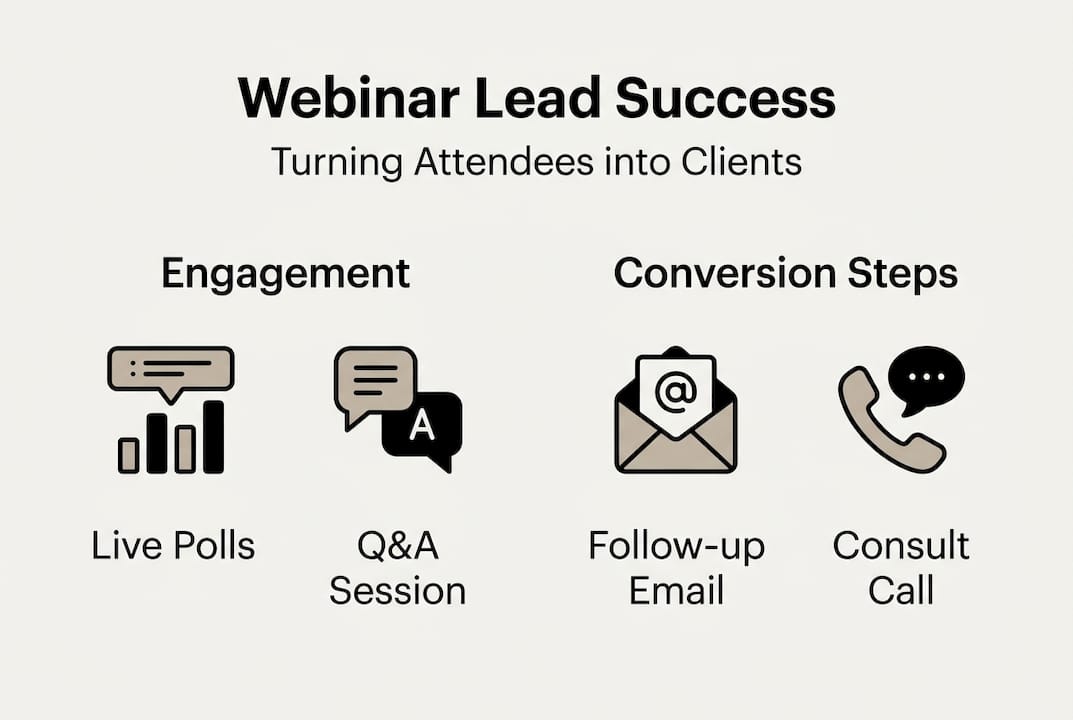
- Engage during the event. Use polls to segment your audience, run a live Q&A, and offer a downloadable resource. These interactions qualify your leads in real time.
- Follow up within 24 hours. Send a replay link, a summary of key points, and a clear next step. Most conversions happen in the follow-up sequence, not during the live event.
| Stage | Action | Goal |
|---|---|---|
| Pre-event | Registration page and email reminders | Maximise attendance |
| During event | Polls, Q&A, downloads | Qualify and engage |
| Post-event | Follow-up sequence | Convert to leads |
| Ongoing | Repurpose content | Extend reach |
Pro Tip: Record every webinar and add it to an automated email sequence. New subscribers who missed the live event can still convert weeks later through online lead generation funnels built around your replay.
The topic selection step is where most businesses go wrong. They choose what they want to talk about rather than what their audience desperately needs to hear. Survey your existing clients, look at the questions in your inbox, and pick the topic that comes up most often.
Comparing webinars to other marketing channels
To place webinars in context, let’s compare them to other marketing approaches. Every channel has its strengths, and webinars are not always the right tool for every situation. But understanding where they outperform other options helps you allocate your time and budget more effectively.
Webinars deliver stronger client education and longer engagement times compared to email campaigns, which makes them particularly effective for complex or high-value services where the buying decision requires more trust.

| Channel | Interaction level | Setup effort | Lead quality | Cost |
|---|---|---|---|---|
| Webinar | High | Medium to high | Very high | Low to medium |
| Email marketing | Low | Low | Medium | Very low |
| Social media posts | Low | Low | Low to medium | Low |
| Google Ads | None | Medium | Medium to high | Medium to high |
| In-person events | Very high | Very high | Very high | High |
A few things stand out from this comparison:
- Webinars offer the best balance of interaction quality and cost for service businesses that can’t afford large in-person events.
- Email and social media are faster to produce but create far less connection with your audience.
- Google Ads can drive high-intent traffic but require ongoing spend and don’t build the same relationship depth.
- In-person events are powerful but expensive and geographically limited, which is a real constraint for Australian businesses serving clients across multiple states.
The practical takeaway is that webinars fill a gap that no other digital channel fills as well. They’re the closest thing to a face-to-face consultation you can deliver at scale. For more tactical breakdowns across channels, the digital marketing blog covers a wide range of approaches worth exploring.
One honest caveat: webinars do require preparation. You need to plan your content, set up your technology, and promote the event. That investment is real. But the return, in terms of lead quality and client trust, is consistently higher than most other formats.
How to create and promote a webinar for your business
Next, let’s get practical about how to really run a webinar for maximum results. The process is more straightforward than most business owners expect, and you don’t need a big tech stack to get started.
Effective promotion across multiple channels increases webinar attendance by over 30%, which means your promotional strategy matters just as much as your content.
Follow these steps to plan, create, and promote your first (or next) webinar:
- Define your audience and outcome. Who is this for, and what will they be able to do after attending? Write this down before you build anything else.
- Choose your platform. Zoom, Google Meet, and Demio are all reliable options for small to medium service businesses. Most are affordable and easy to set up.
- Build your registration page. Keep it simple. State the topic, the date, the time, and the key benefit. Add a short bio to establish credibility.
- Set up automated reminders. Send a confirmation email immediately after registration, a reminder 48 hours before, and another one hour before the event. Attendance rates improve significantly with this sequence.
- Promote across every channel you own. Email your list, post on social media, add a banner to your website, and consider running a small paid ad campaign. SEO-driven lead generation can also support your webinar landing page in organic search over time.
- Deliver value first, pitch second. Spend 80% of your webinar teaching. Reserve the final 10 to 15 minutes for a clear, low-pressure call to action.
- Follow up with every registrant. Whether they attended or not, send a follow-up email within 24 hours. Include the replay, a key takeaway, and a next step.
Pro Tip: Partner with a complementary business to co-host your first webinar. A beauty clinic could partner with a nutritionist. A law firm could partner with an accountant. You double your promotional reach with no extra cost.
The post-event follow-up is where most businesses leave money on the table. A structured email sequence over five to seven days after the event, with progressively stronger calls to action, will consistently outperform a single follow-up message.
The real value webinars offer service businesses
Here’s a perspective worth sitting with: most business owners think of webinars as a lead generation tactic. Run one, collect some leads, move on. That mindset leaves most of the value untouched.
The businesses that see the biggest returns from webinars treat them as the foundation of an ongoing client engagement system. A monthly webinar series builds a community around your brand. Attendees start to see you as a regular part of their professional or personal development. That kind of relationship doesn’t just generate leads; it generates referrals, repeat business, and a reputation that compounds over time.
Repurposing is the other piece most businesses miss. A single 60-minute webinar can produce a month’s worth of content across YouTube, social media, email, and your website. That’s not a bonus; that’s the strategy. When you build lead generation strategies around repurposed webinar content, your marketing becomes far more efficient.
The businesses treating webinars as one-off campaigns are getting a fraction of the return available to them. The ones treating webinars as a recurring, strategic asset are building something genuinely difficult for competitors to copy.
Take your webinar marketing further with expert support
Webinars are a powerful tool, but they work best when they’re part of a broader, integrated marketing system. Running a great webinar and then sending traffic back to a weak website or a poorly structured follow-up sequence means leaving most of your effort unrewarded.
At Business Warriors, we help service-based businesses across Australia build marketing systems that actually convert. Whether you need a marketing vortex strategy that ties your webinars into your broader lead generation, SEO consulting for Perth businesses to drive registrations organically, or a step-by-step marketing plan that makes every channel work together, we have the expertise to help you get there. Reach out to our team and let’s build something that works.
Frequently asked questions
How can I measure the success of my webinar marketing efforts?
Track registration numbers, attendee engagement, and conversion rates after each event. Webinar conversion rates can exceed standard lead generation tactics when you follow up effectively.
Do webinars require expensive software or technical expertise?
Most webinar platforms are user-friendly and affordable, making setup accessible for small businesses. Effective webinar tools can be deployed with minimal upfront cost, even for first-time hosts.
What topics work best for service-based business webinars?
Choose topics addressing common client pain points and offering practical solutions in your field. Webinars tailored to client concerns consistently attract more qualified and engaged attendees.
How can I keep attendees engaged throughout my webinar?
Use interactive elements like polls and live Q&A to maintain attention and foster participation. Audience engagement tools in webinars boost both retention and conversion rates.
Can webinars help with brand awareness as well as lead generation?
Yes, regular webinars establish thought leadership and increase recognition among your target market. Consistent delivery of valuable content positions your business as the go-to authority in your field.
Recommended
- How to optimise your website for 50% more leads – Jarrod Harman
- SEO and Lead Generation: Driving Sales Growth Online – Jarrod Harman
- How to Generate Leads Online for Business Growth – Jarrod Harman
- Why lead generation is vital for service business success – Jarrod Harman
- Live Chat: 10 Gründe für Erfolg auf Ihrer Webseite