22 July 2026
Lead generation in real estate: strategies for Australian agents
Discover what is lead generation in real estate and learn effective strategies for Australian agents to consistently attract qualified leads.
Lead generation in real estate is the process of attracting potential buyers and sellers, capturing their contact details, and nurturing them through a sales cycle until they are ready to transact. Every agent knows this at some level. The ones who build serious careers treat it as a daily discipline, not something they dust off when the pipeline runs dry.
The income gap in Australian real estate is stark. Agents who treat lead generation as a system rather than an afterthought consistently earn significantly more than those who rely on ad hoc effort. A qualified lead is not just anyone who fills out a form. It is someone whose timeline, budget, and motivation you have confirmed, so your follow-up time goes to people who will actually transact.
A few things separate agents who generate leads well from those who struggle:
- They use a real estate CRM to track every contact, automate follow-up sequences, and flag leads that go cold.
- They maintain a consistent lead flow rather than running campaigns in bursts.
- They qualify early, asking timeline and motivation questions in the first conversation rather than chasing unqualified contacts for months.
- They treat their sphere of influence as a pipeline asset, not a social list.
- They run at least one digital channel (SEO, paid social, or Google Ads) alongside relationship-based outreach.
Key real estate lead generation strategies that work in Australia
## 1. Past client follow-up
Nurturing your sphere of influence delivers the highest return of any lead source because acquisition cost is essentially zero. Most agents let this lapse after settlement. A simple quarterly call, a market update email, or a handwritten note keeps you front of mind when a referral opportunity arises. Set a recurring task in your CRM and treat it like a prospecting appointment.
## 2. Facebook and Instagram video ads
Facebook and Instagram video ads remain the strongest paid source for Australian real estate leads in 2026. The targeting options let you reach homeowners in a specific suburb, renters in a particular income bracket, or buyers searching within a defined radius. A short video ad driving to a free suburb report or home valuation tool, followed by an automated text the moment someone opts in, converts far better than a static image ad to a generic landing page.

## 3. YouTube long-form video content
YouTube is the only platform where a video you posted 18 months ago still generates leads today. The first 90 days feel slow. Post weekly, see modest views, and resist the urge to quit. Around month four, the algorithm starts recommending your content, and the compounding effect kicks in. Titles like “Buying a home in [suburb] in 2026” attract high-intent buyers at the exact moment they are researching a move.
## 4. Local property portals and geo-targeted ads
Australian buyers and sellers start their search on Domain and realestate.com.au. Maintaining a strong profile on both, with consistent reviews and up-to-date listings, puts you in front of people who are already in the market. Pair portal presence with geo-targeted Google Ads for high-intent search terms like “houses for sale in [suburb]” to capture buyers at the bottom of the funnel.
## 5. SEO and AI-powered organic lead capture
SEO combined with AI geo-targeting increases organic lead capture and builds local brand recognition over time. A suburb-specific landing page optimised for search, combined with a Google Business Profile and consistent content publishing, can generate leads at near-zero marginal cost once it ranks. The catch is the timeline: expect 6–18 months before meaningful organic traffic arrives. Start now and let it compound.

## 6. Google Ads for high-intent buyer searches
Anyone searching “homes for sale in [suburb]” on Google is ready to act. Google Ads capture that intent directly. The cost per click is higher than social media, but the lead quality justifies it for agents with a defined geographic focus. Google Local Services Ads (Google Screened) sit above standard paid results and charge only when someone calls, making them worth testing for agents in competitive metro markets.
## 7. Email marketing and database nurturing
Your email list is an asset most agents underuse. A weekly or fortnightly newsletter covering local market data, new listings, and recent sales keeps you visible to contacts who are not yet ready to act. Agents who nurture leads online consistently through email convert a far higher percentage of their database over a 12-month period than those who only call when they need a listing.
## 8. Open houses as a lead capture tool
Open houses in 2026 are less about selling the specific property and more about meeting buyers and neighbours who may be considering a move. Blanket the surrounding streets with signage, promote the open house on Facebook and Instagram in the week before, and capture every visitor’s contact details with a simple digital sign-in. Follow up within 24 hours while the interaction is still fresh.
## 9. Geographic farming with a hyper-local newsletter
Pick a suburb or postcode and commit to becoming the recognised agent there. A monthly printed or digital newsletter covering local sales data, upcoming listings, and community news positions you as the area expert. Sellers who are thinking about listing in six months will remember the agent whose name appeared in their letterbox every month.
## 10. Referral partner networks
Mortgage brokers, conveyancers, financial planners, and property managers all work with people who are about to buy or sell. Building genuine relationships with these professionals, and referring business to them in return, creates a steady stream of warm introductions. One strong referral partner can generate multiple transactions per year at zero ad spend.
## 11. AI brand mentions and large language model visibility
Agents who appear in AI-generated answers on ChatGPT, Perplexity, and Google’s AI Overviews get a form of lead generation that did not exist three years ago. Getting your name, suburb expertise, and client results mentioned in authoritative online content, local news, and industry publications increases the likelihood that AI tools surface you when a buyer or seller asks for agent recommendations. This is the new frontier of AI-driven SEO for real estate.
Pro Tip: Pick a few of these strategies and commit to them consistently before adding anything new. Agents who chase every new tactic rarely build momentum in any of them. Past client follow-up plus Facebook video ads plus YouTube is a proven starting combination for most Australian markets.
How the real estate pipeline actually works
Real estate lead generation does not end when someone fills out a form. That is where the work starts. Understanding the full pipeline helps you allocate time and budget to the stages that actually move people toward a transaction.
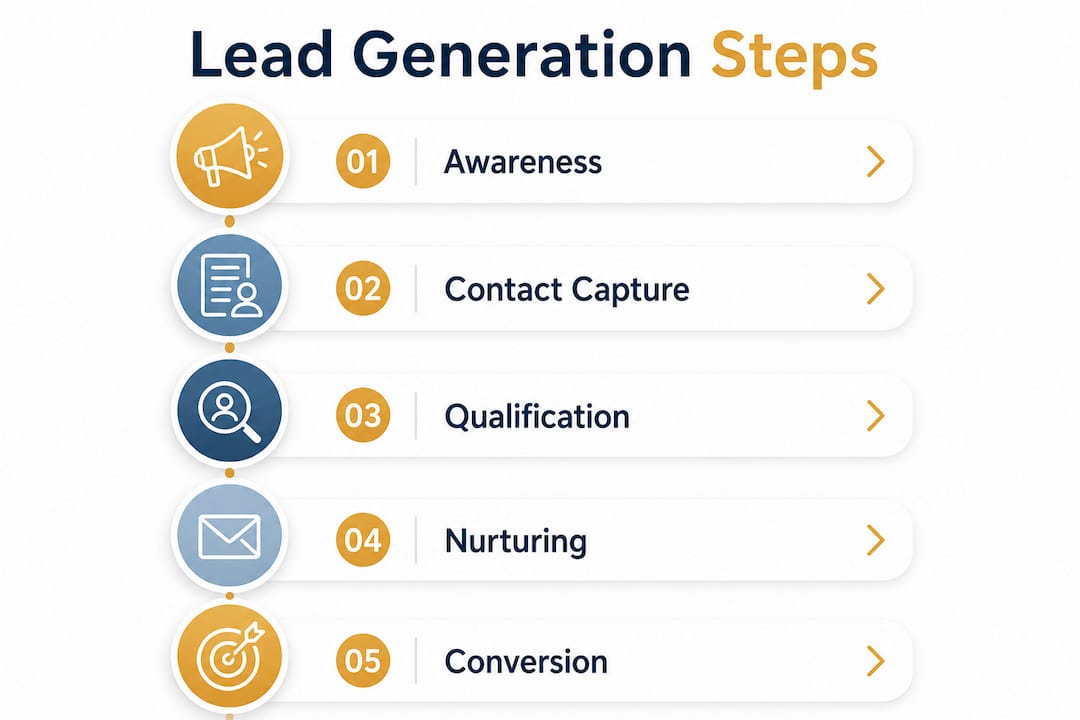
The typical Australian real estate sales cycle moves through six stages: awareness, contact capture, qualification, nurturing, appointment, and conversion. Each stage requires a different type of communication and a different level of effort. Awareness is about being visible. Contact capture is about giving someone a reason to share their details. Qualification is the conversation that tells you whether this person is worth prioritising.
Successful agents run two separate pipelines: one for buyers and one for sellers. Buyer leads are plentiful, cheaper to acquire, and slower to close. Seller leads are scarcer, more expensive to generate, and worth far more per transaction. Treating them the same way wastes effort and misses the different motivations driving each group.
A real estate CRM sits at the centre of all of this. It tracks where every contact sits in the pipeline, triggers automated follow-up sequences, and flags leads that have gone quiet. CRM systems are essential for managing lead nurturing at scale without letting contacts fall through the gaps.
| Pipeline stage | Key action | Primary tool |
|---|---|---|
| Awareness | Content, ads, SEO, open houses | Social media, Google Ads |
| Contact capture | Lead magnet, form, sign-in | Landing page, CRM |
| Qualification | Call or message to confirm timeline | CRM, phone |
| Nurturing | Email sequences, market updates | Email platform, CRM |
| Appointment | Buyer consult or listing presentation | Calendar, CRM |
| Conversion | Contract signed | CRM, follow-up |
Conversion rates improve significantly when leads are followed up within five minutes of opting in. Portal leads go to multiple agents simultaneously, so the first agent to call almost always wins the appointment. Automating the first response with a text or email buys you time to make the personal call.
Australian real estate also carries compliance considerations agents need to respect. Privacy Act obligations govern how you collect, store, and use contact information. Spam Act rules apply to email marketing, requiring clear opt-in consent and an unsubscribe option in every message. These are not optional extras; they are baseline requirements for any lead generation programme.
Advanced digital marketing for real estate lead generation in 2026
The agents pulling the most leads in 2026 are not running one channel. They are running an integrated system where SEO, paid advertising, social media, and email all feed the same CRM and reinforce each other.
SEO for real estate works best at the hyper-local level. A suburb-specific page optimised for terms like “real estate agent [suburb]” or “houses for sale [suburb] 2026” competes in a narrower field than generic national terms. Pair that with a Google Business Profile that has consistent reviews and accurate contact details, and you build a local search presence that generates enquiries without ongoing ad spend.
Paid social media advertising on Facebook and Instagram lets you target by postcode, life event, income, and property ownership status. The most effective real estate ads in Australia right now are short video ads (30–60 seconds) that offer something genuinely useful: a suburb price report, a first-home buyer checklist, or a free home valuation. The ad drives to a landing page with a simple lead form, and the CRM fires an automated follow-up the moment someone submits.
“Multi-channel marketing that integrates SEO, Google Ads, Meta advertising, email marketing, and web development into one connected system produces measurable, compounding growth. Each channel feeds the others: SEO builds authority that improves ad quality scores, email nurtures leads that social media first captured, and Google Ads captures high-intent searches that organic content is still building toward.”, Marketing Vortex Method, Jarrodharman
Google Ads for real estate targets buyers at the moment of highest intent. Campaigns built around suburb-specific search terms, combined with a landing page that matches the search query exactly, convert at a higher rate than broad campaigns. Retargeting ads that follow website visitors across the web keep your name visible to people who showed interest but did not enquire.
AI is changing how agents approach lead generation strategies at every level. AI tools now write property descriptions, personalise email sequences based on lead behaviour, and predict which contacts in a database are most likely to transact in the next 90 days. Agents who build AI into their workflows spend less time on administration and more time on conversations that actually close.
The channels that work together in 2026:
- SEO and content marketing for long-term organic lead capture and AI brand mentions
- Facebook and Instagram video ads for paid buyer and seller lead generation
- Google Ads for high-intent buyer searches and retargeting
- Email marketing for database nurturing and repeat/referral activation
- YouTube for long-form content that compounds over 12–24 months
- CRM automation to connect all channels and ensure no lead is forgotten
Australian real estate lead generation campaigns that deliver results
The most instructive examples from the Australian market share a common pattern: they combine a specific offer with a defined audience and a fast follow-up system.
A Sydney-based agent running Facebook video ads targeting homeowners in a specific postcode with a free “suburb price report” offer generated a consistent flow of seller enquiries over a six-month period. The ad spend was modest, but the targeting was tight and the follow-up was automated within minutes of each opt-in. The key was not the ad creative. It was the CRM sequence that kept the agent visible to every lead for the following 90 days.
A Melbourne buyer’s agent built a YouTube channel focused on suburb comparison videos for interstate relocators. The channel took four months to gain traction, but by month six it was generating inbound enquiries from buyers who had already watched multiple videos and were ready to book a consultation. The cost per lead from YouTube was a fraction of what the same agent was paying for portal leads.
A Brisbane agent combined geographic farming with a monthly email newsletter to a database of 800 homeowners in a target suburb. Over 18 months, the newsletter generated three listings directly from contacts who had been receiving it for more than a year before they were ready to sell. None of those listings required any ad spend.
The pattern across all three: a clear offer, a defined audience, consistent follow-up, and patience. Lead generation in real estate rarely produces instant results. The agents who win are the ones who build systems and run them long enough for the compounding to kick in. If you want expert help building that system for your market, Jarrodharman’s digital marketing services are built specifically for service businesses that need a predictable, measurable pipeline.
Key takeaways
Lead generation in real estate is a system, not an event. Agents who run consistent, multi-channel pipelines with fast follow-up and CRM automation outperform those who rely on ad hoc effort.
| Point | Details |
|---|---|
| Qualify leads early | Confirm timeline and motivation in the first contact to focus effort on people ready to transact. |
| Run two pipelines | Separate buyer and seller lead strategies to match each group’s different sales cycle and value. |
| Follow up within five minutes | Speed of response is the strongest predictor of conversion, especially for portal and paid leads. |
| Commit to 2–3 channels | Pick past client follow-up, Facebook video ads, and one long-term channel, then run them for 90 days before adding more. |
| Use a CRM | Automate follow-up sequences and track every lead stage to prevent contacts from going cold. |