


TL;DR:
- Modern B2B lead generation relies on high-quality content, precision targeting, and first-party data to attract ready-to-convert prospects. Combining inbound SEO and outbound outreach, supported by AI and automation, builds a scalable, trust-based pipeline. Privacy compliance enhances long-term trust and effectiveness, making system integration essential for sustained growth.
Most marketing teams treating lead generation B2B as a numbers game are leaving serious revenue on the table. The old playbook — blast enough emails, run enough ads, fill the top of the funnel — no longer reflects how B2B buyers actually behave. Today’s buyers complete the majority of their research before they ever speak to a vendor, which means your visibility, content quality, and data infrastructure matter far more than sheer volume. This article breaks down the b2b lead generation process from qualification frameworks through to AI-driven SEO, paid advertising, and first-party data activation, so you can build a system that delivers consistent, high-quality pipeline.
Table of Contents
- Key takeaways
- The modern B2B lead generation process
- Inbound lead gen: SEO, GEO, and content that converts
- Outbound tactics: cold email, LinkedIn, and paid ads
- Website visitor identification and intent data
- AI, automation, and pipeline acceleration
- My honest take on B2B lead generation in 2026
- Ready to build a lead generation system that scales?
- FAQ
Key takeaways
| Point | Details |
|---|---|
| Quality beats volume | Precision targeting and lead qualification outperform high-volume, low-intent outreach every time. |
| SEO and GEO work together | Optimising for both search engines and AI-generated answers builds durable organic lead flow. |
| First-party data is now critical | Your website visitor data is your most valuable asset for personalised outreach post-cookie deprecation. |
| Blend inbound and outbound | Combining SEO-driven content with cold outreach and paid ads shortens sales cycles measurably. |
| AI accelerates qualification | Automation and AI tools improve lead scoring, nurturing sequences, and pipeline velocity at scale. |
The modern B2B lead generation process
Business to business lead generation has changed more in the past three years than in the previous decade. It is no longer a straight line from ad click to sales call. Today, the b2b lead generation process involves multiple stages, multiple decision-makers, and a buyer who is often 60 to 70 per cent of the way through their decision before they raise their hand.
Understanding that shift changes everything about how you structure your pipeline. There are four stages worth mapping clearly:
- Awareness. The prospect identifies a problem and begins researching solutions. Your content, SEO rankings, and social media presence determine whether they find you or a competitor.
- Consideration. The buyer evaluates options. They read case studies, compare pricing models, and assess credibility. This is where thought leadership content earns its keep.
- Intent. They show signals of readiness: repeat site visits, pricing page views, webinar registrations. This is the stage where early visibility and relevant content become critical for MQL and SQL conversion.
- Decision. A shortlist forms and vendor conversations begin. If you have not already built trust, you are likely not on that list.
Lead qualification sits at the heart of a productive pipeline. The BANT framework, where BANT stands for Budget, Authority, Need and Timeline, gives sales teams a reliable filter. Leads meeting three or four of those criteria get immediate sales focus, while others are placed into nurture sequences rather than wasted on premature outreach.
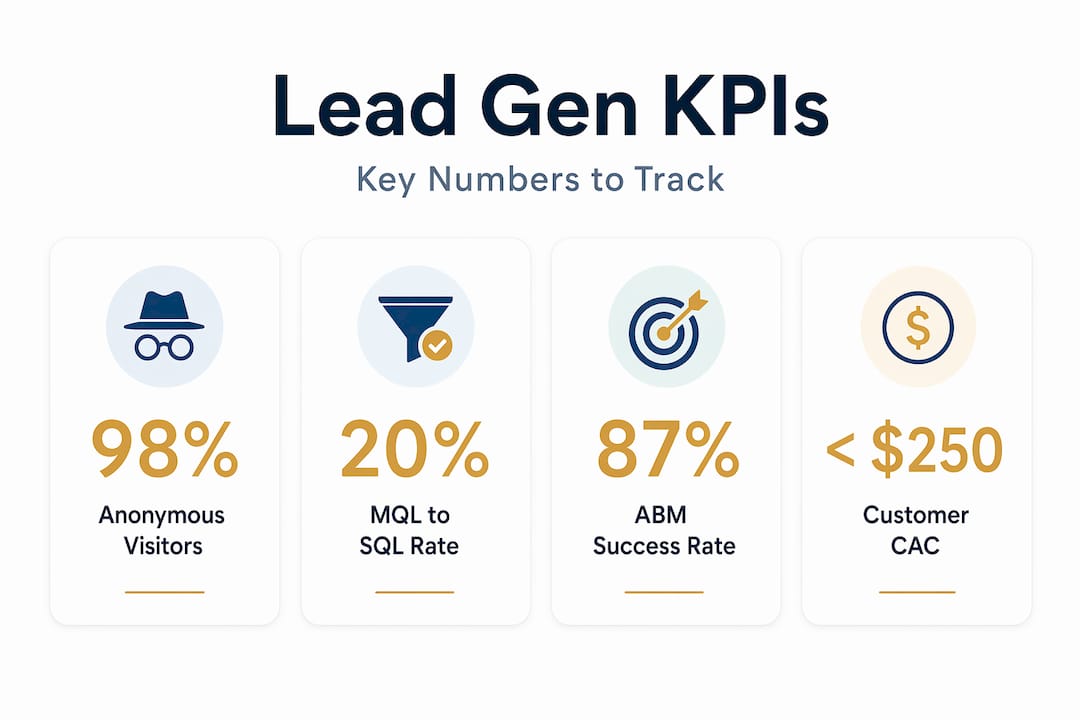
Measuring lead quality means tracking four core metrics: marketing qualified leads (MQLs), sales qualified leads (SQLs), cost per lead (CPL), and pipeline velocity. B2B CPL averages $30 to $200 depending on the industry and method, so knowing your numbers by channel prevents wasteful budget allocation.
Pro Tip: Set a monthly review of your MQL-to-SQL conversion rate. If it drops below 20 per cent, your qualification criteria are too loose, not your lead volume too low.
Inbound lead gen: SEO, GEO, and content that converts
Organic search remains one of the most cost-effective lead generation strategies for B2B service businesses. A well-optimised article or resource page can generate qualified enquiries for years without additional spend. The catch is that SEO in 2026 demands a more sophisticated approach than keyword stuffing and backlink acquisition.

Buyer intent SEO means building content around the specific questions your prospects type into Google at each stage of their research. A law firm targeting corporate clients does not just need to rank for “commercial lawyer Perth.” They need content addressing questions like “what does a commercial lawyer cost” and “how to choose a business solicitor.” That specificity is what attracts leads who are already in buying mode.
Generative Engine Optimisation (GEO) is the newer layer on top of traditional SEO. As AI-powered search tools like Google’s AI Overviews and ChatGPT increasingly answer queries directly, getting your brand mentioned in those AI-generated responses is now a legitimate lead generation tactic. The goal is to structure your content so that large language models cite your website as a trusted source. Clear definitions, cited statistics, and authoritative expert commentary all help your content get surfaced in AI answers, often called zero-click results.
Key inbound tactics worth prioritising right now:
- Long-form educational content that answers specific industry questions without gating it behind a form. Ungated content builds trust and gets more organic links.
- Case studies with real numbers. Vague success stories do not convert. Specific results (“reduced cost per booking by 34 per cent in 90 days”) do.
- Schema markup and structured data to help both search engines and AI models understand your content hierarchy.
- FAQ sections on key service pages to capture voice search and AI-generated answer placement.
Pro Tip: Build a “content cluster” around your core service category. One pillar page covering the broad topic, supported by five to eight detailed supporting articles, tells search engines you are the authority in that space. The SEO lead generation connection becomes compounding over time, as explored in depth at jarrodharman.com.
Outbound tactics: cold email, LinkedIn, and paid ads
If inbound is about being found, outbound is about going to find. The most effective b2b lead generation methods combine both, with outbound delivering faster short-term pipeline while inbound builds durable, long-term flow. High-performing B2B teams combine inbound and outbound methods customised to their budget, team size, and sales cycle length.
Cold email still works when it is done properly. The difference between spam and a genuine conversation-starter is personalisation. AI tools now analyse firmographic data — company size, industry, recent news, hiring patterns — to generate tailored opening lines at scale. One-to-one personalisation that once took hours per prospect now takes seconds.
The most overlooked cold outreach tactic is multi-threaded engagement. Multi-threaded outreach engages 6 to 10 stakeholders simultaneously, mirroring the real composition of B2B buying committees. Rather than sending one email to one contact and hoping for a reply, you map the decision-making group and reach each relevant person with a message calibrated to their specific concerns.
LinkedIn is the single most important social platform for business to business lead generation. Organic thought leadership posts build credibility over time, while LinkedIn Ads allow precise targeting by job title, seniority, industry, and company size. Used together, they create a compounding effect: a prospect sees your content organically, encounters a retargeting ad, and receives a personalised connection request from your sales team.
| Tactic | Speed to results | Cost level | Best for |
|---|---|---|---|
| Cold email with AI personalisation | Fast (days) | Low | SMEs, targeted verticals |
| LinkedIn organic content | Slow (months) | Low | Brand building, warm leads |
| LinkedIn Ads | Medium (weeks) | Medium-high | Enterprise targets, ABM |
| Google Ads (search) | Fast (days) | Medium-high | High-intent buyers |
| Meta/Facebook Ads | Fast (days) | Medium | Retargeting, brand awareness |
Account-based marketing (ABM) is the preferred strategy for enterprise B2B lead generation, with 87 per cent of ABM users reporting better returns than other marketing investments. ABM flips the funnel: instead of attracting many leads and filtering down, you identify specific target accounts and build campaigns around those organisations exclusively.
Privacy compliance matters throughout all of this. Australia’s Privacy Act and equivalents in the UK and EU regulate how you collect, store, and use contact data. Consent-based data collection and clear opt-out pathways are non-negotiable. They are also good business practice, since compliant outreach generates far fewer spam complaints and far more trust.
Website visitor identification and intent data
Here is a number that should change how you think about your website: 98 per cent of website traffic remains anonymous. The vast majority of the people who visit your site, read your case studies, and check your pricing page walk away without leaving any contact information. Traditional B2B lead capture forms catch a fraction of one per cent of that interest.
Visitor identification tools solve this. They work by matching the IP addresses of visiting companies against business databases, revealing which organisations are on your site, which pages they viewed, and how long they spent there. This happens at the company level, not the individual level, which is why it remains compliant with privacy regulations. Cookieless tracking using IP identification is rising specifically because it delivers this capability without relying on third-party cookies that are now largely deprecated.
Practical ways to activate this data:
- Real-time sales alerts. When a target account visits your pricing page, your sales team gets an immediate notification so they can reach out while interest is highest.
- CRM integration. Visitor data flows directly into your CRM, enriching existing records and creating new ones for companies you had not previously identified.
- Lead scoring. Pages viewed, frequency of visits, and content consumed all contribute to a score that tells your team which accounts deserve priority attention.
- Personalised outreach sequences. Knowing a prospect visited your clinic marketing case study lets you open a conversation that references exactly the problem they were researching.
First-party data collected from your website is now the most valuable competitive advantage for B2B lead generation post-cookie deprecation. It powers cookieless retargeting, account prioritisation, and personalised nurturing. Companies building strong first-party data assets now are compounding an advantage their competitors cannot easily replicate.
AI, automation, and pipeline acceleration
The difference between a lead generation programme that plateaus and one that scales is usually found in automation and AI integration. Manual lead nurturing breaks down at volume. AI-driven systems do not. AI tools analyse buyer behaviour and firmographic data to auto-generate tailored messaging, which significantly improves email open rates and lead conversion across the board.
Building a scalable lead generation engine with AI involves four sequential steps:
- Prospect research automation. AI tools crawl LinkedIn, company websites, and news sources to build enriched prospect profiles without manual research hours.
- Personalised nurture sequences. Marketing automation platforms trigger email sequences based on behaviour: a prospect who downloads a guide receives a follow-up series relevant to that specific topic, not a generic newsletter.
- Lead scoring with machine learning. Rather than applying static BANT criteria, AI models learn which behavioural signals most reliably predict conversion in your specific market and adjust scores dynamically.
- Multi-channel orchestration. AI insights coordinate timing across email, LinkedIn, paid retargeting, and direct sales outreach so prospects receive coherent messaging regardless of which channel they engage through.
The KPIs that matter for this kind of system are lead-to-MQL rate, MQL-to-SQL conversion, customer acquisition cost (CAC), and pipeline velocity. Pipeline velocity, measured as the number of deals multiplied by average deal value divided by average sales cycle length, tells you how efficiently your entire system is running. A nurturing practice that improves lead conversion rates across multiple touchpoints directly increases that velocity.
The human element remains non-negotiable in service industries. Automation handles the repetitive, the timely, and the personalised-at-scale. Relationship-building, complex discovery calls, and trust development still require people. The best lead generation systems free your team from administrative tasks so they can focus on exactly those high-value conversations.
My honest take on B2B lead generation in 2026
I have worked with enough service businesses to say this directly: most of them are not losing leads because of a bad product or a weak sales team. They are losing leads because no one has built a system that catches interest at every stage of the journey.
The teams I see generating the most consistent pipeline are not the ones with the biggest budgets. They are the ones who take their website visitor data seriously, who have connected their SEO to their paid retargeting, and who use AI to accelerate SEO effectiveness rather than replace the creative thinking behind their content.
What I have also learned is that compliance is not an obstacle to lead generation. It is a differentiator. When your outreach is built on consent-based data and genuine relevance, response rates are higher and complaints are lower. The businesses that cut corners on privacy do short-term volume. The ones that build trust do long-term revenue.
The future of lead generation strategies for B2B service businesses is a disciplined blend: inbound content building organic authority, outbound campaigns targeting high-value accounts with precision, and automation connecting all of it into a single measurable system. There is no magic channel. There is only a well-built machine.
— Business Warriors | Digital Marketing Agency
Ready to build a lead generation system that scales?
If this article has clarified the gap between what you are currently doing and what a properly integrated B2B lead generation programme looks like, the next step is straightforward.
At Jarrodharman, we specialise in building exactly this kind of omnichannel system for service-based businesses across Australia. From SEO consultancy and digital marketing strategy through to Google Ads, Meta advertising, and the Marketing Vortex Method, everything is designed to generate qualified leads and convert them into clients. We also cover the full spectrum of paid advertising for business growth so your pipeline is never dependent on a single channel. If you are serious about scaling your client acquisition, explore what Business Warriors can do for your business.
FAQ
What is B2B lead generation?
B2B lead generation is the process of identifying and attracting potential business clients who have a genuine need for your product or service, then moving them through a pipeline towards a sales conversation.
What are the most effective B2B lead generation methods in 2026?
The most effective methods combine inbound SEO and content marketing with outbound cold email, LinkedIn outreach, and paid advertising, all supported by first-party data and AI-driven personalisation.
How does the BANT framework help qualify B2B leads?
BANT stands for Budget, Authority, Need, and Timeline. Leads that meet three or four of these criteria are prioritised for immediate sales follow-up, reducing time wasted on unqualified prospects.
Why is website visitor identification important for B2B lead capture?
Because 98 per cent of website traffic is anonymous, visitor identification tools reveal which companies are on your site so you can follow up with targeted outreach before those prospects contact a competitor.
How does AI improve B2B lead generation campaigns?
AI analyses firmographic and behavioural data to personalise outreach at scale, automate lead scoring, and trigger nurture sequences based on specific prospect actions, improving both efficiency and conversion rates.