


TL;DR:
- B2B lead generation focuses on attracting qualified prospects who are likely to buy, using both inbound and outbound methods. The most effective strategy combines multiple channels like SEO, paid advertising, and social outreach while prioritizing conversation quality over volume. AI tools enhance targeting, scoring, and outreach but should complement human engagement for best results.
B2B lead generation is the process of identifying, attracting, and qualifying business prospects who have a genuine likelihood of becoming paying clients. Unlike B2C marketing, where a single decision-maker often acts on impulse, business to business lead generation targets multiple stakeholders across longer sales cycles, requiring a mix of inbound SEO content, outbound outreach, and rigorous qualification. Platforms like LinkedIn and Salesforce have become central to how B2B marketers build pipelines in 2026. The real shift this year is away from raw contact volume and toward qualified conversations that actually convert. Fifty qualified conversations per month consistently outperform 500 cold contacts with no buying intent.
What are the key methods of B2B lead generation in 2026?
B2B lead generation methods split into two primary motions: inbound and outbound. Each serves a different purpose, operates on a different timeline, and carries a different cost profile.
Inbound lead generation
Inbound relies on SEO, content marketing, and organic search to attract prospects who are already looking for solutions. Inbound strategies take 6–18 months to build consistent traffic, but once established, they generate leads at a far lower cost per acquisition than paid channels. A well-ranked blog post on Google, a YouTube explainer, or a LinkedIn article can attract decision-makers around the clock without additional spend. The trade-off is patience. Businesses that invest in SEO and content early gain a compounding asset that outbound cannot replicate.
Outbound lead generation
Outbound covers cold email, phone outreach, and LinkedIn direct messaging. Results arrive in weeks rather than months, which makes outbound attractive for businesses that need pipeline now. The cost is ongoing. Stop the activity and the leads stop. Outbound works best when paired with precise targeting, such as using intent data to contact prospects already researching solutions in your category.
Comparing inbound vs outbound
| Factor | Inbound | Outbound |
|---|---|---|
| Time to first lead | 6–18 months | 2–6 weeks |
| Cost over time | Decreases as assets compound | Remains constant or rises |
| Lead quality | High (prospect initiated contact) | Variable (depends on targeting) |
| Scalability | Strong once established | Requires more resource to scale |
| Best for | Long-term pipeline building | Immediate pipeline generation |
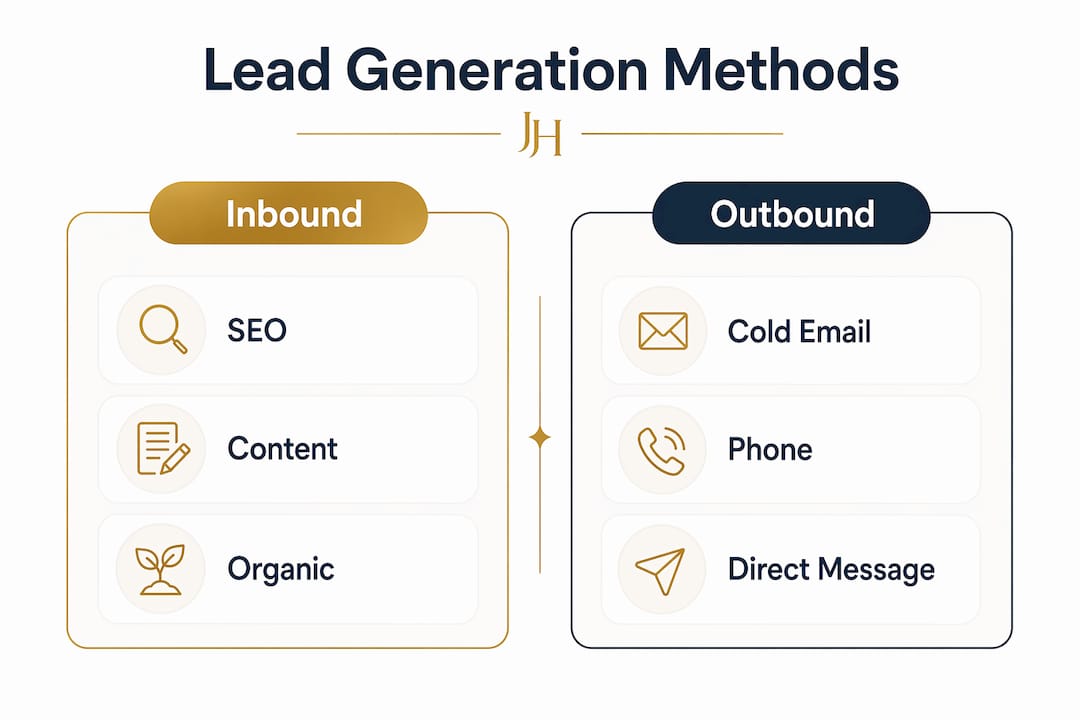
The most effective B2B lead generation strategies in 2026 combine both motions. Google Ads and Meta advertising fill the pipeline while SEO builds long-term authority. Multi-channel approaches combining email, social media, paid ads, and content consistently outperform any single channel. Relying on one source creates fragility. A Google algorithm update or an email deliverability issue can wipe out your pipeline overnight if you have no backup channel running.
Pro Tip: Run outbound to generate immediate revenue, then reinvest a portion into SEO and content so your inbound channel gradually reduces your dependence on paid spend.
How does lead qualification work and why does quality matter more than volume?
Lead qualification is the process of determining whether a prospect has the budget, authority, need, and timeline to buy. The BANT framework (Budget, Authority, Need, Timeline) remains the most widely used qualification standard in B2B sales because it filters out contacts who will never convert regardless of how much nurturing they receive.

The data on BANT is compelling. Verified BANT appointments convert at 90%, producing three times higher conversion rates and 60% lower cost per customer compared to unqualified leads. That gap explains why obsessing over lead volume is a costly mistake. A sales team chasing 200 unqualified MQLs wastes more time and money than one working 30 BANT-verified appointments.
The shift from MQL volume to appointment quality is the defining change in B2B lead generation right now. Traditional MQL metrics measure marketing activity, not buying intent. Sales development reps (SDRs) who run verification calls before passing leads to account executives act as the quality filter between marketing output and sales effort. Without that filter, marketing and sales operate with conflicting definitions of what a “good lead” actually is.
Here is a practical qualification process that works:
- Capture the lead through an inbound form, outbound outreach, or a paid ad conversion.
- Run an SDR verification call to confirm budget range, decision-making authority, and urgency.
- Score against BANT criteria and assign a qualification status before the lead enters the CRM pipeline.
- Pass only BANT-qualified leads to account executives for full discovery and proposal.
- Track appointment quality metrics monthly, not just lead volume, to measure true marketing performance.
Intent data adds another layer of precision. Tracking prospect behaviour on third-party comparison sites and review platforms identifies accounts already in a buying phase. Contacting those accounts first reduces wasted sales effort on prospects who are months away from a decision.
Pro Tip: Never pass a lead to sales without an SDR verification call. One bad lead handed to a senior account executive costs more in lost time than the entire cost of the SDR call.
What role does AI and automation play in modern B2B lead generation?
AI is no longer a nice addition to B2B lead generation. AI tools are core to predictive lead scoring, hyper-personalisation, and outreach automation in 2026. Businesses that treat AI as optional are competing at a structural disadvantage against those that have integrated it into their pipeline processes.
The practical applications of AI in B2B lead generation include:
- Predictive lead scoring: AI analyses CRM data, website behaviour, and firmographic signals to rank prospects by their likelihood to convert, so sales teams contact the right accounts first.
- Automated outreach sequences: AI tools personalise and schedule email and LinkedIn sequences at scale, freeing SDRs to focus on live conversations rather than manual follow-up.
- Visitor identification: Visitor identification tools capture company and contact data from anonymous website traffic before a prospect fills in a form. This enables outreach weeks earlier than traditional gated content allows.
- Intent signal monitoring: AI scans third-party platforms to surface accounts showing buying behaviour, such as visiting competitor pages or reading comparison articles.
- Funnel optimisation: AI identifies where prospects drop out of the funnel and suggests content or outreach adjustments to improve conversion at each stage.
The complete guide to automation in lead generation on Jarrodharman covers how to integrate these tools without replacing the human relationships that close B2B deals. Automation handles the repetitive work. Humans handle the complex conversations.
Pro Tip: Use AI for scoring and sequencing, but write your outreach copy as if a real person sent it. Prospects can detect templated AI copy instantly, and it destroys trust before the conversation starts.
Which multi-channel tactics most effectively generate and nurture B2B leads?
No single channel dominates B2B lead generation. A surround-sound multi-channel approach produces higher engagement and better conversion than any isolated tactic. The goal is to appear in front of the right prospect across multiple touchpoints so that when they are ready to buy, your brand is the first they think of.
Buyers complete 67% of their purchase journey before contacting sales. That means your content and advertising must be present and persuasive long before a prospect raises their hand. Waiting for inbound enquiries without active nurturing means you are invisible during the most critical phase of the buying decision.
The channels that consistently perform in B2B lead generation are:
- LinkedIn outreach and content: Direct messaging to decision-makers combined with thought leadership posts builds credibility and generates warm conversations. LinkedIn remains the highest-quality B2B social platform for professional outreach.
- Google Ads: Paid search targets prospects with active buying intent. A well-structured Google Ads campaign captures demand that already exists rather than creating it from scratch.
- SEO and blog content: Long-form articles targeting specific search queries attract organic traffic from prospects researching solutions. SEO content aligns with the awareness and consideration stages of the buyer journey.
- Email marketing and nurture sequences: Automated email sequences keep prospects engaged between touchpoints, delivering case studies, testimonials, and educational content that builds trust over time.
- Webinars and online events: Hosting a webinar positions your business as an authority and generates a list of warm prospects who have already invested time in your content.
- Retargeting ads: Meta and Google retargeting re-engages website visitors who did not convert on their first visit, keeping your brand visible throughout a long sales cycle.
For practical strategy examples across inbound, outbound, and multi-channel marketing, Jarrodharman has detailed resources covering each channel in depth. The key principle is consistency. Running a channel for four weeks and abandoning it because results are slow is the most common reason multi-channel strategies fail.
Content must align with where the buyer sits in their journey. Awareness-stage content educates. Consideration-stage content compares. Decision-stage content converts. Mapping your content to these stages and distributing it across SEO, social media, and email creates a pipeline that works at every level simultaneously. For businesses exploring multichannel marketing in depth, the principles of channel integration apply directly to B2B lead generation strategy.
Key takeaways
B2B lead generation succeeds when qualification quality, multi-channel presence, and AI-driven targeting work together to fill a pipeline with sales-ready opportunities rather than raw contacts.
| Point | Details |
|---|---|
| Quality over volume | 50 BANT-qualified conversations outperform 500 cold contacts every time. |
| Inbound takes time | SEO and content take 6–18 months to build, but compound in value over time. |
| BANT drives conversion | Verified BANT appointments convert at 90% with 60% lower cost per customer. |
| AI is now standard | Predictive scoring, visitor identification, and automated sequences are core tools in 2026. |
| Multi-channel is non-negotiable | Combining SEO, Google Ads, LinkedIn, email, and retargeting produces the strongest pipeline results. |
What I have learned running B2B lead generation across hundreds of campaigns
The biggest mistake I see B2B marketers make is treating lead generation as a numbers game. They celebrate when the CRM fills up with contacts, then wonder why the sales team is frustrated and conversion rates are low. Volume without qualification is just noise.
The shift that changes everything is measuring appointment quality instead of MQL count. When marketing is accountable for BANT-verified appointments rather than form fills, the entire approach changes. Targeting gets tighter. Messaging gets sharper. Sales and marketing stop arguing about lead quality because they are working from the same definition.
AI has genuinely changed what is possible in 2026, but not in the way most people expect. The biggest gain is not in generating more leads. It is in identifying the right accounts earlier and reaching them before competitors do. Visitor identification and intent data give you a window into buying behaviour that did not exist five years ago. Use it.
The businesses I see winning consistently are not running the most channels. They are running the right channels with discipline and patience. They invest in SEO knowing it takes 12 months to pay off. They run Google Ads to cover the gap. They use LinkedIn to build relationships with decision-makers before those decision-makers are ready to buy. That combination, executed consistently, builds a pipeline that does not collapse when one channel has a bad month.
— Business Warriors | Digital Marketing Agency
How Business Warriors can build your B2B lead generation pipeline
Business Warriors, based in Perth and serving clients across Australia and globally, builds integrated lead generation systems that combine SEO, Google Ads, Meta advertising, email marketing, and social media into one connected approach.
If your pipeline is inconsistent or your current marketing is producing contacts rather than qualified opportunities, the Marketing Vortex method is built to fix that. It combines every channel into a system where each element supports the others, reducing risk and increasing the quality of leads reaching your sales team. Jarrodharman’s SEO and digital marketing services are designed for businesses serious about building a pipeline that compounds over time. Reach out to discuss a strategy tailored to your market and growth targets.
FAQ
What is B2B lead generation?
B2B lead generation is the process of identifying and attracting business prospects who have the potential to become paying clients. It uses inbound methods like SEO and content marketing, and outbound methods like cold email and LinkedIn outreach, to build a pipeline of qualified sales opportunities.
How does BANT qualification improve conversion rates?
BANT filters leads by Budget, Authority, Need, and Timeline. Verified BANT appointments convert at 90%, producing three times higher conversion rates and 60% lower cost per customer compared to unqualified leads.
How long does inbound B2B lead generation take to produce results?
Inbound strategies like SEO and content marketing take 6–18 months to build consistent traffic. Outbound tactics like cold email and LinkedIn outreach produce results in weeks but require ongoing investment to maintain.
What is the role of AI in B2B lead generation?
AI handles predictive lead scoring, automated outreach sequencing, visitor identification, and intent signal monitoring. These tools allow sales teams to focus on high-value conversations while automation manages repetitive follow-up tasks.
How is B2B lead generation different from B2C?
B2B lead generation targets multiple stakeholders within a business across longer sales cycles, requiring nurturing, qualification, and relationship building. B2C typically involves a single decision-maker and a shorter, more emotion-driven purchase process.