23 June 2026
What is leads in marketing: your 2026 growth guide
Discover what is leads in marketing and how it drives growth. Unlock strategies to attract and nurture potential customers for your business.
TL;DR:
- Lead generation involves attracting contacts interested in your product or service for potential follow-up. Businesses succeed by classifying leads properly, nurturing them with personalized content, and tracking revenue impact. It’s essential to combine multiple digital channels and leverage AI to build a resilient and efficient lead system.
A lead in marketing is any individual or organisation that has expressed interest in your product or service, typically by sharing contact details, making them a potential customer worth nurturing. Understanding what is leads in marketing is the foundation of every revenue-generating system, from solo service businesses to national franchise networks. More than 50% of marketing efforts in Q1 2026 focus on lead generation as the primary growth driver. That single statistic tells you where the money and attention are going.
Lead generation in marketing is the formal industry term for the process of attracting and capturing those interested contacts. Whether you run a med spa in Perth, a law firm in Sydney, or an ecommerce brand shipping Australia-wide, your pipeline lives or dies on the quality and consistency of the leads flowing into it. This guide covers every layer of that process, from classification and capture to nurturing, scoring, and revenue attribution.
What are the different types of marketing leads?
Leads are classified as Marketing Qualified Leads (MQLs) and Sales Qualified Leads (SQLs), reflecting engagement level and purchase readiness. These two categories are the backbone of any modern lead management system. Getting the classification right determines which team handles the lead and how fast they move.
MQLs, SQLs, and PQLs explained
An MQL is a contact who has engaged with your marketing content but is not yet ready to buy. They might have downloaded a guide, watched a webinar, or signed up for your email list. An SQL is a contact that the sales team has assessed and confirmed as a genuine buying opportunity. A Product Qualified Lead (PQL) applies to businesses with a free trial or freemium model. A PQL has used the product and shown behaviour that signals readiness to upgrade or purchase.
Beyond these three, leads are also grouped by temperature:
- Cold leads have had no prior interaction with your brand and require significant education before they consider buying.
- Warm leads have engaged at least once, perhaps through a social media ad or a blog post, and are open to further contact.
- Hot leads are actively comparing options and are close to a buying decision.
Lead scoring and segmentation
Lead scoring fundamentally improves pipeline focus by assigning numerical values to lead behaviours and characteristics. A contact who visits your pricing page scores higher than one who only reads a blog post. Scoring lets your sales team prioritise the contacts most likely to convert, rather than chasing every form fill equally.
| Lead Type | Engagement Level | Handled By | Next Step |
|---|---|---|---|
| Cold lead | None or minimal | Marketing | Awareness content |
| Warm lead | Some interaction | Marketing | Nurture sequence |
| MQL | Active engagement | Marketing to Sales handoff | Qualification call |
| SQL | Sales-confirmed fit | Sales team | Proposal or demo |
| PQL | Product usage signals | Sales or success team | Upgrade conversation |
How do businesses generate leads using digital marketing?
35% of companies primarily generate leads through sales prospecting, while 45% balance both sales and marketing channels. The remaining businesses rely almost entirely on inbound marketing. That split shows there is no single correct approach. The most consistent pipelines combine multiple channels so that no single algorithm change or platform policy wipes out your lead flow.

SEO and AI search: capturing buyer intent
SEO remains the highest-intent lead generation channel available. When someone searches “laser hair removal Perth” or “commercial law firm Melbourne,” they are already in buying mode. Ranking for those terms puts your business in front of people who are actively looking, not passively scrolling. In 2026, SEO strategy has expanded to include AI search and Generative Engine Optimisation (GEO). Getting your brand mentioned in AI tools like ChatGPT, Perplexity, and Google’s AI Overviews is now a measurable lead source. Businesses that appear in large language model responses gain authority signals that feed back into traditional search rankings too.
Proven digital lead generation strategies show that combining SEO with structured content, schema markup, and entity-based writing gives you the best chance of appearing in both traditional and AI-generated search results.
Paid advertising: Google Ads and Meta
Google Ads captures demand that already exists. A service business running Search campaigns on Google targets people who are typing in exactly what they need right now. Meta advertising on Facebook and Instagram creates demand by placing your offer in front of audiences who match your ideal customer profile, even before they start searching. The two channels work together. Meta builds awareness and warms audiences. Google converts them when they are ready to act. Paid social media advertising delivers measurable results when campaigns are built around specific lead objectives rather than vanity metrics like reach or impressions.
Building a multi-channel lead system
- Publish SEO-optimised content targeting buyer-intent keywords in your niche to capture organic search traffic.
- Run Google Ads on high-converting search terms to capture active buyers immediately.
- Use Meta and Instagram ads to build retargeting audiences and warm cold traffic.
- Build a referral programme that rewards existing clients for introducing new contacts.
- Create a lead magnet such as a free guide, checklist, or consultation offer to capture email addresses from warm traffic.
- Optimise your website for lead capture with clear calls to action, fast load times, and mobile-first design.
No single channel suffices. Combining three to four channels builds a predictable pipeline that withstands algorithm changes and platform disruptions.
Pro Tip: Set up a simple UTM tracking system across all channels from day one. Knowing exactly which source produced each lead is the only way to make smart budget decisions later.
What is lead nurturing and why does it matter?
Lead nurturing, the middle-of-funnel engagement stage, is critical because personalised emails and content addressing buyer pain points raise conversion rates significantly. Most leads are not ready to buy the moment they first contact you. Research consistently shows that the majority of leads require multiple touchpoints before committing. Nurturing is the process of staying relevant and helpful during that gap.
What effective nurturing looks like
Strong nurturing programmes share several characteristics:
- Personalised email sequences that respond to what the lead has already done, not generic broadcast messages.
- Content matched to funnel stage, so a new subscriber receives educational content while a warm lead receives case studies and testimonials.
- Behavioural triggers that fire follow-up messages when a contact visits a key page, opens an email, or clicks a specific link.
- CRM integration so that every interaction is logged and the sales team sees the full history before making contact.
A leaky funnel is the most common and most expensive problem in lead management. Leads enter at the top, receive no meaningful follow-up, and quietly go cold. A beauty clinic that captures 200 enquiries per month but only follows up with 30 of them is not a marketing problem. It is a nurturing and systems problem.
Pro Tip: Set a behavioural trigger in your CRM or email platform to send a personalised follow-up within 24 hours of a lead visiting your pricing or services page. That single automation consistently outperforms any broadcast email campaign.
Lead nurturing with personalised, content-driven engagement is the most reliable way to convert leads in service-based sectors, where trust and relationship quality drive buying decisions.
How do you measure and optimise lead quality?
Experienced marketers prioritise lead quality and pipeline velocity over lead volume to reduce cost per acquisition. Chasing raw lead numbers is a beginner’s mistake. A business generating 500 low-quality leads per month spends more on follow-up and closes fewer deals than one generating 100 well-qualified contacts. Quality measurement starts with defining what a good lead actually looks like for your specific business.
Lead qualification criteria
Four factors determine whether a lead is worth pursuing:
- Engagement: Has the contact interacted with your content, ads, or website more than once?
- Fit: Does their business size, location, or personal profile match your ideal customer?
- Intent: Have they visited high-intent pages like pricing, services, or booking?
- Decision authority: Are they the person who can actually approve a purchase?
Mapping lead behaviour, such as pricing page visits, informs readiness far better than demographic data alone. A 45-year-old salon owner who has visited your pricing page three times is a better lead than a marketing manager who downloaded one free guide six months ago.
Key lead metrics and KPIs
| Metric | What It Measures | Why It Matters |
|---|---|---|
| Cost per lead (CPL) | Spend divided by leads generated | Benchmarks channel efficiency |
| Lead-to-opportunity rate | Leads that become qualified opportunities | Reveals nurturing effectiveness |
| Opportunity-to-close rate | Qualified leads that become clients | Measures sales team performance |
| Pipeline velocity | Speed leads move through the funnel | Identifies bottlenecks |
| Marketing attribution | Revenue traced back to specific channels | Guides reinvestment decisions |
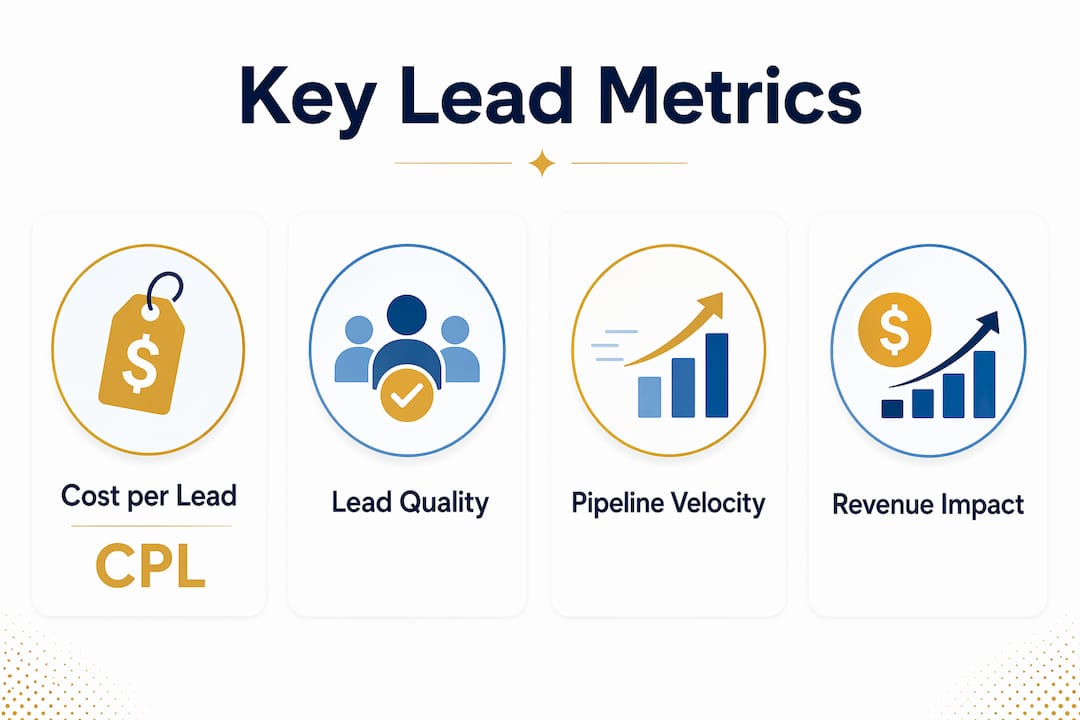
Mapping marketing attribution to closed-won revenue is the key to reinvesting in your highest-performing channels and scaling your business with confidence. Without attribution, you are guessing which half of your budget is working.
True marketing maturity arrives when teams measure pipeline and revenue outcomes, not just lead counts. That shift in thinking separates businesses that grow predictably from those that plateau.
Key takeaways
Effective lead generation requires classifying leads accurately, nurturing them with personalised content, and measuring quality through pipeline velocity and revenue attribution rather than raw volume.
| Point | Details |
|---|---|
| Define your lead types | Classify contacts as MQLs, SQLs, or PQLs to assign the right follow-up at the right time. |
| Build a multi-channel system | Combine SEO, Google Ads, Meta advertising, and referrals to create a pipeline that does not rely on one source. |
| Nurture with behaviour triggers | Use CRM automation to send personalised follow-ups based on what leads actually do, not just when they first opt in. |
| Score leads before handing off | Assign scores based on engagement, fit, and intent so your sales team focuses on the highest-value contacts. |
| Measure revenue, not just volume | Track cost per lead, pipeline velocity, and closed-won attribution to know which channels deserve more budget. |
What I have learned from building lead systems for real businesses
Most businesses I work with have the same problem. They have leads coming in but no clear system for what happens next. The enquiry arrives, someone responds when they get a chance, and the lead goes cold. The issue is not the marketing. The issue is the absence of a process between capture and conversion.
The other pattern I see constantly is an obsession with lead volume. Business owners want more leads, more enquiries, more form fills. But when we audit the pipeline, we find that doubling the lead volume would not double the revenue because the existing leads are not being worked properly. Fixing the nurturing and qualification process almost always delivers faster results than increasing ad spend.
AI has genuinely changed lead management in 2026. CRM platforms now use machine learning to predict which leads are most likely to convert based on behavioural patterns. AI-generated content can personalise email sequences at scale. And AI search tools are becoming a real lead source for businesses that have built enough brand authority to appear in model responses. Ignoring AI in your lead strategy is no longer a cautious choice. It is a competitive disadvantage.
The businesses that win consistently are the ones that treat lead generation as a system, not a campaign. They combine SEO-driven organic traffic with paid advertising, referral programmes, and automated nurturing. They measure every stage. They reinvest in what works. That is not complicated. It just requires discipline and the right infrastructure.
, Business Warriors | Digital Marketing Agency
Jarrodharman’s approach to consistent lead generation
Generating consistent, high-quality leads is the single biggest challenge for service-based businesses in Australia right now. Jarrod Harman and the Business Warriors team have built a proven system for solving exactly that problem.
The Marketing Vortex method integrates SEO, Google Ads, Meta advertising, email marketing, and social media into one connected system that generates leads across multiple channels simultaneously. Rather than relying on a single platform, it builds a pipeline that keeps working even when one channel underperforms. If you want to see what a fully built lead generation system looks like in practice, explore Jarrod’s client results and find out what is possible for your business.
FAQ
What is a lead in marketing?
A lead in marketing is any person or organisation that has shown interest in your product or service, typically by providing contact details. They become a potential customer that your sales and marketing teams can follow up with.
What is the difference between an MQL and an SQL?
An MQL (Marketing Qualified Lead) has engaged with your marketing content but is not yet ready to buy. An SQL (Sales Qualified Lead) has been assessed by the sales team and confirmed as a genuine buying opportunity ready for direct outreach.
How do you generate leads in digital marketing?
Effective digital lead generation combines SEO, Google Ads, Meta advertising, content marketing, and referral programmes. Using three to four channels together builds a more predictable and resilient pipeline than relying on any single source.
Why is lead nurturing important?
Lead nurturing keeps your brand relevant during the gap between first contact and purchase decision. Personalised email sequences and behaviour-triggered follow-ups raise conversion rates by maintaining engagement with contacts who are not yet ready to buy.
How do you measure lead quality?
Lead quality is measured through metrics including cost per lead, lead-to-opportunity rate, pipeline velocity, and closed-won revenue attribution. Linking lead generation to revenue is the most reliable way to identify which channels and tactics deserve more investment.
Recommended
- Lead management strategy for service businesses in 2026 – Jarrod Harman
- Innovative marketing strategies for service businesses 2026 – Jarrod Harman
- Cutting-edge lead generation methods for better online sales – Jarrod Harman
- Step-by-step guide to launching marketing campaigns in 2026 – Jarrod Harman