


TL;DR:
- Responsible digital marketing ensures ethical use of AI, data privacy, and brand transparency. It requires governance, accountability, and ongoing audits across all roles and campaign stages. Building a strong ethical framework offers long-term trust, compliance, and competitive advantage.
Digital marketing responsibility is the set of ethical and operational obligations that ensure marketing activities respect consumer rights, data privacy, and brand integrity while using AI and digital tools effectively. The industry term for this practice is “responsible marketing,” and it sits at the intersection of compliance, governance, and commercial performance. Ethical marketing practices show a 0.58 correlation with corporate social responsibility scores. That number tells you something important: responsible marketing is not a soft concept. It directly shapes how the market perceives your brand. For business leaders and marketing professionals in 2026, digital marketing responsibility covers everything from SEO strategy and paid advertising governance to AI oversight and consumer data management.
What are the core duties in digital marketing responsibility?
Digital marketing responsibility covers five distinct duty areas that every marketing professional must own. These are not optional add-ons. They are the operational baseline for any brand that wants to maintain trust and comply with current standards.
- Ethical campaign decision-making. Every campaign choice, from targeting parameters in Google Ads to Meta Ads creative, carries ethical weight. The question is always whether the tactic respects the consumer or exploits them.
- Consumer data management and privacy compliance. Regulations like the GDPR and Australia’s Privacy Act set the legal floor. Responsible practice goes further by giving consumers genuine control over how their data is used.
- Brand integrity and transparency. Audiences can detect inauthenticity quickly. Transparent reporting, honest claims, and clear disclosures build the trust that drives long-term client retention.
- AI governance. Ethics in digital marketing must become an operational muscle, not a policy document. That means building team consensus around what AI tools can and cannot do on behalf of your brand.
- Performance measurement and accountability. Tracking campaign outcomes against ethical benchmarks, not just revenue metrics, is a core duty for any marketing coordinator or executive.
Pro Tip: Build a one-page responsible marketing checklist that your team reviews before any campaign goes live. Include data handling, targeting logic, and AI tool usage. It takes ten minutes and prevents costly public mistakes.
Responsible marketing practice also requires a clear digital marketing strategy that documents decision-making at every stage. When something goes wrong, that documentation is what protects your brand and your clients.
How does AI change digital marketing responsibility in 2026?
AI is now embedded in SEO, paid advertising, email marketing, and social media content creation. That integration creates new governance obligations that did not exist three years ago.
82% of business leaders believe their company identity must evolve to manage AI’s impact, and 71% demand ethical standards for AI marketing agents. Those figures show that AI governance has moved from a technical concern to a leadership priority. Business leaders who treat AI adoption as purely a productivity question are missing the accountability dimension entirely.
“AI acceptance in marketing is not just technical adoption. It requires governance decisions on what to optimise and human oversight to protect brand integrity. Leading CMOs define AI goals, maintain human authority, and document accountability for outcomes.”
— The Algorithmic CMO, Berkeley Haas
The practical implication is clear. When your AI tools are generating SEO content, optimising Google Ads bids, or personalising email sequences, a human must define the guardrails. Marketing responsibility now extends to the full AI lifecycle: mapping AI use, measuring outputs for bias, and managing with review guardrails. That is not a one-time audit. It is an ongoing operational process.
The role of AI in marketing also intersects with generative engine optimisation (GEO) and AI SEO. Brands that want mentions in large language models like ChatGPT, Perplexity, and Google’s AI Overviews must produce content that is factually accurate, well-sourced, and ethically sound. Algorithmic bias in AI-generated content can damage brand reputation in ways that traditional SEO penalties never could.

| AI Marketing Area | Responsibility Requirement |
|---|---|
| SEO content generation | Human review for accuracy and bias before publication |
| Google Ads bid optimisation | Defined optimisation goals set by marketing leadership |
| Meta Ads audience targeting | Regular equity audits to prevent discriminatory reach |
| Email personalisation | Transparency with subscribers about automated content |
| Social media scheduling | Brand voice governance to maintain consistency and integrity |
Customer loyalty grows from ethical calibration, meaning transparency and consumer autonomy in AI-driven marketing, rather than intrusive prediction. Brands that use AI to serve the customer rather than manipulate them build the kind of trust that converts to repeat bookings and referrals.
What digital marketing roles carry responsibility for ethical practice?
Every role in a digital marketing team carries specific accountability. The title determines the scope, but the obligation to act responsibly applies at every level.
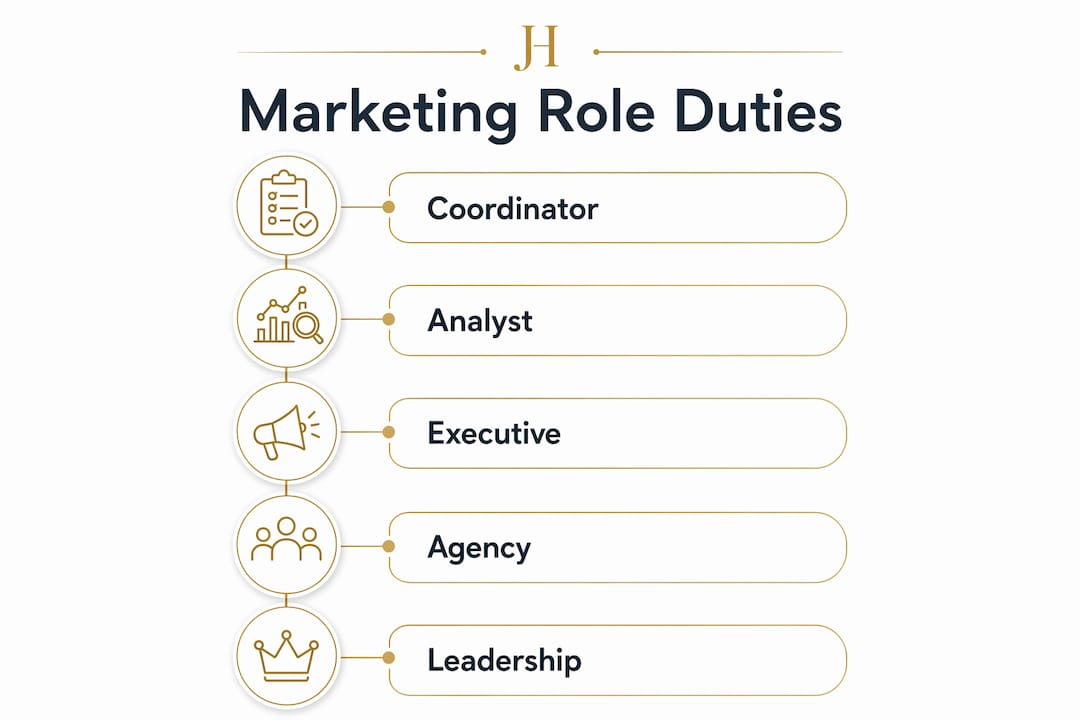
Digital marketing coordinator and analyst roles
Entry-level coordinators require 1–3 years of experience and mastery of Google Ads, Meta Ads, and Google Analytics, acting as the bridge between strategy and reporting. That bridge position is where ethical risks often surface first. A coordinator who notices a targeting parameter that excludes a protected demographic has both the opportunity and the duty to flag it before the campaign runs.
Hybrid coordinator and analyst roles in lean organisations create critical feedback loops that accelerate campaign optimisation. They also concentrate responsibility. When one person handles both execution and measurement, they must apply ethical scrutiny at both stages.
Digital marketing executive roles
Digital marketing executives set policy, approve strategy, and own the outcomes. The digital marketing executive role in 2026 requires fluency in AI governance, data privacy law, and platform compliance rules across Google, Meta, and emerging channels. Executives who delegate AI decisions entirely to junior staff without governance frameworks are creating liability for their organisations.
Pro Tip: Digital marketing executives should schedule a quarterly ethics review that covers AI tool usage, data handling practices, and any near-miss incidents from the previous quarter. Treat it like a financial audit.
| Role | Primary Responsibility Area | Key Accountability |
|---|---|---|
| Digital marketing coordinator | Campaign execution and reporting | Flagging ethical risks in targeting and creative |
| Digital marketing analyst | Data interpretation and measurement | Ensuring data collection meets privacy standards |
| Digital marketing executive | Strategy and policy enforcement | Governing AI use and approving campaign frameworks |
| Digital marketing agency lead | Client outcomes and compliance | Aligning client campaigns with legal and ethical standards |
Agency roles carry an additional layer of responsibility. When a digital marketing agency manages campaigns across multiple clients, the ethical standards it applies become the ethical standards of every brand it represents. That is a significant obligation.
How can businesses build frameworks for responsible digital marketing?
Governance frameworks turn responsible marketing from an intention into a repeatable process. Without structure, ethical commitments erode under deadline pressure and revenue targets.
-
Map every AI tool in your marketing stack. Document what each tool does, what data it accesses, and who reviews its outputs. This mapping exercise is the foundation of AI governance and makes bias audits possible.
-
Conduct regular equity audits on paid advertising. Review Google Ads and Meta Ads audience data quarterly to identify unintended exclusions or over-targeting of vulnerable groups. Adjust targeting parameters based on findings, not assumptions.
-
Run scenario-based team debates before major campaigns. Structured internal debates using real marketing scenarios help teams identify ethical risks before public backlash occurs. This approach is more effective than reactive policy updates after a problem surfaces.
-
Build a decision-making trail for algorithmic choices. Document why specific AI optimisation goals were set, who approved them, and what review process applies. When an algorithm produces an unexpected outcome, that trail is what allows you to respond quickly and credibly.
-
Align your SEO and content strategy with GEO standards. Generative engine optimisation requires that your content be factually accurate, clearly attributed, and free from misleading claims. The same standards that make content trustworthy for human readers make it citable by AI systems.
-
Integrate compliance into your marketing workflow from day one. Compliance added at the end of a campaign is expensive and often ineffective. Build privacy checks, data handling protocols, and ethical review steps into your standard operating procedures.
External certifications from bodies like the Australian Data and Privacy Commissioner and industry standards from the Interactive Advertising Bureau (IAB) Australia provide useful benchmarks. They also signal to clients and partners that your organisation takes responsible marketing practice seriously.
Key takeaways
Digital marketing responsibility requires governance at every level, from coordinator to executive, covering AI oversight, data privacy, SEO integrity, and ethical campaign execution.
| Point | Details |
|---|---|
| AI governance is a leadership duty | Business leaders must define AI optimisation goals and maintain human oversight of all automated decisions. |
| Ethical practice drives loyalty | Transparent, consumer-respecting marketing builds the trust that converts to repeat business and referrals. |
| Role-specific accountability matters | Every team member from coordinator to executive carries defined ethical obligations tied to their function. |
| Scenario-based debates prevent crises | Teams that rehearse ethical dilemmas before campaigns launch avoid the costly backlash of reactive responses. |
| Compliance belongs in the workflow | Privacy and ethical checks integrated from the start of a campaign cost far less than corrections after launch. |
Why I think most businesses are still treating responsibility as a checkbox
After working with service businesses, e-commerce brands, and franchise networks across Australia, the pattern is consistent. Responsible marketing gets treated as a compliance task rather than a commercial advantage. That is a costly mistake.
The businesses I see winning in SEO, paid advertising, and AI-driven content are the ones that have made ethical practice part of their operational identity. They document their AI decisions. They audit their Meta Ads targeting. They build GEO-ready content that large language models can cite with confidence. Their brand mentions in AI search results are growing because their content is trustworthy, not just optimised.
The uncomfortable truth is that most marketing teams do not have a governance framework for AI. They have a tool subscription and a vague sense that someone is watching the outputs. That gap is where reputational risk lives. A single biased AI-generated campaign, a data handling breach, or a misleading SEO claim can undo years of brand building.
My advice is to treat AI governance the same way you treat financial governance. You would not let an algorithm approve your annual budget without human sign-off. Do not let one approve your brand messaging either. The standards will only tighten as regulators catch up with the technology. The businesses that build responsible practice now will have a structural advantage when those standards become mandatory.
— Business Warriors | Digital Marketing Agency
How Jarrodharman supports responsible digital marketing growth
Business leaders who want to grow without cutting ethical corners need a marketing partner who builds compliance into the strategy from the start. Jarrodharman’s approach to digital marketing and SEO consulting combines technical performance with transparent, accountable practice across SEO, Google Ads, Meta advertising, and AI-driven content.

The Marketing Vortex method integrates SEO, paid advertising, social media, and email marketing into a single system with clear reporting and human oversight at every stage. Every campaign is built with data privacy, brand integrity, and measurable outcomes as non-negotiable foundations. If you are ready to build a marketing system that performs and holds up to scrutiny, connect with Jarrodharman to discuss a strategy built around your business.
FAQ
What is digital marketing responsibility?
Digital marketing responsibility is the set of ethical and operational obligations that govern how marketers handle consumer data, use AI tools, and run campaigns. It covers privacy compliance, brand integrity, and accountability for algorithmic decisions.
Why does AI governance matter for digital marketing ethics?
82% of business leaders say their company identity must evolve to manage AI’s impact. Without governance, AI tools can produce biased content or targeting decisions that damage brand reputation and breach consumer trust.
What are the main duties of a digital marketing coordinator?
A digital marketing coordinator manages campaign execution, performance reporting, and data analysis using tools like Google Ads, Meta Ads, and Google Analytics. They are also responsible for flagging ethical risks in targeting and creative before campaigns go live.
How does responsible marketing affect SEO and GEO performance?
Factually accurate, well-sourced content that respects consumer rights performs better in both traditional SEO and generative engine optimisation. Large language models cite trustworthy content more frequently, making ethical practice a direct ranking advantage.
How often should businesses audit their marketing ethics practices?
A quarterly ethics review covering AI tool usage, data handling, and paid advertising targeting is the recommended minimum. Organisations running high-volume campaigns across Google Ads and Meta Ads benefit from monthly spot-checks on audience and output data.