


TL;DR:
- A structured workflow ensures consistent, measurable lead generation for service-based businesses.
- The six core stages are strategy, planning, content creation, implementation, tracking, and optimization.
- Using the right tools and automation maximizes ROI and streamlines the marketing process.
Most service-based business owners think digital marketing means running a few ads and hoping the phone rings. It doesn’t work that way. Real, consistent lead generation comes from something far less glamorous but far more powerful: a repeatable workflow. When you have a structured process guiding every marketing decision, from strategy through to tracking, you stop reacting and start growing. This guide walks you through exactly how a digital marketing workflow operates, what each stage involves, which tools actually help, and how to put it all together so your business attracts leads consistently, not just occasionally.
Table of Contents
- Why workflow matters in digital marketing
- The essential stages of a digital marketing workflow
- Choosing the right tools and automation for your workflow
- Bringing it all together: a sample digital marketing workflow in action
- Why most businesses struggle and how a workflow mindset changes everything
- Take your digital marketing workflow further
- Frequently asked questions
Key Takeaways
| Point | Details |
|---|---|
| Workflow beats guesswork | A structured digital marketing workflow brings clarity and steady growth for service businesses. |
| Tools support, not replace | Start with essential tools and automation but focus first on process, not gadgets. |
| Track and refine often | Ongoing measurement and regular tweaks keep your workflow driving more leads and sales. |
| Real results take method | Adopting a workflow unlocks transformative results and reduces overwhelm. |
Why workflow matters in digital marketing
A digital marketing workflow is a structured, repeatable sequence of steps that guides your marketing activity from initial strategy right through to measuring results. Think of it like a recipe. Without one, you might throw ingredients together and occasionally produce something edible. With one, you get the same great result every single time.
For service-based businesses, this consistency is everything. Whether you run a skin clinic in Melbourne, a consulting practice in Brisbane, or a wellness studio in Perth, your clients expect reliability. Your marketing should deliver the same.
Here’s what a proper workflow gives you:
- Clarity on what needs to happen and when
- Consistency so your marketing doesn’t stop when you get busy
- Measurable growth because every step is tracked and improved
- Time savings from removing guesswork and repeated decision-making
- Accountability across your team or contractors
Without a workflow, most businesses fall into ad-hoc marketing. That means posting on social media when they remember, running an ad campaign when bookings drop, and sending an email newsletter every few months when guilt kicks in. Sound familiar?
| Workflow-driven marketing | Ad-hoc marketing |
|---|---|
| Planned content calendar | Post whenever there’s time |
| Consistent lead tracking | No idea where leads come from |
| Regular performance reviews | React when results drop |
| Defined roles and tasks | Everyone does everything (or nothing) |
| Steady, predictable growth | Feast and famine cycles |
As structured workflows outperform ad-hoc marketing efforts across every key metric, the difference in outcomes is significant. Businesses that follow step-by-step marketing processes consistently outperform those that wing it.
“The businesses that win online aren’t the ones with the biggest budgets. They’re the ones with the most consistent processes.”
A real example: a health clinic that previously ran random Facebook ads saw a 40% increase in enquiries within 90 days simply by mapping out a proper monthly workflow. They didn’t spend more money. They spent it smarter, guided by a clear process. Using a solid digital marketing checklist is often the first step to building that kind of structure.
The essential stages of a digital marketing workflow
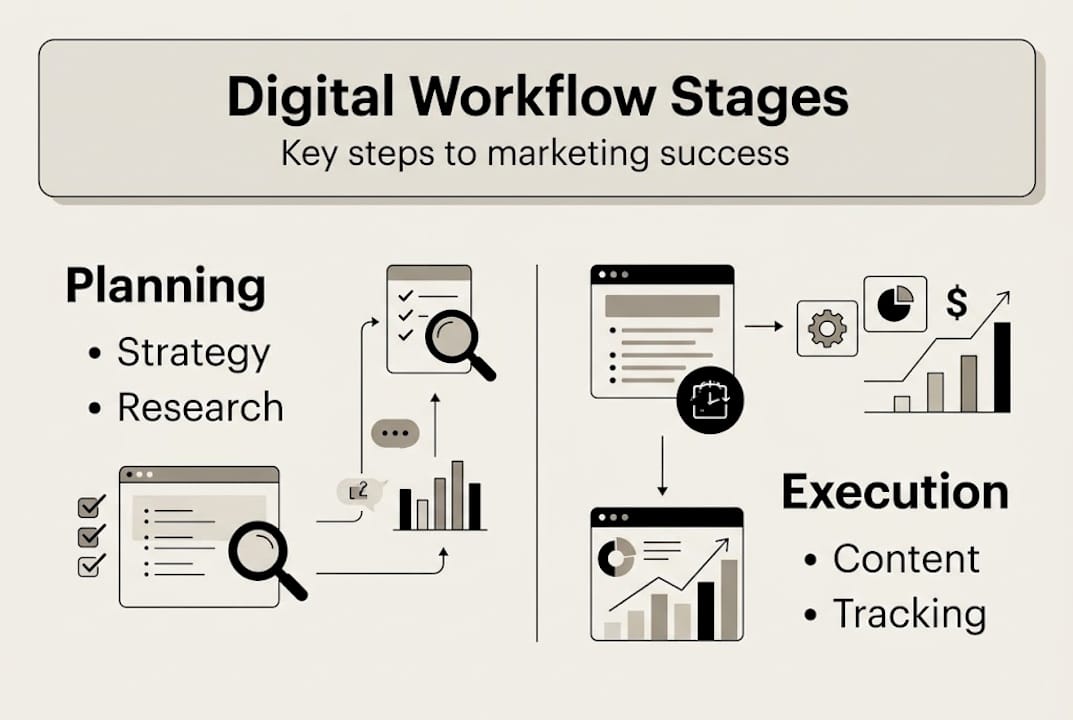
Understanding the ‘why’ leads us naturally to the ‘how’. Every effective marketing workflow moves through six core stages. Skip one and the whole system weakens.
- Strategy – Define your goals, target audience, and key messages. This is your foundation.
- Planning – Map out campaigns, content topics, timelines, and budgets. Follow your winning marketing steps here.
- Content creation – Produce the assets: blog posts, videos, ad copy, email sequences, and social posts.
- Implementation – Publish, schedule, and launch. This is where your content marketing workflow becomes critical.
- Tracking – Monitor performance across all channels using analytics tools.
- Optimisation – Use what the data tells you to improve every element before the next cycle.
| Stage | Goal | Typical tasks | Owner |
|---|---|---|---|
| Strategy | Set direction | Audience research, goal setting | Business owner or strategist |
| Planning | Organise activity | Content calendar, budget allocation | Marketing manager |
| Content creation | Build assets | Writing, design, video production | Content team or freelancer |
| Implementation | Go live | Scheduling, ad setup, publishing | Marketing coordinator |
| Tracking | Measure results | Analytics review, reporting | Account manager |
| Optimisation | Improve performance | A/B testing, copy refresh, bid adjustments | Specialist or agency |
A structured workflow maximises ROI at every stage because nothing is left to chance. Each step feeds the next, creating a loop that gets sharper over time.
Pro Tip: Don’t skip the tracking stage. This is where most service businesses lose momentum. If you’re not measuring, you’re guessing. Even a simple weekly check of your key numbers, such as website visits, enquiry form submissions, and cost per lead, will reveal patterns that help you grow faster.
When launching marketing campaigns, having these six stages mapped out before you spend a single dollar is what separates businesses that scale from those that stall.
Choosing the right tools and automation for your workflow
With your workflow’s steps mapped out, the next piece of the puzzle is the right technology. The good news is you don’t need a dozen different platforms. You need the right tool for each stage, and ideally, ones that talk to each other.
Here are the key tool categories and what they cover:
- Planning and project management: Trello, Asana, or Monday.com keep tasks organised and deadlines visible
- Content scheduling: Meta Business Suite, Later, or Buffer for social media; Mailchimp or ActiveCampaign for email
- SEO and keyword research: Google Search Console, SEMrush, or Ahrefs
- Paid advertising: Google Ads Manager and Meta Ads Manager
- Analytics and reporting: Google Analytics 4, plus platform-specific dashboards
- CRM and lead tracking: HubSpot (free tier is solid for most small businesses) or Zoho CRM
- Automation: Zapier connects your tools so data flows without manual entry
Digital tools and automation platforms are vital for streamlining workflows, particularly for small teams managing multiple channels at once. Automation removes the repetitive tasks, like sending a follow-up email after a form submission, so your team focuses on higher-value work.
The biggest mistake businesses make is collecting tools without a plan. They sign up for five platforms, use none of them properly, and end up more confused than before. A clear content workflow guide helps you decide which tools actually serve your process rather than complicate it.

Pro Tip: Start with one tool per workflow stage. Master it before adding anything else. A simple spreadsheet and one scheduling tool will outperform six half-used platforms every single time.
For Australian service businesses specifically, look for tools with local support, AUD pricing, and integrations that suit your existing systems. Many global platforms now offer Australian-specific features, including GST-compliant invoicing and AEST-friendly scheduling defaults.
Bringing it all together: a sample digital marketing workflow in action
Armed with workflow essentials and the right tools, let’s look at how it works for a real Australian business. Imagine a naturopath in Sydney wanting to attract more clients through online channels. Here’s how their monthly workflow runs:
- Week 1, strategy check: Review last month’s results. Which content performed best? Which ads brought in the most enquiries? Set goals for the coming month.
- Week 1, planning: Map out four blog topics, two email newsletters, three social media themes, and one Google Ads campaign refresh.
- Week 2, content creation: Write blog posts, film two short videos for Instagram Reels, draft email copy, and create ad visuals.
- Week 2 to 3, implementation: Schedule all social posts, send email newsletter one, publish blog post one, and activate the updated ad campaign.
- Week 3 to 4, tracking: Check Google Analytics weekly. Review ad performance every three days. Log enquiry numbers in the CRM.
- End of month, optimisation: Pause the underperforming ad. Boost the top-performing post. Adjust the next month’s plan based on what the data shows.
Stepwise implementation of workflows leads to measurable growth because each cycle builds on the last. This naturopath went from sporadic posts and zero ad tracking to a steady stream of 15 to 20 new enquiries per month within four months.
Pro Tip: Review your workflow results every quarter, not just monthly. Monthly reviews catch quick wins. Quarterly reviews reveal the bigger patterns, like which season drives the most leads or which content type consistently converts.
When you’re focused on getting digital marketing leads at scale, this cyclical approach is what makes the difference between a business that grows and one that plateaus.
Why most businesses struggle and how a workflow mindset changes everything
Here’s our honest take: most business owners don’t fail at marketing because they lack talent or budget. They fail because they chase tactics instead of building systems. They try a new platform, get distracted by the next shiny strategy, and never give any single approach enough time or structure to actually work.
A workflow mindset flips this entirely. Instead of asking “what should I try next?”, you ask “what does my process tell me to do now?”. That shift is enormous. It removes the emotional rollercoaster of marketing, where one bad week sends you scrambling to change everything.
The payoff isn’t just more leads. It’s the peace of mind that comes from knowing your marketing is running, even when you’re flat out serving clients. It’s sustainable growth rather than exhausting bursts of activity followed by silence.
Set-and-forget tools or one-off campaign hacks rarely deliver lasting results. The businesses we see scaling client wins consistently are those that adopt the method, refine it based on real data, and repeat it with discipline. That’s the workflow mindset in action.
Take your digital marketing workflow further
Building a workflow from scratch takes time, and getting every stage right is harder than it looks. If you’ve read this far, you already understand that consistent leads come from consistent processes, not random campaigns.

At Business Warriors, we specialise in building exactly this kind of system for Australian service businesses. Our marketing vortex method integrates SEO, paid ads, email, and social into one connected workflow designed to generate leads every month. Whether you’re starting from scratch or want to sharpen what you already have, our step-by-step growth guide is a great place to begin. Or explore our proven online client strategies to see exactly how we help businesses like yours grow.
Frequently asked questions
What is a digital marketing workflow?
A digital marketing workflow is a structured, repeatable sequence of steps that manages every stage of your marketing from strategy to results tracking. Following structured workflows boosts both organisation and measurable outcomes for service businesses.
How can a workflow help my service business attract more leads?
A good workflow ensures each lead generation activity is planned, tracked, and optimised, making results consistent and scalable. Workflows improve lead generation consistency because nothing falls through the cracks between campaigns.
What are the main steps in a digital marketing workflow?
The main steps are strategy, planning, content creation, implementation, tracking, and ongoing optimisation. These core repeatable steps form the backbone of every effective marketing system.
Do I need expensive tools to build a marketing workflow?
No. Starting with simple, affordable tools for planning and automating is often more effective than jumping straight to complex platforms. Simple tools are highly effective for most small and medium service businesses.
How often should I review and adjust my workflow?
Review your workflow every quarter or after key campaigns to spot improvement opportunities and keep growth on track. Regular review is one of the most reliable ways to improve your digital marketing results over time.