30 June 2026
How to get leads for your digital marketing agency
Discover how to get leads for your digital marketing agency. Uncover proven strategies and tips to attract and convert potential clients effectively.
TL;DR:
- Effective lead generation combines targeted outbound outreach, strong content, and SEO strategies tailored to your niche and deal size. Implementing a precise Ideal Customer Profile and using personalized outreach can quickly book discovery calls and attract high-quality clients. Building a referral system, optimized lead magnets, and consistent SEO efforts create long-term, sustainable agency growth.
Lead generation for a digital marketing agency is the process of attracting, qualifying, and converting potential clients into booked discovery calls through targeted outreach, content authority, and paid channels. Knowing how to get leads for a digital marketing agency means more than running ads or sending cold emails. It requires a system that matches your niche, your deal size, and your growth stage. This guide covers the exact strategies agency owners in Australia are using in 2026, from targeted outbound tactics and AI-assisted SEO to referral flywheels and high-converting lead magnets.
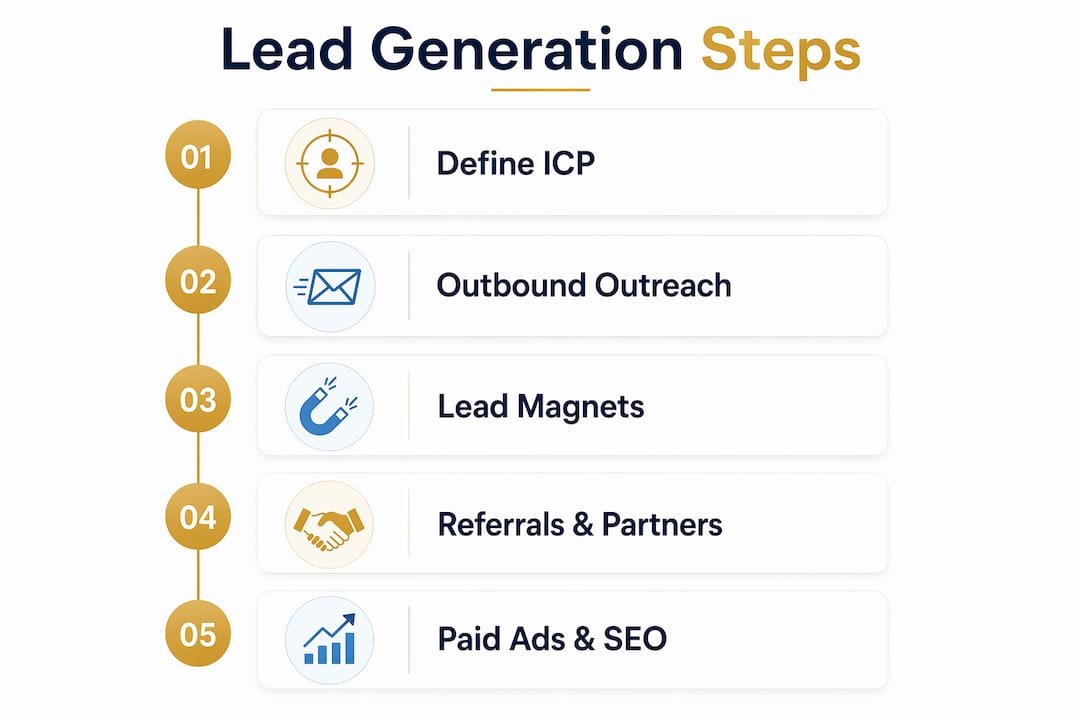
How to get leads for a digital marketing agency: start with your ICP
The single biggest reason agencies struggle to generate leads is a vague Ideal Customer Profile (ICP). Failing to define a one-sentence ICP leads to broad messaging and poor outbound results. Your ICP is not a demographic sketch. It is a filterable set of criteria that tells you exactly who to target, why they need you now, and whether they can afford you.
A strong ICP includes:
- Industry and sub-niche: e.g. med spas in Perth, ecommerce brands in Melbourne spending $50,000+ per month on ads
- Company size: headcount, revenue range, or advertising budget (minimum $50 per day is a practical floor)
- Marketing stack signals: running Google Ads but no Meta, or active on Instagram but no email sequence
- Funding or growth stage: recently opened a second location, just raised capital, or hiring a marketing manager
- Decision-maker title: owner, marketing director, or head of growth
A clear, filterable ICP improves outbound success by targeting decision-makers with immediate budgets and specific pain points. That specificity is what separates a 2% reply rate from a 15% reply rate.
Pro Tip: Write your ICP as a single sentence: “We help [industry] businesses with [specific signal] who want [specific outcome] within [timeframe].” If you cannot write it in one sentence, your targeting is still too broad.

Agencies chasing high-value contracts above $10,000 per month need account-based outbound and partner channels. Agencies targeting deals under $3,000 per month succeed with volume tactics like community engagement and content marketing. Knowing your deal size shapes every tactic that follows.
What outbound strategies actually book discovery calls?
Outbound lead generation is the fastest way to fill your pipeline when you are starting out or entering a new niche. Personalised cold outreach sending 15–25 messages daily with 3–4 follow-ups yields a 15% reply rate and a 25% booking rate. That translates to 3–5 discovery calls per week within 14 days of starting. Those are real numbers, not aspirational benchmarks.
The steps that produce those results:
- Build a focused prospect list. A narrow list of 200–500 high-fit prospects outperforms mass email campaigns every time. Use LinkedIn Sales Navigator, Apollo, or manual research to build it.
- Write personalised openers. Reference a recent business development, not a generic compliment. “I saw you just opened your second clinic in Subiaco” beats “Love what you’re doing with your brand” every time.
- Use multi-channel sequencing. Start with a LinkedIn connection request, follow with a personalised email, then a LinkedIn message. Spread touches across 10–14 days.
- Follow up 3–4 times. Most replies come on the third or fourth touch. Stopping after one message is the most common and costly mistake agencies make.
- Track reply rates by segment. If a segment is not hitting 10% replies after 50 messages, rewrite the opener or change the ICP filter before scaling.
Personalised openers referencing recent business developments are standard practice in 2026 for breaking through to decision-makers. Generic openers get deleted. Specific ones get replies.
Pro Tip: Use AI tools like ChatGPT or Claude to draft personalised first lines at scale. Feed them the prospect’s LinkedIn headline, recent post, or company news and ask for a one-sentence opener. Review and edit each one before sending.
How do lead magnets improve website conversion rates?
Your website is a lead generation system, not a portfolio. Most agency websites fail because they end with a generic contact form. Replacing generic contact forms with lead magnets improves conversion rates 3–5 times. That improvement comes from delivering immediate value before a sales conversation begins.
Effective lead magnets for digital marketing agencies include:
- Free website or SEO audits: Use AI-assisted tools to generate a personalised report in minutes. The prospect gets real data; you get a qualified lead.
- Niche-specific industry reports: “The 2026 State of Digital Marketing for Australian Med Spas” positions you as a category expert before the first call.
- Ad account reviews: Offer a 15-minute Loom video reviewing a prospect’s Google Ads or Meta account. High perceived value, low time cost.
- ROI calculators: A simple tool showing what a 20% improvement in conversion rate means for their monthly revenue creates urgency without a hard sell.
The website as a lead generation system principle means every page has one job: move the visitor one step closer to booking a call. Landing pages tied to paid advertising campaigns need a single call to action, a specific offer, and copy that mirrors the ad that brought the visitor there. Mismatched messaging between your ad and your landing page is the fastest way to waste ad spend.
You can find practical lead magnet examples that work across service-based niches, including templates you can adapt for your agency’s offer.
How do referrals and partnerships create consistent lead flow?
Referrals are the highest-converting lead source for most agencies. Early-stage agencies gain initial clients within 1–3 months primarily from referrals and warm networks, well before organic content channels deliver results. The problem is that most agencies treat referrals as a passive outcome rather than a system they actively manage.
A structured referral programme changes that:
- Schedule a specific ask every 90 days to your happiest clients. Do not ask “Do you know anyone?” Ask “Do you know one other [specific business type] owner who is frustrated with their current agency?”
- Make it frictionless. Write a forwardable intro email your client can send in 30 seconds. A forwardable intro email removes the effort barrier that stops most referrals from happening.
- Acknowledge and reward referrals immediately. A handwritten note, a gift card, or a service credit sent within 24 hours of a referral reinforces the behaviour.
Pro Tip: Partner with complementary service providers, not just clients. A web developer, a business coach, or an accountant who serves the same niche as you can send a steady stream of warm referrals. Offer a reciprocal arrangement and formalise it with a simple agreement.
Community engagement also drives leads, particularly for agencies targeting smaller deals. Showing up consistently in Facebook Groups, LinkedIn communities, or industry forums where your ideal clients spend time builds recognition before you ever send a cold message. Answer questions publicly, share specific results (with permission), and position yourself as the go-to expert in your niche.
How do paid advertising and SEO generate high-intent agency leads?
Paid search and SEO are the two channels that produce the most consistent inbound lead flow for established agencies. They work differently and reward different investment horizons.
Paid search ads targeting agency-intent keywords with geo-fencing and negative keywords improve lead quality and reduce wasted spend. Running Google Ads for terms like “digital marketing agency Perth” or “Google Ads management for med spas” puts you in front of buyers who are actively searching. Tight geo-targeting, a strong negative keyword list, and a landing page that mirrors the ad copy are non-negotiable for a positive return on ad spend.
| Channel | Best for | Key tactic |
|---|---|---|
| Google Ads | High-intent buyers searching now | Geo-fenced, negative-keyword-filtered campaigns |
| Meta Ads | Awareness and retargeting | Video testimonials and case study ads |
| LinkedIn Ads | B2B decision-makers | Sponsored InMail and lead gen forms |
| Organic SEO | Long-term authority and compounding traffic | Niche long-tail content and technical SEO |
| AI/GEO | Brand mentions in AI tools | Entity-building content and structured data |
SEO for agencies requires a niche content strategy built around long-tail keywords your ideal clients actually search. Writing about “how to get more bookings for a med spa in Brisbane” attracts far more qualified traffic than generic posts about digital marketing. Generating leads through digital marketing at scale requires this kind of topical authority, built consistently over 6–12 months.
AI-assisted SEO and Generative Engine Optimisation (GEO) are now critical for visibility. When a business owner asks ChatGPT, Perplexity, or Google’s AI Overview “who is the best digital marketing agency for salons in Australia,” you want your agency mentioned. That happens through entity-building content, structured data markup, consistent brand mentions across authoritative sites, and earning citations in AI-indexed publications. This is not optional in 2026. It is where organic visibility is heading.
Social media platforms amplify all of the above. LinkedIn works for B2B outreach and thought leadership. Instagram and TikTok work for demonstrating results through short-form video. A social media content strategy that shows real client outcomes builds trust faster than any brochure.
Key takeaways
Consistent lead generation for a digital marketing agency requires a dual approach: fast outbound tactics to fill the pipeline now, and compounding content and SEO authority to sustain it long-term.
| Point | Details |
|---|---|
| Define a precise ICP first | A one-sentence ICP filters your outreach to decision-makers with real budgets and specific pain points. |
| Outbound works fast with volume and personalisation | Sending 15–25 personalised messages daily with 3–4 follow-ups produces 3–5 discovery calls per week within 14 days. |
| Lead magnets outperform contact forms | Replacing generic forms with free audits or niche reports improves conversion rates 3–5 times. |
| Referrals need a system, not luck | A scheduled 90-day ask with a forwardable intro email turns passive referrals into a reliable lead source. |
| SEO and GEO build long-term visibility | Niche content, structured data, and AI brand mentions compound over time to produce inbound leads without ongoing ad spend. |
What I have learned about agency lead generation the hard way
Running Business Warriors from Perth and working with agencies across Australia, I have seen the same mistake repeated constantly. Agency owners try one tactic for three weeks, see no results, and switch to something else. They never let anything mature. The data never has time to tell them anything useful.
The dual-focus strategy is not a theory. It is the only approach that works sustainably. You run outbound to get calls this week. You build content and SEO authority to get calls next year. Both tracks run simultaneously. Stopping one to focus on the other is how agencies end up in a feast-and-famine cycle.
Personalised outreach beats mass messaging every single time. I would rather send 25 deeply researched messages than 500 generic ones. The reply rates prove it. The booking rates prove it. The quality of the clients who come through that door proves it.
The agencies I see growing fastest in Australia right now are the ones investing in AI-assisted SEO, building GEO visibility so they show up in ChatGPT and Perplexity answers, and pairing that with tight Google Ads campaigns and a referral system that runs on autopilot. That combination is not complicated. It just requires consistency and the discipline to not abandon a strategy before it has had time to work.
If you are serious about client acquisition that scales, build the system once and let it compound.
, Business Warriors | Digital Marketing Agency
How Jarrodharman can help you grow your agency’s client base
Jarrodharman has spent years helping service-based businesses and agency owners build lead generation systems that produce consistent, qualified enquiries without relying on luck or referrals alone.
The Marketing Vortex Method combines SEO, Google Ads, Meta advertising, email marketing, and social media into one integrated system designed to attract the right clients at the right time. For agency owners who want a step-by-step growth plan built around their niche and deal size, Jarrodharman’s resources and consulting approach give you a clear path from where you are now to a full pipeline. Explore the frameworks, case studies, and proven methods at jarrodharman.com.
FAQ
What is the fastest way to get leads for a digital marketing agency?
Personalised cold outreach sending 15–25 messages daily with 3–4 follow-ups produces 3–5 discovery calls per week within 14 days. This is the fastest method for filling a new pipeline.
How long does SEO take to generate agency leads?
SEO typically takes 6–12 months to produce consistent inbound leads. Pair it with outbound tactics and paid advertising to generate leads while organic authority builds.
What is an Ideal Customer Profile and why does it matter?
An ICP is a precise, filterable description of your best-fit client, including industry, budget, and specific pain points. A clear ICP improves outbound reply rates and lead quality significantly.
How do lead magnets help digital marketing agencies attract clients?
Replacing a generic contact form with a free audit or niche report improves conversion rates 3–5 times by delivering immediate value before a sales conversation begins.
How do I get my agency mentioned in AI tools like ChatGPT?
Publish entity-building content, earn citations on authoritative sites, and use structured data markup. Consistent brand mentions across AI-indexed publications increase the likelihood of appearing in AI-generated answers.