


TL;DR:
- Most new social media marketing agencies struggle because they lack a clear niche, service structure, and client outreach system. Building authority through niche specialization, warm outreach, and SEO are essential for growth, while proper legal and operational foundations prevent early disputes. Focusing on delivering measurable results, leveraging AI, and building systems enable sustainable scaling and long-term success.
Most people who try to start a social media marketing agency stall before signing their first client. They spend weeks building a website, overthink their logo, and eventually wonder why no one is calling. The real obstacle is almost never branding. It’s the absence of a clear niche, a proper service structure, and a system for getting in front of the right people. This guide cuts through that confusion with a practical, step-by-step framework built around what actually works in 2026, including AI-powered tools, realistic pricing, and SEO strategies that build long-term authority for your agency.
Table of Contents
- Key takeaways
- How to start a social media marketing agency the right way
- Choosing your niche and service package
- Legal, financial, and operational foundations
- Landing your first clients
- Delivering your first client projects
- Scaling your agency sustainably
- My honest take on launching a social media agency
- Ready to grow your agency faster?
- FAQ
Key takeaways
| Point | Details |
|---|---|
| Niche before everything | Picking a focused niche dramatically improves your positioning and client conversion rate. |
| Legal setup is non-negotiable | Register your structure and get professional liability insurance before taking on any client work. |
| Warm outreach wins first clients | Your personal network will land your first three clients faster than any cold email campaign. |
| AI lifts your margins significantly | AI-powered production can push gross margins from 30% up to 83%, freeing you for higher-value strategy work. |
| Report on results, not activity | Clients who see clear ROI in your reports renew. Clients who only see post counts cancel. |
How to start a social media marketing agency the right way
The formal industry term for what you are building is a social media management agency, though the broader category sits within digital marketing consultancy. Understanding that distinction matters because it shapes how you position your services, how you price them, and how you eventually layer in complementary offerings like SEO, Google Ads, and paid social advertising.
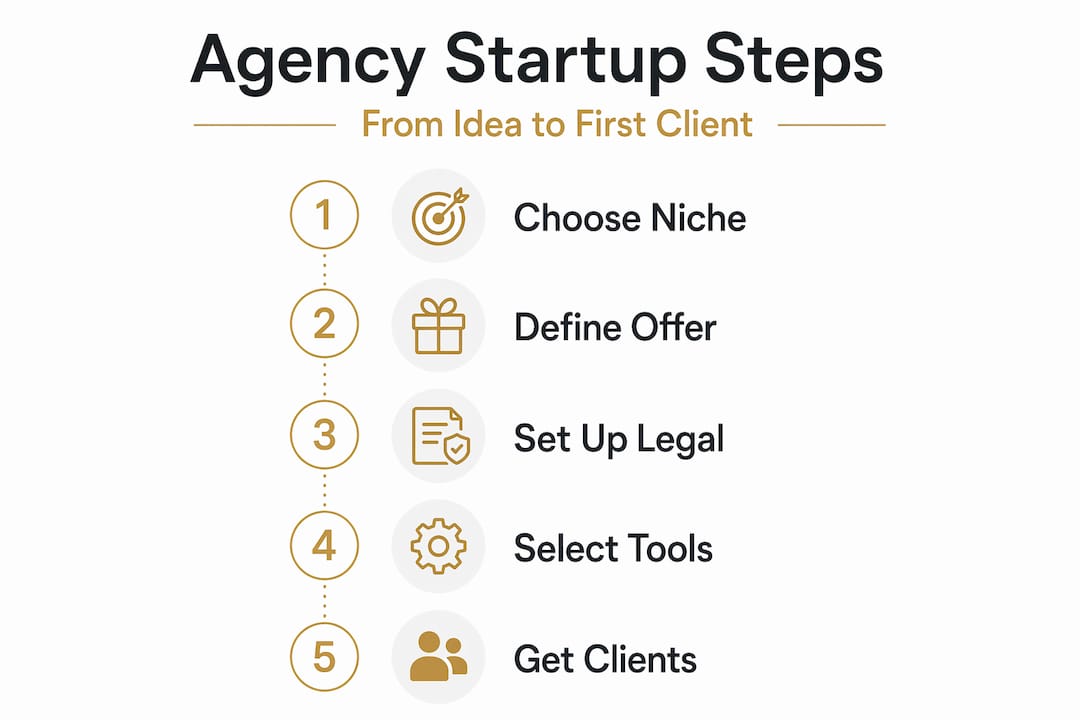
The minimum viable starting point requires five things: a defined niche, a retainer-based service, a legal entity, a lean tool stack, and your first three clients acquired through warm outreach. Everything else, including fancy dashboards, a large team, and elaborate websites, comes after. Tooling costs at startup typically run $150 to $300 per month, which keeps the barrier to entry low and your focus sharp.
Most new agencies underestimate how much SEO matters to their own growth. If you are building a social media agency but not optimising your own site for search, you are handing a free competitive advantage to everyone who is. Building topical authority in your niche, earning brand mentions across the web, and eventually appearing in AI-generated answers on tools like ChatGPT and Google’s AI Overviews are all part of a modern agency’s self-marketing strategy.
Choosing your niche and service package
The single fastest way to improve your win rate when starting a social media agency is to specialise. Generalist agencies compete on price. Niche agencies compete on expertise. When a med spa owner in Brisbane reads “we specialise in social media for aesthetic clinics,” they feel understood in a way that “we do social media for all businesses” never achieves.
Evaluate your niche options across three filters: do you have existing knowledge or contacts in this industry, is there a real budget in this market, and are there enough businesses to sustain growth? Service-based businesses in beauty, wellness, law, and home services consistently meet all three criteria and respond well to content-led social strategies.
Your core service offerings will typically include:
- Content creation and copywriting for Instagram, Facebook, LinkedIn, and TikTok
- Scheduling and publishing using AI-assisted tools
- Community management including comment replies and DMs
- Analytics and monthly reporting tied to real business KPIs
- Paid social advertising management across Meta and Google platforms
On pricing, retainer packages for SMB clients sit at $1,500 to $3,000 per month in 2026, with setup fees ranging from $500 to $3,000. Avoid hourly billing wherever possible. It commoditises your expertise and creates unpredictable income. Productising your services into two or three clearly named packages reduces buyer confusion and stops you competing with low-cost generalists.
Pro Tip: Define what is explicitly excluded from each package in writing. Scope creep kills early-stage agencies. If short-form video editing is not in the package, say so clearly before the contract is signed.
Legal, financial, and operational foundations
Before you take on a single client, get your structure right. In Australia, most solo agency founders start as a sole trader and transition to a company structure once revenue justifies it. Either way, you need an ABN, a separate business bank account, and accounting software from day one. Separating business finances is not just tidy practice. It protects you legally, simplifies tax time, and gives you accurate data to make growth decisions.
Insurance is the part most new agency owners skip until something goes wrong. Do not make that mistake. The three policies worth having are:
- Professional indemnity (errors and omissions): Covers claims that your advice or work caused a client financial loss. E&O insurance costs around $500 to $1,200 annually for $1 million in coverage at a small agency scale. Buy it before you start client work, not after, because claims-made policies only cover incidents that occur after the policy is active.
- Public liability: Covers physical damage or injury claims.
- Cyber liability: Increasingly relevant as agencies hold client social account credentials and customer data.
Your contracts need to cover five non-negotiables: scope of work, payment terms, termination notice periods, intellectual property ownership, and liability caps. Basic contracts prevent the majority of early disputes and signal to premium clients that you operate professionally.
| Tool category | Recommended starting option | Monthly cost (approx.) |
|---|---|---|
| Social scheduling | Buffer, Later, or Publer | $18 to $45 |
| Reporting and analytics | AgencyAnalytics or Databox | $49 to $79 |
| Project management | Notion or ClickUp | Free to $19 |
| Accounting | Xero or QuickBooks | $32 to $55 |
| Client communication | Slack or Google Workspace | $12 to $22 |
Pro Tip: Start with the leanest tool stack that works. Flexible, affordable tools costing $79 to $159 per month cover most early agency needs. Upgrade only when a specific client demand or workflow bottleneck makes it unavoidable.
Landing your first clients

The fastest path to your first three clients is your existing network. That sounds obvious, but most people avoid it because it feels uncomfortable to position themselves as an expert to people who knew them before they had the credential. Get over that hesitation quickly. Tell every person in your professional network what you do, who you help, and what outcome you deliver.
Beyond warm outreach, here is a practical sequence for building your client pipeline:
- Publish content that demonstrates your expertise. Post case studies, breakdowns of social campaigns you admire, or commentary on trends in your niche on LinkedIn or Instagram. This is SEO and social proof working together. Thought leadership content and referrals consistently outperform paid ads for new agencies.
- Engage in niche communities, not general agency groups. If you serve beauty businesses, spend time in Facebook groups and forums where beauty business owners gather. Offer genuine help. Ask smart questions. People buy from people they already trust.
- Build two or three proof assets before you have real case studies. Create a sample content calendar, mock performance dashboard, or example post series for a fictional client in your niche. Proof assets like these speed up trust significantly when your portfolio is still thin.
- Form referral partnerships with complementary service providers. Web designers, SEO consultants, bookkeepers, and business coaches all serve the same small business market without competing with you directly.
- Use cold outreach only after your content and proof assets are in place. A cold message from someone with a credible online presence converts at a far higher rate than an identical message from someone with nothing to review. The social media checklist on Jarrodharman is a strong starting point for structuring this outreach.
Pro Tip: Document your own agency’s social media journey publicly. Show what you are testing, what worked, and what did not. This content attracts potential clients who want transparency, and it doubles as an SEO asset for your website.
Delivering your first client projects
A structured onboarding process is what separates agencies that get renewals from agencies that constantly churn. Your first 30 days with a new client should follow a consistent playbook:
- Week one: Strategy call, brand asset collection, social account access, and a full content audit of their existing channels
- Week two: Deliver a 30-day content calendar for approval, agree on brand voice guidelines, and confirm the publishing schedule
- Week three: Begin scheduled publishing and community engagement. Monitor comments and DMs daily in the first weeks
- Week four: Deliver your first performance report focused on real metrics, reach, engagement rate, website traffic from social, and leads generated
Vanity metrics are the enemy of retention. If your report shows follower count and nothing else, clients will eventually question what they are paying for. Tie every metric back to business outcomes. Weekly check-ins and transparent reporting are directly correlated with client retention in agency research.
AI tools have fundamentally changed what a two-person agency can produce. Tools like Claude, ChatGPT, and purpose-built social content platforms can generate first drafts, repurpose long-form content across formats, and suggest optimal posting times based on audience data. The social media manager tasks resource from Jarrodharman breaks down exactly how to structure this workload across your week.
Pro Tip: Create a shared reporting dashboard for each client using a tool like AgencyAnalytics or Looker Studio. When clients can log in and see their numbers any time, you build trust without spending extra hours on reporting calls.
Scaling your agency sustainably
Most agencies hit a ceiling when the founder is doing everything. Scaling means building systems before you build a team.
Start by hiring contractors before employees. A typical contractor sequence begins with a graphic designer, then a video editor, then a content writer as client volume grows. Contractor costs typically run $500 to $2,000 per month per client served, which is manageable when your retainers are priced correctly.
Cash flow management is the other scaling lever most new agency owners ignore. Invoice on the first of the month, require payment within seven days, and use a billing platform that sends automatic reminders. Agencies that let invoices run 30 or 60 days overdue create unnecessary financial pressure that stunts growth.
| Growth stage | Focus | Key action |
|---|---|---|
| 0 to 3 clients | Validation | Nail your service delivery and get testimonials |
| 3 to 8 clients | Systems | Document every process and standardise onboarding |
| 8 to 15 clients | Team | Bring in contractors to protect delivery quality |
| 15 plus clients | Acquisition | Invest in SEO, paid ads, and referral programmes |
AI-driven production efficiencies mean you should not automatically drop your prices as your output becomes faster. AI content production can push gross margins from 30 to 40 percent up to 75 to 83 percent. Price on the value you deliver to the client, not on the hours it takes you to produce it. A 12-month business plan with quarterly revenue targets and a defined client acquisition budget gives you the framework to scale without guessing.
My honest take on launching a social media agency
I have watched hundreds of aspiring agency owners go through the same painful cycle. They obsess over their brand before they have a single client, then panic when the pipeline is empty six months later. The agencies that survive and grow share one trait: they stayed focused on a specific niche and built their reputation methodically through genuine content and direct relationships.
Early on, I underpriced everything because I was not confident enough to charge what the service was actually worth. That is the mistake I see most often. When you define your niche clearly and back it up with specific proof assets, price resistance drops dramatically. Clients in focused niches understand the value of a specialist.
AI changed my workflow more than any other development in recent years. What previously took a team of three to produce, a capable one or two-person agency can now match in quality and volume. But the work that actually retains clients, the strategy, the relationship management, the reporting, that still requires human judgement. Build your systems around AI for production and humans for strategy.
Realistic expectations matter. You probably will not land a $5,000 retainer in your first month. Your first three clients might pay $1,500 each. That is $54,000 a year before you have hired a single person. That is a real business. Start there and grow steadily.
— Business Warriors | Digital Marketing Agency
Ready to grow your agency faster?
Building a social media agency from scratch is entirely achievable with the right framework in place. Jarrodharman has helped hundreds of service business owners across Australia move from guessing at their marketing to running systems that generate consistent, measurable leads.

If you are ready to move beyond the basics, the proven client acquisition strategies on Jarrodharman will show you exactly how to attract higher-quality clients online, from optimising your SEO presence to running paid advertising campaigns that actually convert. You can also explore the digital marketing step-by-step guide to map out your full growth plan for the next 12 months. The resources are practical, Australia-specific, and built around what is working right now.
FAQ
What does it cost to start a social media agency?
Startup tooling costs typically run $150 to $300 per month, plus around $500 to $1,200 for professional indemnity insurance. Your total first-year overhead can stay under $5,000 if you start lean.
How much should I charge for social media management?
The SMB retainer sweet spot in 2026 sits at $1,500 to $3,000 per month. Charge based on the value you deliver and the outcomes you produce, not the hours you work.
Do I need a niche to launch a social media marketing agency?
You do not technically need one, but agencies with a defined niche consistently win more clients and command higher fees. Specialising in one industry makes every part of your business, from marketing to service delivery, significantly more efficient.
When should I start hiring for my agency?
Begin with contractors once you have three or more active clients and delivery is starting to strain your time. Typical roles to hire first include graphic designers and video editors, with full-time staff considered once revenue is stable above $15,000 per month.
Do I need contracts before starting client work?
Yes. Basic contracts covering scope, payment, termination, IP, and liability are non-negotiable. They protect both parties and signal to serious clients that you operate professionally.