10 August 2026
Facebook lead ads examples: 26 copy-ready templates for 2026
Discover 26 copy-ready Facebook lead ads examples to boost your conversions. Effective templates ensure you capture leads effortlessly in 2026.
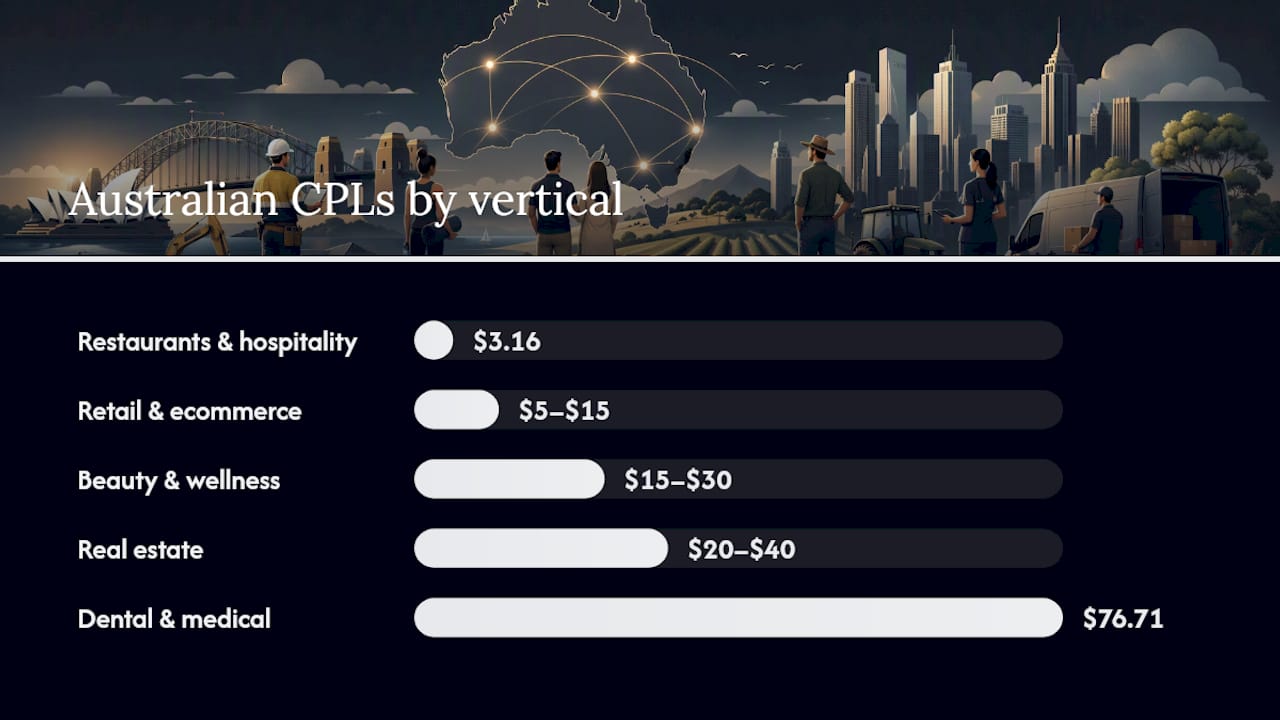
Use specific, low-friction offers with short forms. That single principle separates the Facebook lead ads that generate a steady pipeline from the ones that burn budget. Leadsync’s 2026 dataset puts the cross-industry average conversion rate at 7.72% and the average cost per lead at US$27.66, though restaurants often see CPLs as low as US$3.16 while dental practices can pay US$76.71 or more. The range tells you something important: offer type and audience specificity matter far more than platform mechanics alone.
Below are copy-ready lead ad examples you can paste into Meta Ads Manager today. Each includes a headline, primary text, CTA label, and three suggested form fields. Browse live creative in the Meta Ads Library to see what category leaders are running right now, then adapt these templates to your offer.
Lead magnet
- Headline: “Download Your Free [Industry] Checklist”
- Primary text: “Stop guessing what works. Grab our free [X]-step checklist and [specific outcome] in under a week.”
- CTA: Get It Free | Fields: First name, Email, Business type
Discount offer
- Headline: “20% Off Your First [Service] , This Week Only”
- Primary text: “Book before [date] and save $[amount] on your first [service]. Limited spots.”
- CTA: Claim Offer | Fields: First name, Phone, Preferred date
Appointment booking
- Headline: “Book a Free [Consultation/Skin Check/Strategy Call]”
- Primary text: “Spots fill fast. Reserve your free [X]-minute session with our [specialist] and leave with a clear plan.”
- CTA: Book Now | Fields: First name, Email, Best time to call
Webinar / demo
- Headline: “Join Our Free [Topic] Webinar , [Date]”
- Primary text: “Learn [specific outcome] in 45 minutes. Hosted by [name/credential]. Register free.”
- CTA: Reserve My Spot | Fields: First name, Email, Job title
Event RSVP
- Headline: “You’re Invited: [Event Name] in [City]”
- Primary text: “Join [X] local [industry] owners for a free evening of [topic]. [Date], [Suburb].”
- CTA: RSVP Now | Fields: First name, Email, Number attending
Demo request
- Headline: “See [Product] in Action , Free 15-Min Demo”
- Primary text: “No slides. No fluff. Just a live walkthrough of how [product] solves [pain point].”
- CTA: Get My Demo | Fields: Full name, Work email, Company size
For understanding what a Facebook lead actually is before you build your first campaign, that primer covers qualification basics worth reading first.
Key takeaways
High-converting Facebook lead ads share three non-negotiable traits: a specific, tangible offer, a short form with 5 fields or fewer, and a follow-up system that contacts the lead within five minutes of submission.
| Point | Details |
|---|---|
| Offer specificity wins | Name the exact deliverable, timeframe, and cost in the headline and primary text. |
| Short forms convert more | Keep to 3–5 fields; use progressive profiling in your nurture sequence for additional data. |
| Instant forms for simple offers | Use instant forms for low-friction offers; click-to-website for complex or high-ticket funnels. |
| Follow up within five minutes | It takes 7–13 touches to convert a qualified lead; the first touch must happen while intent is hot. |
| Jarrodharman / Business Warriors | Provides end-to-end Meta lead ad management, CRM integration, and the Marketing Vortex system for Australian service businesses. |
Table of Contents
- Why these lead ad formats convert , the evidence behind the examples
- What every high-converting Facebook lead ad is made of
- 26 annotated Facebook lead ad examples grouped by objective
- Australian-ready swipe templates and localisation tips
- How to set up a campaign in Meta Ads Manager and what to expect on cost
- A/B testing and optimisation: what to test, how long, and what to measure
- Privacy, consent, and your privacy policy , what Australian advertisers need to know
- What we see working for Australian service businesses
- Business Warriors can build and run your lead ad campaigns
- Primary sources and further reading
- Sources
Why these lead ad formats convert , the evidence behind the examples
The mechanism is simple: Meta’s instant forms pre-fill a user’s name, email, and phone number from their profile data. That single step removes the biggest drop-off point in any lead funnel. Conversion confirms that instant forms regularly produce CPLs of US$1–$5 for straightforward ecommerce offers, while click-to-website forms suit higher-consideration purchases where a landing page can do more persuasion work before the form appears.
The practical split looks like this:
- Instant forms work best for simple, tangible offers (free guide, discount, appointment) where the user already trusts the brand enough to submit.
- Click-to-website works better for complex B2B offers, high-ticket services, or any situation where the landing page needs to handle objections before asking for contact details.
Offer specificity is the other lever most advertisers underuse. “Free consultation” is vague. “Free 20-minute skin assessment with our dermal therapist” is specific, and specificity reduces hesitation. LeadsBridge’s analysis of high-performing lead ads consistently finds that one clear promise per ad outperforms multi-benefit copy, and that short forms with a visible privacy link lift completion rates.
There is also a cost pressure worth naming directly. Facebook ad costs have risen roughly 21% year-on-year for some lead campaigns, which means the days of setting and forgetting a lead ad are gone. Tighter audience targeting, creative rotation, and faster follow-up are now table stakes.
Pro Tip: Contact a new lead within five minutes of submission. Research from the Online Marketing Institute shows it typically takes 7 to 13 touches to convert a qualified sales lead, so the first touch needs to happen while the person still remembers filling in your form.
What every high-converting Facebook lead ad is made of
Think of a lead ad as five components that either work together or fail together. Weak creative kills a strong offer. A great offer buried under a long form still loses leads. Here is a practical checklist to audit any ad before it goes live.
Creative
- Use a single hero image or a video under 30 seconds for feed placements; square (1:1) or vertical (4:5) crops perform best in feed, while 9:16 fills Stories and Reels.
- The first three seconds of any video must show the offer or the problem, not a logo or a slow pan. If the viewer does not see the hook in three seconds, they scroll.
- For image ads, use real people over stock photography wherever possible. A photo of your actual clinic, salon, or team outperforms a generic shutterstock image in almost every service-business vertical.
- Avoid cluttered overlays. One text line on the image is enough; let the headline and primary text do the heavy lifting.
Copy
- Open with the reader’s problem or the specific outcome they want, not your brand name.
- Add one credibility line: a client count, a years-in-business figure, a recognisable accreditation, or a suburb-specific social proof signal.
- State the deliverable clearly: what they get, when they get it, and what it costs (even if it is free).
- CTA words that lift completions: “Get,” “Download,” “Book,” “Reserve.” Avoid “Submit” and “Learn More” on lead forms , they signal effort, not reward.
Form design
- Aim for 3–5 fields. Every additional field you add reduces completions. If you need more data, use progressive profiling across a nurture sequence rather than cramming it into the capture form.
- Pre-fill name, email, and phone from Meta profile data wherever the offer allows.
- Add a checkbox for marketing consent with plain-language wording: “I agree to receive [business name]’s updates and offers. You can unsubscribe at any time.”
Privacy and routing
- Place a privacy policy link on every instant form. Meta requires it, and Australian privacy law expects it.
- Route leads to your CRM via a webhook or a tool like LeadsBridge the moment the form is submitted. Manual CSV exports introduce delays that kill lead quality.
- First contact within five minutes is the industry benchmark. Beyond 30 minutes, conversion rates drop sharply.
Pre-launch QA checklist:
- [ ] Creative passes the 3-second hook test
- [ ] Headline states the offer, not the brand
- [ ] Primary text includes a credibility signal
- [ ] CTA uses a reward word (Get, Book, Download)
- [ ] Form has 5 fields or fewer
- [ ] Privacy policy link is live and correct
- [ ] CRM webhook is connected and tested
- [ ] Ad is compliant with any industry-specific rules (medical, financial, legal)
26 annotated Facebook lead ad examples grouped by objective
These examples draw on patterns from AdSpyder’s collection of adaptable hooks and CTAs and LeadsBridge’s roundup of high-converting formats. Each entry shows the headline, primary text, CTA, three form fields, and a short note on why the format works.
Lead magnet examples
1. Free industry guide
- Headline: “The [City] Homeowner’s Guide to Solar Savings”
- Primary text: “Download our free guide and find out exactly how much you could save on your power bill this year.”
- CTA: Download Free | Fields: Name, Email, Suburb
- Why it works: Hyper-local specificity (“City”) and a concrete financial outcome lower resistance immediately.
2. Free checklist
- Headline: “The 10-Point Skin Health Checklist , Free Download”
- Primary text: “Our dermal therapists put together the checklist they use with every new client. Grab your copy.”
- CTA: Get the Checklist | Fields: Name, Email, Skin concern
- Why it works: Professional credibility (“dermal therapists”) attached to a free, tangible asset.
3. Free template pack
- Headline: “Free Social Media Template Pack for Small Businesses”
- Primary text: “30 done-for-you post templates. Download, customise, and post. No design skills needed.”
- CTA: Download Now | Fields: Name, Email, Industry
- Why it works: The specificity of “30 templates” and “no design skills needed” removes two common objections at once.
4. Free report / market data
- Headline: “2026 [Industry] Salary Report , Free for Australian Businesses”
- Primary text: “See what your competitors are paying and where the talent gaps are. Download the full report.”
- CTA: Get the Report | Fields: Name, Work email, Company size
- Why it works: Data-driven offers appeal strongly to B2B decision-makers who need to justify decisions internally.
Discount and promotional examples
5. First-visit discount
- Headline: “First Facial: $49 (Usually $120) , Book This Week”
- Primary text: “New clients only. Our award-winning skin clinic has [X] spots left this month. Lock yours in.”
- CTA: Claim My Spot | Fields: Name, Phone, Preferred day
- Why it works: Anchored pricing (“usually $120”) makes the discount feel substantial. Scarcity (“spots left”) adds urgency without being dishonest.
6. Seasonal promotion
- Headline: “End-of-Financial-Year Sale: 30% Off All [Service] Packages”
- Primary text: “EOFY is here. Lock in your [service] package before 30 June and save 30%. No lock-in contracts.”
- CTA: Get the Deal | Fields: Name, Email, Service interest
- Why it works: EOFY is a genuine Australian buying trigger. “No lock-in contracts” removes a common objection for service packages.
7. Referral reward
- Headline: “Refer a Friend, Both Get $50 Off”
- Primary text: “Know someone who needs [service]? Refer them and you both receive a $50 credit on your next visit.”
- CTA: Refer Now | Fields: Your name, Your email, Friend’s name
- Why it works: Dual incentive structure means both parties have a reason to act, doubling the conversion surface.
Booking and appointment examples
8. Free consultation
- Headline: “Free 20-Min Strategy Call With a Google Ads Specialist”
- Primary text: “Not sure if Google Ads is right for your business? Book a free call and get a straight answer , no pitch.”
- CTA: Book My Call | Fields: Name, Email, Monthly ad budget
- Why it works: “No pitch” directly addresses the most common objection to booking a free call with an agency.
9. Health or beauty appointment
- Headline: “Book Your Free Skin Consultation , [Suburb] Clinic”
- Primary text: “Our therapists assess your skin in person and build a treatment plan that actually fits your lifestyle and budget.”
- CTA: Book Free | Fields: Name, Phone, Skin concern
- Why it works: Suburb-level specificity builds local trust. “Fits your lifestyle and budget” pre-empts cost anxiety.
10. Trades and home services
- Headline: “Free Electrical Safety Inspection , [City] Homes”
- Primary text: “Book your free 30-minute safety check. Our licensed electricians cover [X] suburbs across [City].”
- CTA: Book Inspection | Fields: Name, Phone, Suburb
- Why it works: Safety framing creates urgency without manufactured scarcity. Licensing credential adds compliance trust.
11. Dental and medical
- Headline: “New Patient Offer: Free Check-Up and X-Ray , [Suburb]”
- Primary text: “Bulk billing available. Our friendly team makes your first visit easy. Limited new patient spots this month.”
- CTA: Book Now | Fields: Name, Phone, Health fund (optional)
- Why it works: “Bulk billing available” is a powerful Australian trust signal in the medical space. Note: any medical claim must comply with AHPRA advertising guidelines.
Webinar and demo examples
12. Live webinar
- Headline: “Free Webinar: How to Get 10 New Clients This Month”
- Primary text: “Join [name], [credential], for a free 45-minute session on the exact system we use with our clients. [Date], 7 PM AEST.”
- CTA: Reserve My Spot | Fields: Name, Email, Business type
- Why it works: Named presenter with credential, specific time zone (AEST), and a concrete outcome promise.
13. On-demand demo
- Headline: “Watch a 10-Min Demo of [Product] , No Sales Call Required”
- Primary text: “See exactly how [product] works before you talk to anyone. Watch on your own schedule.”
- CTA: Watch the Demo | Fields: Name, Work email, Company size
- Why it works: “No sales call required” removes the biggest barrier to demo requests in B2B.
14. Workshop registration
- Headline: “Free In-Person Workshop: [Topic] , [City], [Date]”
- Primary text: “Limited to 20 seats. Learn [specific skill] from practitioners who do this every day. Breakfast included.”
- CTA: Save My Seat | Fields: Name, Email, Dietary requirements
- Why it works: Physical scarcity (20 seats) is real and verifiable. “Breakfast included” is a small but memorable incentive.
Event RSVP examples
15. Networking event
- Headline: “Perth Business Owners: Free Networking Night , [Date]”
- Primary text: “Join 50+ local business owners for drinks, conversation, and one practical marketing tip you can use the next day.”
- CTA: RSVP Free | Fields: Name, Email, Industry
- Why it works: Peer social proof (“50+ local business owners”) and a tangible takeaway (“one practical tip”) justify attendance.
16. Product launch
- Headline: “You’re Invited: [Brand] Launch Night , [Suburb], [Date]”
- Primary text: “Be among the first to experience [product/service]. Exclusive preview, drinks, and a special launch offer for attendees.”
- CTA: RSVP Now | Fields: Name, Email, Number of guests
- Why it works: Exclusivity (“among the first”) and an attendee-only offer create genuine FOMO without hyperbole.
Quiz and assessment examples
17. Business health quiz
- Headline: “How Healthy Is Your Marketing? Take the 2-Min Quiz”
- Primary text: “Answer 8 quick questions and get a personalised score with your top three areas to fix first.”
- CTA: Take the Quiz | Fields: Name, Email, Monthly revenue range
- Why it works: Personalised output (“your top three areas”) makes the result feel worth the two minutes.
18. Skin or health assessment
- Headline: “What’s Your Skin Type? Find Out in 60 Seconds”
- Primary text: “Answer a few quick questions and get a personalised skincare routine from our therapists , free.”
- CTA: Start the Quiz | Fields: Name, Email, Primary skin concern
- Why it works: Quiz format is low-commitment and high-curiosity, particularly effective for beauty and wellness audiences.
Local store and retail examples
19. In-store offer
- Headline: “Show This Ad In-Store: Free Gift With Any Purchase Over $50”
- Primary text: “Valid at our [Suburb] store this weekend only. Show this ad at the register to claim your free gift.”
- CTA: Get the Offer | Fields: Name, Email, Postcode
- Why it works: Postcode field lets you verify local relevance and segment your list by geography for future campaigns.
20. Loyalty programme sign-up
- Headline: “Join Our Rewards Club , Get $10 Off Your Next Order”
- Primary text: “Sign up in 30 seconds and your $10 credit is waiting. No minimum spend.”
- CTA: Join Free | Fields: Name, Email, Date of birth (optional)
- Why it works: Immediate reward on sign-up removes the “I’ll do it later” response.
B2B and professional services examples
21. Free audit
- Headline: “Free Website SEO Audit , See Where You’re Losing Traffic”
- Primary text: “Our team reviews your site and sends a plain-English report within 48 hours. No obligation.”
- CTA: Get My Audit | Fields: Name, Work email, Website URL
- Why it works: Specific deliverable (“plain-English report”), specific timeframe (“48 hours”), and zero commitment language.
22. Case study download
- Headline: “How [Industry] Businesses Grew Leads by [X]% , Free Case Study”
- Primary text: “Download the full breakdown of the strategy, the results, and what we’d do differently.”
- CTA: Download Case Study | Fields: Name, Work email, Industry
- Why it works: Case studies attract buyers who are already in research mode and close to a decision.
23. Free proposal
- Headline: “Get a Custom Marketing Proposal , No Cost, No Obligation”
- Primary text: “Tell us about your business and we’ll send a tailored plan within two business days.”
- CTA: Request Proposal | Fields: Name, Email, Monthly budget
- Why it works: “Tailored” and “two business days” set clear expectations and signal professionalism.
Subscription and newsletter examples
24. Newsletter sign-up
- Headline: “Weekly [Industry] Tips , Free, No Spam”
- Primary text: “Every [day], one practical tip from practitioners who work in [industry] every day. Unsubscribe any time.”
- CTA: Subscribe Free | Fields: Name, Email
- Why it works: Two-field form is the lowest possible friction. “No spam” and “unsubscribe any time” address the only real objection.
25. SMS list
- Headline: “Get Exclusive Deals Straight to Your Phone”
- Primary text: “Join our SMS list and be first to hear about flash sales, new arrivals, and member-only offers.”
- CTA: Join the List | Fields: Name, Mobile number, Postcode
- Why it works: SMS lists have higher open rates than email for time-sensitive offers, and the opt-in signals high intent.
Retargeting example
26. Cart abandonment / warm retargeting
- Headline: “Still Thinking About [Product/Service]? Here’s 10% Off”
- Primary text: “You looked. We noticed. Here’s a small thank-you for your interest , 10% off if you book or buy this week.”
- CTA: Claim My Discount | Fields: Name, Email
- Why it works: Retargeting audiences already know the brand, so the form can be shorter and the offer more direct. Warm audiences consistently convert at lower CPL than cold traffic.
Australian-ready swipe templates and localisation tips
These ten templates are built for Australian service businesses, with localisation notes for language, currency, and trust signals. The swipe file reflects the approach Jarrod Harman and Business Warriors use with clients across Perth, Melbourne, Sydney, and Brisbane.
Template 1 , Beauty clinic, new client offer
- Headline: “First Visit: $59 Skin Consultation , [Suburb] Clinic”
- Primary text: “Our AHPRA-registered therapists assess your skin and build a plan that fits your budget. Book this week.”
- CTA: Book My Consult | Fields: Name, Phone, Skin concern
- Localisation note: Reference AHPRA registration for medical and beauty clinics. Use suburb name, not just city.
Template 2 , Trades, free quote
- Headline: “Free Quote: [Service] in [Suburb] , Same-Week Availability”
- Primary text: “Licensed and insured. We’ve completed [X] jobs across [City] this year. Get your quote in 24 hours.”
- CTA: Get My Quote | Fields: Name, Phone, Job description
- Localisation note: “Licensed and insured” is a key trust signal for Australian homeowners. Avoid vague “experienced team” language.
Template 3 , Law firm, free initial consult
- Headline: “Free 30-Min Legal Consult , [Practice Area] Specialists”
- Primary text: “Speak with an accredited specialist. No obligation. Available in [City] and via video call.”
- CTA: Book Free Consult | Fields: Name, Email, Matter type
- Localisation note: Avoid any language that could constitute a guarantee of outcome. Reference accreditation body where applicable.
Template 4 , Hospitality, event booking
- Headline: “Host Your Next Event at [Venue Name] , Get a Free Quote”
- Primary text: “From intimate dinners to corporate functions, our team handles everything. Enquire for [month] availability.”
- CTA: Get a Quote | Fields: Name, Email, Event date
- Localisation note: Mention specific event types Australians search for: end-of-year parties, EOFY lunches, milestone birthdays.
Template 5 , Retail, loyalty sign-up
- Headline: “Join [Brand] Rewards , $15 Credit on Your First Order”
- Primary text: “Free to join. Earn points on every purchase. Redeem for discounts, free shipping, and exclusive offers.”
- CTA: Join Free | Fields: Name, Email, Postcode
- Localisation note: “Free shipping” resonates strongly in Australian retail where delivery costs are a common friction point.
Template 6 , Financial services, free review
- Headline: “Free Super Health Check , Are You on Track to Retire?”
- Primary text: “Our advisers review your super, insurance, and investment mix at no cost. Available across [State].”
- CTA: Book My Review | Fields: Name, Email, Age range
- Localisation note: Super is a uniquely Australian hook. Ensure compliance with ASIC advertising standards for financial services.
Template 7 , Real estate, market appraisal
- Headline: “What’s Your Home Worth in [Suburb]? Free Appraisal”
- Primary text: “Our local agents have sold [X] properties in [Suburb] this year. Get your free market appraisal this week.”
- CTA: Book Appraisal | Fields: Name, Phone, Property address
- Localisation note: Suburb-level sales data is the most persuasive trust signal in Australian real estate lead ads.
Template 8 , B2B SaaS, free trial
- Headline: “Try [Product] Free for 14 Days , No Credit Card”
- Primary text: “Join [X] Australian businesses already using [product] to [specific outcome]. Set up in under 10 minutes.”
- CTA: Start Free Trial | Fields: Name, Work email, Company size
- Localisation note: “Australian businesses” signals local relevance and peer validation simultaneously.
Template 9 , Health and wellness, free class
- Headline: “First Class Free , [Yoga/Pilates/Fitness] in [Suburb]”
- Primary text: “No experience needed. Our [day] morning class has [X] spots left this month. Reserve yours.”
- CTA: Reserve My Spot | Fields: Name, Phone, Fitness level
- Localisation note: Morning class times resonate with Australian wellness audiences. Specify the day to create a concrete commitment.
Template 10 , Automotive, service offer
- Headline: “Free Tyre Safety Check , [Brand] Service Centre, [Suburb]”
- Primary text: “Our technicians check tread depth, pressure, and alignment at no cost. Book online in 60 seconds.”
- CTA: Book Free Check | Fields: Name, Phone, Vehicle make
- Localisation note: “Tyre” (Australian spelling) matters. Use it. “Book online in 60 seconds” sets a low-effort expectation.
Pro Tip: CRM routing is where most Australian businesses lose leads they paid for. Connect your Meta lead form to your CRM via a webhook or LeadsBridge the moment the campaign goes live. Set a follow-up SLA of five minutes for phone-based leads and 30 minutes for email leads. LeadsBridge reviews on Capterra can help you evaluate integration reliability before you commit to a tool.
How to set up a campaign in Meta Ads Manager and what to expect on cost
Campaign setup checklist
- Objective: Select “Leads” as your campaign objective. Choose “Instant Forms” for simple offers; choose “Website” for complex funnels with dedicated landing pages.
- Audience: Start with a saved audience based on location (suburb or postcode radius), age, and interest targeting. For retargeting, build a Custom Audience from your website visitors or existing customer list.
- Placements: Use Advantage+ placements for most campaigns. Manually restrict to Facebook Feed and Instagram Feed if your creative is not formatted for Stories or Reels.
- Budget: Start with a minimum of $30–$50 per day per ad set during the testing phase. Meta’s algorithm needs roughly 50 conversion events per week to exit the learning phase.
- Conversion window: Set to 1-day click for lead form campaigns. Longer windows inflate reported conversions with low-intent leads.
- Bid strategy: Use “Lowest cost” during testing. Switch to “Cost cap” once you have a CPL target validated by at least two weeks of data.
Australian CPL benchmarks by vertical
Leadsync’s 2026 data provides the most current cross-industry benchmarks available. These figures are in USD; Australian campaigns typically see similar or slightly higher CPLs in AUD depending on audience size and competition.
| Vertical | Typical conversion rate | Typical CPL (USD) | Recommended starting daily budget (AUD) |
|---|---|---|---|
| Restaurants and hospitality | ~18.25% | ~$3.16 | $30–$50 |
| Retail and ecommerce | ~9–12% | ~$5–$15 | $40–$60 |
| Beauty and wellness | ~8–10% | ~$15–$30 | $40–$70 |
| Real estate | ~7–9% | ~$20–$40 | $50–$80 |
| Legal services | ~5–7% | ~$60–$100+ | $80–$150 |
| Dental and medical | ~6.38% | ~$76.71 | $80–$150 |
| B2B / professional services | ~4–6% | ~$30–$80 | $60–$100 |
These are sanity-check ranges, not targets. Your actual CPL will vary based on offer quality, creative, audience size, and how quickly you follow up. With Facebook ad costs rising roughly 21% year-on-year for some lead campaigns, building a testing budget into your plan from day one is not optional.
A/B testing and optimisation: what to test, how long, and what to measure
What to test first
Run one variable at a time. The order below reflects where most campaigns find the biggest gains fastest.
- Creative hook (image vs video, first frame of video, hero image choice) , this is usually the highest-leverage variable.
- Headline , test a benefit-led headline against a curiosity or question-led one.
- CTA wording , “Get My Free Guide” vs “Download Now” vs “Claim My Spot.”
- Form length , 3 fields vs 5 fields. Shorter forms almost always lift volume; the question is whether lead quality holds.
- Instant form vs click-to-website , test this only after you have a validated offer, not as your first experiment.
How long to run a test
Do not call a winner before an ad set has generated at least 50 leads or run for seven days, whichever comes later. Shorter windows produce statistically unreliable results. For low-volume campaigns (under $50/day), extend to 14 days before drawing conclusions.
Pro Tip: For a structured A/B testing framework, the AB testing guide for Facebook ads from Stellar covers the seven criteria that actually move the needle , worth bookmarking before you set up your first split test.
Primary and secondary success metrics
- Primary: Cost per lead (CPL) and cost per qualified lead (CPQL). CPL tells you what you paid; CPQL tells you what you actually got.
- Secondary: Lead-to-sale conversion rate, time-to-first-contact, and form completion rate (leads divided by form opens).
- Watch: Lead quality score , if your sales team is rejecting more than 30% of leads as unqualified, the form fields or audience targeting need adjustment, not the creative.
The optimisation loop
Test → wait for statistical significance → analyse → pause the loser → iterate on the winner. Do not make changes mid-test. Do not run more than three ad variations per ad set during the learning phase.
Converting a qualified lead typically requires 7 to 13 touches, so your optimisation loop must include the nurture sequence, not just the ad. A lower CPL means nothing if the follow-up sequence is broken.
Privacy, consent, and your privacy policy , what Australian advertisers need to know
Australian businesses running Facebook lead ads are subject to the Privacy Act 1988 and the Australian Privacy Principles (APPs), which govern how personal information is collected, stored, and used. Meta’s own platform requirements add a second layer. Here is what to get right before you go live.
Checklist for Australian lead ad compliance
- [ ] Your privacy policy is published at a live URL and covers how you collect, store, use, and share personal information.
- [ ] The instant form includes a link to your privacy policy. Meta requires this; it is not optional.
- [ ] Consent language on the form is plain and specific: “By submitting this form, you agree to [Business Name] contacting you about [specific purpose]. We will not share your details with third parties without your consent.”
- [ ] If you are sharing leads with a third party (e.g. a franchise partner or referral partner), this is disclosed on the form.
- [ ] Leads are stored in a system that meets Australian data residency expectations. Check your CRM provider’s data storage location.
- [ ] You have a process for handling access and deletion requests under the APPs.
Sample privacy link wording for instant forms
TermsFeed’s guidance on privacy policies for Facebook lead ads covers recommended consent language and placement in detail, including how to word the policy link itself.
CRM routing and data handling
Route leads to your CRM immediately via a webhook. Do not store leads only in Meta’s lead centre , if Meta’s platform has an outage or your access is restricted, you lose the data. LeadsBridge and similar tools create a real-time bridge between Meta and your CRM, with an audit trail that supports compliance documentation.
Pro Tip: Add a one-line privacy note in your ad’s primary text where the offer involves sensitive data (health, financial, legal): “Your details are kept private and never sold.” It costs you nothing and lifts trust, particularly with Australian audiences who are increasingly privacy-aware.
What we see working for Australian service businesses
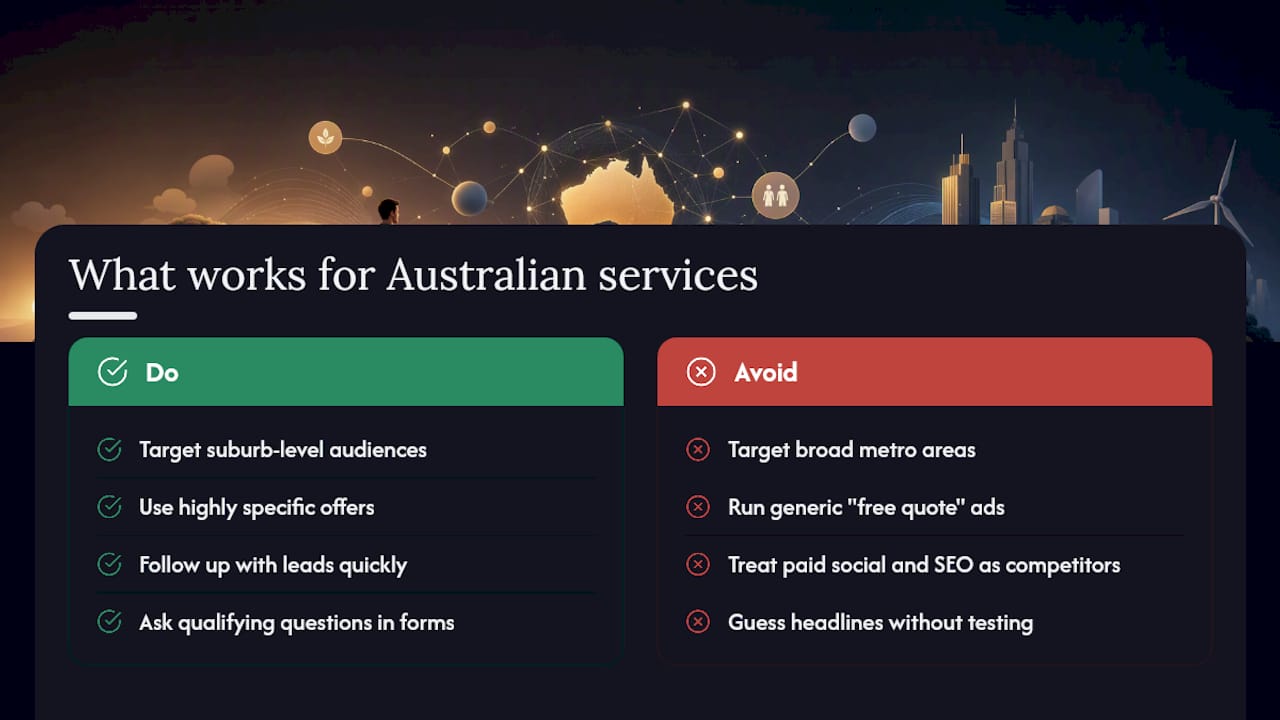
The pattern that shows up most consistently across Business Warriors’ client campaigns is this: the businesses that get the lowest CPLs are not the ones with the biggest budgets. They are the ones with the most specific offers and the fastest follow-up.
Suburb-level targeting is underused. A beauty clinic in Subiaco that targets “Perth” is competing with every other clinic in the metro area. The same clinic targeting a 5-kilometre radius around Subiaco with suburb-specific copy (“serving Subiaco, Shenton Park, and Nedlands”) typically sees higher engagement and lower CPL, because the ad feels local rather than generic.
Two patterns we observe regularly in Australian campaigns:
A trades business running a generic “free quote” ad saw its CPL drop significantly after switching to a suburb-specific headline and adding a licensed-and-insured credential line. The offer did not change. The specificity did. A med spa running a broad “skin consultation” offer restructured its form to ask for skin concern upfront, which allowed the sales team to personalise the follow-up call. Lead-to-booking rate improved because the first conversation was already relevant.
The other shift worth making is treating paid social and SEO as complementary, rather than competing. Facebook lead ads capture demand that exists right now. SEO and AI-assisted content build the brand mentions and topical authority that make your ads cheaper over time, because warm audiences who have seen your content before convert at lower CPL than cold traffic. Generating leads online through an integrated channel mix is consistently more cost-efficient than relying on paid social alone.
AI-assisted copy testing is also changing how fast you can iterate. Running five headline variants through an AI tool before spending a dollar on ads narrows the field to two or three worth testing in-market. That is not a replacement for real data, but it is a faster starting point than guessing.
Business Warriors can build and run your lead ad campaigns
Running Facebook lead ads well requires more than a good template. It requires the right campaign structure, CRM integration, creative rotation, and a follow-up system that actually converts leads into booked appointments or sales calls.
Business Warriors manages end-to-end Meta advertising campaigns for Australian service businesses, from initial campaign setup and audience research through to CRM routing, creative testing, and monthly performance reporting. The agency’s Marketing Vortex method integrates Facebook lead ads with SEO, Google Ads, and email nurture so that every lead captured is followed up systematically, not left in a spreadsheet.
If you want a clear picture of where your current campaigns are losing leads and budget, a digital marketing strategy review is the practical next step. Book a strategy call with the Business Warriors team and get a plain-English assessment of your Meta account, your follow-up process, and the three highest-leverage changes you can make in the next 30 days.
Primary sources and further reading
Use these sources to verify benchmarks, research live creatives, and check privacy requirements before you launch.
- Meta Ads Library , search by keyword, advertiser, or category to see what is running in-market right now. Filter by country (Australia) and ad type (All ads) to find relevant creative. This is the most reliable source of live competitive intelligence available.
- Leadsync 2026 benchmark data , cross-industry conversion rates and CPL figures by vertical. Use as a sanity check when setting CPL targets.
- Conversion , detailed analysis of what makes specific lead ad formats convert, including instant form vs click-to-website guidance.
- LeadsBridge high-converting examples , 26 annotated examples with CRM routing and form design recommendations.
- TermsFeed privacy policy guidance , practical wording and placement advice for Meta lead form privacy policies, including Australian-relevant consent language.
- AdSpyder lead generation ad examples , adaptable hooks, offers, and CTAs across 30 formats for feed-based campaigns.
- PPC.Land on rising Facebook ad costs , documents the roughly 21% year-on-year cost increase affecting some lead campaigns and what it means for budget planning.
- Online Marketing Institute on lead nurture , the foundational research on why 7–13 touches are needed to convert a qualified sales lead, and why immediate routing matters.
How to use Meta Ads Library for creative research: Go to the library, select Australia as the country, and search by a competitor’s page name or a category keyword (e.g. “skin clinic,” “solar,” “mortgage broker”). Filter by “Active” ads to see what is currently running. Screenshot the headlines, primary text, and creative formats that appear most frequently , frequency signals what is working, not just what has been tried.
Sources
- 13 Facebook Lead Ad Examples That Actually Convert (2026)
- Lead Generation Facebook Ad Examples (Copy Breakdowns)
- Get inspired by 26 high-converting Facebook lead ads examples
- Facebook Lead ads – Examples : r/socialmedia
- Why it takes 7 to 13 touches to deliver a qualified sales lead