29 June 2026
What is a Facebook lead? A guide for business owners
Discover what is a Facebook lead and how it can enhance your marketing. Learn to capture quality leads without leaving the app.
TL;DR:
- Facebook leads are contact details captured inside Facebook or Instagram through Meta’s Instant Form ads, eliminating the need for users to leave the app. Connecting lead data to a CRM and acting swiftly within minutes significantly increases conversion chances, making automation essential. Integrating Facebook lead strategies with SEO, AI, and broader marketing systems enhances overall client acquisition and business growth.
A Facebook lead is a potential customer’s contact information captured directly inside Facebook or Instagram through Meta’s Lead Ads platform, without the person ever leaving the app. The industry term for this is a Meta Lead Ad, and the built-in capture mechanism is called an Instant Form. For Australian business owners and marketing professionals, understanding Facebook lead generation meaning is the difference between running ads that build a real prospect database and spending budget with nothing to show for it. This article covers how the system works, how to get quality leads from it, and how to connect it to your broader SEO, paid advertising, and AI marketing strategy.
What is a Facebook lead and how does the ad format work?
A Facebook lead is created when a user taps your ad and a pre-filled form opens inside the Facebook or Instagram app. Meta pulls the user’s name, email address, and phone number directly from their profile, so they only need to confirm the details and tap submit. The entire process takes under 30 seconds, which is why the format produces results that most website landing pages cannot match.

Facebook Lead Ads convert 2 to 5 times better than sending cold traffic to a website. That gap exists because removing the redirect to an external page eliminates the single biggest drop-off point in any paid campaign. Cost per lead typically falls between £3 and £15 depending on the industry and offer, which translates to competitive acquisition costs for most Australian service businesses.
The format runs across both Facebook and Instagram from a single campaign setup inside Meta Ads Manager. You choose the Lead generation objective, build your Instant Form, and the ad serves to your target audience on both platforms simultaneously. You can also capture leads through Messenger conversations or Click to WhatsApp ads, but Instant Forms remain the most widely used format for volume-focused campaigns.
How Instant Forms differ from website conversion ads
The core difference is friction. Website conversion ads send users to a landing page where they must read, decide, and fill in a form from scratch. Instant Forms pre-populate the data and keep the user inside an environment they already trust. The trade-off is intent. Instant Forms suit speed and volume, while website forms work better for complex sales cycles where the prospect needs detailed information before committing.
Key mechanics of Facebook Lead Ads:
- Instant Form opens in-app so users never leave Facebook or Instagram
- Pre-filled fields pull from the user’s Meta profile, reducing typing and friction
- Custom questions can be added to qualify leads before they submit
- Privacy policy link is required and displays on the form
- Lead data stores in Meta for 90 days unless pushed to a CRM
What types of Facebook lead forms produce the best results?
Meta offers two core Instant Form configurations, and choosing the wrong one wastes budget. The choice comes down to whether you need volume or quality.
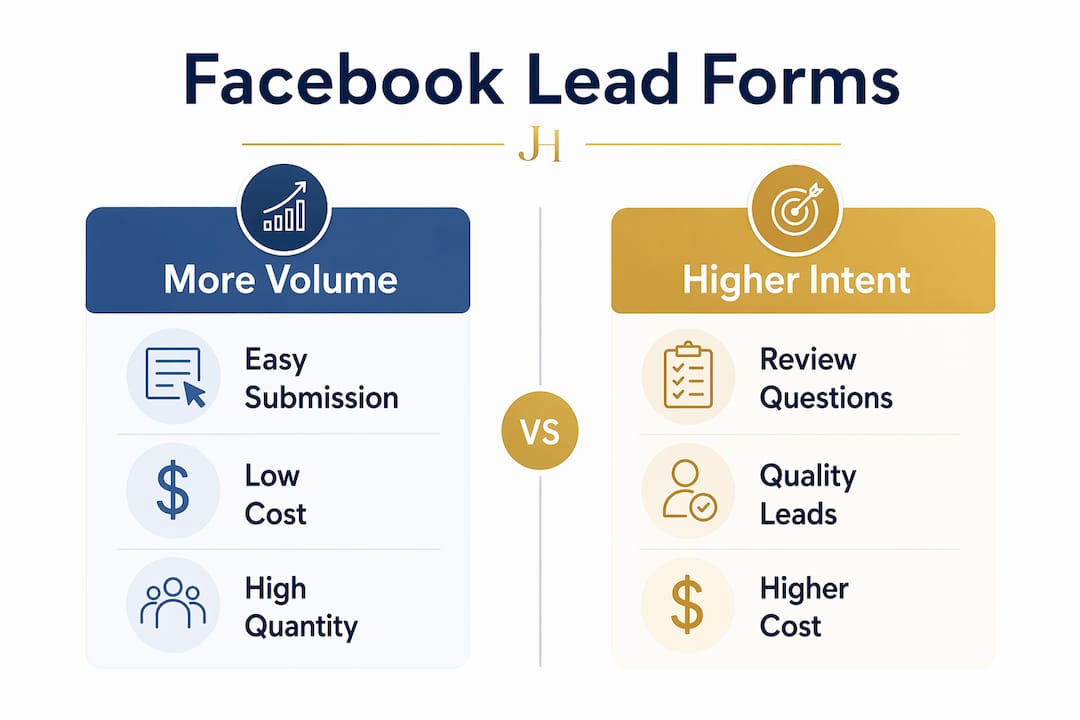
| Form type | Best for | Trade-off |
|---|---|---|
| More Volume | High-volume campaigns, brand awareness, list building | Lower intent, more unqualified leads |
| Higher Intent | High-value services, premium offers, complex sales | Fewer submissions, higher cost per lead |
More Volume forms prioritise easy submission and produce the most leads at the lowest cost. Higher Intent forms add a review step where the user must confirm their details before submitting. That extra step filters out accidental taps and people who were not genuinely interested. The result is fewer leads, but a higher percentage of those leads convert to actual sales.
Qualifying questions and form field strategy
Adding qualifying questions to your Instant Form is the most underused tactic in Facebook lead generation. A single multiple-choice question asking “What service are you interested in?” or “What is your budget range?” separates serious prospects from casual browsers before they ever reach your CRM. Keep the form to three fields maximum for volume campaigns. For higher-value offers, four to five fields including a qualifying question is acceptable.
Lead filtering strategies are necessary after low-friction Instant Form capture. Even with a Higher Intent form, you will collect some leads who are not ready to buy. Build a simple scoring system in your CRM that flags leads based on their answers and routes them to the right follow-up sequence automatically.
Pro Tip: Always link your privacy policy directly in the Instant Form. This is a legal requirement under Meta’s policies and protects your business under Australian Privacy Act obligations. A missing privacy policy link can get your ad account flagged.
How to manage Facebook leads with CRM integration and fast follow-up
Collecting leads inside Meta is only half the job. The other half is getting those leads into your sales process before they go cold.
Meta stores lead data for only 90 days unless you connect it to a CRM. That means if you rely on manually downloading CSV files from Meta Ads Manager, you are already working against yourself. Manual downloads introduce delays, create compliance risks, and make it nearly impossible to follow up at the speed the market demands.
The correct approach is a direct CRM integration or a webhook connection. Meta’s pre-built CRM integrations include Salesforce, HubSpot, Mailchimp, ActiveCampaign, Zoho, and Pipedrive. Each of these pushes lead data to your CRM in near real time the moment a form is submitted. For businesses using a custom platform, a webhook sends the data to your server via API, which requires technical setup but delivers instant lead delivery.
Speed-to-lead is the most important metric you are probably ignoring
Contacting leads within 5 minutes rather than hours significantly increases conversion chances. The reason is simple. A person who just submitted a form is at peak interest right now. Every hour that passes reduces their intent and increases the chance they have already spoken to someone else. Automation is the only reliable way to achieve consistent speed-to-lead at scale.
Follow these steps to build a fast lead response system:
- Connect your Instant Form directly to your CRM using Meta’s native integration or a webhook.
- Set up an automated email or SMS that fires within two minutes of form submission, confirming receipt and setting expectations.
- Assign the lead to a sales team member automatically based on service type or location using CRM routing rules.
- Follow up by phone within 5 minutes during business hours. Outside hours, the automated message holds the relationship until your team is available.
- Log every interaction in your CRM so no lead falls through the cracks during handover.
Legal compliance is non-negotiable in this process. Operators must comply with regulations including TCPA and CAN-SPAM, and failing to do so can result in fines up to $1,500 per message. Australian businesses must also adhere to the Spam Act 2003 and the Privacy Act 1988. Link your privacy policy in every form and include an unsubscribe mechanism in all automated messages.
Pro Tip: If you are not ready to build a full CRM integration, use a tool like Zapier to connect your Facebook Lead Ads to a Google Sheet and trigger an email notification. It is not perfect, but it is far better than checking Meta Ads Manager manually each morning.
How Facebook leads fit into your SEO and paid digital strategy
Facebook leads do not exist in isolation. The most effective campaigns treat Meta Lead Ads as one channel inside a broader digital marketing system that includes SEO, Google Ads, email marketing, and AI-powered targeting.
SEO and Facebook Lead Ads work together in a way most business owners miss. When your website ranks well for service-related search terms, it builds brand recognition that makes your Facebook ads more effective. A prospect who has already seen your website in Google search results is far more likely to submit a form when your ad appears in their feed. This is the core logic behind the Marketing Vortex method, which combines SEO, paid social, and content into a single system.
AI is reshaping how Facebook Lead Ads perform at every level. Meta’s own algorithm uses machine learning to optimise ad delivery toward users most likely to submit a form, based on past behaviour across the platform. Beyond Meta’s built-in AI, marketers now use large language models to write and test ad copy variations at scale, identify high-performing audience segments, and score incoming leads before they reach the sales team. AI-driven lead generation techniques are becoming standard practice for agencies managing significant ad budgets.
Google Ads and Facebook Lead Ads serve different stages of the buying journey. Google captures demand that already exists. Facebook creates demand by reaching people who match your ideal customer profile but have not yet searched for your service. Running both channels together fills the funnel from awareness through to conversion. Businesses that run only one channel leave a significant portion of their addressable market untouched.
“The businesses winning with Facebook leads in 2026 are not just running ads. They are building systems where SEO drives brand trust, Facebook captures interest, and automation converts that interest into booked appointments before a competitor even picks up the phone.”
Key ways Facebook leads connect to your broader digital strategy:
- Retargeting: Use your lead list to create Custom Audiences and retarget non-converters with different offers or formats
- Lookalike Audiences: Feed your best leads into Meta to find new prospects who share the same profile
- Email sequences: Push leads from Meta directly into automated nurture sequences that run alongside your SEO content
- Google Ads remarketing: Sync your lead list with Google Ads to serve display ads to prospects across the web
- AI lead scoring: Use CRM automation to rank incoming leads by quality before your sales team makes contact
For a deeper look at social media lead generation strategies, Jarrodharman covers the full range of tactics that work alongside Facebook Lead Ads.
Key takeaways
Facebook leads are captured through Meta’s Instant Forms inside the app, and their value depends entirely on how fast and how well you follow up with CRM integration and automation.
| Point | Details |
|---|---|
| Facebook lead definition | A lead is contact information captured via Meta’s Instant Form without the user leaving the app. |
| Form type selection | Choose More Volume for list building and Higher Intent forms for premium or high-ticket offers. |
| CRM integration is critical | Meta stores lead data for only 90 days, so connect to Salesforce, HubSpot, or similar immediately. |
| Speed-to-lead drives sales | Contacting leads within 5 minutes significantly increases the chance of conversion. |
| Broader strategy matters | Facebook leads perform best when combined with SEO, Google Ads, and AI-powered targeting. |
What most marketers get wrong about Facebook leads
Running Facebook Lead Ads for years across service businesses in Australia, the pattern I see most often is this: business owners celebrate a low cost per lead and then wonder why their revenue is not growing. The problem is almost never the ad. It is everything that happens after the form is submitted.
The businesses I work with that get the best results treat speed-to-lead as a non-negotiable. They have CRM automations firing within two minutes of submission, a phone call happening within five, and a follow-up sequence running for 30 days if the prospect does not convert immediately. That system is what separates a $20 lead that becomes a $5,000 client from a $20 lead that becomes a wasted line in a spreadsheet.
The other thing I push hard on is the connection between Facebook leads and SEO. Paid social gives you volume now. SEO gives you compounding visibility that makes every paid dollar work harder over time. When someone searches for your service on Google, finds your content, and then sees your Facebook ad the next day, the conversion rate on that ad is dramatically higher than cold traffic. That is not a theory. I see it in the data across every account we manage at Business Warriors.
The emerging opportunity most businesses are sleeping on is AI lead scoring. As large language models become more accessible, you can now build systems that analyse a lead’s answers, cross-reference their behaviour, and assign a quality score before your sales team makes contact. That means your best salespeople spend their time on your best leads. The ROI shift is significant.
, Business Warriors | Jarrodharman
How Jarrodharman can help you generate better Facebook leads
Building a Facebook lead generation system that actually converts takes more than running a few ads.
Jarrodharman and the Business Warriors team work with Australian service businesses, clinics, salons, law firms, and ecommerce brands to build integrated marketing systems that combine Meta advertising, SEO, and CRM automation into one consistent lead flow. If you want leads that convert rather than leads that sit in a spreadsheet, the Marketing Vortex method is the framework that makes it happen. For businesses ready to scale their digital advertising and client acquisition, the team at Business Warriors offers a direct path from ad spend to booked appointments.
FAQ
What is a Facebook lead in simple terms?
A Facebook lead is a person’s contact details collected through a Meta Instant Form ad inside Facebook or Instagram. The user submits their name, email, and phone number without leaving the app.
How do Facebook Lead Ads differ from website ads?
Facebook Lead Ads capture contact details inside the platform using pre-filled forms, while website ads send users to an external landing page. Lead Ads convert 2 to 5 times better than cold website traffic for most campaigns.
How long does Meta store Facebook lead data?
Meta stores lead data for 90 days. After that, the data is deleted unless you have connected your Lead Ads to a CRM like HubSpot, Salesforce, or ActiveCampaign.
What is the difference between More Volume and Higher Intent forms?
More Volume forms minimise friction and produce the most submissions at the lowest cost. Higher Intent forms add a review step that filters out low-quality leads, making them better suited to high-value or high-ticket offers.
Do I need a privacy policy to run Facebook Lead Ads?
Yes. Meta requires a privacy policy link on every Instant Form. Australian businesses must also comply with the Privacy Act 1988 and the Spam Act 2003 when collecting and using lead data.