

Many Australian pharmacy owners invest heavily in price discounts while overlooking digital marketing strategies that increase lead capture rates by up to 30%. This misconception costs pharmacies thousands in lost revenue annually. The Australian pharmacy market is expanding rapidly, projected to exceed USD 65 billion by 2035, yet 40% of pharmacy marketers underestimate digital marketing’s impact on lead generation. This guide reveals proven omnichannel strategies combining compliance, personalization, and integrated digital channels to drive consistent pharmacy leads and sales growth.
Table of Contents
- Australian Pharmacy Market Overview and Trends
- Regulatory Compliance Key for Pharmacy Marketing
- Digital Transformation and Online Marketing Channels
- Omnichannel Marketing Strategies for Pharmacies
- Common Misconceptions in Pharmacy Marketing
- Investment and Budgeting for Pharmacy Marketing
- Case Studies: Success with Integrated Marketing
- Summary and Next Steps for Pharmacy Business Owners
- Partner with Business Warriors for Expert Pharmacy Marketing Growth
Key Takeaways
| Point | Details |
|---|---|
| Market Growth | Australia’s pharmacy retail market will grow at 8.5% CAGR through 2035, creating massive lead generation opportunities. |
| Digital Impact | Integrated digital marketing combining SEO, paid ads, and social media increases pharmacy lead capture by 30%. |
| Compliance Critical | TGA advertising guidelines require accurate, evidence-based claims to avoid penalties and build customer trust. |
| Budget Baseline | Minimum $50 daily spend on paid campaigns generates measurable pharmacy leads and positive ROI. |
| Omnichannel Advantage | Multi-channel strategies outperform single-channel approaches by 25-35% in pharmacy lead generation. |
Australian Pharmacy Market Overview and Trends
Australia’s pharmacy retail market is projected to grow at an 8.5% CAGR to USD 65.25 billion by 2035 driven by demographic shifts and expanding digital services. This growth presents enormous opportunities for pharmacies willing to adopt strategic marketing approaches. Understanding these market dynamics helps you position your pharmacy to capture increasing demand.
Several trends are reshaping how Australian pharmacies must approach marketing. Online and home delivery pharmacy services are experiencing explosive growth as consumers prioritize convenience. An aging population drives sustained demand for pharmaceutical services and wellness products. Healthcare spending per capita continues rising, expanding the total addressable market for pharmacy services.
These shifts create urgent pressure for pharmacies to modernize their marketing strategies. Traditional word-of-mouth and location-based marketing alone cannot capture the digital-first consumers entering the market. Pharmacies implementing pharmacy marketing conversion strategies position themselves to dominate local markets while competitors struggle with outdated approaches.
Key market opportunities for pharmacy marketing in 2026 include:
- Telehealth integration expanding pharmacy service offerings beyond physical locations
- Wellness and preventative health trends driving demand for personalized pharmacy consultations
- Digital prescription management systems creating new customer touchpoints
- Increased consumer research online before selecting pharmacy providers
The Australia pharmacy market growth and trends data confirms that pharmacies combining traditional strengths with digital marketing excellence will capture disproportionate market share. Your marketing strategy must evolve to meet consumers where they increasingly spend their time: online.
Regulatory Compliance Key for Pharmacy Marketing
Pharmacy marketing must comply with Therapeutic Goods Administration advertising guidelines focused on accurate, evidence-based claims to ensure safety and efficacy. These regulations exist to protect consumers from misleading health information. Understanding and implementing compliant marketing practices protects your pharmacy from penalties while building customer trust.
The TGA strictly regulates how pharmacies can advertise therapeutic goods, health services, and wellness products. All marketing claims must be substantiated by credible evidence. Testimonials and case studies require specific disclosures. Comparative advertising faces additional scrutiny to prevent unfair or deceptive practices.
Common compliance pitfalls pharmacy owners encounter include making unsubstantiated health claims in social media posts, using patient testimonials without proper disclosures, comparing products to competitors without evidence, and advertising prescription medications directly to consumers. Each violation risks significant financial penalties and reputational damage.
Pro Tip: Create a compliance checklist for all marketing materials before publication. Include verification of claims, proper disclosures, appropriate language, and TGA guideline alignment to systematically reduce compliance risk.
Building compliant marketing campaigns requires collaboration between marketing teams and healthcare professionals. Your pharmacists should review all content making health or product efficacy claims. Document the evidence supporting each marketing claim. Maintain records of approval processes for regulatory audits.
Compliance-focused marketing actually strengthens customer relationships. When consumers trust your pharmacy provides accurate, evidence-based information, they return for advice and purchases. Transparent, honest marketing differentiates your pharmacy from competitors making exaggerated claims. Review TGA marketing guidelines regularly as regulations evolve to maintain compliant campaigns.
Digital Transformation and Online Marketing Channels
Online pharmacy adoption is increasing significantly, pushing demand for strong digital marketing including SEO and paid ads campaigns. Digital channels now drive the majority of pharmacy customer research and decision-making processes. Pharmacies ignoring digital transformation lose market share to competitors meeting consumers in online spaces.
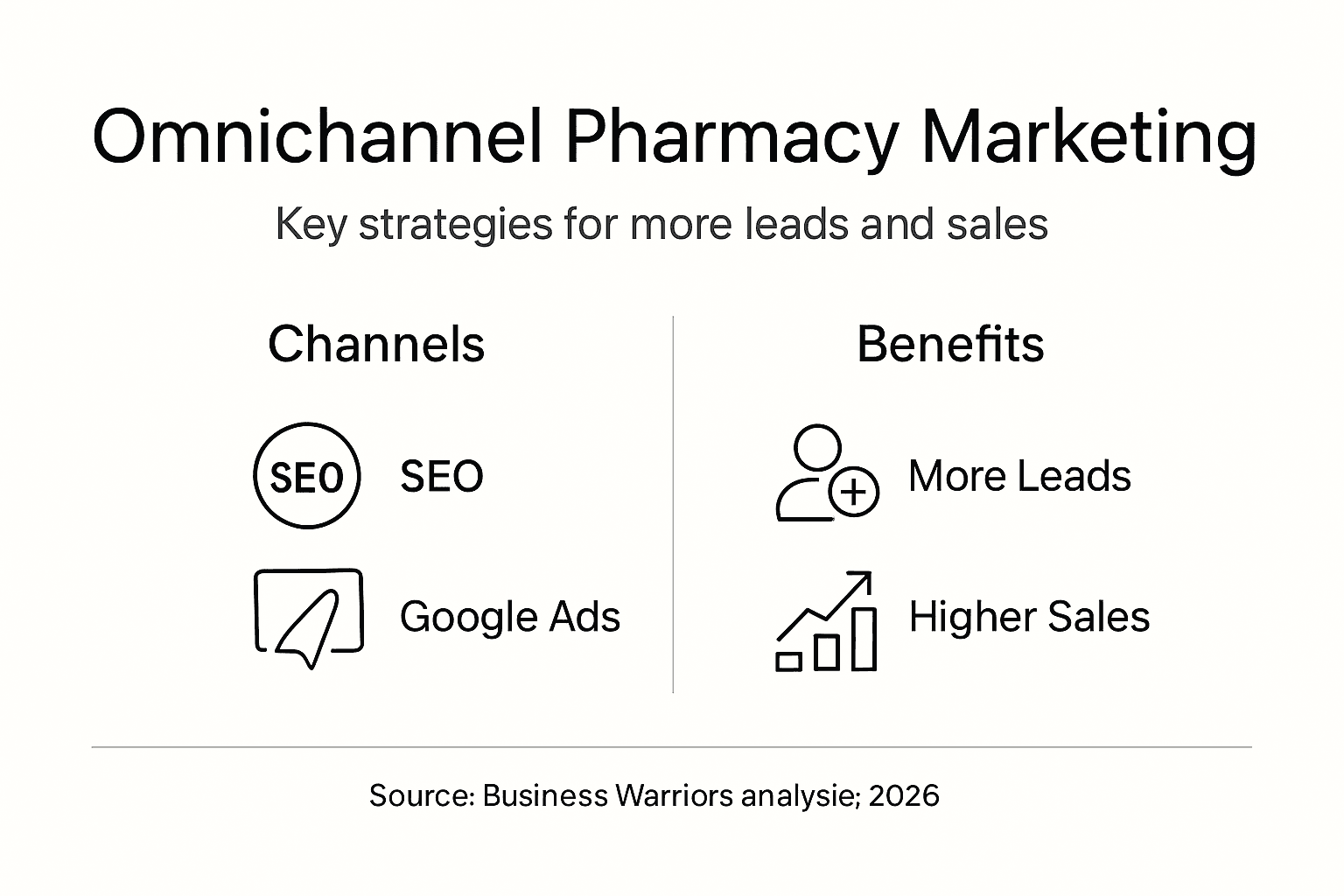
Four primary digital channels drive pharmacy lead generation in Australia. Search engine optimization (SEO) captures high-intent consumers actively searching for pharmacy services and products. Google Ads and paid search deliver immediate visibility for competitive keywords. Social media advertising on Meta platforms builds awareness and engagement with local communities. Email marketing nurtures existing customers while reactivating dormant patients.
Each channel serves distinct functions in your marketing ecosystem. SEO lead generation for pharmacies builds long-term organic visibility and authority. Paid campaigns generate immediate traffic and conversions. Social media creates community connections and brand preference. Email marketing maximizes customer lifetime value through retention and repeat purchases.
| Channel | Primary Benefit | Typical Monthly Cost | Expected ROI Timeline |
|---|---|---|---|
| SEO | Sustainable organic traffic growth | $1,500 – $4,000 | 4-6 months |
| Google Ads | Immediate qualified traffic | $1,500 – $5,000 | 1-2 months |
| Meta Ads | Local awareness and engagement | $1,000 – $3,000 | 2-3 months |
| Email Marketing | Customer retention and repeat sales | $300 – $1,000 | Immediate |
Pro Tip: Start with a combined organic and paid search strategy to maximize visibility while building long-term SEO authority. Add social and email as you scale to create a comprehensive digital presence.
The digital pharmacy market growth data demonstrates that multi-channel approaches consistently outperform single-channel investments. Consumers interact with multiple touchpoints before purchasing. Your pharmacy must maintain presence across the channels your target customers use daily. Implementing digital marketing lead generation strategies tailored to pharmacy services ensures you capture demand at every stage of the customer journey.
Omnichannel Marketing Strategies for Pharmacies
Multi-channel marketing integrating SEO, Google Ads, social media, and email marketing can increase lead capture rates by up to 30% compared to single-channel approaches. Omnichannel strategies create multiple touchpoints that guide potential customers from awareness through conversion. This integrated approach mirrors how modern consumers actually research and purchase pharmacy services.
| Approach | Lead Generation | Customer Retention | Cost Efficiency | Measurement Clarity |
|---|---|---|---|---|
| Single-Channel | Limited | Low | Variable | Simple |
| Omnichannel | High | Excellent | Superior | Comprehensive |
Implementing an effective omnichannel pharmacy marketing strategy follows a systematic process:
- Audit your current marketing activities and identify gaps in channel coverage and customer journey touchpoints.
- Develop customer personas defining your ideal pharmacy patients including demographics, behaviors, and preferred communication channels.
- Create a content calendar coordinating messaging across all channels with consistent branding and compliant health information.
- Implement tracking systems measuring performance across channels including attribution modeling to understand customer paths.
- Optimize continuously based on data, scaling high-performing channels while improving or eliminating underperforming tactics.
Successful integrated pharmacy marketing strategies share several critical elements. Channel consistency ensures customers receive coherent messaging whether they encounter your pharmacy on Google, Facebook, or email. Personalized messaging addresses specific customer needs and preferences rather than generic promotions. Compliant content maintains TGA guideline adherence across all channels. Continual measurement enables data-driven optimization of budget allocation and creative approaches.

Personalized wellness-oriented content significantly enhances pharmacy marketing effectiveness. Modern consumers seek pharmacies offering guidance beyond prescription fulfillment. Content addressing specific health concerns, seasonal wellness tips, and medication management advice positions your pharmacy as a trusted health partner. This approach builds loyalty that discounts alone cannot achieve.
Key elements of pharmacy omnichannel marketing:
- Consistent brand voice and visual identity across all digital and physical touchpoints
- Coordinated campaigns with messaging adapted to each channel’s strengths and audience expectations
- Cross-channel retargeting bringing users back after initial engagement on any platform
- Unified customer data systems tracking interactions across channels for personalized follow-up
The integrated pharmacy marketing impact research confirms that pharmacies adopting omnichannel approaches achieve superior results in lead generation, customer acquisition costs, and lifetime value. Implementing social media lead generation strategies as part of your broader omnichannel framework amplifies results across all channels through increased brand awareness and community engagement.
Common Misconceptions in Pharmacy Marketing
Many pharmacy owners operate under false beliefs that undermine their marketing effectiveness. 40% of pharmacy marketers overestimate the value of price discounts and underestimate digital marketing’s contribution to lead generation. These misconceptions lead to wasted budgets and missed growth opportunities. Correcting these beliefs frees you to implement strategies that actually drive results.
Four prevalent misconceptions damage pharmacy marketing performance:
- Misconception: Price discounts are the primary driver of pharmacy customer acquisition and loyalty. Reality: While price matters, convenience, service quality, and trusted advice drive sustainable pharmacy relationships more effectively than discounting.
- Misconception: Digital marketing works only for large pharmacy chains with massive budgets. Reality: Independent pharmacies often achieve superior ROI from digital marketing due to local focus and personalized service advantages.
- Misconception: Compliance requirements make effective digital marketing impossible for pharmacies. Reality: TGA guidelines establish boundaries but leave substantial room for creative, compelling, compliant marketing campaigns.
- Misconception: Traditional marketing methods like print ads and local sponsorships remain more effective than digital channels. Reality: Digital channels offer superior targeting, measurement, and cost efficiency while print and sponsorship effectiveness continues declining.
These misconceptions persist because they represent comfortable, familiar approaches. Price discounts produce immediate, measurable sales spikes even though they erode margins and fail to build loyalty. Traditional marketing feels safer than digital experimentation. Compliance concerns create paralysis rather than motivating proper implementation.
Successful pharmacy marketing in 2026 requires viewing your marketing as a strategic, multi-faceted discipline rather than ad hoc promotions. This mindset shift enables systematic testing, measurement, and optimization. You invest in channels and tactics that demonstrate positive ROI while eliminating wasteful spending on ineffective legacy approaches.
The common pharmacy marketing misconceptions data reveals that pharmacies overcoming these false beliefs consistently outperform competitors stuck in outdated thinking. Your willingness to challenge assumptions and embrace evidence-based marketing strategies directly determines your pharmacy’s growth trajectory in an increasingly competitive market.
Investment and Budgeting for Pharmacy Marketing
A daily marketing budget of $50 or more is needed for effective paid advertising channels like Google and Meta Ads to generate meaningful pharmacy leads. This baseline investment enables sufficient campaign scale to gather performance data and optimize targeting. Pharmacies investing below this threshold struggle to achieve statistically significant results or compete effectively for customer attention.
Effective pharmacy marketing requires balanced budget allocation across multiple channels. Dedicate 40 to 50% of your budget to paid advertising for immediate lead generation. Allocate 25 to 35% to SEO and content marketing for sustainable long-term growth. Reserve 15 to 25% for email marketing and customer retention programs. Maintain 10% for testing new channels, creative approaches, and emerging platforms.
Budgeting strategies that maximize pharmacy marketing ROI:
- Track detailed ROI by channel and campaign to identify your highest-performing investments and scale accordingly
- Allocate more budget to channels demonstrating positive ROI while reducing or eliminating spending on underperforming tactics
- Plan for seasonal demand fluctuations with increased spending during flu season, allergy season, and health awareness months
- Build in budget flexibility to capitalize on unexpected opportunities or respond to competitive threats
Pro Tip: Set aside 10 to 15% of your monthly marketing budget specifically for testing new approaches, then aggressively scale tactics that demonstrate superior performance and immediately cut those that underperform.
Many pharmacy owners underinvest in marketing relative to the lifetime value of acquired customers. Calculate your average customer lifetime value by multiplying average monthly purchases by average customer relationship duration. Compare this to your customer acquisition cost from marketing. Most pharmacies discover they can profitably invest far more in marketing than current budgets allow.
The digital marketing budgeting steps framework helps pharmacy owners systematically allocate resources for maximum impact. Start with the minimum viable budget to test channels and gather data. Scale investment in proven channels as ROI becomes clear. Continuously optimize based on performance rather than intuition or industry averages. This disciplined approach prevents both underfunding that limits results and wasteful spending on ineffective tactics.
Case Studies: Success with Integrated Marketing
Real Australian pharmacies have achieved remarkable lead generation growth by implementing integrated marketing strategies. These success stories demonstrate the tangible impact of adopting expert-driven, omnichannel approaches. One Melbourne pharmacy increased qualified leads by 35% within six months using combined SEO optimization, targeted Google Ads, and patient-centric wellness content.
A Perth pharmacy chain struggling with declining foot traffic reversed course through strategic digital transformation. They implemented local SEO tactics, created video content addressing common health concerns, and launched targeted Meta advertising to surrounding suburbs. Within eight months, online bookings increased 28% while in-store traffic recovered to pre-decline levels. Their investment in integrated marketing generated a 4.2x return within the first year.
Sydney pharmacy owners adopted a wellness-focused content strategy complementing their traditional services. They published educational blog posts, created short-form video content for social media, and implemented an email nurture sequence for new customers. This patient-centric messaging differentiated them from discount-focused competitors. Customer retention improved by 31% while average transaction value increased 18%.
Key tactics these successful pharmacies implemented:
- Comprehensive local SEO optimization ensuring visibility for location-based searches and Google Maps placement
- Educational video content addressing common health questions and demonstrating product uses in compliance with TGA guidelines
- Targeted advertising campaigns focused on specific services like flu shots, diabetes management, and compounding rather than generic pharmacy promotions
- Email automation sequences nurturing new customers and reactivating dormant patients with personalized health reminders
These pharmacies share common characteristics beyond their tactical choices. They committed to consistent implementation over six to twelve months rather than expecting immediate results. They allocated sufficient budget to test and optimize campaigns. They embraced video content despite initial discomfort. Most importantly, they viewed marketing as a strategic priority worthy of ongoing investment and attention.
Client testimonials consistently highlight the ROI and strategic value of expert-guided marketing implementation. One pharmacy owner noted that professional marketing guidance helped them avoid costly mistakes while accelerating results. Another emphasized that the systematic, data-driven approach provided confidence their marketing budget generated real returns rather than guesswork. Review more pharmacy marketing success stories to see specific results achieved by Australian pharmacies at various scales.
Summary and Next Steps for Pharmacy Business Owners
Successful pharmacy marketing in 2026 requires integrating compliance, digital transformation, and omnichannel strategies. The Australian pharmacy market presents enormous growth opportunities for businesses willing to modernize their marketing approaches. Pharmacies combining TGA-compliant content with strategic digital marketing consistently achieve 25 to 35% lead generation increases.
The evidence throughout this guide demonstrates that traditional marketing assumptions no longer serve pharmacy growth objectives. Price discounting erodes margins without building loyalty. Single-channel marketing leaves revenue on the table. Underinvestment in digital channels cedes market share to more strategic competitors. Pharmacies overcoming these limitations and implementing integrated marketing systems position themselves for sustained success.
Key benefits of adopting expert-driven pharmacy marketing include predictable lead generation systems replacing feast-or-famine customer acquisition, improved customer lifetime value through retention-focused strategies, competitive differentiation based on service and expertise rather than price, measurable ROI enabling confident marketing investment decisions, and scalable systems supporting multi-location growth or expanded service offerings.
Actionable next steps to transform your pharmacy marketing:
- Conduct a comprehensive compliance audit of all current marketing materials against TGA guidelines to identify and correct violations
- Develop a written marketing plan defining target audiences, channel strategies, budget allocation, and success metrics
- Establish your baseline marketing budget at $50+ daily for paid campaigns with additional allocation for SEO and content
- Implement tracking systems measuring lead sources, conversion rates, customer acquisition costs, and lifetime value
- Begin systematic testing and optimization across channels while scaling tactics demonstrating positive ROI
The pharmacies achieving exceptional results share one critical characteristic: they sought expert guidance to accelerate implementation and avoid costly mistakes. Professional marketing partnership provides strategic direction, technical execution, and ongoing optimization that busy pharmacy owners struggle to manage alongside operational responsibilities.
Partner with Business Warriors for Expert Pharmacy Marketing Growth
Business Warriors specializes in scalable digital marketing systems for Australian pharmacies seeking consistent lead generation and sales growth. Our proven Marketing Vortex framework integrates SEO, Google Ads, Meta advertising, email marketing, and compliant content creation into a comprehensive system tailored for pharmacy businesses. We understand the unique challenges pharmacy owners face including regulatory compliance, local competition, and customer retention.

Our online marketing for Australian pharmacies services include TGA-compliant campaign development, multi-channel lead generation systems, customer retention and lifetime value optimization, and transparent reporting with measurable ROI. We work exclusively with serious pharmacy businesses maintaining daily marketing budgets of $50 or more and committed to implementing recommended strategies including video content.
Ready to achieve 30% or greater lead generation growth? Explore our scaling online marketing for pharmacies services and request a personalized marketing strategy evaluation. We’ll analyze your current marketing performance, identify immediate opportunities, and provide a roadmap for implementing integrated systems that drive consistent pharmacy leads and sales.
FAQ
What are the most effective digital channels for pharmacy marketing in Australia?
SEO, Google Ads, social media advertising, and targeted email marketing are the top channels for pharmacy lead generation in Australia in 2026. Integrated use of these channels yields consistent and measurable results, with omnichannel approaches increasing lead capture by up to 30% compared to single-channel tactics. Each channel serves distinct functions from immediate traffic generation to long-term brand building. Learn more about effective digital channels for pharmacy marketing.
How can pharmacies ensure their marketing complies with Australian regulations?
Pharmacies must strictly follow Therapeutic Goods Administration (TGA) advertising guidelines, regularly reviewing marketing materials for accuracy and appropriate disclosures. Consultation with legal or compliance experts during campaign development is recommended, particularly for content making health claims or featuring patient testimonials. Create a systematic review process for all marketing content before publication to maintain compliance.
What is a recommended marketing budget for Australian pharmacies?
A minimum daily budget of $50 is advised for paid digital campaigns to generate meaningful pharmacy leads and achieve statistical significance for optimization. Budget should be allocated across SEO, paid ads, and content marketing channels based on your specific goals and competitive landscape. Most successful pharmacies invest 5 to 10% of revenue in marketing to support consistent growth. Review marketing budget recommendations for detailed allocation strategies.
How do personalized wellness marketing strategies benefit pharmacies?
Personalized wellness marketing improves patient engagement, loyalty, and differentiates pharmacies from competitors focused solely on price discounting. It aligns marketing with consumer trends toward health and lifestyle integration, positioning your pharmacy as a trusted advisor rather than a transactional product seller. This approach increases customer lifetime value and retention rates by 25 to 35%. Explore benefits of personalized wellness marketing for implementation strategies.