


Most business owners believe SaaS marketing is purely about attracting new customers, but that’s only a fraction of the picture. True SaaS marketing excellence encompasses the entire customer journey from initial contact through expansion. This guide reveals proven strategies Australian service businesses can implement to generate consistent leads and achieve sustainable growth in 2026.
Table of Contents
- Understanding SaaS Marketing Beyond Acquisition
- Building A Unified Brand Identity And Messaging For SaaS
- Leveraging Account-Based Marketing And Webinars For Lead Growth
- Focusing On Net Revenue Retention For Sustainable SaaS Growth
- Discover Expert Digital Marketing Support For Your SaaS Growth
- Frequently Asked Questions About SaaS Marketing
Key takeaways
| Point | Details |
|---|---|
| Lifecycle focus | SaaS marketing covers acquire, onboard, retain, and expand stages for recurring revenue success |
| Brand identity | Unified messaging delivers 340% more qualified leads and 58% lower acquisition costs |
| Targeted tactics | Account-based marketing increases deal size by 30% whilst webinars achieve 55% attendance rates |
| Retention priority | Companies with strong net revenue retention grow 25% faster and sustain profitability long term |
Understanding SaaS marketing beyond acquisition
The fundamental difference in SaaS marketing lies in its lifecycle approach. Unlike traditional marketing that ends at the sale, SaaS marketing strategy focuses on acquire, onboard, retain, and expand stages because recurring revenue depends on customer success throughout their entire journey.
Your business needs distinct tactics for each lifecycle stage. Acquisition campaigns drive initial awareness and trials. Onboarding sequences educate new users and reduce early churn. Retention programmes keep customers engaged and satisfied. Expansion strategies identify upsell opportunities and increase customer lifetime value.
Successful SaaS businesses automate these lifecycle communications:
- Welcome sequences that guide new customers through key features
- Educational content delivered based on usage patterns and milestones
- Re-engagement campaigns triggered by declining activity signals
- Upsell promotions aligned with customer success and growth indicators
Pro Tip: Implement marketing automation examples early in your SaaS journey to maintain consistent customer touchpoints without overwhelming your team.
Understanding this lifecycle framework helps you allocate budget appropriately. Many Australian service businesses over-invest in acquisition whilst neglecting onboarding and retention, leaving revenue on the table.
Building a unified brand identity and messaging for SaaS
Your brand identity directly impacts campaign performance and lead quality. Well-defined brand identity and unified messaging increase qualified leads by 340% whilst reducing customer acquisition costs by 58%.

Consistent messaging across your website, social media, email campaigns, and advertising creates stronger brand recall. When prospects encounter the same value propositions and visual identity everywhere, trust builds faster.
| Metric | Before Brand Unification | After Brand Unification | Change |
|---|---|---|---|
| Qualified leads | 100 monthly | 440 monthly | +340% |
| Customer acquisition cost | $450 | $189 | -58% |
| Campaign ROI | 2.1x | 5.8x | +176% |
| Bounce rate | 68% | 42% | -38% |
Start by auditing your current messaging:
- Review all customer-facing materials for consistency in tone and value propositions
- Identify gaps where messaging contradicts or confuses your core offering
- Document your brand voice, key benefits, and differentiation points clearly
- Update all digital channels to reflect unified positioning and visual identity
Pro Tip: Focus messaging on quantifiable benefits your SaaS delivers rather than generic claims about being innovative or customer-focused.
Inconsistent messaging increases bounce rates because visitors can’t quickly grasp what you offer or why it matters. Clear, benefit-focused communication that remains consistent across touchpoints converts better and attracts higher-quality leads. Avoid digital marketing mistakes by establishing brand guidelines before scaling your campaigns.
Leveraging account-based marketing and webinars for lead growth
Two tactics consistently outperform others for SaaS lead generation: account-based marketing and webinars. Account-based marketing increases deal size by 30% by targeting high-value prospects with personalised campaigns.
Account-based marketing (ABM) flips traditional marketing by focusing resources on specific target accounts rather than broad audiences. You identify ideal customers, research their needs, and create tailored content addressing their unique challenges.
Webinars excel at engagement, with 55% average attendance rates far exceeding other content formats. They position your team as experts whilst educating prospects about solutions to their problems.
| Tactic | Primary Benefit | Best For | Key Metric |
|---|---|---|---|
| Account-Based Marketing | Higher deal values | Enterprise SaaS, B2B services | 30% deal size increase |
| Webinars | Deep engagement | Complex solutions, education | 55% attendance rate |
Implement these tactics effectively:
- Identify your 20-50 highest-value target accounts based on revenue potential and fit
- Research each account’s business challenges, goals, and decision-makers thoroughly
- Create personalised content addressing specific pain points for each account
- Plan quarterly webinars on topics your ideal customers actively search for
- Promote webinars through email, social media, and partnerships with complementary businesses
- Follow up with attendees using personalised sequences based on engagement levels
Real results demonstrate impact. Linktech Australia increased sales leads by 200x after partnering with a specialist agency to optimise their digital strategy.
Measure ABM success through account engagement scores, deal velocity, and win rates. Track webinar performance via registration rates, attendance, engagement duration, and post-event conversions. Australian service businesses benefit from adapting these global tactics to local market preferences, emphasising relationship building and practical value delivery.
Learn more about effective lead generation campaigns and discover how to generate more website leads through strategic optimisation.
Focusing on net revenue retention for sustainable SaaS growth
Net revenue retention (NRR) measures revenue from existing customers over time, accounting for upgrades, downgrades, and churn. Companies with higher net revenue retention grow around 25% faster whilst maintaining superior profitability.
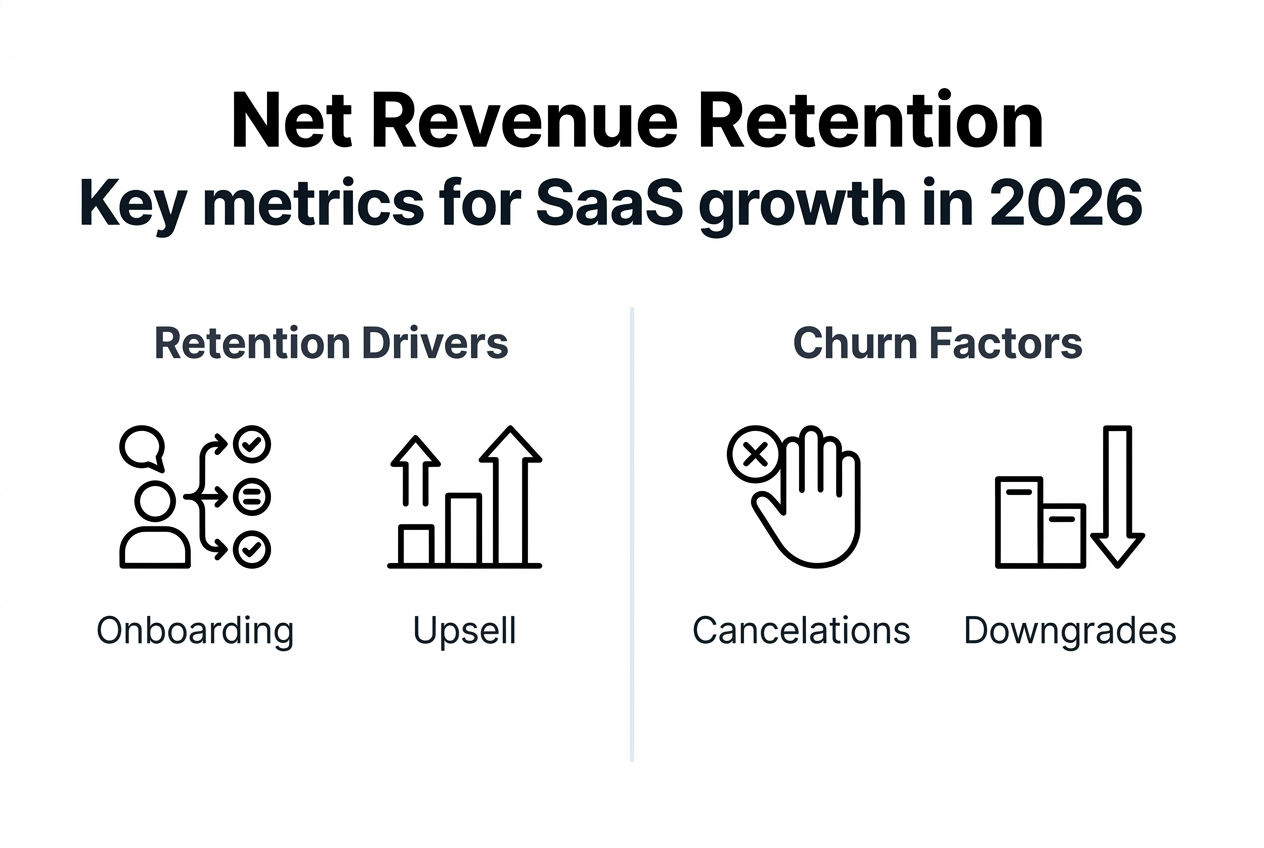
NRR reveals whether you’re expanding customer value or slowly losing ground. An NRR above 100% means existing customers generate more revenue year over year through upgrades and expansion, even accounting for churn. This metric matters more than acquisition for sustainable growth.
Key strategies to improve your net revenue retention:
- Deliver proactive customer success support that identifies issues before customers complain
- Monitor usage patterns to spot expansion opportunities and at-risk accounts early
- Create clear upgrade paths that align with customer growth and evolving needs
- Reduce churn by addressing the root causes of cancellations systematically
- Build community and educational resources that increase product value over time
Strong retention transforms your business economics. Acquiring new customers costs five to seven times more than retaining existing ones. When you retain and expand existing relationships, marketing efficiency improves dramatically.
Evaluate your current retention strategy honestly. Calculate your NRR by comparing revenue from the same customer cohort year over year. Identify which customer segments have the highest retention and expansion rates, then focus acquisition on similar profiles.
Implementing structured client retention improvements creates compounding growth. Each percentage point of retention improvement flows directly to profitability whilst reducing pressure on acquisition channels.
Discover expert digital marketing support for your SaaS growth
Implementing these SaaS marketing strategies requires expertise, time, and consistent execution. Jarrod Harman specialises in helping Australian service businesses build scalable marketing systems that generate steady leads and sustainable growth.
Whether you need strategic guidance on lifecycle marketing, help optimising your brand messaging, or hands-on support building lead generation campaigns that convert, we deliver proven results. Our SEO consultant Perth services and comprehensive digital marketing expertise help service businesses compete effectively and grow profitably. Explore our scaling online marketing guide to learn more about building systems that support your growth ambitions.
Frequently asked questions about SaaS marketing
What is the biggest challenge in SaaS marketing?
Balancing acquisition with retention presents the biggest challenge because most businesses over-invest in attracting new customers whilst neglecting lifecycle marketing. Sustainable SaaS growth requires equal focus on onboarding, engagement, and expansion strategies.
How does SaaS marketing differ from traditional B2B marketing?
SaaS marketing focuses on the entire customer lifecycle rather than ending at the sale, because recurring revenue depends on ongoing customer success. Traditional B2B marketing typically concentrates on driving initial purchases without the same emphasis on retention and expansion.
What marketing channels deliver the best SaaS lead generation results?
Account-based marketing, webinars, content marketing, and search engine optimisation consistently deliver the highest quality SaaS leads. The best channel mix depends on your target audience, deal size, and sales cycle length.
How can I measure success in SaaS marketing campaigns?
Track customer acquisition cost, customer lifetime value, net revenue retention, qualified lead volume, and conversion rates at each lifecycle stage. These metrics reveal both short-term campaign performance and long-term business health.
Why is customer retention more important than acquisition in SaaS?
Retaining customers costs five to seven times less than acquiring new ones, and companies with strong retention grow faster whilst maintaining higher profitability. Recurring revenue models amplify the impact of retention on overall business value.
Recommended
- How to Scale Online Business for Consistent Growth – Jarrod Harman
- 7 Essential Business Scaling Strategies for Aussie Service Owners – Jarrod Harman
- 7 Game-Changing 2025 Marketing Trends for Aussie Businesses – Jarrod Harman
- Complete Guide to Scaling Online Marketing – Jarrod Harman
- How to Plan Content for Scalable Ecommerce Growth | Take Action Blog | Take Action