

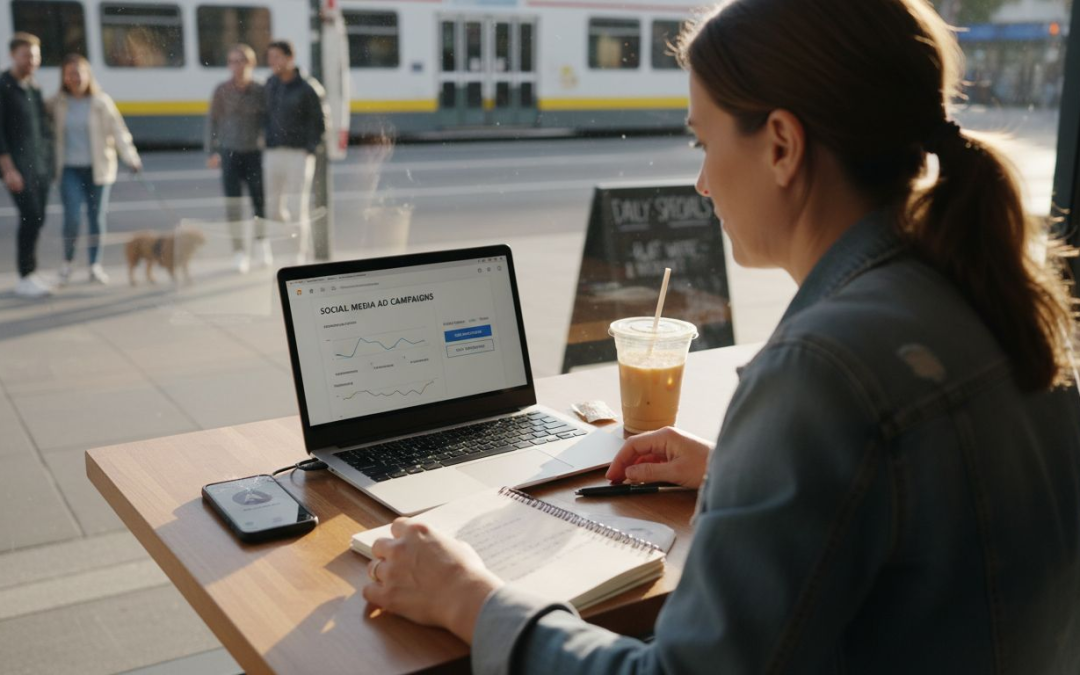
Managing a beauty or wellness business in Australia often means balancing tight budgets with the need for steady client bookings. You’re searching for marketing strategies that deliver measurable results—without wasting money reaching the wrong people. Social media advertising offers a targeted and cost-efficient way to connect with women ready to book beauty and wellness services. Here you’ll discover how precision targeting and flexible budgets can turn online engagement into real-world revenue for your salon, clinic, or spa.
Table of Contents
- Defining Social Media Advertising Benefits
- Major Types of Social Media Ads
- How Advanced Targeting Drives Results
- Real-World Impact for Service Businesses
- Trust and Authenticity Drive Conversions
- Measurable Revenue Impact
- Cost, ROI, and Common Pitfalls
Key Takeaways
| Point | Details |
|---|---|
| Target Precision | Social media advertising allows businesses to reach specific demographics, improving engagement and reducing wasted ad spend. |
| Financial Control | Advertisers can set precise budgets, pausing or scaling campaigns based on performance for better ROI. |
| Brand Recognition | Consistent ad exposure builds brand familiarity, essential in influencing purchase decisions in the beauty and wellness sectors. |
| Database Growth | Social media ads drive not just immediate bookings, but also build valuable client databases for future marketing efforts. |
Defining Social Media Advertising Benefits
Social media advertising isn’t just another marketing channel you toss money at and hope works. For service-based businesses like yours—whether you run a salon, med spa, clinic, or wellness practice—it’s a precision tool that delivers specific, measurable results when you understand what it actually does. Before you spend a single dollar on Facebook, Instagram, or TikTok ads, you need to grasp exactly what benefits you’re paying for and how they translate to actual client bookings.
At its core, social media advertising solves a fundamental business problem: reaching the right people at the right time with a message they actually care about. Unlike traditional advertising where you cast a wide net and hope someone notices, social platforms let you target with surgical precision. You can reach women aged 35-50 in your specific postcode who’ve shown interest in beauty treatments, wellness services, or health solutions. The platforms collect data on user behaviour, interests, location, and engagement patterns, turning that information into targeting capabilities that would have been impossible five years ago. Research demonstrates that real-time marketing capabilities enable brands to engage consumers in meaningful ways, connecting your services to moments when potential clients are actively seeking exactly what you offer. This targeted approach means you’re not paying for visibility with disinterested audiences; you’re paying to connect with people who’ve already signalled they’re in your market.
The financial advantage deserves its own spotlight. Service businesses operating on tight margins cannot afford wasteful marketing spend, and this is where social media advertising delivers genuine ROI advantages. Traditional advertising requires substantial upfront investment with delayed results. Social media operates differently. You control your daily budget down to the dollar, pause campaigns instantly, and only pay when someone takes action (whether that’s clicking your ad, visiting your website, or messaging you for a booking). Social media’s lower marketing costs combined with higher conversion rates create a compelling case for budget-conscious beauty and wellness practitioners. You’re not locked into quarterly contracts or minimum spends. If an ad underperforms, you adjust it within hours. If something works brilliantly, you scale it immediately. This flexibility means your marketing adapts to market conditions, seasonal demand, and business cash flow rather than the other way around.
Beyond immediate bookings, social media advertising builds what I call brand equity through familiarity. When a potential client sees your ad multiple times over weeks, they begin recognising your business name, logo, and value proposition. They might not book on the first viewing, but by the third or fourth encounter, your business has moved from unknown to familiar. This psychological shift matters enormously in the wellness and beauty sectors, where trust precedes purchase decisions. Women in your target age group rarely book services from businesses they’ve never heard of. Social media advertising solves this by putting your business consistently in front of qualified prospects, creating the awareness and recognition necessary for when they’re ready to book. Combined with SEO strategies and Google Ads campaigns, social media advertising amplifies your entire online presence, ensuring your business appears where potential clients are searching, browsing, and engaging daily.
The booking benefit translates into something quantifiable: database building. Every click, message, and website visit from a social ad represents a potential repeat client. Unlike one-off transactions, service businesses thrive on client retention and referrals. Social media advertising doesn’t just bring clients in; it populates your email list, messenger contacts, and booking system with real people interested in your specific services. This creates a foundation for ongoing communication, special offers, and nurturing relationships that turn single bookings into loyal clients who return quarterly or annually.
Pro tip: Start by identifying your single highest-converting service—perhaps a signature treatment or popular appointment type—and run a focused social media campaign targeting that specific offering rather than trying to promote everything at once; this generates faster results and gives you proof of concept before scaling to your full service menu.
Major Types of Social Media Ads
Social media platforms offer far more than a single ad format. You’re not simply choosing between Facebook and Instagram and hoping something sticks. Each platform supports multiple ad types, and each type serves a distinct strategic purpose. Understanding which formats work best for your service business is crucial because running the wrong ad type wastes budget faster than you can adjust it. The good news is that different ad types serve distinct strategic roles including brand awareness, engagement, and conversion, meaning you can match your campaign objective to the format most likely to deliver results.
Feed Ads and Image Carousel Formats
The most familiar format is the feed ad, which appears in users’ news feeds looking like regular posts but marked as sponsored. Image carousel ads let you showcase multiple treatments or before and after transformations in a single ad unit. For a salon or med spa, carousel ads excel because they tell a visual story. You might feature your signature facial treatment, then show skin results, then display customer testimonials, all within one scrolling unit. These formats work because they’re non-intrusive—they fit naturally into the user experience rather than disrupting it. When a woman is scrolling through Instagram during her lunch break, a beautifully designed carousel ad showing your aesthetic results catches her eye without feeling aggressive or pushy. Carousel formats also provide engagement data for each individual image, so you learn which specific treatments or visuals resonate most strongly with your audience.

Video ads represent the evolution of carousel advertising. Rather than static images, you’re showing movement, transformation, and emotion. A 15 to 30 second video of a client’s facial transformation, a meditation session at your wellness centre, or a quick technique demonstration performs remarkably well because video captures attention involuntarily. Even if someone isn’t actively looking for your services, a compelling video stops their scroll. Video also works across all age groups in your target demographic, from younger women discovering your business to older clients who appreciate seeing results demonstrated clearly. The catch is that video requires investment in production, but you needn’t shoot Hollywood quality content. Phone footage of your space, staff performing treatments, or clients sharing results often outperforms polished, corporate looking videos because authenticity resonates more than perfection.
Stories and Reels Advertising
Stories ads appear within the Stories section of Instagram, Facebook, and other platforms. They’re full screen, vertical format, and ephemeral, disappearing after 24 hours. This format works brilliantly for time sensitive offers—a limited availability appointment slot, a weekend special, or a flash discount. Because Stories feel personal and temporary, users engage differently than with permanent feed content. The urgency factor drives action. Reels ads operate similarly but exist within the Reels section where users actively browse short form video content. This is where TikTok like content thrives. Beauty and wellness businesses can leverage Reels to show quick tips, transformation timelapse videos, or behind the scenes footage. A 15 second reel showing your therapist’s massage technique or your aesthetician’s skincare routine positions your business as expert and trustworthy.
Messenger and Collection Ads
Messenger ads appear within messaging apps and work exceptionally well for service bookings because they’re delivered one on one, like a text from a friend. These ads often include a call to action button that starts a conversation directly with your business. Someone sees your ad, clicks “Send Message,” and suddenly they’re chatting with your team about booking. This format has the highest intent to convert because the user is actively choosing to engage in conversation. Collection ads let users browse multiple products or services without leaving the ad itself. A beauty clinic could display different treatment packages, prices, and descriptions in a collection format. Users explore options, find what interests them, then click through to book. This reduces friction because browsing happens in the ad rather than requiring navigation to your website first.
Influencer and Partnership Based Ads
Various social media advertising types including influencer collaborations serve distinct strategic roles in modern marketing. Rather than running solo ads from your business account, you partner with micro influencers or relevant personalities who have audiences matching your ideal client profile. An influencer with 15,000 followers in your local area who focuses on wellness content can showcase your services authentically to their engaged community. Because the recommendation comes from a trusted voice rather than direct corporate advertising, followers are more likely to believe the endorsement. This format works particularly well for Australian beauty and wellness businesses targeting regional audiences where micro influencers have established credibility.
Choosing Your Mix
Most successful campaigns don’t rely on one format alone. Instead, you run complementary campaigns: carousel ads build awareness, video ads drive engagement, messenger ads facilitate bookings, and Stories ads create urgency around limited offers. Your Google Ads campaigns can work in parallel, capturing search traffic while social ads capture browse traffic. The combination creates comprehensive coverage of your potential clients wherever they’re active online.
Here’s an at-a-glance summary of major social media ad formats for service businesses:
| Ad Format | Typical Use Case | Engagement Strength | Booking Likelihood |
|---|---|---|---|
| Feed & Carousel Ads | Awareness, storytelling | Moderate to high | Moderate |
| Video Ads | Education, emotion | High | Moderate to high |
| Stories & Reels | Timely offers, urgency | Very high (short term) | High |
| Messenger Ads | One-on-one bookings | Direct conversion | Very high |
| Collection Ads | Browsing services | Medium | High |
| Influencer/Partnership | Trust, credibility | High (niche audiences) | Moderate to high |
Pro tip: Test one ad format for two weeks before expanding to multiple formats; track which format generates the cheapest bookings or phone calls, then scale that winner while discontinuing underperformers rather than spreading budget thinly across all formats simultaneously.
How Advanced Targeting Drives Results
Here’s the reality that separates businesses booking consistently from those struggling month to month: most service businesses waste 40 to 60 percent of their advertising budget reaching people who will never become clients. They’re showing ads to the wrong demographics, wrong locations, wrong interests. Social media platforms have solved this problem through advanced targeting, but most Australian beauty and wellness business owners don’t realise how powerful these tools actually are. When you set up targeting correctly, you’re not just reducing wasted spend; you’re dramatically improving your cost per booking and your overall return on advertising spend.
Advanced targeting works through sophisticated data collection and analysis. Platforms like Facebook and Instagram track user behaviour across websites, apps, and their own platforms. They know where users shop, what content they engage with, whether they’ve visited your website before, and what life events they’re experiencing. AI in social media advertising enhances targeting through personalisation and predictive analytics, analysing user behaviour and preferences to deliver highly relevant ads. This means you’re not just guessing who might want your services. The algorithm predicts who is most likely to book based on observable patterns. A 42-year-old woman in Perth who has visited beauty clinic websites, engaged with skincare content, and matches demographic profiles of existing clients becomes a high-priority prospect. The platform automatically prioritises showing your ad to her over someone with no relevant signals.
Custom and Lookalike Audiences
One of the most powerful targeting approaches uses your existing customer data. If you’ve been capturing client email addresses or phone numbers, you can upload that list to Facebook and Instagram. The platform creates a custom audience of exactly your current clients. You can then target their close friends and connections, reaching people with similar characteristics and behaviours. This is called a lookalike audience. Building a lookalike audience from your best clients (not all clients, but your repeat bookings and highest value referrers) creates a prospect pool remarkably similar to your ideal customer. They share interests, demographics, location preferences, and purchase patterns. Lookalike audiences often deliver lower cost per acquisition than cold targeting because the similarities are already established.
Behavioural and Contextual Targeting
Behavioural, psychographic, and contextual segmentation represent evolving strategies that optimize ad relevance. Behavioural targeting shows ads to users based on their actions: visited a beauty website, searched for meditation classes, purchased wellness products. Psychographic targeting focuses on values and lifestyle: environmentally conscious consumers, health-focused individuals, luxury seekers. Someone interested in organic skincare and sustainable beauty practices responds differently to your messaging than someone seeking budget beauty solutions. Contextual targeting shows your ads alongside relevant content. Your med spa ad appears in posts about anti-aging or aesthetic procedures rather than appearing randomly in feeds. These combinations ensure your messaging reaches the right person at the right moment when their mind is already in your service category.
Geographic and Device Based Targeting
For service businesses, geographic targeting is non-negotiable. You serve specific suburbs or regions. Why waste budget showing ads to people in Melbourne when you operate in Brisbane? Hyper-local targeting focuses your budget on postcodes where clients can actually visit. You can even set radius targeting around your physical location, showing ads to people within 5 or 10 kilometres of your salon. Device targeting matters too. Someone viewing social media on mobile during their commute has different intent than someone on desktop at home. Mobile users often book appointments quickly if friction is minimal; desktop users might research more first. Your ad creative and call to action can adapt to device type.
Platform Specific Targeting: Google Ads Integration
Whilst we’re focusing on social media, remember that Google Ads integrates with your broader digital advertising strategy to capture additional intent signals. Someone searching “facial near me” or “best med spa in Perth” shows immediate booking intent. Google Ads captures search traffic whilst social media builds awareness amongst people not yet actively searching. Together they cover your prospects at every stage of decision-making.
The Measurement Advantage
Advanced targeting also provides unparalleled measurement clarity. You see exactly which targeting parameters deliver bookings. Is your lowest cost per booking coming from lookalike audiences, or from custom audiences of past clients? Are women aged 40-50 booking more readily than 35-40? Do Instagram users convert better than Facebook users? This data lets you reallocate budget mid-campaign toward what’s working rather than waiting until month’s end. You’re not making targeting decisions based on intuition; you’re making them on evidence.
Pro tip: Start with custom audiences of your best 100 clients rather than your all-time list; create a lookalike audience from that higher-value segment, then run small budget tests ($5 to $10 per day) against that audience for two weeks to establish your baseline cost per booking before scaling.
Real-World Impact for Service Businesses
Theory is useful. Results matter more. Let’s look at what actually happens when Australian service businesses implement social media advertising properly. The difference between struggling and thriving often comes down to whether you’re running ads without strategy or running ads with precision targeting, compelling creative, and clear measurement. Service businesses across beauty, wellness, aesthetics, and health sectors have discovered that social media advertising isn’t a luxury marketing expense—it’s the foundation of consistent client acquisition.
Consider what happens when a salon owner in Brisbane goes from zero social media advertising to strategic campaigns. Month one, she invests $500 testing carousel ads targeting women aged 35-50 within 10 kilometres of her location who’ve engaged with beauty content. Three bookings come through. Not impressive on the surface, but at $167 per booking acquisition, that’s workable. She measures everything: which ad creative gets clicked most, which targeting parameters produce bookings, which time of day generates the lowest cost per click. Month two, she’s refined the targeting, paused underperforming creatives, and scaled budget to $1,200. Now she’s getting eight bookings at $150 each. By month four, she’s running $3,000 monthly on ads generating 22 to 25 bookings. That’s consistent, predictable revenue flowing directly from algorithmic targeting and strategic ad spend. Social media adoption is linked to increases in revenue growth and enhanced customer satisfaction across service industries, and this salon owner is living proof.
But the real-world impact extends beyond immediate bookings. Something profound happens when you’re consistently showing ads to qualified prospects over weeks and months. Your business becomes the default choice. When a woman finally decides she needs a facial or a massage or a wellness consultation, your salon is the one she already knows. You’re not competing against unknown competitors because you’ve been building brand familiarity through repeated ad exposure. This familiarity transforms into referrals and repeat bookings. A client who books through your ad becomes a repeat client who refers friends. That referred friend already recognises your name from seeing your ads. The network effect compounds. Your cost per acquisition decreases as referrals grow because you’re not paying ad spend for those recommendations.
Trust and Authenticity Drive Conversions
One factor separates successful service business advertising from mediocre campaigns: authenticity. Social media advertising significantly influences consumer behaviour through factors like credibility, authenticity, and sustainability, which builds trust and enhances purchase intentions. This means showing real before and after results, featuring your actual staff, and being honest about what treatments deliver. A beauty clinic in Perth that shows genuine client transformations builds trust far more effectively than one using stock photography and corporate messaging. When your ads feature actual clients sharing real results, women viewing those ads believe you deliver what you promise. That belief converts browsers into bookers.
Measurable Revenue Impact
The real-world impact manifests in your bottom line. Service businesses implementing social media advertising systematically report several outcomes: increased booking volume, reduced cost per acquisition, improved client retention, and higher average transaction value. A med spa spending $2,500 monthly on social ads can reasonably expect 15 to 30 new client bookings depending on service price point and targeting precision. Those clients spend an average of $200 to $400 on their initial visit. Even conservatively, that generates $3,000 to $8,000 in revenue from $2,500 investment. The return justifies itself within the first month or two.
What makes this different from traditional advertising is the speed of measurement and adjustment. With radio ads or print advertising, you hope something worked. With social media advertising, you know within 48 hours which ads generate bookings. You see cost per result for every dollar spent. You identify which client segments are most valuable. A laser clinic might discover that targeting women interested in swimwear season generates bookings at $120 per acquisition, whilst targeting women interested in professional networking generates bookings at $185 per acquisition. Suddenly you reallocate budget toward the more efficient segment. This data-driven approach is impossible with traditional media.
Building Long-Term Client Databases
Beyond immediate revenue, social media advertising builds your client database. Every ad click, website visit, and booking represents contact information you can nurture. Email addresses, phone numbers, and messenger connections create channels for ongoing communication. You’re not just selling a single service; you’re building a customer base for repeat business. A woman who books one facial through your ad becomes someone you email monthly with seasonal specials, new treatment information, and loyalty offers. She’s far more likely to rebook because she’s hearing from you regularly. Some businesses report that repeat client revenue eventually exceeds new client revenue generated through ads, making the initial ad investment even more valuable.
Pro tip: Track not just bookings but also client lifetime value by monitoring how many ad-acquired clients return within three months and how much they spend on repeat visits; this reveals your true advertising ROI since repeat revenue often justifies advertising spend that looks marginal on first-booking metrics alone.
Cost, ROI, and Common Pitfalls
Let’s talk money, because understanding what you’re actually paying and what you’re actually getting back separates businesses that thrive from those that bleed budget month after month. Social media advertising costs vary dramatically based on your industry, location, targeting specificity, and ad quality. A beauty salon in a competitive Australian city might pay $2 to $5 per click, whilst a wellness practitioner in a regional area might pay $0.50 to $1.50 per click. Cost per result (the metric that matters most) varies even more widely. A booking might cost $80 to $200 depending on whether you’re running awareness campaigns or conversion campaigns, whether your audience is cold or warm, and whether your creative genuinely resonates.
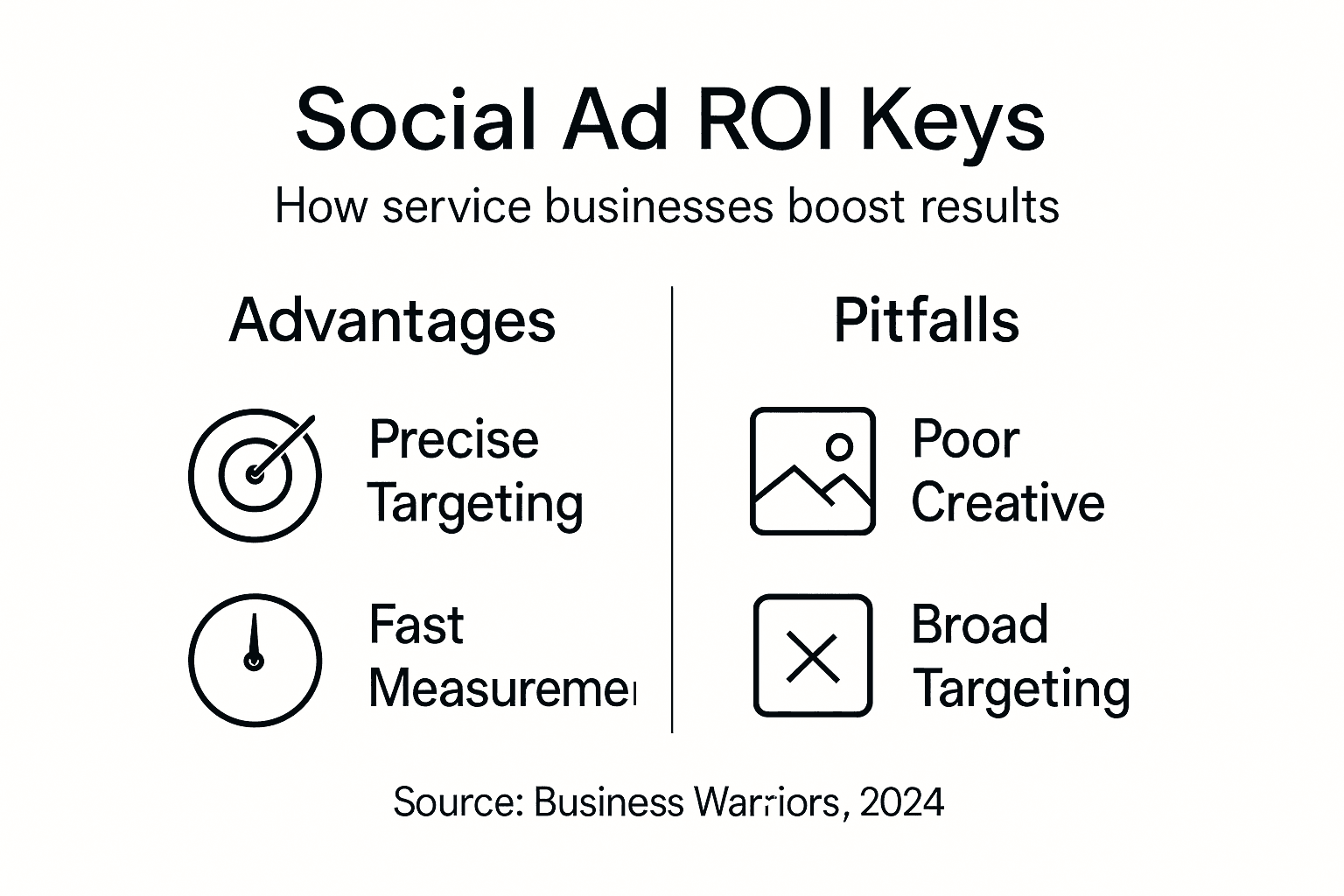
The encouraging news is that social media advertising is significantly more cost effective than traditional recruitment methods, with research showing comparable effectiveness at roughly half the cost of traditional channels. For service businesses, this translates to meaningful budget stretching. You don’t need $5,000 monthly to test viability. You can start with $500 to $1,000 and gather enough data to determine whether social advertising works for your specific business. What you must avoid is spending that budget poorly.
Understanding Your True ROI
Here’s where most businesses make mistakes. They calculate ROI based only on immediate bookings from ads. A business owner spends $2,000 on ads, gets 10 bookings, and calculates $200 cost per acquisition. That seems reasonable until you factor in client lifetime value. If those 10 clients average 4 return visits at $150 per visit, each client represents $600 in total revenue, not just the initial booking value. Your true cost per acquisition is now $200, but your return is $600. That’s a 300 percent return in the first three months, before accounting for referrals that client generates.
Measuring ROI properly requires tracking several metrics simultaneously:
- Cost per click: How much you pay when someone clicks your ad. Target $0.50 to $3 depending on your location and industry.
- Cost per result: How much you pay for each booking, message, or website visit. This is your true acquisition cost.
- Conversion rate: What percentage of people clicking your ad actually book. Most service businesses see 5 to 15 percent conversion rates.
- Client lifetime value: Total revenue from a client across all visits over 12 months. This determines whether your ad spend is justified.
- Return on ad spend (ROAS): Revenue generated divided by ad spend. A 3:1 ROAS means for every dollar spent on ads, you generate three dollars revenue.
Track all four metrics. Don’t just look at cost per booking in isolation. A $150 cost per booking looks terrible until you realise that client averages $600 in revenue across return visits.
Common Pitfalls That Destroy ROI
Most Australian service businesses fail at social media advertising for predictable reasons. The first pitfall is poor ad creative. You cannot run the same ad for six months and expect consistent results. Platforms reward fresh creative and suppress repetitive ads. Your audience tires of seeing the same image or video. Competitors launch newer, more engaging content. After two to three weeks, performance typically declines. Smart operators refresh creative every 14 to 21 days, testing new angles, new before and after photos, different messaging, varied video content. This requires ongoing content production, which many businesses resist.
The second pitfall is targeting too broadly. Setting up ads to reach “all women aged 25 to 65 interested in beauty” wastes massive budget reaching disinterested audiences. You’re paying to show ads to women who will never book. Precision targeting costs slightly more per click but generates dramatically lower cost per booking because you’re reaching only genuinely qualified prospects. Narrow your targeting ruthlessly. Better to spend $100 reaching 500 highly qualified prospects than $100 reaching 5,000 loosely targeted people.
The third pitfall is inadequate budget allocation. Testing costs money. Running a $10 daily budget takes 10 days to gather meaningful data. Most businesses need at least 50 conversions (bookings or leads) to identify what works. If your cost per result is $150, gathering 50 data points requires $7,500 in spend. Businesses that allocate only $300 to $500 monthly never generate enough data to optimise effectively. They spend money, get inconsistent results, and blame social media advertising when the real problem is insufficient budget for testing.
The fourth pitfall is poor booking integration. Your ad drives traffic to a website with no clear booking mechanism. Or the booking process requires three steps when one click booking is available. Or your website is slow on mobile. Every friction point reduces conversion rate. Simplify booking to absolute minimum steps. Mobile optimisation is non-negotiable. Test your booking process yourself weekly. You’d be surprised how many beautiful ads drive traffic to clunky booking experiences that generate 2 to 3 percent conversion instead of 8 to 12 percent possible with optimised experience.
Compare key ROI metrics and pitfalls for Australian service business ad campaigns:
| Metric/Pitfall | Good Practice | Risk If Ignored | Business Impact |
|---|---|---|---|
| Ad Creative Refresh | Update every 2-3 weeks | Rapid performance drop | Maintains conversion |
| Targeting Specificity | Focus on qualified local audiences | Waste budget on broad reach | Improves cost per lead |
| Budget Allocation | Minimum $1,500/month test | Insufficient data, poor scaling | Enables optimisation |
| Booking Integration | Streamlined, mobile-first system | Lost bookings, low conversion | Maximises ROI |
Setting Realistic Budget Expectations
For serious testing, allocate minimum $50 daily ($1,500 monthly) for at least two months. This generates enough data to identify patterns and optimise effectively. Some businesses see strong ROI at $30 to $50 daily. Others need $100 to $150 daily to hit volume targets. Your service price point determines this. A high ticket service (med spa treatments at $400 to $800) needs fewer bookings to justify ad spend than low ticket services (massage at $80 to $120).
Pro tip: Set a maximum cost per acquisition target before launching campaigns (for example, “I won’t spend more than $120 per booking”), then pause or restructure ads the moment they exceed that threshold rather than hoping performance improves; this discipline prevents budget bleed on underperforming campaigns.
Elevate Your Service Brand with Strategic Social Media Advertising
Struggling to connect with your ideal clients despite investing in social media advertising? This article reveals the challenge many service businesses face: wasting precious marketing budget by reaching the wrong audience or using ineffective ad formats. If you want to transform your ad spend into consistent bookings and build lasting brand equity through targeted, authentic campaigns, understanding and applying precision strategies is essential.
Business Warriors specialises in helping Australian service-based businesses like salons, med spas and wellness clinics unlock the real power of social media advertising with the innovative “Marketing Vortex” method. We combine advanced targeting, engaging ad creatives and measurable results to deliver predictable lead flow and maximise your return on investment. Our approach ensures you avoid common pitfalls such as broad targeting, stale content and poor booking integrations.
Are you ready to stop guessing and start booking more clients with strategic, data-driven social media marketing? Discover how to leverage customised campaigns that target your perfect client and turn browsers into loyal customers. Visit our Uncategorized Archives for insights and success stories that prove consistency beats chaos.
Take the next step today – connect with Jarrod Harman and the Business Warriors team through https://jarrodharman.com to learn how our proven client acquisition strategies can scale your service brand’s growth. Don’t let another dollar go to waste. Start converting your social media presence into a powerful business asset now.
Frequently Asked Questions
What are the main benefits of social media advertising for service businesses?
Social media advertising allows service businesses to target specific audiences with relevant messages, thus reducing wasted spending. It also provides measurable results, builds brand familiarity, and helps generate a database of potential clients for future marketing efforts.
How does targeting work in social media advertising?
Social media platforms use sophisticated data collection to create precise targeting options. Businesses can reach potential clients based on demographics, interests, behaviours, and location, ensuring ads reach the right audience at the right time.
What types of ad formats are available for social media advertising?
Platforms offer various ad formats, such as feed ads, carousel ads, video ads, Stories, Reels, Messenger ads, and collection ads, each serving different strategic purposes like awareness, engagement, and conversion.
How can I measure the success of my social media advertising campaigns?
Success can be measured through metrics such as cost per click, cost per booking, conversion rate, and client lifetime value. Tracking these metrics allows businesses to identify effective strategies and adjust campaigns accordingly.
Recommended
- Why Advertise on Social Media: Real Results for Aussie Businesses – Jarrod Harman
- Why Social Media Drives Business Advertising Success – Jarrod Harman
- Social Media Growth Strategies for Service Brands – Jarrod Harman
- Advantages of Social Media in Business Growth – Jarrod Harman
- Top Custom Clothing Services – Expert Comparison 2026 – Prima Dons & Donnas
- Expertise | BPE AUDIO
- IT INNOVE : développement web et mobile | React, React Native et Ruby on Rails