27 July 2026
Upper funnel marketing: a practical guide for marketers
Discover effective upper funnel marketing tactics to boost brand awareness and generate interest. Drive long-term growth with practical insights.
Upper funnel marketing is the set of awareness-focused tactics that put your brand in front of new, relevant audiences before they are actively shopping. Three things to know immediately: success is measured by reach, impressions and brand lift rather than conversions; it directly reduces your long-term cost per acquisition by seeding demand early; and without it, your lower-funnel spend works harder for diminishing returns.
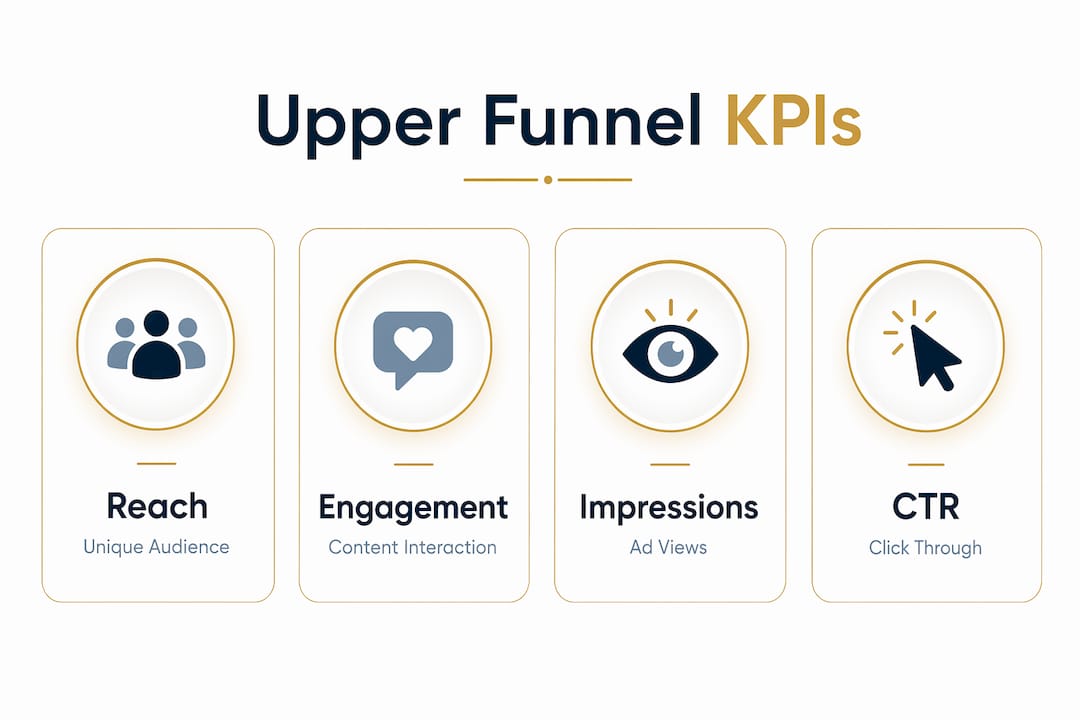
The industry term you will see alongside this is TOFU, short for top of funnel. Both phrases describe the same discipline: reaching cold audiences, building recognition, and generating the kind of interest that eventually flows into your pipeline. IAB Australia publishes local measurement guidelines that define viewability and brand safety standards for this exact type of activity, and platforms like Google Ads/YouTube and Meta Ads are the primary paid channels Australian marketers use to execute it.
Three immediate takeaways:
- Optimise for reach, video view rate and brand lift, not click-through rate or cost per lead.
- Measure success through assisted conversions, branded search growth and multi-touch attribution, not last-click.
- Every dollar spent at the top of the funnel reduces friction and cost at the bottom, but only when messaging stays consistent across every touchpoint.
Table of Contents
- What upper funnel marketing actually is and where it sits in the buyer journey
- Why upper-funnel investment pays off downstream
- Goals and KPIs for upper-funnel campaigns, with Australian benchmarking guidance
- Channels and content formats that work for upper-funnel activity
- How to engage an upper-funnel audience: targeting, messaging and creative
- Measuring effectiveness and attribution for upper-funnel work
- How to integrate upper-funnel activity with mid- and lower-funnel tactics
- Common mistakes in upper-funnel programmes and how to avoid them
- Practical 90-day upper-funnel plan for Australian service businesses
- Key takeaways
- How Business Warriors approaches upper-funnel marketing
- Business Warriors can build your upper-funnel programme
- Useful sources and further reading
What upper funnel marketing actually is and where it sits in the buyer journey
The marketing funnel has three levels: awareness (TOFU), consideration (MOFU) and conversion (BOFU). Upper funnel sits at the widest point, where your audience is largest and intent is lowest. These are people who may not yet know your brand exists, or who are category-aware but have never heard of you specifically.
At MOFU, a prospect knows they have a problem and is comparing options. At BOFU, they are ready to buy and are evaluating price, proof and risk. TOFU audiences are doing neither. They are scrolling, watching, reading, and forming impressions without any purchase intent at all. That is exactly why the creative, the message and the measurement approach must be completely different from what you use lower in the funnel.
The audiences you target at this stage fall into a few broad groups: cold audiences reached through interest and demographic targeting on Meta Ads or LinkedIn Ads; contextual audiences served display or video ads alongside relevant content; and category-intent audiences who are searching for problem-aware terms on Google but have not yet considered your brand. TikTok Ads has become a significant TOFU channel in Australia for reaching younger demographics through short-form video, particularly in beauty, wellness and lifestyle categories.
Typical TOFU outputs to track:
- Reach and unique impressions (how many distinct people saw your message)
- Video view rate and completion rate (how much of your story they consumed)
- Content engagement rate (shares, saves, comments on organic and paid posts)
- Branded search volume growth (a lagging signal that awareness is converting to intent)
- New user sessions from organic search (SEO-driven TOFU traffic)
Think of the signal flow as a simple chain: impression → content engagement → intent signal. Someone sees a YouTube pre-roll, watches 60% of it, later searches your brand name on Google, then visits your site. Last-click attribution credits Google Search. The YouTube impression did the work. Understanding your full marketing funnel is what makes that chain visible.
Why upper-funnel investment pays off downstream
Awareness work seeds demand. When a prospect has already encountered your brand three or four times before they reach a comparison page, your sales team is not starting from zero. That prior exposure shortens the sales cycle, reduces objections and increases close rates, even when the awareness touchpoints never generated a direct click.
The mechanism is assisted conversions. A user sees your Meta Ads video, does not click, sees a display ad two weeks later, still does not click, then searches your brand name and converts. Last-touch attribution gives 100% of the credit to branded search. Multi-touch attribution reveals the video and display impressions as the real drivers. Without upper-funnel investment, that branded search never happens.
Treating the funnel as a rigid linear path is a common error. Modern buyer journeys are non-linear and erratic, and the brands that win build an ecosystem of content and ads that catches buyers at different stages rather than pushing them through a predetermined sequence.
The downstream impact shows up in three measurable ways. First, lower cost per acquisition over time as branded search volume grows and organic traffic compounds through SEO. Second, higher MQL-to-SQL conversion rates because leads arrive pre-educated and pre-qualified. Third, reduced sales friction because your value proposition is already familiar. None of these show up in a 30-day ROAS report, which is why upper-funnel programmes are chronically underfunded by teams measuring only last-touch.
Goals and KPIs for upper-funnel campaigns, with Australian benchmarking guidance
Setting the right KPIs is where most TOFU programmes go wrong. The instinct is to demand leads or conversions from awareness spend. That is the wrong frame. The right frame is: did this campaign reach the right people, hold their attention, and shift their perception of our brand?
| Metric | What it measures | How to interpret for TOFU |
|---|---|---|
| Reach | Unique people exposed to your message | Scale of audience penetration; benchmark against total addressable market |
| Impressions | Total ad exposures | Frequency planning; aim for 3–7 impressions per person per flight |
| Video view rate | % who watched 50%, 100% of video | Creative quality and message resonance; completion rates considered solid are those with significant viewer retention |
| CPM (cost per thousand impressions) | Efficiency of reach buying | AU CPMs vary by channel; LinkedIn runs higher than Meta or YouTube |
| Engagement rate | Likes, shares, saves, comments | Content relevance to audience; saves signal high intent to return |
| Brand lift | Aided/unaided awareness shift | Measured via platform lift studies (Google, Meta); shows actual perception change |
| Assisted conversions | Conversions where TOFU touchpoint appeared in path | Reveals downstream value of awareness; requires multi-touch attribution |
| Branded search volume | Growth in brand-name searches | Lagging indicator of awareness compounding; track via Google Search Console |
For Australian service businesses, realistic CPM benchmarks differ significantly by channel. Meta Ads typically delivers the broadest reach at the lowest CPM for consumer audiences. LinkedIn Ads carries a premium CPM justified by professional targeting precision, making it worth the cost for B2B service businesses. YouTube pre-roll sits between the two. TikTok Ads CPMs in Australia remain competitive for reaching audiences under 40.
Brand lift studies are available directly through Google Ads and Meta Ads for campaigns above certain spend thresholds. Run them on any flight with sufficient budget to get statistically meaningful results. For smaller budgets, use branded search volume in Google Search Console as a proxy.
Measurement notes:
- Use viewability (not just impressions) as a quality filter; IAB Australia’s viewability standard for display is 50% of pixels in view for one second.
- Multi-touch attribution in GA4 requires custom configuration; the default last-click model will systematically undervalue your TOFU spend.
- Time-lag analysis in GA4 shows how many days pass between first touch and conversion, which helps you set realistic attribution windows for awareness campaigns.
Channels and content formats that work for upper-funnel activity
Choosing channels is not about being everywhere. A multi-channel approach executed well on two or three channels consistently outperforms shallow activity spread across many. Pick the channels where your audience actually spends time, then go deep.

| Channel | Strengths | Best content formats | AU cost/effort profile |
|---|---|---|---|
| Meta Ads (Facebook & Instagram) | Broad reach, precise interest targeting, strong creative testing | Short-form video (Reels), carousel, static image | Low-to-mid CPM; high creative volume needed |
| Google/YouTube Ads | Intent-adjacent reach, high viewability, brand safety | 15–30 sec pre-roll, bumper ads, responsive display | Mid CPM; strong for brand recall |
| LinkedIn Ads | Professional audience, job-title targeting | Thought leadership articles, video, sponsored posts | High CPM; essential for B2B service businesses |
| TikTok Ads | High engagement, younger demographics, viral potential | Native-style short video (15–60 sec) | Competitive CPM; requires platform-native creative |
| SEO and content | Compounding organic reach, topical authority | Long-form blog, pillar pages, answer-led content clusters | Low cost, high effort; long payback period |
| Podcasts | Engaged niche audiences, high trust transfer | Host-read sponsorships, branded segments | Variable; strong for professional services |
| CTV and programmatic display | Targeted reach at scale, high viewability | 15–30 sec video, rich media display | Mid-to-high CPM; growing fast in Australia |
Where SEO and AI-SEO fit into TOFU
SEO is one of the highest-leverage upper-funnel channels because it compounds. A well-structured content cluster on a topic your audience is researching drives organic traffic for years, not just the duration of a paid flight. The emerging layer on top of this is AI-SEO, sometimes called GEO (generative engine optimisation). Large language models like ChatGPT, Perplexity and Google’s AI Overviews now surface brand mentions and content recommendations to users who never click a traditional search result. Optimising for topical authority and entity associations means structuring your content so LLMs recognise your brand as a credible source on a given topic.
Practically, this means building answer-led content clusters rather than disconnected keyword pages. Each cluster should cover a topic comprehensively, with a pillar page linking to supporting articles, and every page should answer a specific question a prospective buyer would ask. This structure earns both traditional search rankings and LLM citations. SEO as a driver of brand awareness is no longer just about Google; it is about being the brand an AI recommends when someone asks for help in your category.
Pro Tip: Integrate your paid search data into your organic keyword strategy. The search terms converting in Google Ads reveal exactly what language your audience uses, which makes them the most reliable input for SEO content briefs and AI-SEO content clusters.
How to engage an upper-funnel audience: targeting, messaging and creative
Targeting approaches for TOFU
- Broad demographic and interest targeting on Meta Ads and TikTok Ads to reach cold audiences at scale.
- Contextual targeting on Google Display and YouTube to appear alongside content your audience already consumes.
- Lookalike audiences built from your best existing customers, suppressing current clients to avoid wasted spend.
- Intent-seeding via Google Ads broad match on category-level terms (not brand terms) to capture early-stage problem awareness.
- Privacy-aware targeting note: Australia’s Privacy Act and the phasing out of third-party cookies mean first-party data is now a competitive asset. Build your email list and CRM segments now; they will be your most reliable targeting input within 12 months.
Creative checklist for TOFU campaigns
- Hook in the first two seconds. On Meta Reels and TikTok, you have two seconds before the scroll. Lead with a visual or statement that stops the thumb.
- Tell a story, not a pitch. TOFU audiences are not ready to buy. Show them a problem they recognise or an aspiration they hold.
- Use soft CTAs. “Learn more,” “See how it works,” or “Watch the full story” outperform “Buy now” or “Book today” at this stage.
- Keep frequency in check. Three to seven impressions per person per flight is the working range; above that, engagement drops and negative sentiment rises.
- Match the platform’s native style. A polished TV-style ad performs poorly on TikTok. A raw, direct-to-camera video often outperforms high-production creative on Instagram Reels.
Message templates for TOFU
- Short-form video (15 sec): Open with the problem (“Still spending hours on X with nothing to show for it?”), show the contrast (“Here’s what changes when you do Y”), close with a soft CTA (“See the full breakdown at [brand].”).
- Display ad headline: Lead with the category benefit, not the brand name. “Clearer skin in 6 weeks” beats “[Brand Name] skincare” for cold audiences.
- SEO headline: Answer the question the searcher is asking. “How to [solve problem] without [common frustration]” consistently outperforms generic brand-led headlines for organic TOFU traffic.
Measuring effectiveness and attribution for upper-funnel work
The hardest part of upper-funnel marketing is not running the campaigns. It is proving their value to a leadership team that wants to see cost per lead on a spreadsheet. Here is the measurement stack that makes the case.
Measurement checklist:
- Brand lift tests: run via Google Ads Brand Lift or Meta Brand Lift for any flight over $10,000 AU. These measure aided awareness, ad recall and purchase intent shifts against a holdout group.
- Geo or holdout incrementality tests: split your market into exposed and unexposed regions and measure the difference in branded search volume, direct traffic and pipeline over the flight period.
- Multi-touch attribution: configure GA4 with a data-driven attribution model to distribute credit across touchpoints. Full-funnel attribution surfaces assisted conversions and influenced pipeline that last-click models hide entirely.
- Assisted conversions report: available in GA4 under Advertising > Attribution. Shows every conversion path where a TOFU touchpoint appeared, even when it was not the last click.
- Time-lag analysis: shows the average number of days between first touch and conversion. If your average is 21 days, a 7-day attribution window is cutting off most of your TOFU credit.
- Marketing mix modelling (MMM): for businesses spending $50,000+ AU per month across channels, MMM provides the most accurate read of upper-funnel contribution to revenue. It requires historical data and statistical modelling but is the gold standard for proving awareness ROI.
GA4 changes and Australian implications
GA4’s shift away from session-based to event-based measurement changed how upper-funnel engagement is tracked. Scroll depth, video engagement and content interaction events now need to be configured manually or via Google Tag Manager. Without this setup, you are flying blind on TOFU content performance. Aligning paid and organic campaign data inside GA4 gives you the clearest picture of how awareness spend flows into pipeline.
Pro Tip: When reporting TOFU results to leadership, translate metrics into influenced pipeline. Take your assisted conversions, apply your average deal value, and present “awareness campaigns influenced $X in pipeline this quarter.” That number lands differently than a CPM figure.
How to integrate upper-funnel activity with mid- and lower-funnel tactics
Awareness without a handoff plan is money left on the table. The path from anonymous TOFU user to sales-ready lead has four stages, each with a clear signal that triggers the next step.
- Anonymous TOFU user: Seen your ad or content, no identity captured. Signal: video view, page visit, content engagement. Action: retarget with MOFU content (case studies, comparison content, webinar invites).
- Identified lead: Submitted a form, downloaded a resource, or booked a call. Signal: form fill or CRM entry. Action: trigger email nurture sequence, assign lead score based on source and behaviour.
- Nurtured prospect: Engaged with nurture emails, returned to the site, visited pricing or service pages. Signal: behavioural thresholds such as multiple pricing page visits or content depth. Action: increase lead score, alert sales team.
- Sales-ready lead: Crossed the MQL-to-SQL threshold. Signal: score above agreed threshold, high-intent behaviour. Action: sales outreach within 24 hours; speed-to-lead is the single biggest variable in conversion rate at this stage.
Practical handoff steps between marketing and sales:
- Define behavioural thresholds in your CRM (e.g., 3+ page visits + pricing page view = MQL).
- Tag leads by TOFU source in your CRM so sales knows the context of the first touch.
- Set up automated lead score triggers that notify sales when a prospect crosses the MQL threshold.
- Brief sales on the TOFU creative the prospect saw so their outreach references familiar messaging.
- Review MQL-to-SQL conversion rates monthly and adjust thresholds based on what actually closes.
Retargeting rules and cadence
Retarget TOFU engagers within 7–14 days with MOFU content. After 30 days of no engagement, move them back into the TOFU pool rather than continuing to serve BOFU offers to a cold audience. Cap retargeting frequency at 3–5 impressions per week to avoid fatigue. Exclude converted customers from all retargeting audiences. Building consistent marketing funnels that connect these stages is what separates programmes that compound from those that plateau.
Common mistakes in upper-funnel programmes and how to avoid them
Most TOFU programmes fail not because the strategy is wrong but because execution breaks down in predictable places.
Common errors:
- Measuring TOFU by last-touch conversion rate. This will always make awareness look worthless. It is the wrong metric for the wrong stage.
- Siloed creative and landing pages. Businesses often lose a large portion of upper-funnel traffic at landing pages when the promise in the awareness creative is not mirrored on the destination page. The hook in your ad must match the headline on your landing page.
- Inconsistent messaging across channels. If your YouTube ad says one thing and your Meta Ads say another, you are not building a brand; you are creating confusion.
- Ignoring speed-to-lead. A prospect who fills in a form after seeing your awareness content and waits 48 hours for a response will have forgotten the context entirely.
- Poor nurture sequences. Many teams get the attraction piece right and then let leads drift. The highest-leverage fix in most programmes is improving nurture timing and segmentation, not increasing TOFU spend.
- Attribution blindness. Without multi-touch attribution configured, leadership will cut TOFU budget the moment a quarter gets tight, because the data will not show its contribution.
Launch checklist before switching budget on:
- [ ] Creative-to-landing-page message match confirmed
- [ ] GA4 event tracking configured for scroll depth, video engagement and form fills
- [ ] Multi-touch attribution model selected and tested in GA4
- [ ] Audience exclusions set up (existing customers, recent converters)
- [ ] Retargeting audiences built and suppression lists applied
- [ ] Lead scoring thresholds agreed with sales
- [ ] Brand lift study or geo holdout test scheduled for the flight period
- [ ] Reporting dashboard built with assisted conversions visible
Practical 90-day upper-funnel plan for Australian service businesses
This plan is designed for service businesses running a daily budget of AU$50–$200+. Adjust spend ranges based on your market size and competitive intensity.
Phase 1: Research and setup (weeks 1–4)
- Audit existing content and identify gaps in your TOFU content cluster (topics your audience searches that you do not yet rank for).
- Define your cold audience segments in Meta Ads and Google Ads based on demographics, interests and lookalike data from your CRM.
- Configure GA4 event tracking: scroll depth, video engagement, form fills, and a data-driven attribution model.
- Brief creative assets: minimum two short-form video concepts (15 sec and 30 sec), two static display variants, and one long-form SEO article targeting a category-level keyword.
- Set up your retargeting audiences and suppression lists before any paid activity goes live.
Phase 2: Creative testing and soft launch (weeks 5–8)
- Launch Meta Ads and YouTube with two creative variants per format. Split budget 60/40 between the two platforms initially.
- Publish the first two SEO content cluster articles and submit to Google Search Console for indexing.
- Run a brand lift study if budget allows; otherwise, baseline branded search volume in Google Search Console now.
- Review creative performance at week 6: pause underperforming variants, scale the winner.
- Begin retargeting TOFU engagers with MOFU content (a case study, a webinar, or a detailed guide).
Phase 3: Scale and measurement (weeks 9–12)
- Scale winning creative on the top-performing channel. Add a third channel (LinkedIn for B2B, TikTok for consumer) if phase 2 results support it.
- Run geo or holdout incrementality test across weeks 9–12 to measure branded search uplift and direct traffic lift.
- Review assisted conversions report in GA4 and calculate influenced pipeline.
- Publish two more SEO cluster articles and begin internal linking between all cluster content.
- Present results to leadership using the influenced pipeline frame: “Our TOFU programme influenced $X in pipeline this quarter, with an average duration from first touch to conversion that indicates the sales cycle length.”
Sample budget ranges (AU$ per month, guideline only):
- Small service business (e.g., clinic, salon): AU$2,000–$5,000 across Meta Ads and YouTube, with SEO content investment of AU$1,000–$2,000.
- Mid-tier service business (e.g., law firm, med spa): AU$5,000–$15,000 across Meta, YouTube and LinkedIn, with SEO at AU$2,000–$4,000.
- Enterprise or multi-location: AU$15,000–$50,000+ across all channels including CTV and programmatic, with dedicated SEO and AI-SEO content investment.
A service business in the professional services category ran a 90-day TOFU pilot across YouTube and Meta Ads, pairing short-form video with a three-article SEO content cluster. By week 12, branded search volume had grown measurably, assisted conversions attributed to the awareness flight accounted for a significant share of that quarter’s new client revenue, and the average days-to-conversion dropped compared to the prior quarter. The key variable was message consistency: the same hook used in the video appeared on every landing page the retargeting audience reached.
Key takeaways
Upper funnel marketing builds the demand that makes every lower-funnel tactic more efficient, and its value only becomes visible when you measure it with multi-touch attribution and brand lift rather than last-click conversions.
| Point | Details |
|---|---|
| Measure with multi-touch attribution | Configure GA4’s data-driven model to surface assisted conversions and influenced pipeline from awareness spend. |
| Start with two channels, go deep | Meta Ads and YouTube cover the broadest Australian reach; add LinkedIn or TikTok once you have a repeatable playbook. |
| SEO and AI-SEO compound over time | Build answer-led content clusters to earn both Google rankings and LLM brand mentions for long-term TOFU reach. |
| Fix creative-to-landing-page match first | Inconsistent messaging between ad and landing page is the single biggest cause of funnel leakage at the TOFU stage. |
| Business Warriors runs the full stack | Jarrodharman’s Marketing Vortex integrates SEO, paid social, Google/YouTube and measurement into one connected awareness-to-conversion system. |
How Business Warriors approaches upper-funnel marketing
Most agencies treat upper-funnel and lower-funnel as separate briefs with separate teams. The awareness team runs brand campaigns. The performance team runs conversions. Nobody owns the handoff. That is where most of the budget leaks.
At Business Warriors, the approach is different. The Marketing Vortex method treats the entire funnel as one connected system. SEO and AI-SEO content clusters build topical authority and earn organic TOFU reach that compounds month over month. Paid social on Meta Ads and TikTok Ads runs creative testing at the top of the funnel, with retargeting audiences feeding directly into MOFU nurture sequences. Google Ads and YouTube handle intent-adjacent reach and brand recall. Every touchpoint is tracked through a unified attribution setup so the team can see exactly how awareness spend flows into pipeline and revenue.
The measurement layer is what makes this defensible to leadership. Jarrodharman’s programmes are built around influenced pipeline reporting, not vanity metrics. When a client asks whether their TOFU spend is working, the answer comes from assisted conversions, branded search growth and time-lag analysis, not from impressions alone.
Jarrod Harman founded Business Warriors in Perth, Western Australia, and the agency now serves clients across Australia and internationally. The focus is on service-based businesses that need consistent leads and a marketing system that does not depend on any single channel.
Business Warriors can build your upper-funnel programme
If you are running a service business in Australia and your pipeline depends entirely on referrals or last-click Google Ads, you are one algorithm change away from a quiet month. Business Warriors offers a free digital marketing audit for Australian service businesses that want to understand where their awareness gaps are and what a 90-day TOFU pilot would look like for their specific market.
The audit covers your current channel mix, SEO and AI-SEO content gaps, paid social creative performance, and attribution setup. From there, the team builds a programme across the services most relevant to your stage: SEO and AI-SEO content clusters, Google Ads and YouTube awareness campaigns, Meta Ads and TikTok creative, and a full measurement and attribution setup that makes TOFU value visible to your leadership team. For businesses ready to move faster, the online advertising guide for Australian service businesses is a practical starting point. Book a discovery call through the Jarrodharman website to find out what a pilot looks like for your business.
Useful sources and further reading
- IAB Australia: The local industry body for digital advertising standards. Their viewability guidelines and brand safety frameworks are the benchmark for any TOFU campaign running in Australia.
- Google Ads Brand Lift documentation: Google’s own guide to setting up and interpreting brand lift studies for YouTube and display campaigns.
- Meta Brand Lift studies: Meta’s measurement tool for quantifying awareness and recall shifts from Facebook and Instagram campaigns.
- GA4 attribution reporting: Google’s documentation on configuring data-driven attribution and reading assisted conversions in GA4.
- Marketing funnel strategy guide: Jarrodharman’s comprehensive guide to funnel strategy, including how to connect TOFU activity to mid and lower-funnel outcomes.
- SEO and lead generation: How SEO-led awareness drives pipeline for Australian service businesses, with practical guidance on content and keyword strategy.
- Sales funnel strategies for 2026: Updated funnel tactics and measurement considerations relevant to the current Australian market.
- Content marketing formats that drive sales: A practical breakdown of which content formats work at each funnel stage, with examples relevant to service businesses.