2 July 2026
Marketing funnel strategy: a complete guide for 2026
Discover the ultimate marketing funnel strategy for 2026. Learn how to guide customers through every stage and enhance your lead generation.
TL;DR:
- A marketing funnel guides potential customers through awareness, consideration, conversion, and loyalty stages using targeted tactics. AI and social media have shifted discovery behaviors, making omnichannel presence and AI optimization essential for success. Proper lead qualification and post-sale strategies significantly improve conversion rates and long-term growth.
A marketing funnel strategy is a structured system that moves potential customers through four defined stages: awareness, consideration, conversion, and loyalty. Each stage requires different tactics, different messages, and different channels. Get the alignment right and your lead generation compounds. Get it wrong and you spend budget attracting people who never buy. The buyer journey has also shifted. AI-powered search, social media discovery, and video-first content have changed how people find and evaluate businesses, making a modern funnel approach non-negotiable for growth in 2026.
What are the four stages of the marketing funnel?
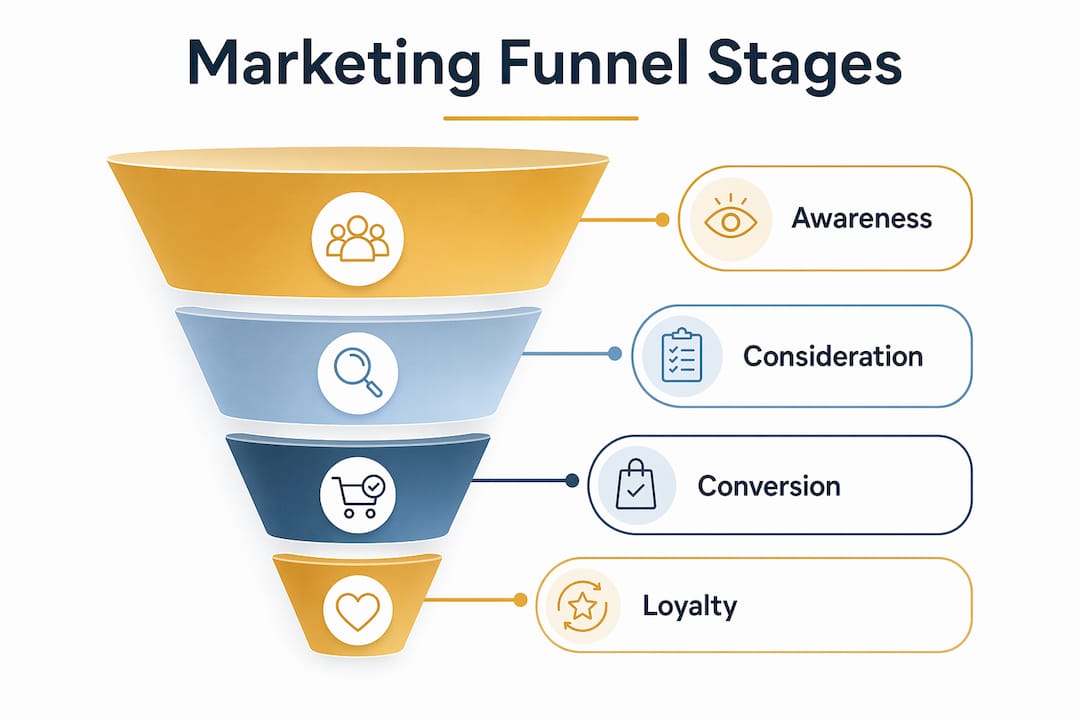
Marketing funnels follow four stages: awareness (top of funnel, TOFU), consideration (middle of funnel, MOFU), conversion (bottom of funnel, BOFU), and loyalty. Each stage demands a distinct set of tactics. Treating all four the same is the fastest way to waste your budget.
Awareness (TOFU) is where prospects first encounter your brand. SEO drives organic discovery here, including traditional text-based search, video SEO on YouTube, AI SEO for large language model visibility, and geo-targeted content for local service businesses. Google Ads and Meta advertising extend your reach to audiences who have never heard of you. Social media content on TikTok and Instagram builds brand recognition through short-form video. The goal at this stage is volume: get in front of the right people.
Consideration (MOFU) is where you build trust. Prospects know you exist. Now they are comparing options. Email nurturing sequences, webinars, detailed blog content, and remarketing campaigns keep your brand front of mind. This stage is where most businesses underinvest. They pour money into awareness ads but have no system to follow up with warm leads.
Conversion (BOFU) is where the sale happens. The tactics here focus on removing doubt and reducing friction. Testimonials, case studies, free consultations, and product demos all serve this purpose. A slow website, a confusing booking form, or a missing trust signal will kill conversions that your awareness spend already paid for.

Loyalty is the stage most businesses ignore entirely. Retention marketing, referral programmes, and personalised follow-up communications turn one-time buyers into repeat clients and advocates. This stage costs far less than acquiring new customers and delivers a higher return.
| Funnel stage | Primary goal | Example tactics |
|---|---|---|
| Awareness (TOFU) | Reach new audiences | SEO, Google Ads, TikTok, Instagram, AI SEO |
| Consideration (MOFU) | Build trust and educate | Email nurturing, remarketing, webinars, content |
| Conversion (BOFU) | Close the sale | Testimonials, demos, frictionless checkout |
| Loyalty | Retain and grow | Referral programmes, personalised offers, reviews |
Pro Tip: Map your current marketing spend against each stage. Most businesses discover they are spending 80% on awareness and almost nothing on consideration or loyalty. Rebalancing that split often produces faster revenue growth than increasing the total budget.
How has AI and social media changed funnel strategy?
The traditional funnel assumed buyers moved in a straight line from awareness to purchase. That model no longer reflects reality. 73% of buyers display non-linear behaviour, looping between exploration and evaluation before committing. This is called the “messy middle.” It means a prospect might see your Instagram ad, read a blog post, watch a YouTube video, and then search your brand name on Google before booking. Your funnel needs to be present at every one of those touchpoints.
Social media has become a primary search engine. 66.6% of US consumers use social platforms to search for products and services. That figure signals a fundamental shift in discovery behaviour. If your business is not producing video-first content on TikTok, Instagram Reels, and YouTube Shorts, you are invisible to a large portion of your potential audience at the awareness stage.
AI is reshaping discovery further. Generative AI tools like ChatGPT, Perplexity, and Google’s AI Overviews now answer buyer questions directly. If your content is not structured for AI extraction, you miss citations in these responses. AI SEO, also called GEO (Generative Engine Optimisation), focuses on getting your brand mentioned inside AI-generated answers. This is a new layer of awareness-stage visibility that did not exist three years ago.
The implications for paid advertising are significant. Strict adherence to linear funnel models risks budget misallocation because it ignores where buyers actually spend their time. A media mix that includes Google Ads for intent-based search, Meta ads for social discovery, and YouTube pre-roll for video consideration covers the non-linear journey far more effectively than any single channel.
- Produce short-form video content for TikTok and Instagram to capture social search traffic
- Optimise blog content for AI extraction with clear definitions, structured headings, and named entities
- Run remarketing campaigns across Google Display, Meta, and YouTube to re-engage looping buyers
- Use geo-targeted SEO and Google Ads to capture local intent searches
- Track cross-channel attribution to understand which touchpoints actually drive conversions
Pro Tip: Use social analytics platforms to identify which content formats drive the most profile visits and link clicks. Video content that generates saves and shares on Instagram typically signals strong MOFU intent. Redirect that audience into an email sequence immediately.
“Buyers’ journeys today are non-linear, requiring omnichannel marketing systems that can engage prospects as they loop rapidly among different funnel stages, sometimes completing the cycle within a single platform session.”, eMarketer
What are best practices for lead qualification and nurturing?
Lead qualification transforms anonymous visitors into known leads ready for active nurturing. This transition is the most critical moment in the funnel. Without it, your awareness spend generates traffic that disappears. With it, you build a repeatable asset that compounds over time.
Lead scoring is the method that makes qualification systematic. You assign point values to specific actions: downloading a guide scores differently from requesting a demo. A prospect who has visited your pricing page three times and opened four emails scores higher than someone who clicked one ad. When a lead crosses a defined score threshold, it triggers a handoff to your sales team. Lead scoring aligns marketing and sales, preventing the common problem of sales rejecting leads as unqualified while marketing insists they are ready.
Personalised email nurturing sequences move MOFU leads toward conversion without requiring manual follow-up. A well-built sequence delivers the right content at the right time based on the prospect’s behaviour. A lead who downloaded a pricing guide gets a different sequence than one who watched a webinar. CRM integration makes this tracking possible and gives your sales team full visibility of the lead’s journey before they make contact.
Misalignment between marketing and sales is one of the most common causes of wasted funnel spend. Marketing generates leads that sales ignores because the qualification criteria were never agreed upon. Fixing this requires a shared definition of what a “qualified lead” looks like, documented in your CRM and reviewed regularly.
Here is a practical process for building an effective lead qualification system:
- Define your ideal client profile with specific criteria including industry, business size, and budget
- Map the actions that indicate genuine purchase intent, such as demo requests, guide downloads, and pricing page visits
- Assign point values to each action and set a score threshold that triggers sales follow-up
- Build automated email sequences that nurture leads based on their specific behaviour
- Integrate your CRM so both marketing and sales can see the full lead history
- Review lead quality monthly with your sales team and adjust scoring criteria based on which leads actually convert
Pro Tip: Add a single qualifying question to your lead capture forms, such as “What is your monthly marketing budget?” This one field filters out tyre-kickers before they enter your nurturing sequence and saves your sales team significant time.
How do you optimise conversions and build post-sale loyalty?
Bottom-of-funnel success requires a frictionless process and social proof. These two elements work together. Social proof removes doubt. A smooth process removes the practical barriers that cause drop-off at the final step. Removing either one reduces your conversion rate.
Social proof at the BOFU stage includes client testimonials, Google reviews, before-and-after case studies, and video testimonials. The most effective format depends on your industry. Service businesses convert well with detailed written case studies that show specific results. E-commerce businesses convert well with star ratings and user-generated content. The key is placing this proof at the exact moment the buyer is deciding, not buried on a separate page.
User experience improvements at the conversion stage include reducing form fields, offering multiple payment options, displaying trust badges, and making your booking or checkout process mobile-first. A prospect who has spent two weeks in your consideration stage will abandon a checkout that takes more than three minutes to complete. Optimising UX and leveraging social proof at this stage is critical for closing sales your earlier funnel stages already warmed up.
The loyalty stage is where sustainable growth lives. Sales funnel strategies that convert consistently include post-sale systems, not just pre-sale tactics. Retention marketing, referral incentives, and personalised follow-up communications all serve this purpose.
Conversion and loyalty tactics worth implementing:
- Place client testimonials and case studies on your booking or checkout page, not just your homepage
- Reduce form fields to the minimum required for a qualified enquiry
- Send a post-purchase email sequence that delivers value and requests a review
- Build a referral programme with a clear incentive for existing clients
- Use personalised email campaigns to re-engage past clients with relevant offers
- Improve client retention by creating a structured follow-up schedule at 30, 60, and 90 days post-sale
Key takeaways
A strong marketing funnel strategy integrates SEO, paid advertising, social media, email nurturing, and retention systems across all four stages to convert leads consistently and build long-term revenue.
| Point | Details |
|---|---|
| Four-stage framework | Awareness, consideration, conversion, and loyalty each require distinct tactics and budgets. |
| Non-linear buyer behaviour | 73% of buyers loop between stages, requiring omnichannel presence across SEO, social, and paid channels. |
| Lead qualification | Lead scoring based on specific actions aligns marketing and sales, reducing wasted spend. |
| Social proof at BOFU | Testimonials and case studies placed at the conversion stage directly reduce drop-off. |
| AI and social SEO | Optimising for AI extraction and social search is now a core awareness-stage requirement. |
What I have learned running funnels for Australian service businesses
The biggest mistake I see business owners make is treating the funnel as a one-time build. They set up a landing page, run some Google Ads, and wonder why results plateau after three months. A funnel is a living system. Buyer behaviour changes, platform algorithms shift, and your competitors adapt. Your funnel needs to adapt with them.
The non-linear buyer journey is real and it changes how you allocate budget. Successful funnels embrace omnichannel approaches that meet prospects across multiple platforms, sometimes compressing the entire discovery-to-purchase cycle into a single session. That means your Meta ad, your Google remarketing, your Instagram Reel, and your email sequence all need to tell a consistent story. Inconsistency across channels is invisible to you but obvious to the buyer.
AI SEO is not optional anymore. If your content does not appear in AI-generated answers on ChatGPT or Perplexity, you are losing awareness-stage visibility to competitors who have invested in structured, entity-rich content. This is the new front page of search. The businesses that win in 2026 are the ones building content specifically designed for AI citation, not just Google ranking.
The marketing and sales handoff is where most funnels silently fail. I have seen businesses with excellent lead generation and terrible conversion rates, and the cause is almost always a broken handoff process. Agreed lead scoring criteria, shared CRM visibility, and a documented follow-up protocol fix this faster than any new ad campaign.
Test one variable at a time. Change your headline, your call to action, or your landing page layout, but never all three at once. Data-driven decisions require clean data. If you change everything simultaneously, you learn nothing.
, Business Warriors | Digital Marketing Agency
How Jarrodharman helps you build a funnel that actually converts
Jarrodharman’s Marketing Vortex method is an integrated system that combines SEO, Google Ads, Meta advertising, email marketing, social media, and web development into a single omnichannel funnel. It is built specifically for service-based businesses that need consistent leads and measurable results, not just traffic.
If you are a business owner or marketing manager ready to build a funnel that works across every stage, Jarrodharman offers digital marketing growth strategies tailored to your industry, your budget, and your growth targets. From AI SEO and paid advertising to lead nurturing and client retention, the full system is designed to generate bookings and revenue, not just clicks. Visit jarrodharman.com to see how the Marketing Vortex method applies to your business.
FAQ
What is a marketing funnel strategy?
A marketing funnel strategy is a structured plan that guides potential customers through four stages: awareness, consideration, conversion, and loyalty. Each stage uses specific tactics to move prospects closer to a purchase and retain them afterwards.
How do you build a marketing funnel from scratch?
Start by defining your ideal client, then map content and tactics to each funnel stage. Use SEO and paid ads for awareness, email nurturing for consideration, social proof for conversion, and retention programmes for loyalty.
Why do most marketing funnels fail to convert?
Most funnels fail because of poor lead qualification, misalignment between marketing and sales, or no system at the conversion and loyalty stages. Lead scoring and CRM integration fix the most common causes of drop-off.
How does AI affect marketing funnel strategy in 2026?
AI-powered tools like ChatGPT and Perplexity now answer buyer questions directly, making AI SEO and GEO a core awareness-stage tactic. Businesses that optimise content for AI extraction gain visibility that traditional SEO alone cannot deliver.
What is the difference between a sales funnel and a marketing funnel?
A marketing funnel covers the full journey from brand discovery to post-sale loyalty. A sales funnel typically refers to the narrower process of converting a qualified lead into a paying client, starting at the consideration or conversion stage.