13 July 2026
What is local lead generation: your 2026 guide
Discover what local lead generation is and how it can boost your business visibility and customer inquiries in your area. Explore strategies now!
TL;DR:
- Local lead generation involves attracting and converting nearby prospects through coordinated visibility, trust signals, and rapid response. Businesses using multi-channel strategies like SEO, paid ads, and outreach see faster pipeline growth and higher-quality leads. Tracking and automating reviews, responses, and attribution are essential for sustained success and growth.
Local lead generation is the practice of attracting and converting potential customers within a specific geographic area through targeted visibility, trust signals, and rapid response. For Australian business owners, this means combining local SEO strategies, Google Business Profile management, paid advertising, social media, and outbound outreach into one coordinated system. The industry term for this broader practice is “local customer acquisition,” and it goes well beyond ranking on Google. 76% of mobile searchers visit a business within 24 hours of searching. That single fact tells you everything about the urgency of getting your local visibility right.
What is local lead generation and why does it matter?
Local lead generation is defined as the process of generating qualified enquiries from prospects within a defined geographic market, then converting those enquiries into paying customers. It is not the same as general digital marketing. The goal is hyper-specific: attract the right person in the right suburb at the right moment.

The multi-channel approach to local lead gen produces higher qualified lead volume than any single tactic alone. This means your Google Business Profile, your Facebook ads targeting a 10km radius, your SEO content, and your outbound email sequences all need to work together. Businesses that treat local lead generation as “just SEO” leave significant revenue on the table.
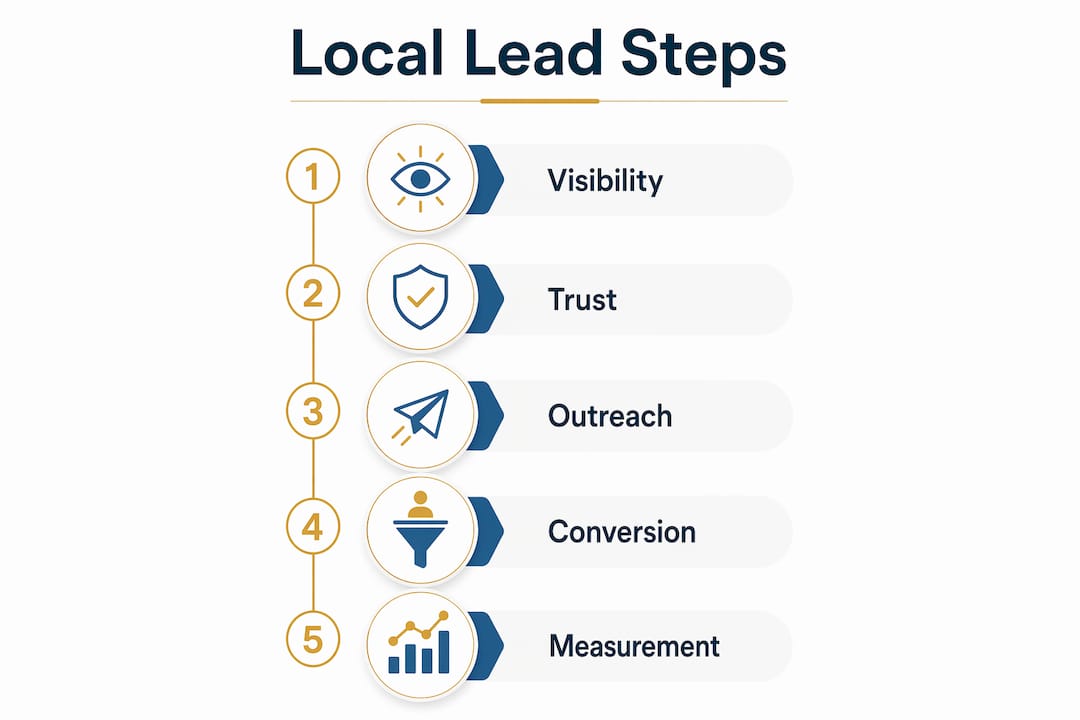
Three core components drive results. First, visibility: your business must appear when and where local prospects search. Second, trust: reviews, social proof, and a professional web presence convert visitors into enquiries. Third, responsiveness: the speed at which you reply to a lead determines whether you win or lose the booking.
How does local SEO drive qualified leads?
Local SEO is the intersection of visibility and conversion-focused web design. It combines Google Business Profile optimisation, review velocity, mobile conversion speed, and locally specific content into one system. Each element feeds the others.
Your Google Business Profile is the single most visible asset in local search. A complete profile with accurate categories, service areas, photos, and weekly posts signals to Google that your business is active and relevant. Incomplete profiles rank lower and convert fewer visitors into calls.
Reviews are the trust currency of local search. 80% of consumers prefer businesses that respond to every review, and generic replies deter 50% of potential leads. That means a copy-paste “Thanks for your feedback!” response actively costs you customers. Write personalised replies that mention the service, the outcome, and your appreciation.
Recency matters as much as volume. 74% of consumers prioritise reviews posted within the last three months. A business with 200 reviews from two years ago loses to a competitor with 30 reviews from last month. Consistent review acquisition is not optional. It is a core operational task.
Pro Tip: Automate your review requests. Sending review requests within two hours of service completion significantly increases the rate at which customers follow through. Use your CRM or booking software to trigger these messages automatically.
One technical trap catches many business owners. When you search for your own business on Google while logged into your account, you see a personalised result. It is not what your customers see. Use grid-based rank tracking tools or incognito browsing to measure your true local rankings accurately.
What is outbound local lead generation?
Outbound local lead generation is the practice of proactively reaching out to qualified prospects in your area rather than waiting for them to find you. It contrasts with inbound methods, where the customer initiates contact. Both approaches are necessary for a full pipeline.
Outbound works by targeting a defined list of local accounts that match your ideal customer profile. For a Perth med spa, that might mean targeting women aged 35–50 within a 15km radius who have shown interest in beauty or wellness services. The tighter your qualification criteria, the better your results.
Cold outreach to local accounts yields reply rates of 5%–8%. That figure sounds low, but it means one in every 12–20 contacts responds. With personalised messaging that references a specific local context, such as a recent community event or a local competitor gap, those rates improve.
A structured outbound process looks like this:
- Build a targeted local prospect list using criteria such as location, industry, business size, and buying signals.
- Write personalised outreach messages that reference something specific to the prospect’s situation or area.
- Follow up at least three times across different channels, including email, phone, and LinkedIn.
- Log every interaction in your CRM so no lead falls through the cracks.
- Track reply rates, meeting rates, and conversion rates by list segment to identify what works.
Pro Tip: Combining inbound and outbound local lead generation produces faster pipeline development and higher quality leads than either method alone. Run your SEO and Google Ads to capture demand, and run outbound sequences to create demand.
How do social media and paid ads boost local lead generation?
Paid advertising and social media marketing are the accelerators of local customer acquisition. SEO builds long-term visibility. Paid ads deliver leads this week.
Google Ads with location targeting puts your business in front of prospects at the exact moment they search for your service. A salon in Subiaco running Google Ads for “eyebrow tinting near me” captures high-intent traffic that organic SEO may take months to reach. The key is matching your ad copy to the specific local intent of the search.
Meta advertising, which covers Facebook and Instagram, works differently. It targets demographics and interests rather than search intent. For service businesses, this means you can reach your ideal local customer based on age, location, interests, and behaviour, even before they know they need you. Social media advertising builds awareness that converts into inbound enquiries over time.
The most effective local paid advertising strategy combines both:
- Google Ads for high-intent, bottom-of-funnel searches (“book a facial in Fremantle”)
- Meta ads for awareness and retargeting of website visitors and lookalike audiences
- Geo-targeted display ads to maintain visibility across local news and lifestyle sites
- Retargeting campaigns that follow up with people who visited your site but did not enquire
AI-driven ad optimisation now handles much of the bid management and audience refinement automatically. Google’s Performance Max campaigns and Meta’s Advantage+ targeting use machine learning to find the local prospects most likely to convert. Your job is to feed these systems with strong creative, clear offers, and accurate conversion tracking.
Connecting your ad accounts to your CRM closes the attribution loop. You can see exactly which ad, which keyword, or which audience segment produced a booked appointment. That data tells you where to spend more and where to cut.
How does AI improve local lead generation?
AI is reshaping every part of the local lead generation funnel, from how prospects find you to how quickly you respond to their enquiry.
In search, AI-powered results in Google and tools like Perplexity and ChatGPT now surface local business recommendations directly in the answer. Getting your brand mentioned in these AI-generated responses, a practice known as GEO (Generative Engine Optimisation), requires the same foundations as traditional local SEO: authoritative content, strong reviews, and consistent business information across the web.
Fast response is a competitive necessity in AI-assisted search environments. Immediate replies are more likely to secure leads. AI-powered chatbots and automated SMS responses handle after-hours enquiries so no lead waits until the next business day. For a clinic or salon, that difference between a 10-minute response and a 10-hour response can mean the difference between a booked appointment and a lost customer.
| AI Application | Local Lead Gen Benefit |
|---|---|
| Chatbots and SMS automation | Captures and qualifies leads 24 hours a day |
| Grid-based rank tracking | Shows true local search visibility without personalisation bias |
| Automated review requests | Increases review volume through timely post-service triggers |
| AI ad optimisation | Finds highest-converting local audiences automatically |
| CRM lead scoring | Prioritises follow-up based on prospect behaviour and fit |
Pro Tip: Attribution tracking tied to CRM routing is the most overlooked part of local lead generation. Without it, you cannot tell which channels produce revenue. Set up source tracking from day one, not after you have spent six months on ads.
How do you measure local lead generation success?
Measurement turns local lead generation from guesswork into a system you can improve. The businesses that grow fastest are the ones that track the right numbers and act on them.
The key performance indicators for local lead generation are:
- Lead volume by channel: How many enquiries came from Google organic, Google Ads, Meta ads, referrals, and outbound outreach each month?
- Cost per lead: What did each channel cost to produce one qualified enquiry?
- Lead-to-booking rate: What percentage of enquiries converted into a confirmed appointment or sale?
- Review acquisition rate: How many new reviews did you receive this month, and what is the average rating?
- Response time: What is your average time to first reply to a new enquiry?
Tracking these numbers requires connecting your tools. Your Google Analytics account, Google Ads account, Meta Ads Manager, CRM, and booking software all need to share data. Without this connection, you are making decisions based on incomplete information.
Online reviews drive measurable revenue growth for small and medium businesses. Tracking your review count, average rating, and response rate as formal KPIs gives you a clear picture of your trust-building progress.
Ongoing testing is what separates good local lead generation from great local lead generation. Test different ad creatives, different landing page headlines, different review request timing, and different outreach messages. Run each test for long enough to collect meaningful data, then scale what works and cut what does not. For more on building a complete lead generation strategy, the principles of testing and iteration apply at every stage of the funnel.
The AI-driven lead generation landscape in 2026 means your measurement framework also needs to account for brand mentions in large language models. If ChatGPT or Perplexity recommends a competitor when someone asks for a local service provider, that is a visibility gap you need to close.
Key takeaways
Local lead generation requires a coordinated system of visibility, trust, outreach, and measurement working together to produce consistent, qualified enquiries from your local market.
| Point | Details |
|---|---|
| Multi-channel approach | Combining SEO, paid ads, social media, and outbound outreach produces more leads than any single channel. |
| Reviews drive conversions | 74% of consumers prioritise recent reviews; automate requests within two hours of service completion. |
| Outbound fills gaps fast | Cold outreach yields 5%–8% reply rates and accelerates pipeline when inbound alone is too slow. |
| AI speeds up response | Automated replies and chatbots capture leads around the clock and improve conversion rates. |
| Attribution is non-negotiable | CRM-linked source tracking is the only way to know which marketing spend produces real revenue. |
The honest truth about local lead generation in 2026
After working with service businesses across Australia, one pattern stands out clearly. Most business owners focus on getting more leads. The ones who grow fastest focus on the full system: visibility, response speed, trust, and attribution all at once.
The single biggest mistake I see is over-reliance on one channel. A business that depends entirely on Google organic rankings is one algorithm update away from losing half its pipeline. A business running only paid ads stops generating leads the moment the budget runs out. The answer is a system where each channel supports the others, which is exactly what the Marketing Vortex method is built to do.
Vanity metrics are the other trap. Page one rankings feel good. A high follower count feels good. Neither pays the bills. The only metrics that matter are enquiries, bookings, and revenue attributed to specific channels. If you cannot trace a lead back to its source, you cannot improve your results.
The future of local lead generation belongs to businesses that treat AI as a tool, not a replacement for strategy. AI can automate review requests, qualify leads, and optimise ad bids. It cannot replace a clear offer, a well-trained team, and a genuine commitment to customer experience. Build the system first. Then let AI make it faster.
, Business Warriors | Digital Marketing Agency
How Jarrodharman can help you generate more local leads
Jarrodharman works with service-based businesses across Australia to build local lead generation systems that produce consistent, measurable results.
Jarrod Harman and the Business Warriors team combine local SEO, Google Ads, Meta advertising, and CRM-linked attribution into one integrated approach. The Marketing Vortex method is designed specifically for businesses that need leads now and want a system that keeps delivering over time. Whether you run a clinic, a salon, a law firm, or a service business of any kind, the process is the same: build visibility, build trust, and convert faster. Explore Jarrod’s approach and see how the system works for businesses like yours.
FAQ
What is local lead generation in simple terms?
Local lead generation is the process of attracting potential customers from a specific geographic area and converting them into enquiries or bookings. It combines SEO, paid ads, reviews, and outreach to reach nearby prospects.
Is local SEO the same as local lead generation?
Local SEO is one component of local lead generation, not the whole system. A complete local lead generation strategy also includes paid advertising, social media, outbound outreach, and CRM tracking.
How quickly should I respond to a local lead?
Immediate response is the standard. Fast replies significantly increase the likelihood of converting a lead, particularly in competitive local markets where prospects contact multiple businesses at once.
How many reviews do I need to generate local leads?
Review recency matters more than total volume. 74% of consumers prioritise reviews from the last three months, so a steady flow of new reviews outperforms a large but outdated collection.
What is the best way to track local lead generation results?
Connect your Google Analytics, Google Ads, Meta Ads Manager, and CRM into one attribution system. Tracking lead volume, cost per lead, and lead-to-booking rate by channel gives you the data needed to improve your marketing spend.