


TL;DR:
- Effective online lead nurturing requires multiple personalized touchpoints across multiple channels over time.
- Segmentation and automation help deliver relevant messages tailored to each prospect’s journey stage.
- Monitoring key KPIs and testing variables optimize nurture sequences for higher conversion rates.
Most service businesses invest real money attracting online leads, then watch those prospects go cold because follow-up falls flat. The gap between interest and income isn’t usually a traffic problem. It’s a nurturing problem. 50% of leads are not yet sales-ready when they first make contact, which means a single email or one social post simply won’t cut it. This guide walks you through a proven, step-by-step approach to building digital nurture systems that keep prospects engaged, build trust over time, and turn online enquiries into consistent, paying clients for your Australian service business.
Table of Contents
- Understanding the modern buyer journey online
- Preparation: Tools and segmentation for nurturing success
- Execution: Multi-channel nurturing strategies that convert
- Optimise and measure: Improving your prospect nurture process
- Our perspective: Why ‘persistent nurturing’ alone falls short
- Take the next step towards consistent sales growth
- Frequently asked questions
Key Takeaways
| Point | Details |
|---|---|
| Multi-touch journey | Turning prospects into clients online requires 8 or more touchpoints across channels. |
| Segmentation matters | Personalised nurturing by buyer stage and behaviour drives conversion far better than generic follow-ups. |
| Smart tools essential | A CRM and automated triggers let you nurture at scale without losing the human touch. |
| Measure and refine | Tracking response and adjusting your approach are vital for consistent sales growth. |
Understanding the modern buyer journey online
The way prospects make decisions online has shifted dramatically. Gone are the days when a potential client would see your ad, pick up the phone, and book. Today’s buyer researches, compares, reads reviews, and consumes content across multiple platforms before committing to anything. Understanding this journey is the foundation of any effective lead nurturing process.
Most service prospects move through three distinct stages before they convert:
- Awareness: They realise they have a problem and start searching for solutions.
- Consideration: They’re comparing options, reading testimonials, and evaluating providers.
- Decision: They’re ready to act and are choosing between a shortlist of businesses.
The critical insight here is that most of your leads are sitting in the awareness or consideration stage when they first find you. Segmenting audiences by buyer journey stage allows you to deliver the right message at the right moment, rather than sending every prospect the same generic pitch.
How many touchpoints does it actually take? The numbers might surprise you. Research consistently shows that service prospects need between 8 and 20 meaningful interactions before they’re ready to buy. That’s not 8 emails in a week. That’s 8 to 20 relevant, value-driven contacts spread across channels and time.
| Buying stage | Typical touchpoints needed | Best content type |
|---|---|---|
| Awareness | 1 to 4 | Educational blogs, social posts, short videos |
| Consideration | 5 to 12 | Case studies, testimonials, comparison guides |
| Decision | 13 to 20+ | Free consultations, offers, direct outreach |
For Australian service businesses specifically, online lead nurturing needs to account for how local buyers prefer to communicate. SMS is increasingly powerful, particularly for under-44 audiences who expect fast, personal responses. Mapping your prospect’s journey before you build any nurture sequence saves you enormous time and prevents the common mistake of treating every lead identically.
Preparation: Tools and segmentation for nurturing success
Once you understand the journey, you need the right setup to guide prospects forward. The good news is that you don’t need an enterprise-level tech stack to get started. You need three core components working together: a CRM, a communication platform, and basic analytics.
Here’s a practical comparison of common tools Australian service businesses use:
| Tool type | Entry-level option | Mid-level option | What it does |
|---|---|---|---|
| CRM | HubSpot Free | ActiveCampaign | Stores contacts, tracks behaviour |
| Email/SMS | Mailchimp | Klaviyo | Sends automated sequences |
| Analytics | Google Analytics | HubSpot Reports | Measures engagement and conversions |
Personalising via CRM integration, whether through MYOB, HubSpot, or another platform, enables drip campaigns and content personalisation that make your follow-up feel human rather than robotic. This is what separates businesses that convert at scale from those that rely on manual follow-up alone.
Segmentation is where most businesses skip a step. Rather than treating your entire list the same way, divide your prospects by:
- Behaviour: Did they visit your pricing page? Download a resource? Watch a video?
- Fit: Are they in your target location, industry, or budget range?
- Stage: Where are they in the awareness to decision journey?
- Engagement level: Are they opening emails, clicking links, or going quiet?
Lead scoring is a simple way to prioritise your effort. Assign points for actions like opening three emails in a row, visiting your booking page, or clicking a case study link. When a prospect hits a threshold score, trigger a more direct outreach.

Choosing the right lead generation software for your business size matters enormously here. Overcomplicating your stack early is a common trap.
Pro Tip: Set up automated nurture triggers from day one. When a prospect submits a form or views your services page twice, that’s a signal. Your CRM should automatically enrol them in a relevant sequence without you lifting a finger. This is how you nurture leads for growth without burning out your team.
Execution: Multi-channel nurturing strategies that convert
With systems in place, you’re ready to nurture prospects directly. The biggest mistake service businesses make here is relying on a single channel. Multi-channel nurturing using email as the primary channel, combined with social, retargeting ads, SMS, and direct mail, consistently outperforms single-channel approaches.
Here’s a sample nurture sequence for a new enquiry:
- Day 1: Automated welcome email with a helpful resource (not a sales pitch).
- Day 3: Retargeting ad on Meta showing a relevant client success story.
- Day 5: Second email with a case study or before-and-after result.
- Day 8: SMS message with a personalised check-in or limited-time offer.
- Day 14: Social media engagement (comment on their post or send a DM if appropriate).
- Day 21: Email with a soft call to action, such as booking a free consultation.
- Day 30+: Ongoing value emails every 7 to 10 days until they convert or opt out.
This sequence works because it mirrors how real relationships are built. Each touchpoint adds value before asking for anything. The omnichannel marketing approach ensures your brand stays visible across the platforms your prospects actually use.
“75% of Australians under 44 prefer SMS for business communication, making text-based follow-up a critical part of any nurture sequence for service businesses.”
SMS response rates are significantly higher than email for time-sensitive messages, which is why blending both channels is so effective. The key is using SMS sparingly and only when the message is genuinely relevant and personal.
The most common execution mistake is sending generic email blasts to your entire list. Prospects can tell when a message wasn’t written for them. Tailor your content to each segment and stage, and your online lead conversions will improve noticeably. Understanding multi-channel marketing principles helps you build sequences that feel cohesive rather than scattered.
Pro Tip: Write your nurture emails as if you’re writing to one specific person, not a list. Use their first name, reference the service they enquired about, and keep the tone conversational. This single shift can double your reply rates.
Optimise and measure: Improving your prospect nurture process
Execution alone isn’t enough. Nurturing works best when it’s measured and improved. Without tracking the right metrics, you’re essentially flying blind.
The key performance indicators (KPIs) every service business should monitor are:
| KPI | What it tells you | Benchmark to aim for |
|---|---|---|
| Email open rate | Subject line and sender reputation | 35%+ |
| Click-through rate | Content relevance and CTA strength | 2.5%+ |
| Lead progression rate | How many move from enquiry to consultation | Varies by industry |
| Time to conversion | How long your nurture cycle actually takes | Track and improve |
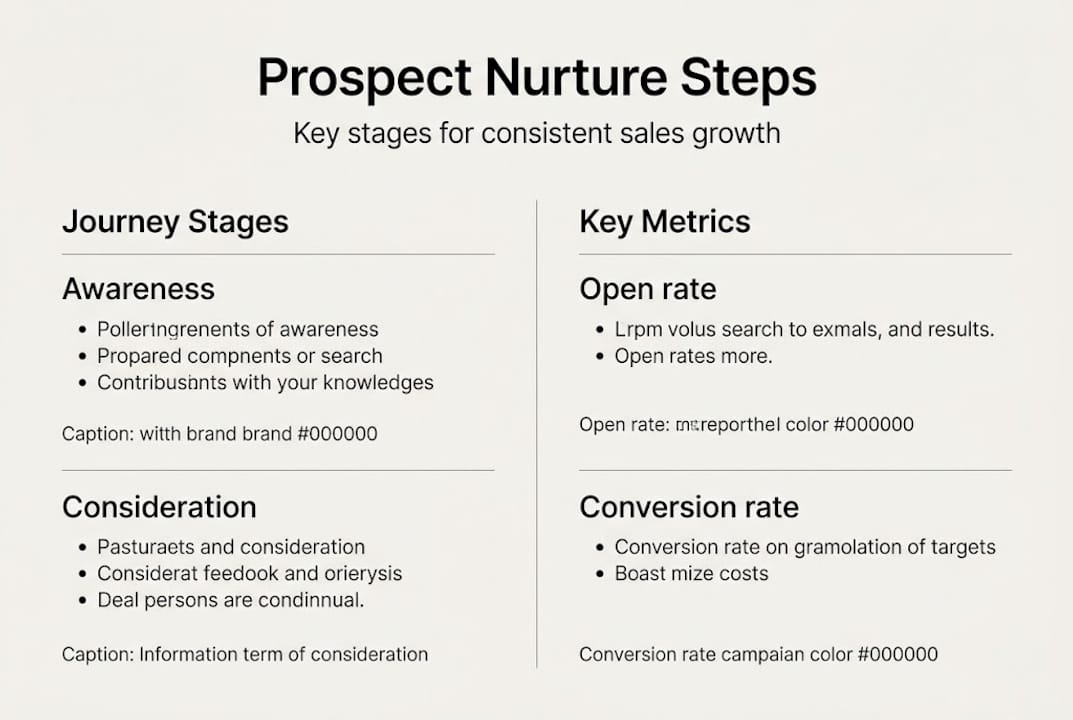
Mailchimp benchmarks show average open rates of 35.63% and click-through rates of 2.62% across industries. Use these as your baseline and work to exceed them through testing.
A/B testing is your most powerful optimisation tool. Test one variable at a time:
- Subject lines (question vs. statement vs. personalised)
- Send times (morning vs. evening, weekday vs. weekend)
- Call-to-action wording (“Book a call” vs. “Claim your free strategy session”)
- Email length (short and punchy vs. detailed and educational)
AI tools for lead scoring and subject line optimisation can increase open rates by up to 25%, but human input remains essential for handling objections and crafting messages that feel genuine. Don’t hand the entire process to automation.
The top optimisation mistakes to avoid are:
- Set-and-forget workflows: Sequences need regular reviews, at least quarterly.
- Ignoring unsubscribes: High unsubscribe rates signal irrelevant content, not just list fatigue.
- No personalisation: Generic sequences consistently underperform segmented ones.
- Skipping the data: Your lead conversion strategies should be driven by what the numbers tell you, not gut feel alone.
Set a monthly review date to check your KPIs, update your sequences, and test new approaches. Nurturing is a living system, not a one-time build.
Our perspective: Why ‘persistent nurturing’ alone falls short
Here’s the truth most marketers won’t tell you: sending more messages doesn’t equal more sales. Buyers have become remarkably good at ignoring noise. Inboxes are full. SMS notifications are muted. Social feeds are saturated. Volume alone is not a strategy.
65% of marketers still lack structured nurture programmes, yet personalised, multi-channel approaches generate 63% higher response rates. The gap isn’t in effort. It’s in intent.
The businesses winning at nurturing in 2026 are the ones leading with genuine value, not persistence. They send fewer messages, but each one is more relevant, better timed, and clearly connected to what the prospect actually cares about. That requires knowing your audience deeply, not just having a long email sequence.
Our advice: audit your current nurture sequences and ask honestly whether each message earns the right to the next one. If you’re nurturing for business growth with authenticity and context as your guide, you’ll stand out in a crowded market without needing to shout louder than everyone else.
Take the next step towards consistent sales growth
Building a nurture system that consistently converts prospects into clients takes the right strategy, the right tools, and honest expertise. If you’ve read this far, you already understand the framework. The next step is putting it into practice.
At Business Warriors, Jarrod Harman and the team specialise in building exactly these kinds of systems for Australian service businesses. The marketing vortex method integrates every channel into a single, cohesive growth engine. Explore proven online client strategies tailored for businesses like yours, or meet Jarrod Harman to learn how personalised support can accelerate your results. The businesses growing fastest right now aren’t working harder. They’re nurturing smarter.
Frequently asked questions
What is the best channel for nurturing prospects online?
Email remains the most effective primary channel for nurturing, but combining it with SMS, social, and retargeting consistently delivers the strongest conversion results across service industries.
How many touchpoints do I need to convert an online lead?
Service prospects typically need between 8 and 20 touchpoints before they’re ready to buy, with trust-building across long nurture cycles being the key factor in conversion.
How do I know if my nurture process is working?
Track your email open rates against the 35.63% industry benchmark, monitor click-through rates above 2.5%, and measure how many leads progress from initial enquiry to booked consultation each month.
What’s the fastest way to warm up cold leads online?
A personalised re-engagement sequence over 60 to 90 days using educational content, direct SMS outreach, and a genuine offer works far better than a single re-engagement email blast.