15 April 2026
Why use multi-channel marketing: boost client growth and sales
Discover why multi-channel marketing drives 287% higher purchase rates for Australian service businesses and how to build a system that grows clients and sales.
TL;DR:
- Multi-channel marketing achieves significantly higher purchase rates and ROI for service businesses.
- Consistent messaging across selected platforms builds trust and increases client lifetime value.
- Focusing on three targeted channels and measuring results ensures effective and scalable growth.
Most service businesses in Australia rely on one or two marketing channels and wonder why growth feels slow. The numbers tell a different story. Campaigns using 3+ channels achieve 287% higher purchase rates than single-channel efforts, and 78% of marketers report stronger ROI when they spread their message across multiple platforms. If you run a salon, clinic, law firm, or any other service-based business, this guide will show you exactly what multi-channel marketing is, why it works, and how to build a system that brings in consistent clients and drives real sales growth.
Table of Contents
- What is multi-channel marketing?
- The proven benefits: ROI, sales, and client lifetime value
- How multi-channel marketing works in practice
- Choosing the right channels for your service business
- Getting started: Steps to launch your multi-channel campaign
- Why most businesses get multi-channel marketing wrong and what to do instead
- Expert help to build a high-performing multi-channel system
- Frequently asked questions
Key Takeaways
| Point | Details |
|---|---|
| Higher ROI | Multi-channel marketing delivers a measurable increase in return on investment compared to focusing on a single platform. |
| Increased purchases | Using three or more channels can result in 287% higher purchase rates from clients. |
| Longer client value | Client lifetime value jumps by 30% when service providers adopt a multi-channel approach. |
| Start with three channels | Launching with three targeted channels strikes the best balance of impact and manageability. |
What is multi-channel marketing?
Multi-channel marketing means showing up for your potential clients across more than one platform at the same time. Instead of putting all your effort into, say, Facebook ads alone, you combine several touchpoints, such as Google search, email, social media, and local directories, to reach people wherever they already spend their time. Understanding what is multichannel marketing at a practical level is the first step toward using it well.
Single-channel marketing, by contrast, means funnelling every dollar and hour into one outlet. It feels simpler, but it leaves you completely exposed if that one channel changes its algorithm, raises its costs, or simply stops performing. One platform shift can wipe out months of progress overnight.
Here are the channels Australian service businesses use most often:
- Google Search and Google Ads
- Facebook and Instagram (Meta) advertising
- Email marketing and SMS sequences
- SEO and Google Business Profile
- LinkedIn for professional services
- YouTube and short-form video content
A common misunderstanding is that multi-channel marketing just means posting the same content everywhere. It does not. Each channel has its own audience behaviour, format, and tone. The goal is a coordinated strategy where every channel reinforces the others.
“Multi-channel approaches can increase purchasing frequency by up to 250%, making it one of the most powerful levers for service business growth.”
Pro Tip: Before adding new channels, survey your existing clients and ask where they first heard about you. Start there, then expand outward.
The proven benefits: ROI, sales, and client lifetime value
With a clear understanding of the concept, let’s look closely at what you actually gain by adopting a multi-channel approach.

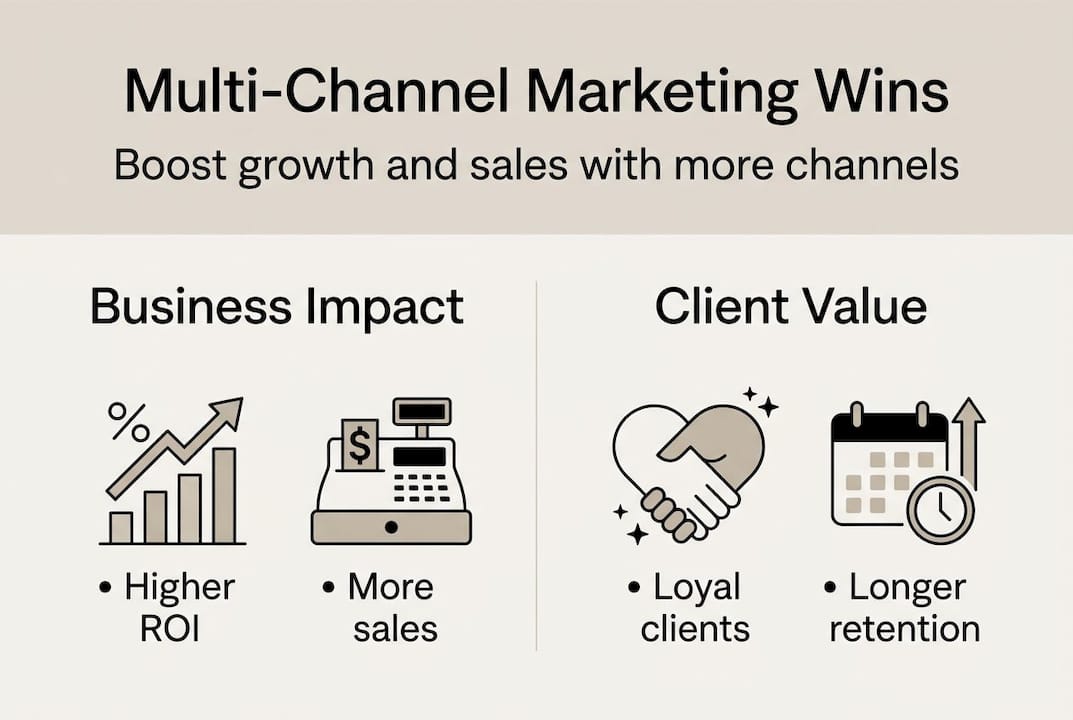
The financial case is hard to ignore. 78% of marketers report higher ROI when they use multi-channel strategies, and clients who engage across multiple touchpoints show a 30% boost in lifetime value compared to those reached through a single channel. That means more repeat bookings, stronger referrals, and a business that compounds its growth over time.
Here is a direct comparison of what the data shows:
| Metric | Single-channel | Multi-channel |
|---|---|---|
| Purchase rate | Baseline | Up to 287% higher |
| Purchasing frequency | Baseline | Up to 250% higher |
| Customer lifetime value | Baseline | Up to 30% higher |
| Marketer-reported ROI | Lower | 78% report improvement |
For cross-channel marketing for sales growth, the compounding effect is what makes the biggest difference. A client who finds you on Google, follows you on Instagram, and then receives a well-timed email is far more likely to book than someone who saw one ad once.
Top benefits for service-based businesses include:
- More consistent lead flow, even when one channel underperforms
- Stronger brand recall because clients see you in multiple places
- Higher average spend per client due to increased trust
- Better attribution for marketing ROI so you know what is actually working
- Reduced risk from algorithm changes or platform disruptions
The bottom line is that diversifying your marketing channels is not just a nice idea. It is a measurable competitive advantage.
How multi-channel marketing works in practice
Evidence of strong results is compelling, but how does multi-channel marketing actually play out in a real Australian service business?
The process starts with mapping your client journey. Think about every step a new client takes from first hearing about you to booking and then returning. Each stage is an opportunity to place a relevant message on the right platform.
Here is a practical framework to follow:
- Define your ideal client and identify which platforms they use daily.
- Map the journey from awareness (Google search, social media ad) to consideration (website visit, email opt-in) to decision (booking, phone call).
- Create consistent messaging across all channels. Your tone, offer, and visuals should feel unified, even if the format changes.
- Set up tracking so you can see which channel each new client came from.
- Automate follow-up sequences using email or SMS to re-engage anyone who did not book on the first visit.
Multi-channel campaigns with 3+ channels achieve 287% higher purchase rates, and the reason is simple: repetition builds trust. A prospect who sees your brand three times across three different platforms is far more likely to take action than someone who saw you once.
The marketing vortex method is built on exactly this principle, pulling clients through a coordinated sequence of touchpoints rather than relying on a single ad to do all the work. For a broader view of how to structure your approach, a solid digital marketing strategy guide can help you prioritise.
Pro Tip: Use a free tool like Google Analytics or a CRM with source tracking to record where every new lead comes from. After 30 days, you will have clear data on which channels deserve more investment.
A common pitfall is launching on too many platforms at once without a clear plan. Start with three channels, get them working together, then add more.
Choosing the right channels for your service business
Now that you know how multi-channel marketing functions day-to-day, let’s tackle a critical success factor: choosing the channels that actually reach your best clients.
Not every platform suits every business. A med spa targeting women aged 35 to 50 in Perth will get very different results from LinkedIn versus Instagram. The most successful campaigns are built on platforms where ideal clients already spend the most time, not on whatever is currently trending.
Top performing channels for Australian service businesses in 2026:
- Google Search Ads and SEO: Captures high-intent clients actively searching for your service
- Facebook and Instagram Ads: Strong for visual services and local audience targeting
- Email marketing: Highest ROI per dollar spent for nurturing existing leads
- Google Business Profile: Essential for local discovery and reviews
- YouTube: Builds authority and trust for complex or high-ticket services
When choosing channels, consider three things: your budget, your team’s capacity to create content, and where your message fits naturally. A well-produced video works brilliantly on YouTube but may feel out of place in a text-heavy LinkedIn post.
Explore social media marketing strategies to understand which social formats drive the most engagement for service businesses, and review types of marketing strategies to see how digital channels fit into your broader plan.
Pro Tip: Pick three channels and run them consistently for 60 days before adding a fourth. Consistency on fewer channels always outperforms scattered effort across many.
Measure results by tracking leads, bookings, and cost per acquisition on each platform monthly. Cut what is not working and reinvest in what is.
Getting started: Steps to launch your multi-channel campaign
With channel choices clear, the next question is execution. Here is how to design and run your first integrated, multi-channel marketing campaign.
Campaigns spanning at least three channels see the strongest impact on client acquisition and purchase frequency, so your goal from day one should be to reach that threshold in a coordinated way.
Follow these steps to launch:
- Research your audience. Build a clear picture of your ideal client, including their age, location, pain points, and which platforms they use.
- Set specific goals. Decide on measurable KPIs (key performance indicators) such as 20 new enquiries per month or a 15% increase in repeat bookings.
- Choose your three starting channels. Based on your research, select the platforms most likely to reach your audience at each stage of their journey.
- Create your core message. Write a clear, benefit-focused message that stays consistent across all channels, even as the format adapts.
- Build your tracking system. Set up UTM parameters (tracking codes added to URLs) in Google Analytics and connect your CRM so every lead is attributed correctly.
- Launch and monitor weekly. In the first four weeks, check performance data every week and make small adjustments to targeting, budget, or creative.
- Refine and scale. After 60 days, double down on the channels delivering the best cost per lead and consider adding a fourth channel.
For ideas on growing your audience through social platforms, social media growth strategies offers practical frameworks you can apply immediately. The key is to treat your campaign as a living system, not a one-off project.
Why most businesses get multi-channel marketing wrong and what to do instead
Here is the uncomfortable truth: most businesses that try multi-channel marketing do not fail because the strategy is flawed. They fail because they chase every new platform without a unifying plan.
We see it constantly. A business owner hears that TikTok is growing, adds it to their mix, then reads that LinkedIn is booming and jumps there too. Within three months they are producing content for five platforms, none of it is performing well, and they are exhausted. The problem was never the channels. It was the absence of a tight, integrated strategy holding everything together.
What actually works is a 360° marketing strategy built around three to four channels that are deliberately connected. One local service business we worked with cut from six platforms down to three, focused on consistent messaging and disciplined tracking, and saw sustained growth within 90 days. No new platforms. No extra budget. Just better integration.
Consistency beats novelty every single time. Measurement beats guessing. And a tightly integrated campaign with fewer channels will always outperform a scattered presence across many.
Expert help to build a high-performing multi-channel system
If the frameworks in this article have sparked ideas but you want faster results without the trial and error, Business Warriors can help. We build done-for-you multi-channel marketing systems specifically for Australian service businesses, combining SEO, Google Ads, Meta advertising, email, and social into one coordinated engine.
Our 360° strategy for service businesses is designed to pull clients through every stage of their journey, from first search to loyal repeat customer. If you want to see how a marketing vortex for leads works in practice, or you are ready to attract more online clients with a proven system behind you, reach out to our team for a custom strategy session. We will map out exactly which channels fit your business and how to connect them for maximum impact.
Frequently asked questions
What is the main advantage of multi-channel marketing?
78% of marketers report higher ROI with multi-channel marketing, and clients engaged across multiple platforms show stronger purchase frequency and longer-lasting relationships compared to those reached through a single channel.
How many channels should a service business use?
Start with three well-chosen channels for the biggest impact without stretching your resources too thin. Campaigns with 3+ channels deliver 287% higher purchase rates, making three a practical and proven starting point.
How do I measure the results of multi-channel marketing?
Track client acquisition, engagement rates, and sales across each platform monthly and compare the results against your previous single-channel baseline to see where growth is coming from.
Is multi-channel marketing suitable for small service businesses?
Absolutely. Multi-channel marketing scales to fit any business size, and smaller service providers often see the fastest gains because a 250% increase in purchase frequency from even a modest campaign can meaningfully change monthly revenue.
Recommended
- Digital Advertising Media: Boosting Business Growth Online – Jarrod Harman
- Functions of Digital Marketing: Boosting Leads and Loyalty – Jarrod Harman
- blog – Jarrod Harman
- 7 Essential Types of Marketing Strategies for Business Growth – Jarrod Harman
- How to Use Content Marketing to Boost Cannabis Sales – Cannabiz Marketing Solutions – Dope SEO