


TL;DR:
- Women-led service businesses excel in social media use but often lack strategic lead generation.
- An executive approach aligns social content with clear business goals and builds genuine relationships.
- Using the right tools and consistent analytics enhances visibility and transforms social activity into results.
Women business owners are reshaping how service-based industries use social media, and the numbers are striking. 61% of women-owned businesses use social media for promotion, compared to just 49% of men-led businesses. Yet despite this head start, many talented business owners still confuse consistent posting with a genuine lead generation strategy. There is a crucial difference between showing up on social media and showing up with executive-level intent. This guide breaks down exactly what a social media and marketing executive does differently, why it matters for your service business, and how you can apply the same strategic thinking to generate leads with confidence.
Table of Contents
- What does a social media and marketing executive actually do?
- Why a strategic executive approach unlocks more leads
- The essential framework: Social media and marketing executive success steps
- Tools, tactics and pitfalls: What every service business owner should know
- Our perspective: The executive edge most miss in social media marketing
- Next steps: Elevate your social media strategy with expert support
- Frequently asked questions
Key Takeaways
| Point | Details |
|---|---|
| Executive mindset matters | Approaching social media as an executive lets you align strategies with business goals for better results. |
| Human-first outreach wins | Building genuine, permission-based connections drives more valuable leads than cold pitching. |
| Framework boosts consistency | A clear executive process and toolkit transforms random posting into repeatable lead generation. |
| Learn and evolve | Using analytics and feedback helps you adapt your social media approach for ongoing business success. |
What does a social media and marketing executive actually do?
Most people picture a social media role as someone scheduling posts and replying to comments. A marketing executive operates at a completely different altitude. Their job is to lead the strategy, not just carry it out. They set the direction for how the brand shows up across every channel, what story it tells, and how that story converts followers into paying clients.
At the executive level, social media becomes a business development tool. Every piece of content is connected to a goal, whether that is driving discovery calls, building authority in a niche, or nurturing warm prospects toward a decision. Understanding the social media basics is the starting point, but an executive takes those foundations and builds a deliberate pipeline on top of them.
Here is what separates executive-level activity from everyday posting:
- Strategy before content: An executive maps content to specific business outcomes, not just audience engagement metrics.
- Personal brand leadership: Their own name and face carry weight. On platforms like LinkedIn, executive social presence drives real pipeline because buyers trust people before they trust brands.
- Relationship building over broadcasting: The goal is genuine connection, not reach for its own sake. Executives open conversations; they do not just push content.
- Permission-based outreach: Rather than cold pitching strangers, executives engage with people who have already shown interest, which produces far warmer conversations.
- Analytics as a compass: Every month, an executive reviews what is working, what is wasting budget, and what needs to shift.
“Human-first engagement and permission-based outreach consistently outperform automated or cold-pitch approaches. The executive who shows up as a real person builds pipelines that algorithms cannot replicate.”
For service-based business owners, this executive mindset is not reserved for corporate marketing departments. You can apply it right now, regardless of your team size or budget.
Why a strategic executive approach unlocks more leads
Posting on social media without a strategy is like handing out flyers in a shopping centre with no idea who you are targeting. You might get lucky occasionally, but you will not build a reliable flow of leads. Executive-level strategy changes that entirely.

When your social media activity is guided by clear business goals, every post, story, and comment serves a purpose. Your brand voice stays consistent, your audience knows what to expect from you, and the right people start to self-select into your world. The data backs this up. Women-led service businesses are already ahead of the curve in social media usage, which means the opportunity is real. The missing piece is usually strategy, not effort.
Here is a direct comparison to illustrate the difference:
| Factor | Random posting approach | Executive strategy approach |
|---|---|---|
| Content planning | Ad hoc, reactive | Planned monthly with content pillars |
| Platform focus | All platforms, inconsistently | Two to three aligned with audience goals |
| Lead tracking | None or vanity metrics | Tracked via calls booked and conversions |
| Brand voice | Varies week to week | Consistent, documented tone and style |
| Engagement approach | Broadcast and hope | Permission-based, relationship-led outreach |
| Reporting | Rarely reviewed | Monthly analytics review with adjustments |
The executive approach does not require a bigger team. It requires a clearer mind. When you explore proven strategy tips tailored to service businesses, you will quickly see how much more traction you can get from the same amount of effort.
Pro Tip: Before you plan next month’s content, write down your top three business goals for the quarter. Then ask yourself: does each piece of content I am creating move someone closer to one of those goals? If not, reconsider it. For practical guidance built specifically for Australian women in business, the marketing tips for businesswomen resource is worth bookmarking.
The essential framework: Social media and marketing executive success steps
Strategy without a clear process is just good intentions. Here is the practical framework that marketing executives use to turn social media into a consistent lead engine.
- Set executive goals. Start with revenue outcomes, not content outputs. How many discovery calls do you need each month? How many new clients? Work backwards from those numbers to determine what your social activity needs to achieve.
- Get crystal clear on your audience. Know exactly who you are speaking to: their pain points, their objections, the language they use, and the platforms where they spend time. A well-built marketing plan template will guide this process.
- Build content pillars. Choose three to five recurring themes that reflect your expertise and your clients’ needs. Rotate between them consistently so your audience always knows what value you bring.
- Use permission-based outreach. Human-first engagement means starting conversations with people who have already interacted with your content, not cold messaging lists. Comment meaningfully, reply to stories, and follow up with warmth rather than a script.
- Show your leadership publicly. Share your perspective, your story, and your expertise. LinkedIn thought leadership posts, behind-the-scenes reels, and direct-to-camera content all build the kind of trust that converts.
- Monitor and adapt monthly. Use a social media checklist to review your performance each month. Track inbound messages, profile visits, and calls booked, then adjust what is not working.
61% of women-owned service businesses already use social media for promotion. The ones generating consistent leads are the ones pairing that effort with an intentional, executive-level framework.
Tools, tactics and pitfalls: What every service business owner should know
Having a strategy is one thing. Having the right tools to execute it without burning out is another. Here are the platforms and approaches that give service-based business owners the most return for their time.
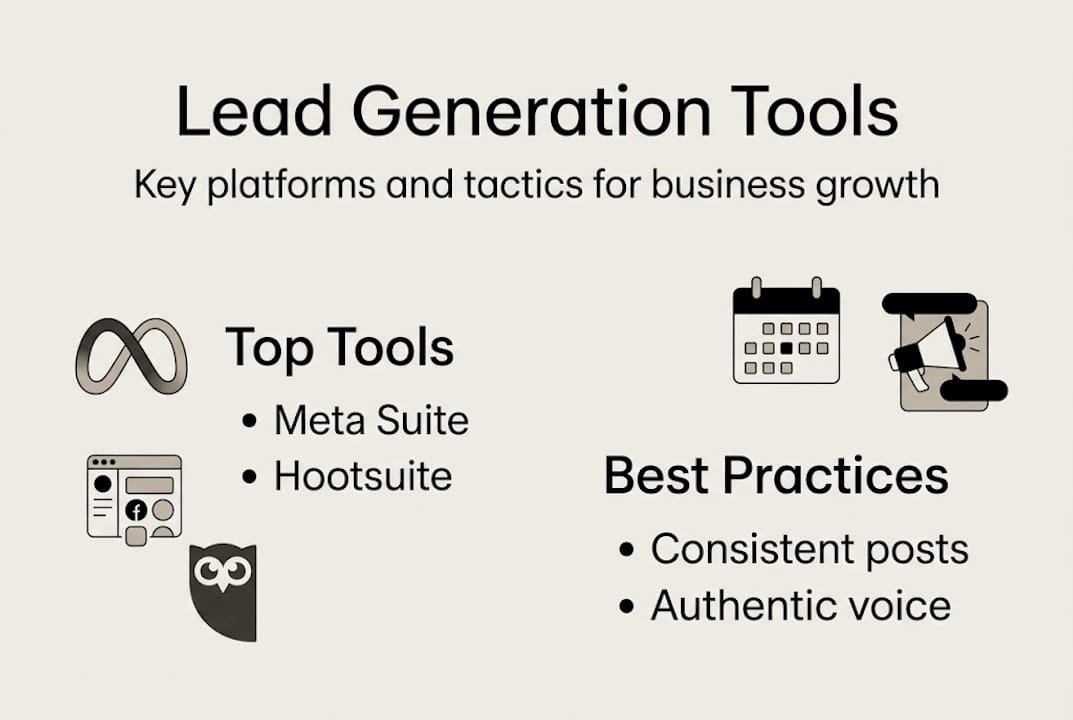
| Tool | Best use | Why it matters |
|---|---|---|
| Meta Business Suite | Facebook and Instagram scheduling and ads | Centralises content and paid campaigns |
| LinkedIn Campaign Manager | Executive visibility and B2B lead generation | Tracks post performance and audience data |
| Google Analytics | Website traffic from social | Shows which platforms drive real conversions |
| Canva Pro | Branded visual content creation | Keeps your visuals consistent and professional |
| Later or Buffer | Multi-platform scheduling | Saves time and ensures posting consistency |
Women-owned service businesses are already leading in social media adoption, so the advantage comes from using these tools smarter, not just more often.
High-leverage executive tactics worth prioritising:
- Publish a weekly thought leadership post that shares your genuine opinion on an industry topic.
- Run a monthly analytics review to identify your top performing content and double down on it.
- Use audience listening tools to track what your ideal clients are asking and talking about online.
- Explore creative ideas to boost engagement and rotate fresh formats into your content mix.
- Delegate repetitive tasks such as scheduling and hashtag research to a social media manager so your executive energy goes toward strategy.
Common mistakes to avoid:
- Posting without a content calendar, which leads to inconsistency and audience drop-off.
- Measuring success only by likes and followers rather than leads and bookings.
- Copying competitor content instead of leading with your own unique expertise.
- Automating your personality. Your voice, your story, and your lived experience are what build trust.
Pro Tip: Resist the urge to automate everything. Scheduling tools are brilliant for consistency, but your authentic voice is your greatest competitive advantage. Show your story, share your wins, and let your expertise speak.
Our perspective: The executive edge most miss in social media marketing
Here is something most marketing advice does not say directly: the majority of service businesses are not losing leads because of a bad product. They are losing leads because they are invisible as leaders. They post content, but they never show up as the authority behind the brand.
The uncomfortable truth is that surface-level posting keeps you busy without building a pipeline. Real lead generation comes from strategic visibility. When you share your perspective boldly, tell stories that reflect your client’s journey, and engage with genuine curiosity, you create the kind of presence that makes people reach out to you.
Executive social presence on platforms like LinkedIn has been shown to directly drive revenue conversations, because buyers connect with people, not logos. If you want to boost your social media presence in a way that actually fills your calendar, start by owning your narrative. Be the expert your audience needs to find. That is the executive edge.
Next steps: Elevate your social media strategy with expert support
You now have a clear picture of what separates a genuine lead generation strategy from random social activity. The next move is applying it in a way that fits your business, your goals, and your available time.
At Business Warriors, we work with service-based business owners across Australia to build marketing systems that generate consistent, qualified leads. Our Marketing Vortex method brings together social media, SEO, ads, and email into one integrated strategy. If you are ready to move from scattered posting to consistent lead generation, explore our proven lead generation strategies or book a discovery call to see how we can accelerate your growth together.
Frequently asked questions
How does a social media and marketing executive differ from a manager?
An executive sets the strategy, direction, and brand voice, while a manager focuses on day-to-day execution and content scheduling. Executive presence on LinkedIn is specifically linked to driving revenue pipeline, which goes well beyond a manager’s typical remit.
Which platform is best for service-based female business owners?
LinkedIn is ideal for executive visibility and lead generation, while Facebook and Instagram remain strong for brand awareness and community building. Women-owned service businesses are already active across these platforms, so the priority is strategy over presence.
What is permission-based outreach in marketing?
It is connecting with prospects who have already shown interest in your content or business, rather than cold pitching strangers. This approach consistently leads to better engagement, warmer conversations, and stronger trust. Human-first outreach outperforms automated or cold messaging every time.
How can I measure if my executive social strategy is generating leads?
Track profile visits, inbound messages, discovery calls booked, and campaign conversion rates as your core indicators. Vanity metrics like likes and impressions are secondary to these real business signals.
Recommended
- 7 Powerful Social Media Lead Generation Strategies – Jarrod Harman
- 7 Essential Social Media Lead Generation Tools for Growth – Jarrod Harman
- Social media checklist: proven steps to win more clients – Jarrod Harman
- Social media strategy tips to boost sales for services – Jarrod Harman
- Better Marketing Guide: Strategies for Success in 2025 – Affinsy Blog | Affinsy