20 April 2026
Omnipresent marketing: grow your service business with consistent leads
Learn what omnipresent marketing is, how it works, and how Australian service businesses can use it to generate consistent leads across multiple digital channels.
TL;DR:
- Omnipresent marketing involves consistent, multi-channel visibility to build trust and lead generation.
- Focus on a few key channels, like Google, social media, and email, before expanding.
- Simplicity and consistency over complexity and overexposure drive long-term marketing success.
Most Australian service business owners are running ads, posting on social media, and hoping something sticks. The problem is not effort. It is visibility. Research shows you need 7 to 13 touchpoints before most people trust a brand enough to buy. If your marketing only shows up in one or two places, you are invisible to most of your potential clients. Omnipresent marketing changes that. Instead of burning budget on isolated tactics, it builds a consistent presence across multiple channels so your ideal clients see you, trust you, and choose you. This guide breaks down what omnipresent marketing is, how it works, and how Australian service businesses can use it to generate steady leads.
Table of Contents
- What is omnipresent marketing?
- How does omnipresent marketing work? Key mechanics and pillars
- Omnipresent marketing vs. omnichannel: What’s the difference?
- Getting results: Omnipresent marketing in action for Australian service businesses
- The overlooked truth: Why simplicity creates omnipresence momentum
- Ready to put omnipresent marketing to work for your business?
- Frequently asked questions
Key Takeaways
| Point | Details |
|---|---|
| Omnipresent marketing defined | It means making your brand visible across multiple digital and offline channels so prospects see and trust you everywhere. |
| Four pillars drive results | Paid ads, quality content, organic social presence, and retargeting work together to win leads. |
| Start simple, stay consistent | Choose a few key platforms, build regular presence, and gradually expand for sustainable growth. |
| Trust comes from repetition | Consistent touchpoints boost buyer trust and increase conversion rates for Australian service businesses. |
What is omnipresent marketing?
Omnipresent marketing is not about being everywhere all at once with no strategy. It is about being consistently visible in the places your ideal clients already spend their time. Think of it like this: a physio clinic that shows up on Google Search, runs Instagram Reels, sends a fortnightly email, and retargets website visitors is far more memorable than one that just runs a single Facebook ad.
The formal definition puts it clearly: omnipresent marketing is a strategy where a brand achieves consistent visibility across multiple digital and offline channels to build familiarity, trust, and preference. The key word is consistent. It is not scattergun. It is intentional repetition across a curated set of channels.
Many business owners confuse omnipresent marketing with simply doing more. They throw money at Google, Facebook, a podcast, a YouTube channel, and a newsletter all at once, then burn out within six weeks. That is not omnipresence. That is overwhelm. The difference is having a core message that threads through every channel and a system that makes showing up feel manageable.
The data backs this up. Consumers are 82% more likely to trust a brand they encounter across multiple channels compared to one they only see in a single place. Trust is the currency that drives bookings for service businesses, whether you run a skin clinic in Melbourne or a law firm in Perth.
“Omnipresent marketing is not about shouting louder. It is about showing up reliably so your audience feels like they already know you before they ever make contact.”
Here are the channels Australian service businesses typically use in an omnipresent strategy:
- Google Search and SEO to capture high-intent local searches
- Google Business Profile to dominate local map results
- Meta advertising (Facebook and Instagram) for targeted awareness
- Email marketing to nurture warm leads over time
- Organic social media for consistent, human touchpoints
- YouTube or short-form video for authority building
- Retargeting ads to re-engage visitors who did not convert
Understanding the role of online marketing in how Australians discover and choose service providers is crucial before building your omnipresent strategy.
| Channel | Primary goal | Cost level |
|---|---|---|
| SEO | Long-term visibility | Low to medium |
| Google Ads | High-intent leads | Medium to high |
| Meta Ads | Awareness and retargeting | Medium |
| Email marketing | Nurture and retention | Low |
| Organic social | Trust and consistency | Low |
| Google Business Profile | Local discovery | Free |
How does omnipresent marketing work? Key mechanics and pillars
With the definition clear, it is time to look at how omnipresent marketing is structured and what actually drives results.
Omnipresent marketing runs on four foundational pillars. Together they move a prospect from first noticing you to booking an appointment or signing a contract. Key mechanics include four pillars: paid ads for awareness, professional content for trust, organic social for consistency, and retargeting for conversions.
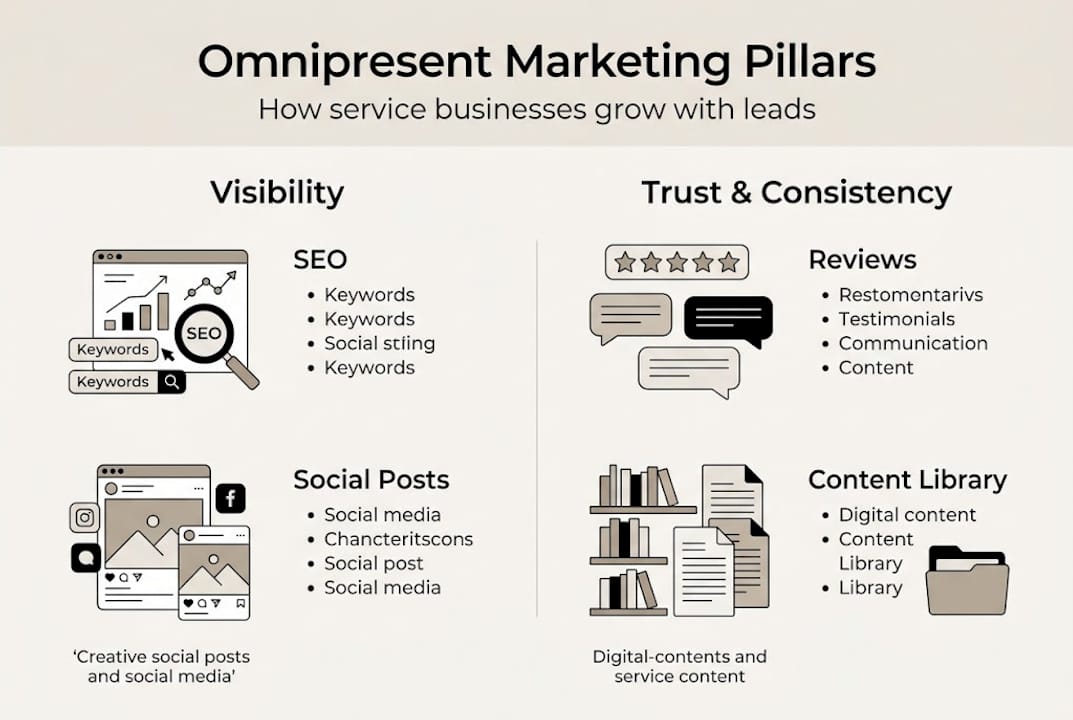
Think of these pillars as a relay race. Paid ads introduce you to someone who has never heard of you. Your content gives them a reason to stick around and see you as credible. Organic social keeps you visible and human between their decision points. Retargeting nudges them when they are close to committing. Remove any one pillar and the relay breaks down.
Here is what the typical journey looks like for an Australian service lead:
- A potential client sees your Instagram ad while scrolling during their lunch break.
- They visit your website, read a blog post, and leave without booking.
- Over the next two weeks, your retargeting ad follows them on Facebook and YouTube.
- They find your Google Business Profile when they search your name.
- They read a few Google reviews and check your Instagram feed.
- They receive a value-packed email after downloading your free guide.
- They book a consultation.
That is not a complicated funnel. It is a reliable sequence of touchpoints that builds trust through repetition. Explore brand omnipresence explained for a deeper look at the psychological mechanics behind why repeated exposure works so effectively.
For practical guidance on building out your content engine, the content marketing tips resource is worth bookmarking. And if you want to know how to increase online visibility beyond social media, that is the next logical step.
Pro Tip: Do not try to activate all four pillars at once. Start with the channel your audience uses most, get consistent there, then layer in the next. A clinic running three channels well will outperform one running seven channels poorly every single time.
| Approach | Channels used | Avg. trust level | Lead consistency |
|---|---|---|---|
| Single-channel | 1 | Low | Unpredictable |
| Omnipresent | 4 to 7 | High | Steady and compounding |
Omnipresent marketing vs. omnichannel: What’s the difference?
But are not ‘omnipresent’ and ‘omnichannel’ just different words for the same thing? Not exactly, and here is why that matters.
Omnichannel marketing is about creating a seamless, integrated experience for the customer across every channel. If someone adds a product to their cart on their phone, abandons it, then opens a desktop browser and sees the same cart, that is omnichannel in action. It requires sophisticated data sharing, integration between platforms, and often a significant technology investment.
Omnipresent marketing, on the other hand, is about repeated visibility. The focus is on showing up consistently so people remember you. As the research confirms, omnipresent strategy differs from omnichannel by emphasising visibility and repetition over full integration. For most local Australian service businesses, omnipresence is the smarter starting point.
“Familiarity breeds trust. The mere exposure effect in psychology tells us that people develop a preference for things simply because they have seen them before. For service businesses, this is gold.”
Omnichannel is where you want to eventually get. But trying to build a perfectly integrated system before you have consistent visibility is like decorating a house you have not built yet. Get seen first. Get trusted. Then refine the experience.
Prioritise omnipresence over omnichannel when:
- You are in the early to mid stages of your business growth
- Your marketing budget is under $5,000 per month
- You do not yet have a CRM or integrated data system in place
- Your audience is local and relationship-driven
- You want steady leads before investing in complex technology
For more context on how this principle applies to service-to-service relationships and referral-based industries, the B2B marketing ideas guide covers it well. And for a broader comparison, omnichannel vs multichannel explained breaks down the technical distinctions clearly.
Once your omnipresent foundation is solid and leads are coming in consistently, then you layer in the data integrations, CRM workflows, and personalised customer journeys that define a true omnichannel approach.
Getting results: Omnipresent marketing in action for Australian service businesses
Knowing the ‘why’ is powerful. Here is the ‘how’ for Australian service businesses ready for more leads.
The research is clear: for Australian service businesses, omnipresence via consistent touchpoints across SEO, social, Google Business Profile, and paid ads generates leads far better than isolated tactics, and building systems prevents the burnout that kills so many well-intentioned marketing efforts.
The most practical approach is phased:
Phase 1: Build your core digital presence. Claim and optimise your Google Business Profile. Make sure your website loads fast and has clear calls to action. Get your SEO foundations right.

Phase 2: Build a content library. Create pillar content, whether that is blog posts, videos, or podcast episodes, that answers the questions your ideal clients are already asking. This becomes the raw material you repurpose across every channel.
Phase 3: Layer in paid and retargeting. Once organic content is running, amplify it with Meta or Google Ads and set up a simple retargeting campaign to bring back website visitors.
Key platforms to prioritise for Australian service businesses:
- Google Business Profile for local map visibility
- Instagram and Facebook for community building and paid reach
- SEO-optimised blog content for long-term organic traffic
- Google Ads for capturing clients actively searching for your service
- Email sequences for nurturing leads who are not ready to book yet
For further reading, the content marketing guide walks through building a content system that supports omnipresence without requiring a full-time content team. The social media marketing tips resource is especially relevant for women-led service businesses in Australia.
Pro Tip: Aim to show up across your chosen channels at least three to five times per week in total, not per channel. Repurposing one piece of pillar content into a Reel, a blog snippet, an email, and a Google post is smart, not lazy.
For hyper-local marketing strategies that go even deeper at the suburb level, that resource is a practical companion to your omnipresent plan.
The most common pitfalls to avoid are resource strain from launching too many channels at once, and content burnout from trying to create everything from scratch. Systems solve both.
The overlooked truth: Why simplicity creates omnipresence momentum
Here is the perspective most marketing guides will not give you: the businesses we see fail at omnipresent marketing almost always fail because they overcomplicate it, not because they lack budget or talent.
There is a real temptation, especially when you are motivated and ready to grow, to activate every platform simultaneously. TikTok, LinkedIn, Pinterest, email, a podcast, Google Ads, all at once. Within a month, content quality drops, posting becomes inconsistent, and the whole system falls apart. This is not a discipline problem. It is a strategy problem.
As the research confirms, resource strain and overexposure are genuine risks when businesses spread across too many channels without focus. The fix is not more willpower. It is choosing fewer channels and doing them exceptionally well.
The best omnipresent strategies we have seen in Australian service businesses start with two or three channels their audience genuinely uses. They build consistency there first, then expand. Simplicity creates momentum. Momentum creates results. And results create the confidence and revenue to invest in more.
For businesses ready to scale beyond the early stages, the business scaling strategies guide offers a structured roadmap to grow your marketing without losing what is already working.
Ready to put omnipresent marketing to work for your business?
If you have read this far, you already understand something most of your competitors do not: visibility built on consistent, multi-channel presence beats any single tactic. The Marketing Vortex Method is built on exactly this principle, combining SEO, paid ads, content, and retargeting into one integrated system designed for service-based businesses in Australia.
Small, consistent actions compound over time. You do not need to do everything at once. Start with the right channels, build a rhythm, and let the system do the work. For a step-by-step resource on building that rhythm, the consistent leads guide is the perfect next read. If you want to understand digital marketing’s role in your broader growth strategy, that is a great companion piece as well.
Frequently asked questions
How is omnipresent marketing different from just running more ads?
Omnipresent marketing builds trust through consistent touchpoints across multiple channels, while simply running more ads on a single platform often delivers diminishing returns. The focus is on multi-channel presence, personalised experiences, and data-driven optimisation rather than ad volume alone.
Do I need a big budget to start with omnipresent marketing?
No. A phased approach focusing on your two or three best-performing platforms lets small businesses build real visibility without overspending. As the research confirms, it is smart to start with omnipresence for smaller budgets, then evolve to a more integrated omnichannel system as you grow.
What are some mistakes to avoid with omnipresent marketing?
The biggest mistake is spreading your resources across too many channels at once. Resource strain and overexposure are common risks, so focus on the channels your audience actually uses and build consistency before expanding.
How long before I see results with omnipresent marketing?
Some early results can appear within a few weeks, particularly from paid ads and Google Business Profile optimisation. However, consistent application over three to six months is where the real impact builds, given that 7 to 13 touchpoints are typically needed before most people make a purchase decision.