


Pouring more budget into paid ads and watching leads stay flat is a frustrating cycle that many service business owners know too well. The counterintuitive truth is that community-driven marketing consistently outperforms traditional advertising for long-term, predictable growth. Rather than renting attention through ad spend, a well-built marketing community compounds over time, turning clients into advocates who refer, return, and stay. Communities drive recurring revenue through membership models and higher customer lifetime value, creating a business asset that no algorithm change can take away. This article walks you through exactly what marketing communities are, how they generate consistent leads, and how to build one without burning out.
Table of Contents
- What defines a marketing community for service businesses
- How marketing communities drive recurring revenue and retention
- Proven methods to build and nurture effective communities
- Pitfalls, edge cases, and measuring ROI from community marketing
- Why most service businesses approach community-building backwards
- How Jarrod Harman helps you build thriving marketing communities
- Frequently asked questions
Key Takeaways
| Point | Details |
|---|---|
| Predictable revenue streams | Communities convert occasional clients into recurring revenue through loyalty and membership models. |
| Retention and referrals | Engaged communities drive client retention and powerful referral growth for service businesses. |
| Sustainable engagement methods | Wave-based activities, expert Q&A, and local partnerships build strong communities without burnout. |
| Avoid common pitfalls | Over-promotion and weak service quality can harm community trust and ROI—focus on value and moderation. |
| Measure real impact | Monitor engagement, retention, and support metrics to assess true community marketing success. |
What defines a marketing community for service businesses
A marketing community is not just a Facebook group with your logo on it. It is a recurring relationship structure where clients, prospects, and partners engage with your brand regularly, not just when they need to buy. Think of it as the difference between a vending machine and a local café. One is transactional. The other builds loyalty through familiarity, trust, and shared experience.
For service businesses, a social community for business growth typically takes one of three forms:
- Online groups: Private Facebook or LinkedIn communities where members ask questions, share wins, and engage with your content on a regular basis.
- Local partnerships: Referral alliances with three to five non-competing businesses in your area, where you actively send each other clients.
- Event series: Monthly or quarterly micro-events such as workshops, Q&A sessions, or expert panels that keep your audience connected to your brand.
Each of these shifts the client mindset from buyer to advocate. When someone feels like they belong to something, they stop shopping around. They refer their friends. They become part of your digital marketing functions without you having to ask.
“Communities shift the client relationship from transactional to relational, driving recurring revenue and boosting business valuation through retention and referrals.” Source
This matters because communities drive recurring revenue and boost business valuation through retention and referrals. A business with a loyal community is worth significantly more than one dependent on cold ad traffic. When you go to sell, refinance, or scale, that retention data becomes a genuine asset on your balance sheet. For Australian service businesses competing in crowded markets, this is the edge that separates sustainable growth from the feast-and-famine cycle.

How marketing communities drive recurring revenue and retention
The financial case for community marketing is stronger than most business owners realise. Let’s look at what the data actually shows.
B2B communities reduce support tickets by 25% and significantly boost client retention. One HVAC firm saw a 1,546% engagement increase simply by creating hyper-local Facebook content for their community. These are not outlier results. They reflect a consistent pattern across industries: engaged communities reduce your cost to serve while increasing the lifetime value of each client.
Here is a snapshot of how community marketing compares to traditional advertising across key performance areas:
| Metric | Traditional ads | Community marketing |
|---|---|---|
| Lead quality | Cold, low intent | Warm, referred, high intent |
| Cost per acquisition | High and rising | Decreases over time |
| Client retention | Dependent on offers | Built on relationships |
| Revenue predictability | Volatile | Recurring and stable |
| Business valuation impact | Minimal | Significant |
The mechanics behind this are straightforward. Membership models create predictable monthly income. Referrals from community members convert at higher rates because trust is already established. Peer learning inside your group keeps members engaged between purchases, reducing churn without requiring constant promotions.
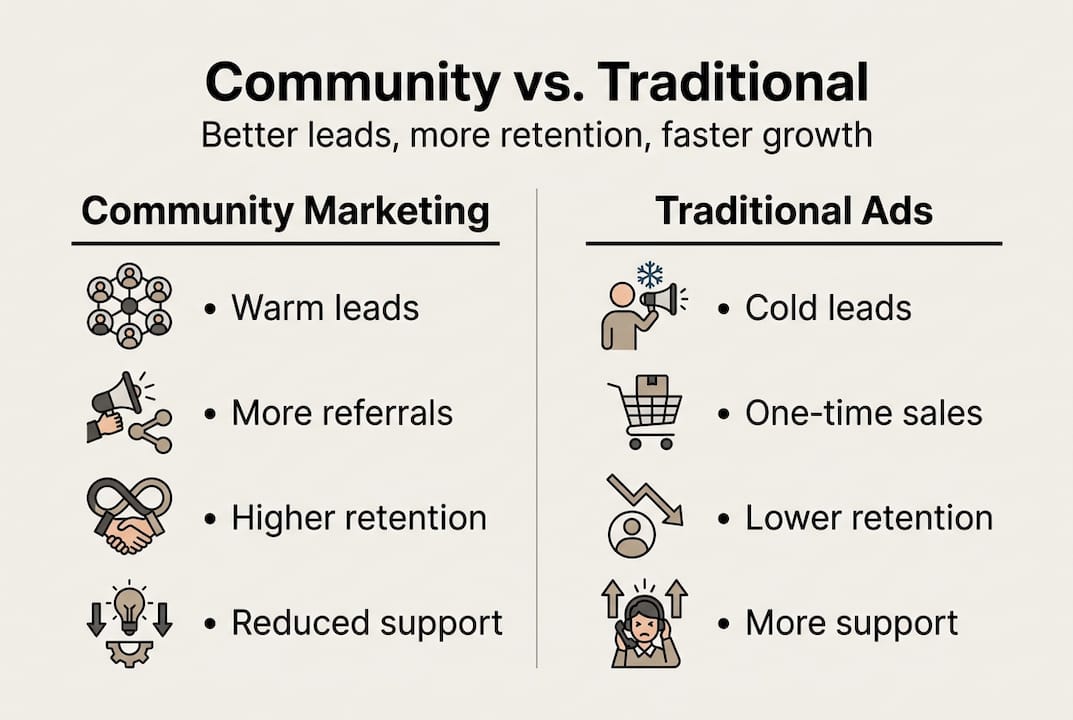
For improving client retention, community engagement is one of the most cost-effective tools available. Loyalty programmes, event participation, and peer accountability loops all reinforce the decision to stay. When your clients are talking to each other inside your community, they are reinforcing each other’s commitment to your brand.
Think about what scaling your marketing looks like when your existing clients are doing part of the work for you. Every referral from a community member costs you nothing in ad spend. Every question answered in your group builds trust with dozens of lurkers who are watching but not yet ready to buy. That compounding effect is what makes community marketing so powerful over time.
Proven methods to build and nurture effective communities
Knowing the financial benefits is one thing. Building a community that actually works without consuming all your time is another. Here are the methods that consistently deliver results for Australian service businesses.
1. Form three local partnerships. Identify three non-competing businesses serving the same client profile as you. A beauty clinic might partner with a nutritionist and a fitness studio. Agree to actively refer each other and create joint content or events. This immediately expands your reach without any ad spend.
2. Answer three questions per week in relevant groups. Choose two or three Facebook or LinkedIn groups where your ideal clients hang out. Commit to answering three genuine questions per week. No pitching. Just B2B marketing ideas delivered through helpful responses. Over 90 days, this positions you as the go-to expert in your niche.
3. Run monthly micro-events. A 30-minute online Q&A, a local morning tea, or a short expert panel keeps your community warm between purchases. These do not need to be elaborate. Consistency matters far more than production value.
4. Use wave-based engagement. Rather than posting daily and burning out, wave-based engagement involves short bursts of high activity followed by lighter maintenance periods. This is sustainable and still delivers strong results.
5. Apply the help-first approach. Diagnose a problem your audience has, assist them publicly, then invite them into your community or service. This sequence builds trust before you ask for anything.
Pro Tip: Before you invite anyone into your community, make sure you have a clear value proposition for members. Ask yourself: “What does someone get from being here that they cannot get anywhere else?” Answering that question honestly will shape everything from your content to your creative social media marketing strategy.
For those just starting out, mastering social media marketing fundamentals will help you understand which platforms suit your audience before you invest time in building a group.
Pitfalls, edge cases, and measuring ROI from community marketing
Even with the right methods, there are traps that derail even well-intentioned community efforts. Knowing them upfront saves you months of wasted energy.
The biggest mistake is over-promotion killing engagement. When every post is a sales pitch, members disengage fast. Trust evaporates. The community becomes a ghost town. The rule of thumb is 80% value, 20% promotion. If you are unsure whether a post is too salesy, it probably is.
Other common pitfalls include:
- Weak service quality: Communities amplify everything, including bad experiences. If your service delivery has gaps, fix those before you build a community around your brand.
- Wrong market fit: Communities are less effective in low-demand industries or for products with very infrequent purchase cycles. If your clients only need you once every five years, a high-engagement community may not be the right model.
- Chasing vanity metrics: A group with 5,000 members and 2% engagement is worth less than a group with 300 members and 40% engagement.
- No moderation: Unmoderated communities attract spam and off-topic content, which drives away quality members quickly.
Pro Tip: Track engagement rate, referral volume, client retention rate, and support request volume as your core community metrics. These four numbers tell you far more about community health than follower counts ever will.
When measuring ROI, look at social media’s role for B2B as part of a broader system rather than a standalone channel. Communities work best when integrated with your CRM, email sequences, and sales process. For deeper B2B lead generation strategies, community engagement should feed your pipeline, not replace it. You can also explore B2B community strategies from leading brands to benchmark your approach against proven models.
Why most service businesses approach community-building backwards
Here is what we see repeatedly with service businesses that try community marketing and give up: they start with content instead of conversations. They build a group, post a few times, get crickets, and conclude that communities do not work for their industry.
The real problem is sequence. Most businesses treat community-building like a broadcast channel rather than a relationship engine. They push content hoping for viral reach, get a short spike, then fade. Compounding retention through a help-first strategy consistently outperforms viral content bursts over any 12-month period.
The businesses that win with community marketing start with diagnosis. They listen to what their audience is struggling with, assist publicly and generously, and then invite people into a space where that help continues. When you integrate this approach with your CRM and follow-up sequences, you create a flywheel where every new member strengthens the community for everyone else.
Steady, consistent engagement compounds in a way that no single viral post can replicate. Building community-driven growth requires patience in the first 90 days, but the return on that patience is a lead generation system that works even when you are not actively promoting.
How Jarrod Harman helps you build thriving marketing communities
Building a marketing community that actually generates leads and recurring revenue takes more than good intentions. It takes a structured framework, the right platforms, and a strategy tailored to your specific service business.
Jarrod Harman’s marketing vortex method integrates community-building with SEO, paid ads, email, and social media into one cohesive system. Rather than treating community as a side project, it becomes a core revenue driver. If you are ready to stop relying on cold traffic and start building something that compounds, explore how to create a marketing vortex for consistent leads. You can also meet Jarrod Harman to learn how his team supports service businesses across Australia in building and scaling their communities.
Frequently asked questions
What is the main benefit of building a marketing community for service businesses?
The main benefit is predictable, recurring revenue and higher customer lifetime value through engaged relationships and referrals. Communities boost business valuation through retention rather than relying on continuous ad spend.
How can you avoid burnout when managing a marketing community?
Focus on wave-based engagement and micro-events rather than posting daily, and set a routine of answering a few questions per week rather than always creating new content.
How do you measure the success of a marketing community?
Track engagement rates, referral volume, retention, and support ticket reductions rather than just membership numbers, as these metrics reflect genuine community health and business impact.
Are marketing communities ideal for all service businesses?
They are less effective in low-demand markets or for businesses not ready to deliver high service quality, as communities amplify negativity if the underlying service experience has gaps.