


TL;DR:
- Effective social media marketing begins with clear, SMART goals and understanding your target audience’s needs and preferences. Focusing on two to three platforms and developing content pillars ensures consistent, engaging content that builds community and trust over time. Patience and strategic integration of organic efforts, paid advertising, and SEO are essential for measurable growth and business success.
Social media marketing can feel like standing in front of a control panel with no manual. You know you need it, but every platform looks different, every “expert” contradicts the last, and you still have a business to run. If you want to know how to start social media marketing as a beginner, the answer is not to post more. It is to start with a clear strategy before you touch a single caption. This guide walks you through every practical step, from setting goals and picking platforms to scheduling content, building engagement, and reading your analytics without losing your mind.
Key takeaways
| Point | Details |
|---|---|
| Start with SMART goals | Define specific, measurable goals before creating any content to keep your efforts focused. |
| Choose 2-3 platforms only | Concentrate on the platforms where your audience actually spends time instead of being everywhere. |
| Plan your content calendar first | Build your first month of content before publishing to avoid the blank profile problem. |
| Batch-create for efficiency | Producing 6-10 pieces of content at once is three times more efficient than daily creation. |
| Track metrics tied to goals | Map every metric back to a specific goal to cut through vanity data and focus on real results. |
How to start social media marketing: goals and audience first
Every effective social media marketing strategy begins with two things: knowing what you want and knowing who you are talking to. Skip this and you will spend months creating content that gets polite likes from your mum and little else.

According to Buffer’s 2026 strategy guide, a recommended 7-step cyclical approach for beginners starts with setting SMART goals and defining your audience before anything else. SMART stands for Specific, Measurable, Achievable, Relevant, and Time-bound. A vague goal like “grow my Instagram” tells you nothing. A SMART goal sounds like this: “Gain 300 new local followers on Instagram within 90 days by posting three times per week.”
Once your goals are set, dig into your audience. Most beginners stop at basic demographics: age, gender, location. Go further. Think about:
- What problems keeps your ideal customer up at night?
- What kind of content do they comment on or save?
- Which platforms do they actually use daily versus occasionally?
- What language, tone, and references resonate with them?
This psychographic layer changes everything. A beauty salon owner in Perth targeting women aged 30-45 will create very different content on Instagram than a B2B consultant targeting marketing managers on LinkedIn. Same marketing basics, completely different execution.
Your goals also connect directly to SEO and paid advertising. If your goal is website traffic, you need to track link clicks and optimise your bio links for specific landing pages. If your goal is bookings, you might combine organic posts with a small Meta Ads budget to push a targeted offer. Knowing the goal upfront means you can integrate paid and organic channels without doubling your effort.
Pro Tip: Write your goals down and paste them somewhere visible. Review them weekly. Most beginners set goals once and forget them, then wonder why their content feels aimless after two months.
Choosing platforms and building content pillars
One of the biggest mistakes in social media marketing for beginners is trying to be on every platform at once. You stretch yourself thin, the quality drops, and nothing gains traction. The Buffer 2026 guide makes it clear: focus on platforms where your audience actively spends time and resist the pressure to be everywhere.
Here is a quick breakdown of where different audiences tend to live:
| Platform | Best for | Content style |
|---|---|---|
| Visual brands, B2C, beauty, lifestyle | Reels, carousels, Stories | |
| Local businesses, older demographics, community groups | Posts, video, events, groups | |
| B2B, professional services, consulting | Articles, text posts, thought leadership | |
| TikTok | Younger audiences, entertainment, trend-driven brands | Short-form video, trends, tutorials |
For most small business owners just getting started, picking two or three of these and doing them well will always beat spreading across all four. A salon, clinic, or service business typically does well starting with Instagram and Facebook, given the demographic overlap.
Once you have chosen your platforms, you need content pillars. These are three to five recurring themes that organise everything you post. For a beauty clinic, pillars might include client transformations, treatment education, behind-the-scenes content, and seasonal promotions. For a consultant, they might be industry insights, client results, personal story, and practical tips.
Content pillars serve two purposes. They stop you from staring at a blank screen every time you need to post, and they train your audience to know what to expect from you. They also feed naturally into your SEO strategy: each pillar can map to keyword themes that you reinforce across your website, blog, and social profiles.
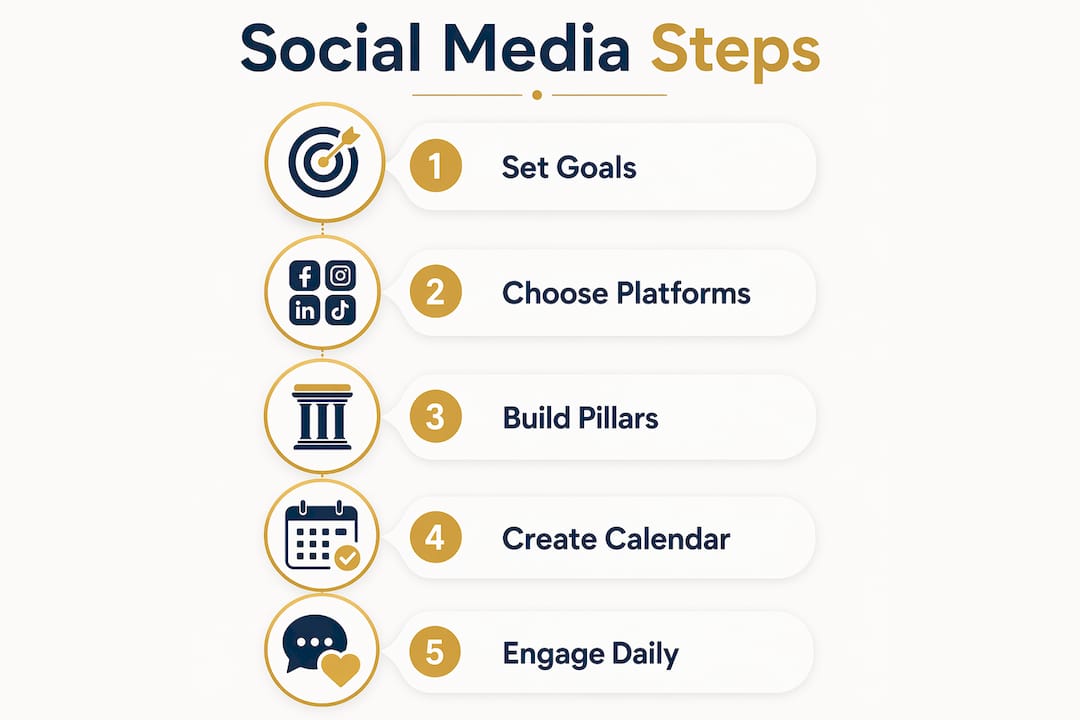
The content mix ratio matters too. Research shows 80% of content should educate, entertain, or inspire, with only 20% being promotional. If every post is a sales pitch, your organic reach will suffer and your audience will stop engaging.
Pro Tip: Pick your two or three platforms and commit to them for at least 90 days. Consistency on fewer channels builds momentum far faster than scattered effort across many.
Building and using a content calendar
Knowing what to post is one thing. Having a system to plan and produce it without burning out is another. A content calendar solves both problems.
You can build a content calendar in under 30 minutes using a free tool like Google Sheets, Notion, or Trello. Here is a practical way to get started:
- Open a simple spreadsheet with columns for: date, platform, content pillar, post format (reel, carousel, story, text), caption notes, and status.
- Map out four weeks of dates across the top, one row per planned post.
- Fill in your content pillars across the calendar so no pillar goes more than a week without appearing.
- Add specific topics or ideas to each cell, even if it is just a rough title.
- Mark each post as “to create,” “in progress,” or “scheduled” so you always know where things stand.
Building your first full month of content before you publish anything addresses what creators call the “blank profile” problem. Your profile looks active and credible from day one, which matters enormously for first impressions and algorithmic momentum.
Once your calendar exists, batch your content creation. Rather than creating one post per day, dedicate two to three hours once per week or fortnight to produce a batch of six to ten pieces at once. This approach is significantly more efficient and dramatically reduces the creative exhaustion that kills most beginners’ consistency.
For scheduling, free tools like Meta Business Suite handle Facebook and Instagram. Later and Buffer offer free tiers that cover multiple platforms. Pair your scheduling with SEO thinking: include geo-specific hashtags, relevant keywords in captions, and location tags where applicable. This lifts your organic discoverability both on-platform and in Google search results, which increasingly surfaces social content.
Pro Tip: Plan 2-4 weeks ahead but leave one or two open slots per week for reactive posts tied to trending topics or timely events. Rigid calendars miss spontaneous moments that often drive the highest engagement.
Daily engagement and community building
Posting consistently is not enough on its own. The platforms reward accounts that participate in conversations, not just broadcast content. Engaging authentically for 15-20 minutes daily builds community and earns algorithmic favour more reliably than simply increasing your posting frequency.
Practical daily engagement looks like this:
- Reply to every comment on your posts within the first hour of publishing, when engagement velocity matters most to the algorithm.
- Leave genuine, specific comments on posts from accounts in your niche or by your ideal clients. Generic responses like “great post!” add nothing.
- Check your direct messages daily and respond promptly. Many small business owners lose bookings simply by being slow to reply.
- Follow relevant hashtags and engage with content appearing in those feeds.
- Use social listening by setting up Google Alerts for your brand name, key services, and competitor names to track mentions and conversations happening outside your own profile.
Authentic engagement also feeds your content strategy in ways that paid advertising cannot replicate. When you notice your audience consistently asking the same question in comments or DMs, that is a content idea handed to you directly. It also signals SEO relevance: if people keep asking about a topic, it is worth a detailed post, a blog article, and potentially a paid campaign targeting that specific question.
If you are also running Google Ads or Meta Ads, the engagement data you gather organically helps you refine ad targeting. High-performing organic posts can be boosted for a fraction of the cost of creating new ad creative from scratch.
Pro Tip: Set a timer for 15 minutes each morning dedicated solely to engagement. Treat it like a non-negotiable appointment. Consistent short bursts of genuine interaction outperform occasional marathon engagement sessions.
Measuring what actually matters
Most beginners obsess over the wrong numbers. Follower counts and likes are vanity metrics that feel good but say almost nothing about whether your social media marketing is growing your business. A profile with 800 engaged followers who book appointments is more valuable than one with 8,000 followers who scroll past.
The metrics that actually matter depend on your goals:
- Awareness goals: Track reach (unique accounts who saw your content) and impressions (total times content was viewed). These tell you how far your message is spreading.
- Engagement goals: Focus on engagement rate (comments, saves, and shares divided by reach), saves specifically, and profile visits. Saves are the strongest signal that your content has genuine value.
- Conversion goals: Watch link clicks, website traffic from social (check Google Analytics), and direct enquiries or bookings attributed to social channels.
- Growth goals: Monitor follower growth rate, not raw numbers. A rate of 5-10% per month for an early-stage account is healthy progress.
Matching your metrics to your goals before you look at any data removes the temptation to chase meaningless numbers. Review your analytics monthly rather than daily. Daily data is too noisy and leads to reactive decisions that undermine long-term strategy.
When you find a post that performed exceptionally on a specific metric tied to your goal, document what made it work: the format, the topic, the posting time, the caption structure. Then replicate it deliberately. This is how social media marketing becomes a continuous loop of planning, publishing, measuring, and improving over time.
Pro Tip: Create a simple goal-to-metric map before your first monthly review. Write your goal on the left, draw an arrow, and write the one or two metrics that directly reflect progress toward that goal. Ignore everything else.
My honest take on starting out
In my experience working with small business owners across Australia, the biggest mistake is not a lack of creativity or budget. It is impatience. Most beginners expect meaningful results within the first four weeks, and when they do not arrive, they either change strategy entirely or give up. The reality is that meaningful progress typically takes 3-6 months of consistent effort, with real business results showing between 6-12 months. That is not discouraging. It is freeing, because it means the competition keeps quitting while you keep showing up.
What I have also found is that beginners conflate being busy with being strategic. Posting every day feels productive but often generates less traction than posting three times per week with genuine thought behind each piece. Quality does beat quantity. Always.
The other thing worth saying plainly: social media works best as one part of a broader digital marketing system. Organic social builds trust and community. Paid advertising on Meta or Google Ads amplifies what is already working. SEO pulls people in who are actively searching for what you offer. AI-powered tools are now also helping brands appear in large language model results and AI-generated answers, which is where search behaviour is shifting. None of these channels is a standalone solution. The businesses I have seen grow fastest are the ones who treat organic social, paid ads, and SEO as interconnected tools, not separate experiments.
Be patient. Be consistent. Start with a clear social media strategy and let the data guide your evolution.
— Business Warriors | Digital Marketing Agency
Ready to build your social media strategy?
Starting strong is easier when you have the right guidance and a proven framework behind you. Jarrodharman has helped hundreds of small business owners and service-based brands across Australia move from confused and inconsistent to purposeful and profitable online.
Whether you are mapping out your first content calendar, figuring out which platforms suit your business, or looking to combine organic social with a targeted paid advertising campaign, the resources at Jarrodharman are built specifically for where you are right now. Explore Jarrod’s digital marketing expertise to see how the Marketing Vortex Method brings SEO, paid ads, and social media together into one cohesive growth system. You can also work through the digital marketing step by step framework to start seeing measurable results faster. The next step is yours to take.
FAQ
How long does social media marketing take to show results?
Most beginners see meaningful progress between 3-6 months of consistent effort, with measurable business results like leads and bookings typically appearing between 6-12 months.
Which social media platforms should a beginner start with?
Start with two or three platforms where your audience already spends time. For most service-based businesses, Instagram and Facebook offer the best combination of reach, targeting options, and audience fit.
How often should I post on social media as a beginner?
A consistent posting schedule you can maintain beats posting frantically then going quiet. Aim for three to five times per week on your primary platform and adjust based on your capacity and results.
What metrics should beginners track on social media?
Track metrics that align with your specific goal. Awareness campaigns should focus on reach, engagement goals need saves and engagement rate, and conversion goals require link clicks and website traffic from social channels.
Do I need a budget to start social media marketing?
You can start with zero budget using organic content alone. Combining organic efforts with a modest paid advertising budget of $10-$20 per day on Meta Ads will accelerate results significantly once your content strategy is working.