9 June 2026
PPC lead gen strategies for service businesses in 2026
Discover effective PPC lead gen strategies for service businesses in 2026. Optimize your ad spend and capture high-quality leads today!
TL;DR:
- PPC lead generation uses targeted ads and in-ad lead forms to attract high-intent prospects efficiently. It emphasizes accurate tracking, qualification questions, and rapid follow-up to improve lead quality and conversions. Successful campaigns depend on structured keyword segmentation, CRM integration, and aligning messaging to maximize revenue outcomes.
PPC lead generation is the process of using pay-per-click advertising to attract and convert high-intent prospects by targeting searchers or audiences with offers designed to capture their contact information efficiently. In the context of service-based businesses, pay-per-click lead generation sits at the intersection of Google Ads, SEO strategy, and CRM integration, making it one of the most measurable forms of online lead generation available. Tools like Google Ads lead form assets, enhanced conversions, and AI-driven bidding have fundamentally changed how service businesses capture and qualify prospects in 2026. This guide covers the mechanics, tools, common pitfalls, and a practical framework for getting the most from your paid search lead generation investment.
How does PPC lead generation work?
PPC lead gen operates on a straightforward principle: you pay for each click on your ad, and the goal is to convert that click into a contact, booking, or enquiry. The mechanics, however, are more layered than most business owners realise when they first start running campaigns.
The process works in four stages:
- Keyword and audience targeting. You select keywords that signal purchase intent, such as “laser hair removal Perth” or “commercial cleaning quote Sydney,” and layer on audience signals like location, device, and remarketing lists to reach people most likely to convert.
- Ad and offer presentation. Your ad copy, extensions, and lead form assets present a specific offer. The clarity and relevance of this offer determines whether a high-intent searcher becomes a lead or scrolls past.
- Lead capture. Google Ads lead form assets let users submit contact information directly inside the ad, removing the need to visit a landing page. This reduces friction and enables direct CRM syncing for faster follow-up.
- Conversion tracking and optimisation. Every lead is tracked back to the keyword, ad, and audience that generated it. Offline conversions from your CRM are fed back into Google Ads so the algorithm learns which clicks produce actual sales, not just form fills.
The shift from traditional landing page funnels to in-ad lead capture is significant for service businesses. A salon owner running Google Ads no longer needs a perfectly optimised landing page to capture a booking enquiry. The form lives inside the ad itself, and the lead data flows directly into a CRM or webhook.
Pro Tip: Set up a webhook integration between your Google lead form assets and your CRM on day one. Manual CSV downloads create delays that cost you leads, particularly when rapid follow-up within five minutes of a form submission dramatically increases conversion rates compared to following up a day later.

What Google Ads tools improve lead quality and tracking?
Running ads that generate volume is straightforward. Running ads that generate qualified leads at a profitable cost per acquisition requires a specific set of tools working together.
Lead form assets with qualifying questions
Qualifying questions in lead form ads filter for higher-intent prospects before your sales team ever makes contact. A med spa, for example, might ask “When are you looking to book?” or “Which treatment are you interested in?” These questions add a small amount of friction, but the leads that come through are far more likely to convert into paying clients.
Enhanced conversions
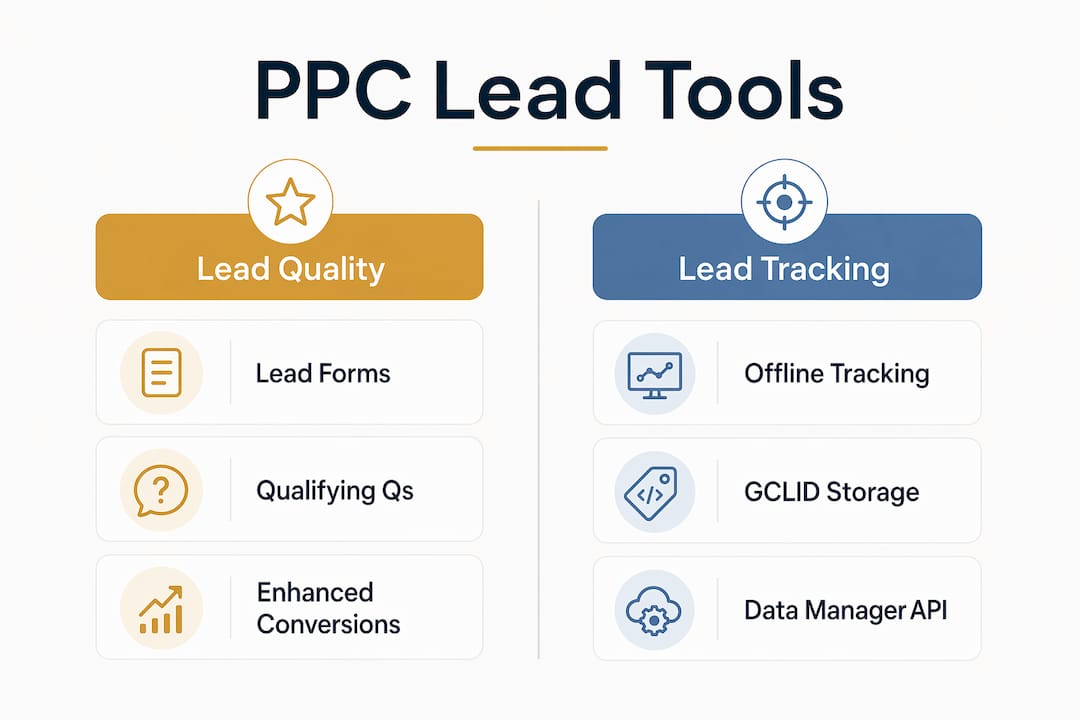
Enhanced conversions improve measurement accuracy by matching hashed first-party data, such as email addresses, back to the original ad click. Studies from April 2024 to April 2025 show an average 8% incremental improvement in reported ROAS on search campaigns. For service businesses spending $5,000 or more per month on Google Ads, that improvement in measurement directly influences how the algorithm allocates budget.
Offline conversion tracking with GCLID
Storing click identifiers (GCLID) with lead data in your CRM is the foundation of accurate offline conversion tracking. Without GCLID capture, you cannot attribute a closed sale back to the original keyword or ad. This means your bidding strategy is optimising for form fills rather than actual revenue, which is a costly distinction in service industries where a single client might be worth thousands of dollars.
Data Manager API and AI bidding
Google’s Data Manager API connects CRM and offline conversion data directly to Google Ads, giving the AI bidding system richer signals to work with. When the algorithm knows which leads became paying clients, it can identify patterns in search behaviour, device usage, and time of day that correlate with high-value conversions. This is where AI-driven PPC advertising strategies create a compounding advantage over time.
The table below summarises the core tools and their primary function:
| Tool | Primary function |
|---|---|
| Lead form assets | Capture contact info inside the ad, reducing landing page dependency |
| Qualifying questions | Filter leads by intent before sales contact |
| Enhanced conversions | Improve ROAS measurement using first-party data matching |
| GCLID offline tracking | Attribute closed sales back to original keywords and ads |
| Data Manager API | Sync CRM data with Google AI for smarter bidding |
What challenges affect PPC lead gen success?
The most common reason PPC campaigns underperform for service businesses is not poor keyword selection. Most wasted PPC spend results from misaligned landing pages and weak offer architecture. Understanding this distinction changes how you approach campaign audits and budget decisions.
Lead quality versus lead volume
Reducing friction with lead form assets increases submission rates, but it can also attract people who are casually browsing rather than ready to buy. The solution is pairing lead form assets with qualifying questions and using negative keywords to exclude irrelevant searches. A law firm running ads for “family lawyer” should exclude searches like “free legal advice” and “DIY divorce forms” to protect lead quality.
Ad copy and landing page alignment
When your ad promises a free consultation and your landing page talks about your company history, the disconnect kills conversions. Every element of the user journey, from the keyword to the ad headline to the form or page they land on, must reflect the same specific offer. Price anchors and audience qualifiers in ad copy, such as “from $299” or “for businesses with 10+ staff,” reduce click-through rate but improve lead quality significantly. Platforms reward high CTR, but high CTR without quality leads wastes budget.
Pro Tip: Run a simple audit comparing your top five keywords to the headline and first paragraph of the page or form they lead to. If the language does not match within three words, you have found a conversion leak worth fixing before increasing spend.
Sales follow-up speed
PPC lead gen is only as effective as the sales process behind it. Following up within five minutes of a lead submission dramatically increases conversion rates. Most service businesses follow up within 24 to 48 hours, which means a significant portion of their ad spend produces leads that go cold before anyone calls. Automating an immediate SMS or email response from your CRM closes this gap without adding headcount.
How to structure PPC lead gen campaigns for service businesses
A well-structured paid search lead generation campaign for a service business follows a clear framework. The goal is to concentrate budget on the searches most likely to produce a qualified lead, not the highest traffic volume.
- Segment keywords by commercial intent. Separate your keywords into three tiers: transactional (e.g., “book physio appointment Brisbane”), commercial investigation (e.g., “best physio clinic Brisbane”), and informational (e.g., “how long does physio take”). Allocate 70% of your budget to transactional keywords and use the remainder to test commercial investigation terms.
- Write ad copy with qualifiers. Include price anchors, service specifics, and audience signals in your headlines. “Laser facials from $150, Surry Hills” attracts a more qualified click than “Best facial treatments in Sydney.”
- Set up CRM integration on day one. Lead form assets paired with CRM webhooks and qualifying questions prevent poor quality leads from consuming your sales team’s time. Without this pairing, reduced landing page friction simply increases volume without improving quality.
- Track cost per qualified lead, not cost per lead. Feed closed sale data back into Google Ads via GCLID and offline conversion import. This shifts your optimisation target from form fills to revenue-generating contacts.
- Use value-based bidding once you have data. Once you have 30 to 50 offline conversions recorded in Google Ads, switch to Target ROAS or Maximise Conversion Value bidding. The AI system uses rich conversion signals including qualified leads and purchase actions to improve targeting over time.
For service businesses exploring broader lead generation techniques beyond PPC, integrating paid search with SEO, social media marketing, and email follow-up sequences creates a compounding acquisition system rather than a single-channel dependency.
Pro Tip: Review your search term report weekly for the first 90 days of a new campaign. Add irrelevant terms as negative keywords and identify high-converting search queries that are not yet in your keyword list. This single habit reduces wasted spend faster than any automated rule.
Key takeaways
Effective PPC lead gen for service businesses requires tracking revenue, not just form fills, and aligning every element of the campaign from keyword to follow-up speed.
| Point | Details |
|---|---|
| Track offline conversions | Store GCLID in your CRM and import closed sales back to Google Ads for accurate measurement. |
| Use qualifying questions | Add intent-filtering questions to lead form assets to improve lead quality before sales contact. |
| Align ad copy to offer | Match headline language to the specific offer on your form or landing page to reduce conversion drop-off. |
| Follow up within five minutes | Automate an immediate SMS or email response to new leads to prevent them going cold. |
| Prioritise transactional keywords | Allocate the majority of budget to high-intent keywords that signal readiness to book or buy. |
What I have learned running PPC campaigns for service businesses
After working with service businesses across Australia through Business Warriors, the pattern I see most often is this: business owners judge their PPC campaigns on cost per lead, then wonder why their revenue does not reflect their ad spend. The real number that matters is cost per qualified lead, and then cost per closed sale. Those two figures tell a completely different story.
The businesses that get the best results from pay-per-click lead generation are not necessarily the ones with the biggest budgets. They are the ones who have connected their CRM to their Google Ads account, who are feeding offline conversion data back into the platform, and who have trained their sales team to respond to leads within minutes rather than days. The technology side of this is not complicated. The discipline side is where most businesses fall short.
One thing I would push back on is the idea that AI bidding strategies remove the need for human oversight. Google’s AI is only as good as the data you feed it. If you are optimising for form fills from a lead form with no qualifying questions, the algorithm will find you more form fills, many of which will be from people who have no intention of spending money. Garbage in, garbage out. The full lead-to-sale journey must be mapped and measured before you hand control to automated bidding.
For service businesses serious about sustainable growth, PPC works best as one layer of a broader system that includes SEO for long-term visibility, social media for brand trust, and email marketing for nurturing leads that are not ready to buy today. That integrated approach is what we call the Marketing Vortex at Business Warriors, and it is what separates businesses that grow consistently from those that chase leads campaign by campaign.
, Business Warriors | Digital Marketing Agency
Take your PPC lead gen results further
If you are running Google Ads and not seeing the lead quality or cost per acquisition you need, the issue is almost always structural rather than a matter of spending more. At Business Warriors, we build PPC lead generation systems that connect your ad account to your CRM, track revenue rather than clicks, and use Google’s AI tools the right way. Whether you are a clinic, salon, law firm, or service business of any kind, we tailor campaigns to your specific client acquisition goals. Explore our client acquisition strategies for service businesses, or see how digital advertising fits into a full-growth system. If you are ready to build a campaign that actually converts, let’s talk.
FAQ
What is PPC lead generation?
PPC lead generation is the practice of using pay-per-click advertising platforms, primarily Google Ads and Meta Ads, to capture contact information from high-intent prospects. Campaigns are structured to convert ad clicks into enquiries, bookings, or form submissions that feed a sales pipeline.
How do Google lead form assets work?
Google lead form assets allow users to submit their contact details directly within the ad, without visiting a separate landing page. The data syncs to a CRM via webhook, reducing friction and speeding up follow-up.
Why is lead quality a bigger issue than lead volume?
High lead volume with poor intent wastes sales team time and inflates cost per acquisition. Adding qualifying questions to lead forms and using negative keywords filters out low-intent clicks before they reach your pipeline.
What is enhanced conversions and why does it matter?
Enhanced conversions match hashed first-party data such as email addresses back to ad clicks, improving conversion measurement accuracy by an average of 8% incremental ROAS on search campaigns. Better measurement means better bidding decisions from Google’s AI.
How should service businesses structure their PPC campaigns?
Service businesses should segment keywords by commercial intent, allocate the majority of budget to transactional searches, integrate CRM tracking from day one, and use structured PPC campaigns that track cost per qualified lead rather than cost per form fill.