10 June 2026
How to market a book on social media in 2026
Discover how to market a book on social media in 2026! Engage readers with authentic content, video strategies, and tailored advertising.
TL;DR:
- Effective social media book marketing in 2026 requires focusing on 2 to 3 platforms, applying the 80/20 content rule, and engaging communities daily to build long-term momentum. Authors should prioritize short-form videos, SEO-optimized captions, and targeted paid advertising, especially involving fans of similar authors, to amplify discoverability organically and through ads. Success depends on consistent effort, genuine interaction, and optimizing content for AI and search engine visibility beyond launch phases.
Social media book marketing is the practice of building an engaged reader community across platforms like Instagram, TikTok, and Facebook to drive sustained book sales through authentic content and targeted advertising. Knowing how to market a book on social media in 2026 means moving well beyond posting cover reveals and buy links. The authors gaining real traction combine the 80/20 content rule, short-form video, SEO-optimised captions, and AI tools to create momentum that compounds over time. This guide gives you a platform-by-platform breakdown, a content creation framework, paid advertising tactics, and a daily engagement routine you can start this week.
Which social media platforms best suit book marketing?
Platform choice is the single most consequential decision in any book promotion plan. Choosing the wrong platform means producing content for an audience that will never buy your book.
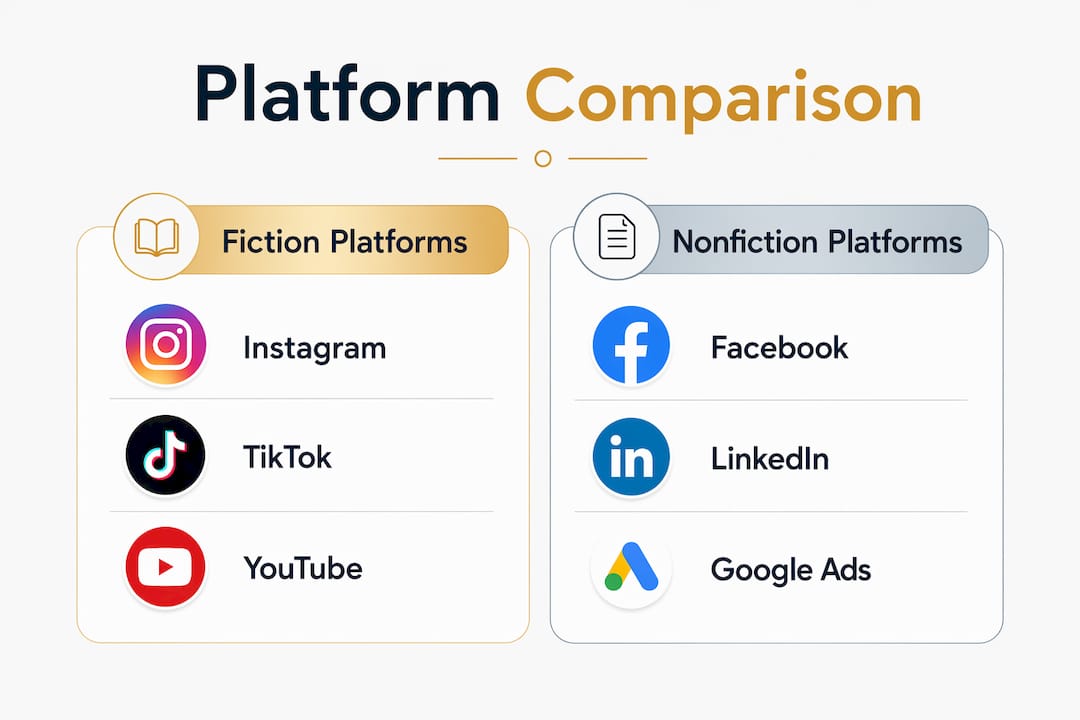
Instagram and TikTok deliver the strongest organic visibility for fiction authors, while Facebook performs best for nonfiction and audiences aged 35 and above. This matters because a literary thriller author posting exclusively on LinkedIn is essentially shouting into an empty room.
Here is a quick comparison to help you decide where to focus:
| Platform | Best for | Content style | Ad targeting strength |
|---|---|---|---|
| Instagram (Bookstagram) | Fiction, romance, YA | Aesthetic photos, Reels, carousels | Strong interest and lookalike targeting |
| TikTok (BookTok) | Fiction, genre fiction | 15 to 30 second video, trends | Growing but less refined |
| Facebook Groups | Nonfiction, older readers | Long posts, community discussion | Most mature ad platform |
| YouTube Shorts | All genres | Short narrated clips, author vlogs | Strong search intent targeting |
Key considerations when selecting your platforms:
- Audience fit: Go where your genre’s readers already spend time. BookTok has driven millions of sales for fantasy and romance titles since 2021.
- Content capacity: Each platform demands a different content style. Spreading yourself across four platforms with mediocre content beats nothing.
- Algorithm behaviour: Instagram and TikTok reward consistency and watch time. Facebook Groups reward genuine participation and discussion.
- Ad infrastructure: Facebook Ads Manager remains the most mature paid advertising tool for authors, offering granular interest targeting by author name and subgenre.
Consistency on 2 to 3 platforms outperforms being spread thin across many, because algorithms favour regular presence over breadth. Pick your two strongest platforms and commit to them for at least 90 days before evaluating results.
How to create content that builds community and sells books
The most effective social media strategies for authors treat every post as either education or entertainment, never as an interruption. This is the edutainment model, and it is the modern marketing approach that replaces the old broadcast mindset.

The 80/20 rule defines the ideal content split: 80% of your posts should deliver value through storytelling, genre discussions, writing tips, polls, or behind-the-scenes glimpses, and only 20% should be direct promotional posts. Audiences follow authors they find interesting, not authors who constantly ask them to buy something.
Here is a practical content creation process you can follow each week:
- Define your content pillars. Choose three to four recurring themes: your author journey, genre world-building, reader interaction, and writing craft. These pillars give your feed coherence and make planning faster.
- Lead with short-form video. 15 to 30 second clips featuring chapter hooks or narrated reads maximise visibility on TikTok, Instagram Reels, and YouTube Shorts. A single compelling hook in the first two seconds determines whether viewers keep watching.
- Write SEO-optimised captions. Use keywords your readers actually search, such as “dark fantasy book recommendations” or “cosy mystery reads 2026.” This is where AI tools like ChatGPT or Jasper earn their place, generating multiple caption variations and integrating search terms naturally.
- Build a pre-launch hype phase. Sharing your writing journey and character reveals months before launch creates early advocates who amplify your release day posts organically.
- Use polls, questions, and reader votes. Asking your audience to vote on cover options or character names turns passive followers into invested participants who feel ownership over your book.
Pro Tip: AI tools can generate multiple social captions, transform video transcripts into blog ideas, and schedule posts automatically. Use them to maintain consistent output without losing your authentic voice by always editing AI drafts to sound like you.
Getting your content indexed by AI tools like ChatGPT and Perplexity is increasingly relevant in 2026. When your captions, blog posts, and social profiles use consistent keywords and named entities, large language models are more likely to surface your book when readers ask for recommendations in your genre. This is the intersection of social media marketing and AI SEO, and authors who understand it gain a discoverability edge that pure social posting cannot deliver alone.
How to use paid advertising to amplify your organic reach
Paid social advertising accelerates what organic content starts. The mistake most authors make is running broad campaigns with no clear objective and wondering why the budget disappears without results.
Targeting fans of specific authors in your subgenre is the most effective way to optimise paid ad spend and conversions. If you write grimdark fantasy, targeting readers who follow Joe Abercrombie or Robin Hobb on Facebook delivers far better return than targeting “people who like books.”
Practical rules for paid book advertising:
- Start small and test. A daily budget of $5 to $10 run for at least seven days gives the algorithm enough data to optimise delivery before you commit to larger spends.
- Set one clear campaign objective. Use traffic campaigns to drive readers to your Amazon page, engagement campaigns to build social proof on a post, or awareness campaigns to reach cold audiences. Mixing objectives in one campaign confuses the algorithm and wastes money.
- Boost your best organic content. Paid ads work hardest when they amplify posts that already perform well organically. A Reel with strong watch time and saves is a proven asset worth putting budget behind.
- Run A/B tests on visuals and copy. Effective paid campaigns use iterative A/B testing to identify which cover image, headline, or call to action resonates most before scaling spend.
- Avoid vanity metrics. Likes and impressions feel good but do not pay royalties. Track link clicks, landing page views, and ultimately sales or email sign-ups as your real performance indicators.
Pro Tip: Facebook Ads Manager allows you to create custom audiences from your email list and lookalike audiences based on your existing readers. This is one of the most cost-effective targeting options available to self-published authors with a modest budget.
Google Ads is worth considering alongside Meta advertising, particularly for nonfiction authors whose readers search with high intent. A campaign targeting search terms like “best productivity books 2026” can capture readers at the exact moment they are ready to buy.
What does a consistent content and engagement routine look like?
Posting great content without engaging with your community is like opening a bookshop and refusing to talk to customers. The 15-minute daily engagement rule often outperforms posting alone, because algorithms reward accounts that generate genuine conversation.
Here is a weekly routine that works for authors managing social media alongside writing:
- Monday and Wednesday: Post one piece of value-driven content (a writing tip, genre discussion, or behind-the-scenes clip). Use AI scheduling tools like Buffer or Later to queue posts in advance.
- Tuesday and Thursday: Spend 15 minutes commenting meaningfully on posts from readers, fellow authors, and genre communities. Generic “great post!” comments do nothing. Specific, thoughtful replies build real relationships.
- Friday: Post one promotional piece, such as a book excerpt, a review quote, or a limited-time offer.
- Weekend: Join the conversation in genre-specific spaces. Micro-communities in Reddit, Discord, and Facebook Groups create deep reader loyalty and extend your reach beyond follower counts. Authors who engage genuinely in genre-specific forums gain stronger conversions than those chasing vanity metrics.
- Monthly: Review your analytics. Track which content types drove the most profile visits, link clicks, and follower growth, then adjust your content pillars accordingly.
| Task | Frequency | Time required |
|---|---|---|
| Post value-driven content | 3 to 4 times per week | 30 to 60 minutes |
| Community engagement | Daily | 15 minutes |
| Promotional post | Once per week | 20 minutes |
| Analytics review | Monthly | 45 minutes |
| Paid ad optimisation | Weekly | 20 minutes |
Hosting monthly live Q&A sessions on Instagram or Facebook is one of the highest-return activities available to authors. Live video receives preferential algorithmic treatment on both platforms, and the direct reader interaction builds the kind of trust that converts browsers into buyers.
Common pitfalls in social media book marketing and how to avoid them
Most authors do not fail because they lack talent or a good book. They fail because they make predictable, avoidable mistakes in their marketing execution.
The most damaging errors include:
- Overextending across too many platforms. Maintaining six platforms at a mediocre level is worse than excelling on two. Burnout leads to inconsistency, and inconsistency kills algorithmic reach.
- Treating social media as a billboard. Posting only cover images and “buy now” links trains your audience to scroll past you. Every post should offer something worth stopping for.
- Ignoring community interaction. Relying solely on ads while neglecting organic engagement is expensive and unsustainable. Ads work best when they land on a profile that already looks active and credible.
- Poor ad targeting. Broad, untargeted campaigns waste budget at a remarkable rate. Narrow your audience to readers who already consume your genre before spending a dollar.
- Neglecting SEO and AI discoverability. Authors who write captions without keywords, never blog, and have no presence in AI search results are invisible to a growing segment of readers who discover books through ChatGPT, Perplexity, and Google’s AI Overviews.
“The transition from author to marketer is not about abandoning your creative identity. It is about adding a strategic layer that ensures the right readers can actually find your work.” Source
Micro-influencers with engaged followings of 1,000 to 10,000 often deliver better conversion rates than large accounts. Partnering with a BookTok creator who has 5,000 highly engaged fantasy readers will outperform a sponsored post from an account with 500,000 passive followers almost every time.
Key takeaways
Successful social media book marketing requires platform focus, the 80/20 content rule, daily community engagement, and targeted paid advertising working together as a single system.
| Point | Details |
|---|---|
| Platform selection | Choose 2 to 3 platforms matching your genre’s audience and commit for at least 90 days. |
| Content ratio | Apply the 80/20 rule: 80% value-driven posts, 20% promotional content. |
| Short-form video | Post 15 to 30 second Reels, TikToks, or Shorts with strong hooks to maximise organic reach. |
| Paid advertising | Start with a small daily test budget, target fans of similar authors, and boost proven organic content. |
| Community engagement | Spend 15 minutes daily in genuine interaction across genre-specific groups, Reddit, and Discord. |
What I have learned about book marketing that most guides will not tell you
After working with dozens of service-based businesses and content creators on their social media presence, the pattern I see most often is this: authors invest enormous energy into their craft and almost none into understanding how discovery actually works in 2026.
The platforms have changed. Readers no longer browse bookshop shelves as their primary discovery method. They ask ChatGPT for “books like The Name of the Wind,” they scroll BookTok at midnight, and they find authors through Reddit threads in r/Fantasy or r/Cozybooks. If your name and your book title do not appear in those spaces, you are functionally invisible to a large portion of your potential readership.
What I recommend to every author I work with is to think about their social media presence the way a business thinks about SEO. Your Instagram bio, your TikTok captions, your Facebook Group description, and your author website all contribute to whether AI tools and search engines surface your name when readers go looking. This is not a future consideration. It is the present reality of book marketing.
The authors I see winning are not necessarily the most talented writers or the ones with the biggest budgets. They are the ones who show up consistently, engage genuinely, and treat their social media organic growth as a long-term asset rather than a launch-week sprint. Community beats follower count every single time. A Discord server with 200 passionate readers who pre-order every book you release is worth more than 20,000 passive Instagram followers who have never clicked a link.
Be patient. Be specific. And never stop learning how the algorithm and the AI tools are evolving, because the authors who adapt fastest will always have the advantage.
, Business Warriors | Digital Marketing Agency
Ready to build a marketing system that works beyond launch day?
If you have read this far, you already understand that promoting your book on social media is not a one-off task. It is an ongoing system that combines content, community, paid advertising, SEO, and AI discoverability into a single, compounding strategy.
At Jarrodharman, the Marketing Vortex Method is built exactly for this. It integrates social media, SEO, paid advertising, and content strategy into a 360-degree approach that creates consistent reader engagement rather than launch-week spikes. Whether you are a self-publisher looking for your first 1,000 readers or an established author scaling to a wider audience, the framework applies. Explore how to build consistent audience engagement and turn your social media presence into a reliable reader acquisition system.
FAQ
What is the best platform for marketing a book on social media?
Instagram and TikTok deliver the strongest organic reach for fiction authors, while Facebook performs best for nonfiction and older demographics. Choose based on where your genre’s readers already spend their time.
How often should authors post on social media?
Posting 3 to 5 times per week combined with 15 minutes of daily community engagement produces stronger results than posting daily without interaction. Consistency and quality outperform volume.
How much should I spend on Facebook advertising for my book?
Start with a daily budget of $5 to $10 run for at least seven days to gather performance data before scaling. Target fans of authors in your specific subgenre for the best return on spend.
Do AI tools help with social media book marketing?
AI tools like ChatGPT and Jasper generate caption variations, repurpose video transcripts into blog content, and support SEO keyword integration. They save time and improve discoverability without replacing your authentic voice.
How do I get my book mentioned by AI tools like ChatGPT?
Consistent use of genre-specific keywords across your social profiles, captions, author website, and blog posts increases the likelihood that large language models surface your book in reader recommendation queries. This is the core principle of AI SEO and GEO (Generative Engine Optimisation) applied to social media marketing strategies for authors.