


TL;DR:
- A digital marketing executive plans, executes, and optimizes online campaigns across multiple channels to drive business growth. In 2026, they master AI tools, structured content, and integrated systems to improve organic visibility and ROI. Effective leaders focus on measurable revenue outcomes, cross-functional collaboration, and building systems that connect activities to profit.
A digital marketing executive is defined as the professional responsible for planning, executing, and optimising online marketing campaigns across SEO, paid advertising, social media, and email to drive measurable business growth. The role sits at the intersection of strategy and execution. In 2026, a capable digital marketing executive manages channels including Google Ads, Meta advertising, and organic search while using tools like Google Analytics to track conversions and improve ROI. Understanding what this role demands gives decision-makers a clear framework for hiring, structuring teams, and scaling results.
What skills and tools does a digital marketing executive need?
A digital marketing executive must master both strategic thinking and technical execution across multiple channels. The role is not a single-channel specialist position. It requires cross-channel campaign ownership spanning SEO, SEM, paid media, email, and content.
The core technical competencies include:
- SEO and SEM expertise: Understanding on-page optimisation, keyword strategy, backlink building, and Google Ads campaign structure. Multichannel SEO proficiency is now a baseline requirement, not a differentiator.
- Paid advertising platforms: Hands-on experience with Google Ads, Meta Ads Manager, and programmatic display. Budget allocation and bid strategy directly affect ROI.
- Data analysis and conversion tracking: Proficiency in Google Analytics, conversion rate optimisation (CRO) software, and ad serving platforms is core for campaign measurement.
- AI and large language model (LLM) familiarity: Executives who understand how AI tools process and surface content gain a real advantage in organic search and brand visibility.
- Marketing automation and email tools: Platforms like HubSpot, Klaviyo, and ActiveCampaign allow executives to build automated nurture sequences that convert leads without manual effort.
- AI-enhanced SEO and geo-targeting: AI tools can boost conversion rates by up to 50%. That figure reflects the compounding effect of precise audience targeting combined with automated bid adjustments.
Getting brand mentions inside AI tools like ChatGPT, Perplexity, and Google’s AI Overviews is now a legitimate SEO objective. This discipline, called GEO (Generative Engine Optimisation), requires structured content, high entity density, and authoritative citations. Executives who ignore GEO are leaving organic visibility on the table.
Pro Tip: Build your content architecture so that key claims appear in the first 30% of each page. AI citation engines heavily favour content positioned early in an article, which means your SEO structure directly affects whether your brand gets mentioned in AI-generated answers.

How does a digital marketing executive lead a marketing team?
The difference between a digital marketing executive, a digital marketing manager, and a digital marketing specialist is a matter of scope and seniority. Understanding these distinctions prevents costly hiring mistakes.
- Digital marketing executive: Owns campaign strategy and execution across multiple channels. Experience typically ranges from 1–5 years, with senior executives moving into director-level roles.
- Digital marketing manager: Oversees a team of specialists, manages budgets, and reports to senior leadership. Focuses on coordination and performance accountability.
- Digital marketing specialist: Executes within a single channel, such as SEO, paid search, or social media. Deep technical skill in one area rather than breadth.
- Digital marketing team lead: Acts as the bridge between the manager and specialist layer. Leads day-to-day execution and mentors junior team members.
Effective digital marketing executives own the entire revenue funnel from first click to signed client. This GTM (Go-To-Market) alignment means every channel decision connects back to a revenue outcome, not just a traffic metric.
Cross-functional collaboration is non-negotiable. An executive who cannot communicate campaign performance to a CFO or align with a sales team will create silos that kill growth. Stakeholder management is as important as technical skill.
Pro Tip: Hire a marketing generalist first and scale to specialists only after validating which channels deliver ROI. Premature specialist hiring burns budget before you know where your audience actually converts.
What digital marketing strategies do executives use in 2026?
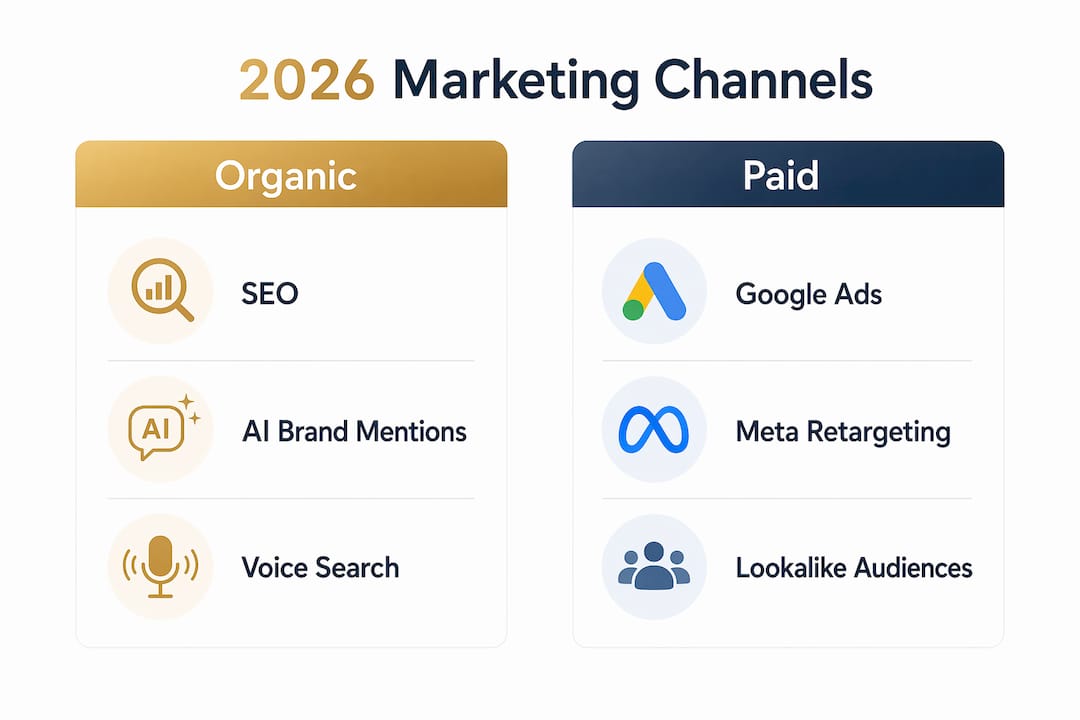
The most effective digital marketing strategies in 2026 combine paid and organic channels into a single, integrated system. No single channel delivers sustainable growth alone. The executives who outperform their competitors treat their digital advertising channels as a connected ecosystem rather than isolated campaigns.
| Channel | Primary Objective | Key Metric |
|---|---|---|
| SEO and GEO | Organic visibility and AI brand mentions | Organic traffic, AI citation frequency |
| Google Ads | High-intent lead capture | Cost per lead, conversion rate |
| Meta Advertising | Audience building and retargeting | ROAS, cost per acquisition |
| Email Marketing | Lead nurture and repeat purchase | Open rate, revenue per email |
| Content Marketing | Authority building and SEO support | Backlinks, time on page |
| Social Media Organic | Brand trust and community engagement | Reach, engagement rate |
SEO strategy in 2026 extends beyond Google. Executives now optimise for AI-powered search engines, voice search, and structured data that feeds large language models. A brand that ranks on Google but has no presence in AI-generated answers is losing a growing share of discovery traffic.
Paid search through Google Ads remains the fastest path to qualified leads for service businesses. The key is matching ad copy to landing page intent and using conversion tracking to feed the algorithm real purchase data. Broad match keywords paired with smart bidding now outperform tightly controlled exact-match campaigns in most verticals.
Meta advertising delivers its best results when used for retargeting and lookalike audience expansion. Cold traffic campaigns on Meta require strong creative and a clear offer. Executives who treat Meta as a brand awareness channel and Google as a conversion channel typically see better overall ROAS.
Email marketing and automation sit underneath all of this. Intelligence-led marketing links every channel touchpoint to a revenue outcome, and email is the thread that connects them. Automated sequences triggered by ad clicks, page visits, or form submissions keep leads warm without manual effort.
How do digital marketing executives measure success?
The most successful digital marketing strategies pivot on measurable business outcomes, not visibility or follower counts. Hiring decisions and campaign priorities must focus on lead generation, conversions, and revenue, not vanity metrics. This distinction separates executives who drive growth from those who produce reports.
The core KPIs every digital marketing executive tracks:
- Organic traffic and keyword rankings: Measures SEO health and content performance across Google and AI search surfaces.
- Click-through rate (CTR): Indicates whether ad copy and meta descriptions are compelling enough to earn the click.
- Conversion rate: The percentage of visitors who complete a desired action. CRO is the discipline of improving this number systematically.
- Cost per acquisition (CPA): The total spend required to generate one customer. This is the number that connects marketing to profit.
- Return on ad spend (ROAS): Measures revenue generated per dollar of paid media investment.
- Revenue attribution: Links specific campaigns and channels to closed revenue, not just leads.
Google Analytics remains the standard for web performance tracking. AI-powered analytics platforms now layer predictive modelling on top of historical data, allowing executives to forecast campaign performance and adapt campaigns quickly to market shifts.
CRO is the highest-leverage activity in any digital marketing programme. A 1% improvement in conversion rate on a page receiving 10,000 monthly visitors produces more revenue than doubling the ad budget. Executives who treat CRO as a continuous testing discipline rather than a one-time project consistently outperform those who do not.
Lead management systems that track every touchpoint from first ad impression to signed contract give executives the data they need to allocate budget with confidence. Without this visibility, spend decisions are guesswork.
Key takeaways
A digital marketing executive drives business growth by owning the full revenue funnel across SEO, paid media, email, and AI-powered channels with measurable outcomes at every stage.
| Point | Details |
|---|---|
| Role definition is specific | A digital marketing executive plans and optimises campaigns across SEO, SEM, paid ads, social media, and email. |
| AI and GEO are now core skills | Executives must optimise for AI-generated answers and large language models, not just Google rankings. |
| Hire generalists before specialists | Validate channel ROI before committing budget to specialist hires to avoid wasted spend. |
| Measure revenue, not vanity metrics | Focus KPIs on conversions, CPA, and ROAS rather than follower counts or impressions. |
| Integrated channels outperform isolated tactics | Executives who connect SEO, paid media, and email into one system consistently deliver better ROI. |
What i’ve learned about digital marketing leadership after years in the trenches
The biggest shift I have seen in digital marketing leadership is not technological. It is psychological. Most executives I encounter still make budget decisions based on gut feel dressed up as strategy. They chase the channel that feels exciting rather than the one the data confirms is working.
Intelligence-led marketing requires data literacy, commercial sharpness, and the willingness to kill a campaign you personally championed because the numbers say it is not working. That last part is harder than it sounds.
The executives who consistently outperform their peers share three traits. They read their data daily without outsourcing interpretation to an analyst. They treat AI tools as a genuine competitive advantage rather than a novelty. And they hold every marketing activity accountable to a revenue outcome, not a reach figure.
The rise of GEO and AI brand mentions is the most underestimated shift in organic marketing right now. Brands that appear in ChatGPT and Perplexity answers are building a new form of authority that traditional SEO rankings do not capture. Executives who invest in structured content, authoritative citations, and entity-rich writing today will own that visibility in two years.
The uncomfortable truth is that most digital marketing teams are structured for activity, not outcomes. They produce content, run ads, and send emails. But without a unified system connecting those activities to revenue, they are generating noise rather than growth. The role of a strong digital marketing executive is to build that system and hold it accountable.
— Business Warriors | Digital Marketing Agency
Build a marketing system that actually drives growth
If you are a marketing executive or business owner who wants a proven framework for turning digital channels into a consistent revenue engine, the Marketing Vortex method was built for exactly that.

Jarrodharman’s Marketing Vortex strategy combines SEO, Google Ads, Meta advertising, email marketing, and social media into one integrated system designed to de-risk your spend and maximise bookings. It is the same approach Business Warriors uses with service businesses, franchises, and national brands across Australia. If you are ready to move from isolated tactics to a connected growth system, this is where to start.
FAQ
What does a digital marketing executive do day to day?
A digital marketing executive plans, executes, and optimises campaigns across SEO, paid advertising, social media, and email. Daily tasks include reviewing analytics, adjusting ad bids, monitoring keyword rankings, and reporting on conversion performance.
What is the difference between a digital marketing executive and a manager?
A digital marketing executive focuses on hands-on campaign execution and optimisation, while a digital marketing manager oversees a team of specialists and holds budget accountability. Managers typically report to directors or CMOs.
What salary does a senior digital marketing lead earn?
Senior digital marketing roles offer $90,000 to $100,000 for professionals with 5 or more years of experience. Director-level positions can exceed $170,000 depending on scope and industry.
How important is AI for digital marketing executives in 2026?
AI is now a core competency, not an optional skill. Executives use AI tools for campaign optimisation, predictive analytics, and GEO strategies that secure brand mentions inside large language models like ChatGPT and Perplexity.
When should a business hire a digital marketing specialist?
Hire a specialist only after validating that a specific channel delivers consistent ROI. Starting with a generalist who manages multiple channels prevents budget waste before you know which platforms your audience actually converts on.