


TL;DR:
- Personal branding on social media involves intentionally creating a consistent digital reputation based on expertise, values, and voice. It takes at least 90 days of focused activity to build recognition and trust, regardless of audience size. Prioritizing clarity, repetition, and alignment with business goals ensures your online presence effectively generates opportunities.
Personal branding on social media is the deliberate creation of a consistent online reputation that clearly communicates who you are, what you do, and why people should trust you. Unlike a standard personal profile, a personal brand is an intentional system built on expertise, values, and a recognisable voice. Building this recognition requires at least 90 days of consistent, focused activity before most audiences begin to associate your name with a specific idea or outcome. The good news is that you do not need a massive following to make it work. You need clarity, repetition, and a strategy that connects your digital identity to real business or career results.
What is personal branding on social media?
Personal branding on social media is the intentional process of shaping how others perceive you across digital platforms. It is your professional reputation made visible, searchable, and shareable. The term “digital identity” is the broader industry concept that covers everything from your Google search results to your LinkedIn bio, but personal branding on social media is the active, ongoing practice of building and managing that identity through content and engagement.
The foundation is simple: every post, comment, and profile element either reinforces or dilutes the impression you want to create. Most people treat their social profiles as passive accounts. A personal brand treats every platform as a channel in a deliberate communication system. That shift in thinking changes everything about how you show up online.
Jarrodharman’s approach to personal branding centres on this exact principle. Clarity of identity comes first, and the content strategy follows from it. Without a clear answer to “who am I and what do I stand for,” no amount of posting frequency will build a brand worth having.
What key elements make up an effective personal brand on social media?
An effective personal brand rests on four core pillars. Defining these four pillars converts casual viewers into engaged followers who remember you and refer you.
- Who you are. Your story, background, and the values that drive your work. This is not a biography. It is the human context that makes your expertise feel trustworthy rather than transactional.
- What you do. Your niche and area of expertise. The more specific, the better. “Marketing consultant” is forgettable. “I help service businesses in Australia generate leads through SEO and paid social” is memorable.
- Who you help. Your audience. Knowing exactly who you serve shapes every content decision, from the language you use to the platforms you prioritise.
- Why you are trusted. Your credibility signals: case studies, client results, media mentions, certifications, and consistent delivery over time.
Visual identity is the layer that makes these pillars instantly recognisable. Consistent visual identity with 3–5 colours and 2 fonts can increase brand-related revenue by up to 23%. That number reflects a simple truth: people buy from brands they recognise, and recognition requires repetition of the same visual cues.
Your verbal identity matters just as much. The tone you use across platforms, whether direct and data-driven or warm and conversational, should remain consistent. Switching registers between LinkedIn and Instagram confuses your audience about who you actually are.

Profile consistency across platforms means using the same handle, profile photo, colour palette, and imagery style everywhere. In a fast-scrolling feed, you have less than two seconds to be recognised. A coherent system across platforms makes that recognition automatic.
Pro Tip: Lock your handle across every platform you use, even ones you are not active on yet. Squatting your own name on TikTok, Threads, and YouTube costs nothing and protects your brand identity as new platforms emerge.
How does personal branding differ from a general social media presence?
A social media presence is an account. A personal brand is a reputation. The difference is intent and consistency. Most people post reactively, sharing what feels relevant in the moment. Personal branding requires a publishing strategy, a defined point of view, and the discipline to repeat your core message until it sticks.
Personal branding functions as “reputation in motion,” offering a protective career layer that increases visibility and opportunity even in volatile economic conditions. That is a fundamentally different value proposition from simply having followers.
“A personal brand is not vanity-driven. It signals your professional destination and shortens sales cycles by conveying status before personal interactions ever happen.”
This distinction matters enormously for business owners and professionals aged 25–45. Your personal brand travels with you across jobs, industries, and platforms. A business brand is tied to a company. Your personal brand is tied to you. If the company closes or you change direction, the personal brand remains intact and continues generating inbound opportunities.
The practical impact on sales is significant. Effective personal branding attracts inbound opportunities and reduces the effort required to sell, because prospects arrive already convinced of your credibility. That pre-sold trust is the most valuable asset a personal brand creates.
Pro Tip: Audit your LinkedIn profile as if you were a potential client seeing it for the first time. Does it communicate your niche, your results, and your point of view within 10 seconds? If not, rewrite the headline and summary before you post another piece of content.
What social media strategies reinforce and grow a personal brand?
The most effective personal branding strategy is built on content pillars, not content volume. Committing to 3–4 content pillars for 90 or more days builds the predictability that audiences associate with authority. Predictability is trust made visible.
- Define your content pillars. Choose 3–4 themes that sit at the intersection of your expertise and your audience’s problems. For a business consultant, those might be client acquisition, mindset, case studies, and industry commentary. Every piece of content maps to one of these pillars.
- Apply SEO thinking to your content. Search engine optimisation is not just for websites. LinkedIn articles, YouTube video titles, Instagram captions, and TikTok descriptions all benefit from keyword research. When your content answers the questions your audience is already searching for, it gets found organically. Pair this with GEO (generative engine optimisation) to earn brand mentions inside AI tools like ChatGPT and Perplexity.
- Use AI tools to maintain output without losing authenticity. AI can assist with drafting, repurposing, and scheduling content. Building thought leadership with AI requires a clear framework: use AI to handle structure and research, then add your own voice, opinions, and specific examples before publishing. The human layer is what makes the content worth reading.
- Integrate paid social advertising for targeted reach. Organic content builds credibility. Paid advertising on Meta and Google Ads accelerates reach to the exact audience you want. Running a small retargeting campaign to people who have already engaged with your organic content is one of the highest-return tactics available. Your social media presence grows faster when organic and paid work together.
- Avoid trend-chasing. Jumping on every viral format dilutes your brand message. Audiences remember you for your point of view, not your ability to replicate trending audio.
Pro Tip: Repurpose one long-form piece of content, such as a LinkedIn article or YouTube video, into five to seven shorter posts across platforms. This multiplies your output without multiplying your workload, and it reinforces your core message through repetition.
How do you measure the success of your personal branding efforts?
Measurement turns personal branding from a creative exercise into a business asset. The metrics that matter fall into three categories.
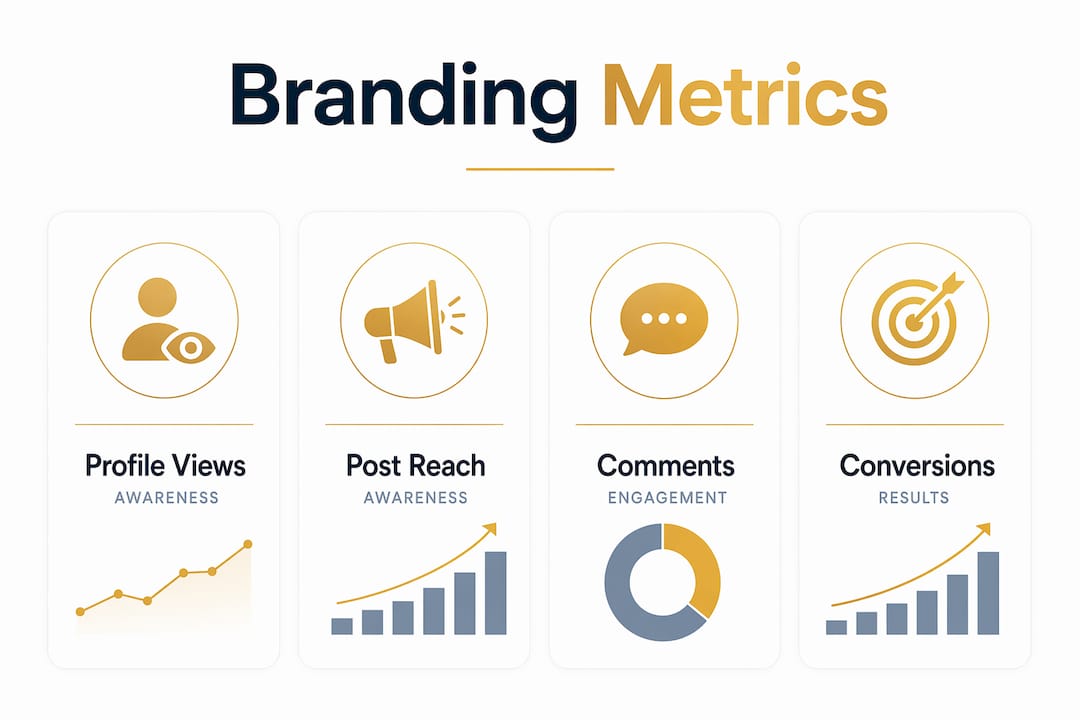
Awareness metrics tell you whether your brand is reaching new people. Track profile views, post reach, and follower growth rate. A steady upward trend over 90 days confirms your content pillars are resonating. A plateau signals that your content needs a format refresh, not a message change.
Engagement metrics tell you whether your audience finds your content valuable. Comments, saves, and shares carry more weight than likes. A post with 50 comments and 200 likes outperforms a post with 2,000 likes and no comments, because comments signal genuine interest and extend organic reach.
Conversion metrics tell you whether your brand is generating business outcomes. Track the ratio of followers to enquiries, the number of inbound messages referencing your content, and the percentage of new clients who mention finding you on social media. Brand consistency directly influences these downstream results.
| Metric category | What to track |
|---|---|
| Awareness | Profile views, post reach, follower growth |
| Engagement | Comments, saves, shares per post |
| Conversion | Inbound enquiries, content-attributed clients |
| SEO and discoverability | Search impressions, branded keyword traffic |
| Trust signals | Testimonials received, referrals, media mentions |
Review these metrics monthly, not daily. Daily fluctuations create noise. Monthly trends reveal whether your strategy is working or needs adjustment. Use the online branding checklist from Jarrodharman to audit your consistency across all tracked dimensions.
What role does authenticity play in personal branding in 2026?
Authenticity is now a competitive advantage, not just a buzzword. In the era of AI-generated content, authenticity cannot be replicated by algorithms. Every platform is flooded with polished, generic content produced at scale. The brands that cut through are the ones with a clear, human point of view.
Strategic positioning takes authenticity one step further. Your personal brand should signal where you are going, not just where you have been. A professional who posts exclusively about past achievements looks backward. One who shares opinions on industry trends, challenges conventional thinking, and documents their current work signals forward momentum. That forward signal attracts the opportunities you want next, not the ones you have already had.
“Simplified and consistent messaging builds memorability and enables others to advocate effectively on your behalf.”
The brands that earn the highest trust follow a counterintuitive rule: they say less, but they say it more clearly and more often. Many personal brands fail by communicating too many ideas across too many topics. The strongest brand messages stay simple and consistent over time.
- Post your opinion, not just information. Anyone can share a statistic. Only you can share your interpretation of what it means.
- Show your process, not just your results. Audiences trust people who are transparent about how they work.
- Engage with your audience’s content, not just your own. Commenting thoughtfully on others’ posts builds visibility and goodwill simultaneously.
- Use video. Faces build trust faster than text. Even a 60-second talking-head video outperforms a polished graphic carousel for trust-building.
The AI tools available in 2026 make it easier than ever to produce content. That means the bar for human authenticity has risen, not fallen. Your lived experience, specific opinions, and genuine personality are the only things AI cannot replicate at scale.
Key takeaways
Personal branding on social media succeeds when you commit to a clear identity, repeat it consistently across platforms, and measure its impact on real business outcomes.
| Point | Details |
|---|---|
| Define your four pillars | Clarify who you are, what you do, who you help, and why you are trusted before posting. |
| Maintain visual and verbal consistency | Use 3–5 colours and 2 fonts across all platforms to build instant recognisability. |
| Commit to 90 days minimum | Recognition and trust require sustained repetition of your core message over time. |
| Blend SEO, AI, and paid advertising | Organic content builds credibility; SEO and paid ads accelerate reach to the right audience. |
| Measure conversion, not just reach | Track inbound enquiries and content-attributed clients to confirm your brand drives business results. |
Why most personal brands stall before they gain traction
The most common mistake I see is not a lack of talent or content ideas. It is a lack of commitment to a single, clear message. People start strong, post consistently for three or four weeks, see modest results, and pivot to a completely different approach. That pivot resets the clock on recognition every single time.
Personal branding is not a sprint with a finish line. It is a long game that rewards patience and penalises inconsistency. The professionals I have watched build genuinely powerful brands share one trait: they decided what they stood for, and they repeated it until the market repeated it back to them.
The other misconception worth addressing is that personal branding requires you to perform a version of yourself that feels unnatural. The opposite is true. The most effective brands are built on a simplified, amplified version of who you already are. You are not creating a character. You are clarifying a signal.
AI tools have changed the content production equation significantly. They make it faster and cheaper to produce more content. But they have also made authenticity rarer and therefore more valuable. The professionals who will win the next decade of personal branding are the ones who use AI for efficiency and bring their genuine perspective to every piece of content they publish. That combination is genuinely difficult to replicate.
— Business
How Jarrodharman can help you build a brand that generates real results
Personal branding without a distribution strategy is a diary entry. Jarrodharman’s approach connects your brand identity to the full digital marketing ecosystem, including SEO, Google Ads, Meta advertising, and AI-powered content systems that get your name in front of the right people consistently.
Jarrod Harman works with business owners and professionals who are serious about turning their personal brand into a client acquisition engine. From digital marketing strategy to the Marketing Vortex Method, the focus is always on measurable outcomes: more inbound enquiries, shorter sales cycles, and a reputation that works for you around the clock. If you are ready to build a brand that actually drives growth, explore Jarrod’s approach and see what a structured personal branding strategy looks like in practice.
FAQ
What is personal branding on social media?
Personal branding on social media is the intentional process of building a consistent online reputation based on your expertise, values, and voice. It differs from a standard profile because every element is designed to communicate a specific professional identity.
How long does it take to build a personal brand on social media?
Building recognisable personal branding requires at least 90 days of consistent, focused content activity. Recognition builds through repetition, and 90 days is the minimum threshold for most audiences to associate your name with a specific idea.
What content pillars should I use for my personal brand?
Choose 3–4 themes that sit at the intersection of your expertise and your audience’s problems. Stick to these pillars for at least 90 days before evaluating whether to adjust them.
How does SEO help with personal branding on social media?
SEO techniques applied to social content, including keyword-optimised captions, video titles, and LinkedIn articles, make your content discoverable through search. This extends your reach beyond your existing followers and builds long-term findability across platforms and AI tools.
What is the biggest personal branding mistake to avoid?
Communicating too many ideas across too many topics is the most common failure point. The strongest personal brands stay simple, consistent, and specific over time.