


Undifferentiated marketing, also called mass marketing, is the practice of promoting a product or service to an entire market with a single unified message, treating all potential buyers as one homogeneous group. No segmentation. No tailored messaging. One campaign, one offer, maximum reach. The strategy works because certain products, think toothpaste, soft drinks, and cleaning supplies, genuinely solve the same problem for almost everyone who buys them.
Key features of undifferentiated marketing at a glance:
- Single marketing mix: one product, one price, one promotional message across all channels
- Broad channel use: TV, radio, billboards, and mass social media placements
- No segmentation required: the product’s universal appeal does the heavy lifting
- Cost efficiency: one campaign budget instead of multiple targeted ones
- Brand consistency: every consumer sees the same message, reinforcing recognition
This approach is foundational knowledge for any marketer working in Australia or globally. Understanding where it works, and where it falls short, shapes every strategic decision that follows.
Table of Contents
- Real-world examples of undifferentiated marketing in action
- How does undifferentiated marketing compare to differentiated marketing?
- Advantages and disadvantages of undifferentiated marketing
- Modern strategic perspectives on undifferentiated marketing in Australia
- Where did undifferentiated marketing come from?
- Jarrodharman: built for businesses that need more than mass reach
- Key takeaways
Real-world examples of undifferentiated marketing in action
The clearest way to understand this strategy is to look at brands that have built empires on it.

Coca-Cola is the textbook case. The brand sells a product with near-universal appeal, and its mass marketing strategy includes Super Bowl advertisements, Olympic sponsorships, and product placements in blockbuster films. None of those placements target a specific demographic. They target everyone watching.
Cadbury takes a similar approach in the confectionery space. The brand actively worked to shed the perception that chocolate was only for children, running campaigns that appealed across age groups, genders, and income levels. The result is a product that sits in trolleys across every demographic in Australian supermarkets.
Colgate uses mass marketing for its core toothpaste range. While the brand does produce specialised variants, its flagship products are promoted with a single message: clean teeth for everyone. That simplicity is the point.
Other products well suited to this approach:
- Paper goods and household cleaning supplies
- Over-the-counter medications like paracetamol
- Pantry staples such as flour, sugar, and cooking oil
- Basic apparel and footwear
- Petrol and automotive consumables
Pro Tip: Before committing to a mass marketing strategy, ask whether your product genuinely solves the same problem for every buyer. If the answer requires more than one sentence, you probably need segmentation.
In the Australian context, large FMCG brands running national TV campaigns during prime-time programming are the most visible practitioners. The logic is straightforward: broad advertising channels like television and outdoor billboards reach the maximum possible audience without requiring audience data.
How does undifferentiated marketing compare to differentiated marketing?
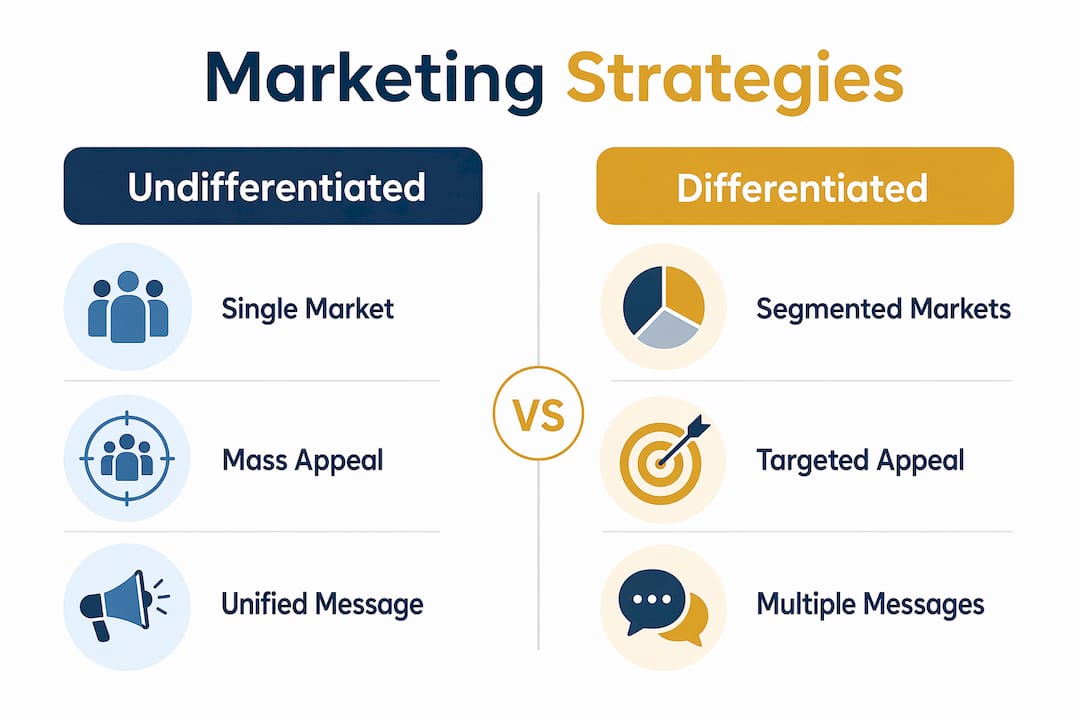
The core difference is whether you treat your market as one group or many. Undifferentiated marketing ignores segment differences entirely. Differentiated marketing, by contrast, identifies distinct customer segments based on demographic, behavioural, psychographic, and geographic data, then builds separate campaigns for each.
| Factor | Undifferentiated marketing | Differentiated marketing |
|---|---|---|
| Audience view | Homogeneous, one group | Segmented, multiple groups |
| Campaign count | One universal campaign | Multiple tailored campaigns |
| Cost | Lower upfront spend | Higher due to multiple campaigns |
| Personalisation | None | High |
| Best for | Mass-appeal products | Niche or specialised products |
| Complexity | Low | High |
| Risk | Vulnerable to niche rivals | Spread across segments |
When is each appropriate? Undifferentiated works when your product has wide appeal and a simple value proposition. Differentiated marketing suits businesses where buyer needs vary significantly, such as a fitness supplement brand serving both elite athletes and casual gym-goers. A fitness brand running one generic ad loses to a rival that speaks directly to each group.
Key distinctions worth remembering:
- Differentiated marketing requires ongoing customer research and data collection
- Undifferentiated marketing trades personalisation for scale and simplicity
- Australian businesses targeting multichannel marketing across digital and traditional channels often blend both approaches
Advantages and disadvantages of undifferentiated marketing
Advantages:
- Cost and time savings. Forgoing segmentation and developing one campaign cuts both production costs and management overhead considerably.
- Broader audience reach. A message with universal appeal can reach buyers you would never have identified through segmentation.
- Consistent brand image. Every consumer encounters the same message, which builds recognition and reinforces brand identity over time.
- Access to mass channels. TV, radio, and large-format outdoor advertising do not support personalisation, so undifferentiated campaigns are a natural fit.
Disadvantages:
- No customisation. 71% of consumers expect personalised interactions from brands, and a one-size-fits-all message cannot deliver that.
- Vulnerable to niche rivals. A competitor running targeted campaigns for specific segments can outmanoeuvre a mass marketer by speaking more directly to each buyer’s actual needs.
- Wasted spend. Without audience filtering, a portion of every campaign budget reaches people with no purchase intent.
- Less effective for service businesses. Salons, clinics, law firms, and other service providers rarely have the universal appeal that makes mass marketing efficient.
- SEO and digital penalties. Search engines prioritise content relevancy, meaning generic mass-appeal content can underperform in organic search without careful optimisation.
The context dependency of this strategy is the part most marketers underestimate. A cleaning product brand can run the same TV ad for a decade. A med spa in Perth cannot.
Modern strategic perspectives on undifferentiated marketing in Australia
“Mass advertising is best for grabbing attention in original ways rather than driving direct conversions. The shotgun approach increases the odds of hitting a target, but it is less efficient than targeted conversion strategies.” — Mass marketing research
Australian marketers face a specific tension in 2026. The mass marketing playbook still works for FMCG and commodity products, but digital marketing tools now demand that even broad-reach campaigns carry SEO-optimised, broad-interest content to avoid being deprioritised by search algorithms. You cannot simply run a generic TV script on YouTube and expect organic visibility.
The shift is real. Modern segmentation using demographic, geographic, psychographic, and behavioural data is reducing reliance on purely mass methods across Australian markets. Service-based businesses in particular are moving toward integrated digital approaches combining SEO, Google Ads, Meta advertising, and email marketing.
This is precisely where the Marketing Vortex methodology, developed by Business Warriors in Perth, becomes relevant. Rather than choosing between mass reach and targeted precision, the Marketing Vortex approach integrates SEO, paid search, social media, and email into an omnichannel system that generates consistent qualified leads for service businesses. It is the structural opposite of undifferentiated marketing, built for businesses where personalisation drives bookings.
Strategic recommendations for Australian marketers in 2026:
- Use undifferentiated campaigns for brand awareness at the top of the funnel, then layer targeted retargeting below
- Invest in AI-driven SEO and GEO (Generative Engine Optimisation) to get brand mentions inside large language models like ChatGPT and Perplexity
- Run Google Ads with broad match keywords for discovery, then tighten to exact match for conversion campaigns
- Use social media advertising to amplify mass-reach content while building custom audiences for retargeting
- Ensure mass-appeal content is optimised for featured snippets and AI citation to capture both traditional and AI-driven search traffic
Pro Tip: Getting your brand cited inside AI tools like ChatGPT or Google’s AI Overviews requires structured, authoritative content. Write clearly, cite credible sources, and use schema markup. That is the new version of mass marketing reach.
Effective mass marketing still requires significant upfront research to confirm that a product genuinely has mass appeal before committing budget to broad channels. Skipping that step is where Australian businesses most often waste ad spend.
Where did undifferentiated marketing come from?
Mass marketing has its origins in the 1920s with the rise of commercial radio. For the first time, a single advertiser could reach millions of listeners simultaneously with one message. That was a genuinely new capability, and corporations moved quickly to exploit it.
The strategy expanded through the 1940s and 1950s as television became a household fixture. Major consumer-goods companies built their entire growth models around mass production, mass distribution, and mass promotion. The logic was circular and self-reinforcing: produce at scale, advertise to everyone, sell in volume, reduce unit costs, repeat.
The approach slowed during the anti-consumerist movements of the 1960s and 1970s, then surged again through the 1980s and 1990s as mass media reached its peak influence. By the late 20th century, undifferentiated marketing had become a worldwide industry worth billions of dollars.
The internet changed the economics fundamentally. Suddenly, advertisers could target by postcode, age, purchase history, and browsing behaviour. The target market approach became not just possible but affordable for small businesses. Mass marketing did not disappear, but it became one tool among many rather than the default.
Today, the brands still running pure undifferentiated campaigns are mostly those selling products so universal that segmentation would add cost without adding relevance.
Jarrodharman: built for businesses that need more than mass reach
Mass marketing builds awareness. Consistent leads require something more precise.

Jarrodharman and the Business Warriors team work with service-based businesses across Australia that have outgrown generic advertising and need a system that actually fills their calendar. The Marketing Vortex method combines SEO, Google Ads, Meta advertising, email marketing, and social media into one integrated approach, so your marketing budget works across every channel simultaneously rather than betting everything on one broad campaign.
Unlike a mass marketing strategy that treats every potential buyer the same, the Marketing Vortex is built around your specific audience, your location, and your service. The result is qualified leads, not just impressions. If you are a clinic owner, salon director, or service business operator ready to move beyond broad-reach advertising, explore the digital marketing approach that Business Warriors uses with clients Australia-wide, and book a conversation with Jarrod directly.
Key takeaways
Undifferentiated marketing works when a product genuinely appeals to the entire market, but service businesses in Australia consistently generate better results through integrated, targeted digital systems like the Marketing Vortex.
| Point | Details |
|---|---|
| Core definition | Mass marketing targets the whole market with one message, assuming similar needs across all buyers. |
| Best-fit products | Everyday staples like cleaning supplies, toothpaste, and pantry goods suit this approach most naturally. |
| Main disadvantage | 71% of consumers expect personalised brand interactions, reducing the effectiveness of generic campaigns. |
| Digital adaptation | SEO-optimised broad-interest content is now required to avoid search engine penalties on mass-reach campaigns. |
| Jarrodharman approach | The Marketing Vortex integrates SEO, Google Ads, and social media for service businesses needing consistent qualified leads. |