


TL;DR:
- Expanding your business online involves setting clear KPIs, choosing targeted channels, and optimizing your website and content. Implementing a connected 90-day plan with measured testing and iteration maximizes growth and ensures effective resource use. An integrated system like the Marketing Vortex combines SEO, paid ads, and retention strategies to produce sustainable results for Australian service and e-commerce brands.
To expand your business online, follow these seven steps: set revenue and traffic KPIs, pick one to three channels that match your buyers’ intent, fix your website speed and conversion rate, publish SEO content targeting Australian search queries, run Google Ads and Meta campaigns with a defined test budget, build email and SMS retention flows, then measure and iterate every 30 days.
That is the whole plan. Everything below unpacks how to execute each step, with cost estimates, tools, and the integrated Marketing Vortex framework Jarrod Harman uses with Australian service businesses and e-commerce brands.
Your next action (do it in the next 24–72 hours): Run your site through Google PageSpeed Insights, write down your current monthly revenue and traffic baseline, and pick the single channel where your best customers already spend time.
- Step 1: Define your primary outcome (revenue, leads, bookings) and set a 90-day target.
- Step 2: Profile your buyers and choose one to three channels by intent.
- Step 3: Audit your website for speed, mobile UX, and a single clear call to action.
- Step 4: Map keyword intent for Australian searchers and publish your first five pieces of content.
- Step 5: Launch a 30-day paid test on Google Ads or Meta with a fixed daily budget.
- Step 6: Set up a welcome email series and a cart-abandonment flow.
- Step 7: Review GA4 data weekly; double down on what converts, cut what does not.
Table of Contents
- What are the right growth goals and KPIs for online expansion?
- How do you choose the right customers and online channels?
- How do you turn your website into a high-converting sales engine?
- What does an SEO and content strategy look like for Australian businesses?
- When should you use Google Ads vs Meta ads, and how much should you spend?
- How do social commerce, marketplaces and partnerships grow your reach?
- How do you turn new customers into repeat buyers?
- How do you scale operations to support online growth?
- How much does online expansion cost and how long does it take?
- What metrics should you track, test, and scale?
- The Marketing Vortex: Jarrod Harman’s integrated 90-day plan
- Key takeaways
- Why most Australian businesses get online expansion backwards
- Business Warriors can help you execute this plan
- Useful tools and resources for Australian businesses
What are the right growth goals and KPIs for online expansion?
Before you spend a dollar on ads or an hour on content, you need a number to aim at. Many consumers now start their product and service searches online, which means the opportunity is real, but so is the competition. Vague ambition (“grow sales”) loses to a specific target every time.
Build your KPI template in four columns:
- Baseline: What is the metric right now? (e.g., 800 monthly sessions, $12,000 monthly revenue)
- Target: What does success look like in 90 days? (e.g., 2,400 sessions, $20,000 revenue)
- Timeframe: 30 / 60 / 90-day checkpoint dates
- Owner: Who is responsible for reporting and acting on each metric?
Primary outcome metrics to track: monthly revenue, qualified leads or bookings, and cost per acquisition (CAC). Supporting metrics: organic sessions, paid click-through rate, conversion rate, and customer lifetime value (LTV). Keep the list short. Five KPIs you review weekly beat twenty you ignore.
On timeline: a realistic 90-day online expansion plan moves through three phases. Days 1–30 are setup and testing. Days 31–60 are optimisation based on early data. Days 61–90 are scaling what works. Budget and resource decisions should match each phase, not front-load everything into week one.
One compliance note worth building into your timeline: before you drive significant traffic, your site needs a current privacy policy, terms of service, and compliance with the Australian Consumer Law on refunds and guarantees. These are not optional extras; they affect ad account approvals and customer trust.
Stat: 87% of consumers start product and service searches online. If your business is not visible in search, you are handing those buyers to competitors.
How do you choose the right customers and online channels?

Most businesses fail online not because they chose the wrong product, but because they tried to be everywhere at once. The better approach: profile your buyers precisely, then pick the one to three channels where those buyers show up with intent to act.
Build a compact buyer profile using three questions:
- What job are they trying to get done? (e.g., “book a facial before a wedding”)
- Where do they search when they are ready to buy? (Google, Instagram, a marketplace?)
- What does a high-margin customer look like, and what is their average order value?
Once you have that profile, channel selection becomes a decision rule rather than a guess. High-intent buyers who are ready to purchase now belong on Google Search via Google Ads. Discovery-stage buyers who do not yet know your brand respond better to Meta (Facebook and Instagram) or TikTok. Buyers comparing products across sellers often start on marketplaces like Amazon Australia or eBay Australia. Service businesses should prioritise Google Search while retail brands may find social and marketplaces generate faster traction.
Pro Tip: Run a 30-day channel test before committing budget. Allocate $15–$20 per day to each candidate channel, track cost per lead or cost per click, and compare. The channel with the lowest CAC at the end of the month gets the majority of the next month’s budget.

The rule that matters most: choose channels by customer intent and margin, not by what your competitors are doing or what is trending. Being excellent on two platforms beats being mediocre on five.
How do you turn your website into a high-converting sales engine?
Your website is the one asset you own outright. Every paid campaign, every social post, and every SEO article eventually sends traffic back to it. If the site is slow, confusing, or untrustworthy, you are paying to fill a leaky bucket.
Page load time should be fast enough to keep bounce rates low and conversion rates high. Your pages must load in under three seconds to meet user expectations and maximise conversions. Run a free audit through Google PageSpeed Insights and fix the top three issues it flags before you spend another cent on traffic. Faster websites directly improve both SEO rankings and conversion rates, so speed work pays twice.
Conversion checklist for your site:
- Value proposition visible within five seconds of landing
- Single primary call to action per page (not three competing buttons)
- Trust signals above the fold: reviews, credentials, logos, guarantees
- Simplified checkout or enquiry form (fewer fields = higher completion)
- Active SSL certificate and mobile-responsive layout
- Landing pages that match the exact message of the ad that sent the visitor there
That last point is one most businesses get wrong. If your Google Ad says “Same-day bookings available,” the landing page must say the same thing. Message mismatch kills ad relevance scores and conversion rates simultaneously.
Quick CRO experiments to run in your first 30 days:
| Experiment | What to test | Metric to watch |
|---|---|---|
| Headline test | Two versions of your hero headline | Time on page, bounce rate |
| CTA text | “Book Now” vs “Get a Free Quote” | Click-through rate |
| Form length | 3-field vs 6-field enquiry form | Form completion rate |
| Page speed | Compress images, defer scripts | PageSpeed score, bounce rate |
High-converting landing pages share a consistent pattern: a single focused offer, social proof close to the CTA, and a form that asks only for what is needed. For more on optimising your site for leads, Jarrodharman’s practical guide covers the full checklist.
What does an SEO and content strategy look like for Australian businesses?
SEO is the only acquisition channel that compounds. A well-optimised page published today can generate organic traffic and leads for years. The catch: it takes three to six months to build momentum, which is why you start it in week one, not month three.
Begin with keyword intent mapping for Australian searchers. Transactional queries (“book laser hair removal Perth”) and high-intent informational queries (“how much does laser hair removal cost in Australia”) convert far better than broad awareness terms. A focused keyword approach consistently outperforms broad coverage because it concentrates your authority on the terms that actually drive enquiries.
Content types that work for Australian service and e-commerce businesses:
- How-to guides and FAQ pages structured for featured snippets
- Local landing pages targeting city or suburb-level queries (e.g., “accountant Parramatta”)
- Case studies that demonstrate real client outcomes
- Product and service pages with structured data markup
- Blog content that answers the questions your sales team hears every day
Technical SEO non-negotiables: structured data (Schema.org), a clean XML sitemap submitted to Google Search Console, Core Web Vitals passing, and GA4 conversion tracking live before you publish anything. Google Business Profile is also worth setting up immediately; local listings are one of the fastest ways to appear in map results for nearby searches.
AI and answer-engine visibility is now part of any serious SEO strategy. ChatGPT, Perplexity, and Google’s AI Overviews pull answers from pages with clear headings, concise paragraph answers, and FAQ schema. Structure your content the same way you would for a featured snippet: question as the heading, direct answer in the first sentence, supporting detail in the next two to three sentences. Getting your brand mentioned in large language models (a practice sometimes called GEO, or Generative Engine Optimisation) requires the same signals: authority, clarity, and consistent brand mentions across the web.
Pro Tip: Use AI tools like Claude or ChatGPT to draft content outlines and first drafts at scale, but always have a human review for accuracy, brand voice, and topical depth before publishing. AI-generated content without human oversight tends to drift toward generic answers that rank poorly and fail to build authority.
For deeper visibility tactics tailored to service businesses, Jarrodharman’s guide on increasing online visibility covers local SEO and content frameworks in detail.
When should you use Google Ads vs Meta ads, and how much should you spend?
Paid acquisition accelerates what organic channels take months to build. The key is knowing which platform to use for which stage of the buyer journey, and setting a test budget you can afford to lose while you gather data.
Google Ads captures demand that already exists. Someone searching “emergency plumber Sydney” is ready to buy right now. Google Search campaigns work best for service businesses with clear transactional intent, higher average order values, and a defined geographic area. Meta (Facebook and Instagram Ads) creates demand. It works for businesses where buyers do not yet know they need the product, for retargeting warm audiences, and for visual products where creative drives the decision.
| Platform | Best use | Ideal objective | Early metric to watch |
|---|---|---|---|
| Google Search Ads | High-intent, transactional queries | Leads, bookings, sales | Cost per conversion, Quality Score |
| Google Display/YouTube | Retargeting, brand awareness | Reach, video views | CPM, view-through rate |
| Meta (Facebook/Instagram) | Discovery, retargeting, visual products | Traffic, leads, purchases | Cost per lead, ROAS |
A simple test-budget formula: multiply your target cost per lead by 10, then divide by 30 to get a daily test budget. If you want to pay no more than $50 per lead, your 30-day test budget is $500 total, or roughly $17 per day. Run that for 30 days before scaling.
Funnel mapping for paid media:
- Prospecting: Cold audiences who match your buyer profile. Objective: awareness or traffic. KPI: CPM, click-through rate.
- Retargeting: People who visited your site or engaged with your content. Objective: leads or purchases. KPI: cost per lead, ROAS.
- Conversion: Warm leads who have shown clear intent. Objective: booking or sale. KPI: cost per acquisition.
On attribution: GA4’s default attribution model gives most credit to the last click, which undervalues Meta’s role in the early funnel. Use GA4’s attribution comparison report to see how each channel contributes across the full path before cutting spend on any platform. For lead generation tactics that pair with paid campaigns, Jarrodharman’s guide covers funnel examples in detail.
Stat: A large majority of consumers begin their search online. Paid campaigns that intercept that search intent at the right moment consistently outperform broad awareness spend.
How do social commerce, marketplaces and partnerships grow your reach?
Social platforms and marketplaces let you reach buyers who are not yet searching for you by name. They are also the fastest way to test product-market fit without building a full e-commerce infrastructure from scratch.
Social commerce works best when the format matches the product. Short-form video (Reels, TikTok) drives impulse purchases for retail and beauty products. Carousels work for catalogues and service menus. Shoppable posts on Instagram reduce the steps between discovery and purchase, which matters for lower-consideration buys. For service businesses, social content that shows real results (before/after, client stories, behind-the-scenes) builds trust faster than polished brand advertising. Jarrodharman’s guide on social media strategy for services covers the formats and posting cadences that generate enquiries.
Marketplaces serve a different purpose. Amazon Australia and eBay Australia give you access to buyers who are already in purchase mode and trust the platform’s checkout. Use them to test demand for new products, clear excess stock, or reach customers outside your existing audience. Shopify works differently: it is your own storefront, giving you full control over branding, data, and margins, but you are responsible for driving your own traffic.
Checklist for launching on a marketplace vs running direct-from-site:
- Marketplace: lower setup cost, faster first sale, lower margins, limited customer data ownership
- Direct (Shopify): higher setup effort, full data ownership, better margins long-term, requires traffic investment
- Partnership/affiliate: co-market with complementary businesses, referral programmes, local collaborations
Partnerships are underused by most Australian SMEs. A beauty clinic partnering with a bridal boutique, or a law firm cross-promoting with an accountancy practice, can generate warm referrals at near-zero cost. Set up a simple referral agreement with two or three complementary businesses in your first 30 days.
How do you turn new customers into repeat buyers?
Acquiring a new customer costs five to seven times more than retaining an existing one. Lifecycle marketing is where the maths of online growth actually works in your favour.
Core retention channels and when to use each:
- Email: Best for nurturing, post-purchase follow-up, and re-engagement. Segmented, automated email sequences deliver strong ROI when paired with a CRM. Industry benchmarks consistently place email among the highest-ROI digital channels for businesses that invest in segmentation.
- SMS: Best for time-sensitive offers, appointment reminders, and flash sales. Higher open rates than email, but use sparingly to avoid opt-outs.
- Subscriptions: Works for consumables, recurring services, and memberships. Predictable revenue and higher LTV per customer.
- Loyalty programmes: Effective for retail and hospitality. Points-based or tiered programmes increase purchase frequency.
Key lifecycle automations to build first:
- Welcome series (three to five emails over seven days) that delivers value before asking for a second purchase
- Post-purchase follow-up with an NPS survey or review request at day three to seven
- Cart-abandonment flow triggered within one hour of abandonment
- Reactivation campaign for customers who have not purchased in 90 days
Track repeat purchase rate, churn rate, and cohort LTV monthly. When your repeat purchase rate climbs, your CAC effectively drops because you are spreading acquisition cost across more revenue per customer. That is the compounding effect retention creates.
How do you scale operations to support online growth?
Growth without operational capacity creates a customer service crisis. Before you scale traffic, check that your fulfilment, support, and team structure can handle two to three times your current volume.
Fulfilment options by business type:
- In-house: Full control, lower per-unit cost at scale, but requires warehouse space and staff. Suits businesses with predictable, high-volume orders.
- Third-party logistics (3PL): Variable cost, faster to scale, no fixed overhead. Suits businesses with seasonal demand or limited storage.
- Dropship: Lowest upfront cost, but lowest margins and least control over delivery experience. Useful for testing new product lines.
Match your fulfilment model to your margin and lead-time requirements before you scale paid spend. A 3PL that ships in two days beats in-house fulfilment that ships in five, especially when Amazon Australia has trained buyers to expect speed.
Customer service at scale: Build scripted response flows for your top ten enquiry types, integrate a chatbot for after-hours queries, and connect your helpdesk to your CRM so every support interaction is visible to your sales and marketing team. A CRM-connected marketing stack lets you measure CAC and LTV accurately and act on that data to improve ROI.
30/60/90-day resourcing checklist:
- Days 1–30: Appoint an ads manager (in-house or agency) and a CRO lead
- Days 31–60: Hire or contract a content producer and a customer service coordinator
- Days 61–90: Assess whether a fulfilment manager or 3PL partner is needed based on order volume
How much does online expansion cost and how long does it take?
There is no single answer, but there are realistic bands. The numbers below reflect typical Australian market spend for service-based and e-commerce businesses.
Cost bands by phase:
- Test phase (days 1–30): $1,500–$5,000 total. Covers a basic website audit and fixes, $500–$1,500 in paid ad testing across one or two channels, and initial content production.
- Growth phase (days 31–60): $3,000–$10,000 per month. Adds SEO content production, expanded paid budgets, email automation setup, and possibly a part-time ads manager.
- Maturity phase (days 61–90+): $8,000–$25,000+ per month for businesses scaling aggressively. Includes full-funnel paid media, ongoing SEO, CRO testing, and CRM integration.
30/60/90-day milestones and expected outcomes:
- Day 30: Website speed fixed, GA4 tracking live, first paid campaigns running, first five SEO articles published, email welcome series active.
- Day 60: Paid campaigns optimised based on first-month data, organic traffic beginning to grow, first repeat-purchase emails sent, CAC calculated per channel.
- Day 90: Clear picture of which channels deliver the lowest CAC, SEO content gaining rankings, retention flows reducing churn, LTV trending up.
CAC vs LTV modelling: divide your total monthly marketing spend by the number of new customers acquired that month to get CAC. Divide average order value by your churn rate to estimate LTV. When LTV is at least three times CAC, the model is healthy. Below 2:1, you need to either reduce acquisition cost or increase retention.
Budget examples:
- Service-based lead gen (e.g., clinic, law firm): $2,000–$5,000/month in ads, $1,000–$2,000/month in SEO and content, $500/month in tech and automation.
- Retail e-commerce: $3,000–$15,000/month in paid media, $1,500–$3,000/month in content and SEO, $500–$2,000/month in platform and fulfilment tools.
What metrics should you track, test, and scale?
Data without a decision framework is just noise. The goal is a weekly rhythm: review core metrics, identify the one thing to test this week, run the experiment, and apply the learning.
Core analytics stack: GA4 for traffic and conversion tracking, a CRM (HubSpot, Salesforce, or Zoho CRM) for lead and customer data, and a simple dashboard that surfaces your five key metrics in one view. Connect GA4 to your Google Ads and Meta accounts for cross-channel attribution.
Metrics that matter:
| Metric | What it tells you | Healthy benchmark |
|---|---|---|
| Organic sessions | SEO traction | Growing month-on-month |
| Conversion rate | Website effectiveness | A modest conversion rate typical for most service sites |
| CAC | Acquisition efficiency | A CAC level well under the customer’s lifetime value |
| LTV | Customer value | An LTV at least several times higher than CAC |
| ROAS | Paid media return | A positive return on ad spend sufficient to sustain budget |
| Churn rate | Retention health | Low monthly churn rates typical for healthy subscriptions |
| Repeat purchase rate | Lifecycle marketing effectiveness | Rising quarter-on-quarter |
A/B testing roadmap: test headlines first (highest leverage, easiest to run), then CTA text and placement, then pricing presentation, then form length. Run each test for at least two weeks or until you have reached statistical significance (most A/B testing tools calculate this automatically). Never run two tests on the same page simultaneously.
Checklist for running an experiment:
- Define one hypothesis (“Changing the CTA from ‘Submit’ to ‘Get My Free Quote’ will increase form completions”)
- Set a success metric and a minimum sample size before you start
- Run the test without changing anything else on the page
- Document the result and apply the learning to all similar pages
Stat: Faster websites improve both SEO rankings and conversion rates simultaneously, making page speed one of the highest-leverage technical fixes in any measurement and optimisation plan.
The Marketing Vortex: Jarrod Harman’s integrated 90-day plan
The Marketing Vortex is the framework Jarrod Harman and Business Warriors use with Australian service businesses and e-commerce brands to integrate every channel into a single, self-reinforcing system. Rather than running SEO, Google Ads, Meta, email, and social as separate campaigns, the Vortex connects them so each channel feeds the others.
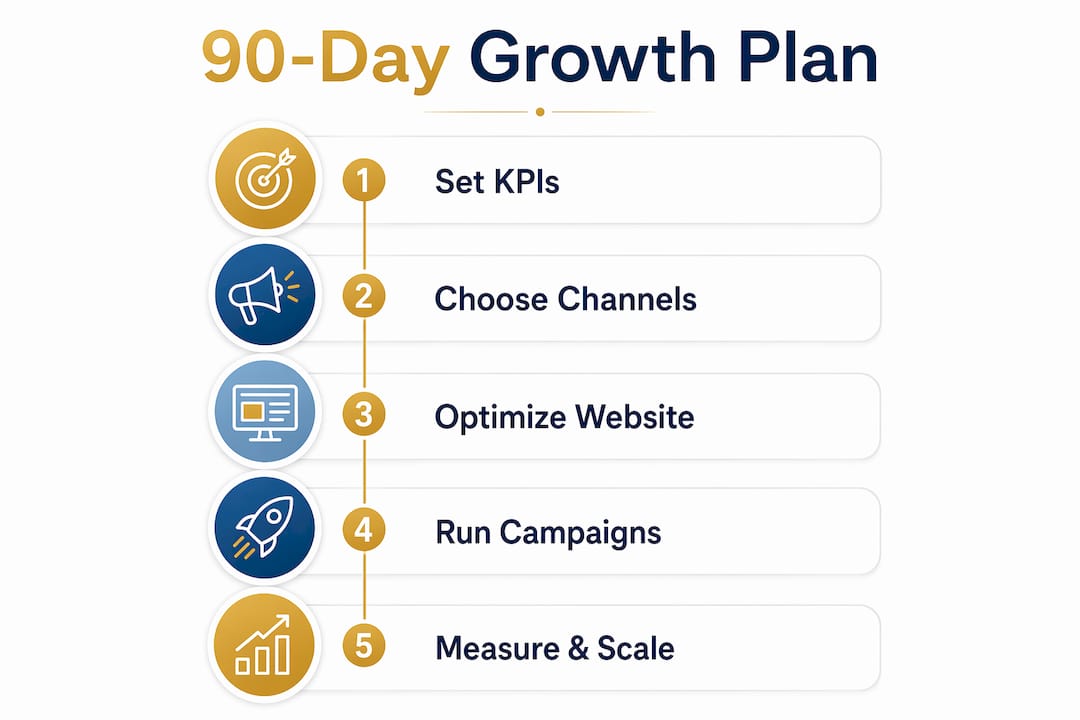
How the Marketing Vortex works:
SEO content attracts organic traffic and builds topical authority. Google Ads captures high-intent buyers who are ready to act now. Meta ads retarget visitors who did not convert on the first visit. Email and SMS nurture leads through the decision process. Website funnels convert that traffic into bookings or sales. Automation handles the follow-up so no lead falls through the cracks. Every channel reports into GA4 and the CRM, so the team can see exactly which combination of touchpoints produces a customer.
90-day implementation plan:
- Week 1–2: Audit website speed and conversion rate. Install GA4 and connect to Google Ads and Meta. Set up Google Business Profile. Define primary KPIs and channel priorities.
- Week 3–4: Launch Google Ads test campaign. Publish first three SEO articles targeting transactional Australian queries. Set up email welcome series.
- Week 5–6: Launch Meta retargeting campaign. Begin link-building outreach for SEO. Review paid campaign data and adjust bids and creative.
- Week 7–8: Publish next five SEO articles. A/B test landing page headline and CTA. Set up cart-abandonment email flow.
- Week 9–10: Review 60-day data. Scale the paid channel with the lowest CAC. Begin loyalty or referral programme setup.
- Week 11–12: Full 90-day performance review. Document CAC, LTV, ROAS, and organic traffic growth. Set targets for the next quarter.
E-E-A-T assets:
Jarrod Harman is the founder of Business Warriors, a full-service digital marketing agency based in Perth, Western Australia, serving clients across Australia and internationally. Business Warriors specialises in scalable sales and marketing systems for service-based businesses, with deep niche expertise in beauty, wellness, retail, and professional services. The agency’s Marketing Vortex method integrates SEO, Google Ads, Meta advertising, email marketing, social media, and web development into a single omnichannel system with measurable, guaranteed outcomes.
[CASE STUDY PLACEHOLDER: Insert client name, industry, baseline metrics, 90-day outcomes, and key tactics used.]
[TESTIMONIAL PLACEHOLDER: Insert verified client quote with name, business type, and specific result achieved.]
Pro Tip: Before handing off to an agency or internal team, document your current baseline metrics, your top three customer acquisition sources, and your average order value. An agency that does not ask for these numbers in the first meeting is not ready to be accountable for your results.
Checklist for agency or team handoff:
- GA4 access granted with admin permissions
- Google Ads and Meta Business Manager access shared
- Current website login and hosting details provided
- Existing customer database exported and segmented
- KPIs and 90-day targets agreed in writing
Key takeaways
Expanding your business online requires a connected system of SEO, paid media, retention, and measurement, not a collection of disconnected tactics.
| Point | Details |
|---|---|
| Start with KPIs | Set a revenue, traffic, and CAC baseline before spending on any channel. |
| Fix the website first | Pages must load in under three seconds; conversion rate and speed work pays twice. |
| SEO compounds | A focused keyword strategy targeting Australian search intent builds traffic that grows month-on-month. |
| Paid media needs a funnel | Map Google Ads to high-intent queries and Meta to discovery and retargeting; test with a defined daily budget before scaling. |
| Jarrodharman’s Marketing Vortex | Business Warriors integrates SEO, Google Ads, Meta, email, and automation into a single 90-day system with measurable, guaranteed outcomes for Australian businesses. |
Why most Australian businesses get online expansion backwards
The conventional advice is to “build a presence on every channel.” It sounds thorough. In practice, it is the fastest way to spread a limited budget so thin that nothing works. Most businesses that come to Business Warriors have already tried this. They have a Facebook page, a Google Ads account, a Shopify store, and an email list, and none of them talk to each other. The data lives in four different places. The messaging is inconsistent. And the owner cannot tell you which channel actually produced a customer last month.
The integrated approach works because it forces a decision: what is the one outcome we are optimising for right now? Everything else is subordinate to that. When a Google Ad, a landing page, an email sequence, and a retargeting campaign all carry the same message and feed into the same CRM, the system gets smarter with every conversion. That is compounding. Disconnected tactics do not compound; they just cost money.
The other thing most guides will not tell you: SEO and AI visibility are now the same problem. If your content does not appear in Google’s AI Overviews or in Perplexity’s answers, you are invisible to a growing share of buyers who never scroll past the AI-generated response. Structuring content for answer engines is not a future consideration. It is a current requirement, and it rewards the same discipline that good SEO always has: clear answers, specific expertise, and consistent publishing.
Business Warriors can help you execute this plan
If the 90-day plan above is exactly what you need but you would rather have an experienced team execute it than manage it yourself, Business Warriors is the agency built for that.

Business Warriors works with Australian service businesses, e-commerce brands, and national franchises to implement the Marketing Vortex method: a fully integrated system combining SEO, Google Ads, Meta advertising, email automation, website funnels, and CRM reporting. Every engagement comes with defined KPIs, transparent reporting, and guaranteed outcomes for qualifying clients. The agency is based in Perth and serves clients across Australia and internationally.
Services directly aligned to this guide: SEO with tiered packages and ranking guarantees, Google Ads and Meta Ads management, website and funnel development, email marketing automation, social media content, and comprehensive monthly reporting. For businesses ready to build a consistent lead-generation system, the Marketing Vortex how-to page is the right starting point.
Book a strategy session with Jarrod Harman to get a channel audit, a 90-day growth plan, and a clear picture of what your CAC and LTV should look like at the end of the first quarter.
Useful tools and resources for Australian businesses
These are the tools referenced throughout this guide, with a note on where each fits in your first 30 days.
- Google PageSpeed Insights: Free. Run your site URL and fix the top three issues before launching any paid campaigns.
- GA4 (Google Analytics 4): Free. Install on day one. Set up conversion events for form submissions, phone clicks, and purchases.
- Google Ads: Paid. Start with a Search campaign targeting your top three transactional keywords. Set a daily budget you can sustain for 30 days.
- Meta Ads Manager: Paid. Use for retargeting website visitors and prospecting lookalike audiences based on your existing customers.
- Shopify Australia: Paid (from $56 AUD/month). Best for e-commerce businesses wanting full control over their storefront and customer data.
- Amazon Australia: Marketplace. Use to test product demand and reach buyers already in purchase mode.
- eBay Australia: Marketplace. Useful for clearing stock and reaching price-sensitive buyers.
- Google Business Profile: Free. Set up in week one for any business with a physical location or defined service area.
- Jarrodharman: Marketing Vortex method: Agency resource. Full-service implementation of the integrated 90-day plan described in this guide.
- Jarrodharman: online visibility for service businesses: Practical SEO and local visibility tactics for Australian service businesses.