


Marketing automation adoption in Australia has jumped dramatically, with 68% of B2B enterprises now using automation, up 30% since 2024. Yet many female business owners still struggle with visibility fears, funding gaps, and inconsistent lead generation despite this technology boom. This guide cuts through the confusion with proven enterprise marketing strategies tailored for Australian service-based businesses, showing you exactly how to align sales and marketing, automate intelligently, and measure what matters to drive consistent leads and revenue growth.
Table of Contents
- Key takeaways
- Current landscape of enterprise marketing in Australia
- Challenges unique to female business owners and overcoming them
- Core components of an effective enterprise marketing strategy
- Implementing and measuring your enterprise marketing success
- Start building your enterprise marketing strategy today
- Frequently asked questions
Key Takeaways
| Point | Details |
|---|---|
| Strong ROI from automation | Marketing automation delivers an average 300% return on investment in the first year, with higher gains when strategy aligns with your market position. |
| Sales and marketing alignment | Aligning sales and marketing improves follow up and lead quality, ensuring prospects are engaged consistently across channels. |
| Service based tailoring | Automation tailored for service based businesses helps salons, clinics, law firms and retailers compete with enterprise level marketing without large teams. |
| Overcome visibility and funding | Women entrepreneurs face societal expectations that limit visibility and growth and often encounter funding barriers that constrain marketing budgets. |
Current landscape of enterprise marketing in Australia
Australian enterprises are embracing marketing automation at record speed. The 68% adoption rate represents a seismic shift in how businesses generate and nurture leads, particularly among SMEs seeking competitive advantage. Brisbane SMEs alone show 40% increased adoption of marketing automation tools, signalling strong momentum across regional markets.
Service-based businesses benefit enormously from tailored automation. Salons, clinics, med spas, law firms, and retail operations can now compete with enterprise-level marketing sophistication without massive teams. Automation handles repetitive tasks like email sequences, appointment reminders, and lead scoring, freeing you to focus on client delivery and strategic growth.
Key benefits driving Australian adoption:
- Faster lead response times that capture prospects before they move on
- Improved lead quality through automated scoring and segmentation
- Consistent follow-up that prevents leads falling through cracks
- Data-driven insights that reveal what’s working and what needs adjustment
- Scalable systems that grow revenue without proportional cost increases
Yet misconceptions persist. Many business owners assume automation is too complex, too expensive, or only relevant for tech companies. Reality contradicts this. Modern platforms offer intuitive interfaces, tiered pricing for every budget, and templates specifically designed for service industries. The B2B marketing ideas for Australian service businesses demonstrate how accessible and effective these tools have become.
Statistic spotlight: Marketing automation delivers an average 300% return on investment within the first year of implementation, with some Australian businesses reporting even higher returns when strategy aligns with their unique market position.
The Australian marketing landscape now demands automation competency. Competitors using these tools respond to enquiries within minutes, nurture leads systematically, and convert at higher rates. Businesses relying solely on manual processes struggle to keep pace, losing opportunities to faster, more organised rivals.
Challenges unique to female business owners and overcoming them
Women entrepreneurs face distinctive obstacles that directly impact marketing effectiveness. Research shows 81% experience societal gender expectations that limit business visibility and growth. These barriers aren’t abstract concepts but daily realities affecting how confidently you market, network, and position your expertise.
Visibility fears stem from multiple sources. Societal conditioning often teaches women to avoid self-promotion, leading to hesitation about sharing achievements, raising prices, or claiming authority. This directly undermines marketing, which requires consistent, confident communication about your value. When you hold back from video content, speaking opportunities, or thought leadership, potential clients never discover your expertise.
Funding barriers compound marketing challenges. Women-owned businesses typically receive less investment capital and face higher loan rejection rates, limiting budgets for advertising, tools, and professional marketing support. This creates a catch-22 situation where the marketing needed to grow revenue requires upfront investment that’s harder to secure.
Strategic approaches to overcome these barriers:
- Start with owned media like email lists and social channels that cost time rather than money
- Build authority through consistent content that showcases expertise without requiring paid promotion
- Join collaborative networks and referral partnerships that expand reach organically
- Prioritise high-ROI channels like Google Ads for service intent searches where budgets stretch further
- Use automation to maximise impact of limited resources through systematic follow-up
Burnout presents another critical challenge. Juggling multiple roles as business owner, marketer, service provider, and often primary caregiver leaves little energy for consistent marketing. This inconsistency kills momentum. Prospects need repeated exposure before they’re ready to buy, but sporadic marketing never builds that familiarity.
Understanding these challenges enables strategic compensation. The role of online marketing for Australian businesses becomes even more crucial when traditional networking and visibility tactics feel uncomfortable or inaccessible. Digital channels offer controlled environments where you can craft messaging carefully, test approaches, and build confidence gradually.
Pro Tip: Combine authenticity with strategic visibility by sharing your genuine expertise and client results rather than trying to project perfection. Audiences connect with real stories and practical value, making marketing feel less like self-promotion and more like helpful education.
Addressing these challenges head-on transforms them from roadblocks into strategic advantages. Your unique perspective, client empathy, and commitment to authentic relationships become differentiators that attract ideal clients seeking genuine expertise over flashy marketing.
Core components of an effective enterprise marketing strategy
Building a robust enterprise marketing strategy requires integrating multiple components into a cohesive system. Each element strengthens the others, creating compound effects that drive consistent lead generation and revenue growth.
Sales and marketing alignment forms the foundation. When these teams operate independently, opportunities vanish. Statistics reveal 80% of sales need 5+ follow-ups, yet 40% of leads go unreached without proper coordination. Alignment means shared definitions of qualified leads, agreed handoff processes, and collaborative campaign planning that considers both acquisition and conversion.

| Component | Without Alignment | With Alignment |
|---|---|---|
| Lead definition | Marketing and sales disagree on quality | Shared criteria ensure both teams pursue ideal clients |
| Follow-up timing | Delays of days or weeks lose hot prospects | Automated handoffs trigger immediate sales contact |
| Messaging consistency | Prospects hear conflicting information | Coordinated narratives build trust and clarity |
| Performance tracking | Finger-pointing when results disappoint | Joint accountability drives continuous improvement |
Multi-channel strategies recognise that your ideal clients engage across multiple platforms. Service-based businesses thrive when combining:
- Search engine optimisation to capture high-intent prospects actively seeking solutions
- Google Ads for immediate visibility on commercial keywords
- Email marketing to nurture relationships and stay top of mind
- Social media to build community and demonstrate expertise
- Content marketing to establish authority and answer client questions
- Events and webinars to create personal connections at scale
Each channel serves distinct purposes within the buyer journey. SEO and paid search capture awareness and consideration stages. Email and social media deepen relationships. Events and consultations facilitate decision-making. The automation in lead generation guide shows how to orchestrate these channels systematically.
Lead nurturing transforms enquiries into clients through strategic communication. Most prospects aren’t ready to buy immediately. They need education, trust-building, and perfect timing alignment. Automated nurture sequences deliver relevant content based on behaviour, gradually moving prospects toward purchase readiness without manual effort.
Effective nurture campaigns segment audiences by:
- Interest area: Different service lines require tailored messaging
- Engagement level: Hot leads need sales contact while cold leads need education
- Buyer stage: Awareness content differs from decision-stage content
- Previous interactions: Personalisation based on downloads, page visits, and email opens
Data analytics informs every strategic decision. Track metrics that matter like cost per lead, lead-to-client conversion rate, customer acquisition cost, and lifetime value. These numbers reveal which channels deliver ROI and which drain resources. The lead generation strategies for digital marketing emphasises measurement as the key to scalable growth.
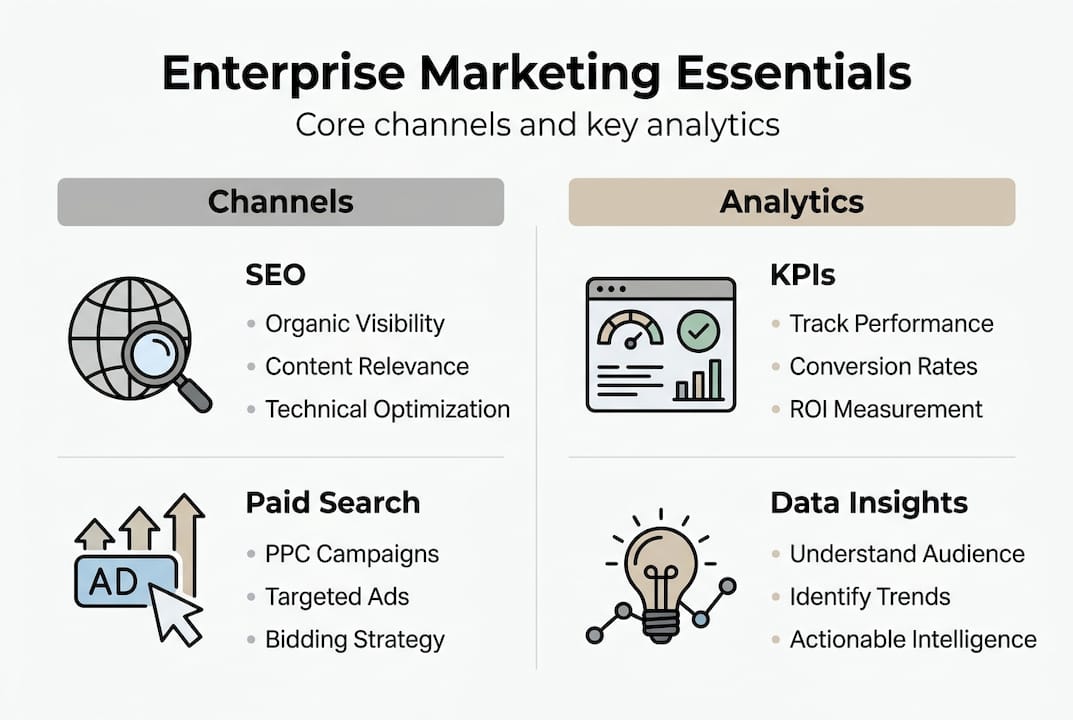
Pro Tip: Start with one well-executed channel before expanding. Master Google Ads or SEO completely, build profitable systems, then layer additional channels using proven frameworks rather than spreading resources too thin from the beginning.
Integrating these components creates marketing that works while you sleep. Automation handles repetition. Analytics guide optimisation. Multi-channel presence ensures you’re discoverable. Alignment prevents leads from falling through gaps. Together, these elements build enterprise-grade marketing accessible to businesses of any size.
Implementing and measuring your enterprise marketing success
Strategy without execution remains theoretical. Implementation transforms plans into revenue-generating systems through deliberate, measured steps.
Step-by-step implementation framework:
- Audit current state: Document existing marketing activities, tools, budgets, and results to establish baseline metrics
- Define ideal client profile: Create detailed descriptions of who you serve best, including demographics, challenges, and buying behaviour
- Select core channels: Choose 2-3 channels where your ideal clients actively search for solutions
- Implement automation platform: Set up email marketing, CRM, and lead scoring tools that integrate with chosen channels
- Create content assets: Develop lead magnets, nurture sequences, and conversion-focused landing pages
- Launch pilot campaigns: Start small with limited budget to test messaging and refine approach
- Establish review cadence: Schedule weekly performance reviews and monthly strategy adjustments
Marketing automation delivers 50% faster lead response times and 75% report more qualified leads, making speed and quality improvements immediately measurable. These gains compound over time as systems optimise and data accumulates.
Critical performance indicators to track:
- Lead response time: How quickly you contact new enquiries
- Lead source ROI: Revenue generated per dollar spent on each channel
- Conversion rates: Percentage moving from lead to consultation to client
- Customer acquisition cost: Total marketing spend divided by new clients
- Lead quality score: Percentage of leads matching ideal client profile
- Pipeline velocity: Average time from first contact to closed sale
Timeline alignment matters for Australian businesses. Financial year planning, seasonal demand fluctuations, and market cycles all influence campaign timing. Service businesses often see peaks around New Year resolutions, pre-summer preparation, and post-holiday periods. Align major campaigns and budget allocation with these natural rhythms.
| Metric | Target Benchmark | Review Frequency |
|---|---|---|
| Lead response time | Under 5 minutes | Daily |
| Cost per lead | Industry-specific | Weekly |
| Lead-to-client rate | 10-30% depending on service | Monthly |
| Customer lifetime value | 3x acquisition cost minimum | Quarterly |
Tool selection significantly impacts execution success. The best lead generation software comparison evaluates platforms based on Australian business needs, integration capabilities, and price points. Choose tools that grow with you rather than requiring complete replacement as you scale.
Essential tool categories:
- CRM system: Centralises client data and tracks interactions
- Email platform: Automates nurture sequences and broadcasts
- Analytics dashboard: Consolidates performance data from all channels
- Landing page builder: Creates conversion-optimised pages quickly
- Scheduling tool: Streamlines consultation bookings
Regular review cycles prevent strategy drift. Weekly check-ins assess immediate performance and tactical adjustments. Monthly reviews evaluate strategic alignment and resource allocation. Quarterly planning sessions set new goals and major initiatives. This rhythm maintains momentum while allowing course correction based on real data.
Pro Tip: Implement a simple traffic light system for your KPIs where green means on track, amber signals attention needed, and red demands immediate action. This visual system makes performance status instantly clear during reviews.
The generate leads online for business growth resource provides detailed implementation checklists and templates that accelerate setup. Rather than reinventing processes, adapt proven frameworks to your specific business context.
Measurement transforms guesswork into science. When you know precisely which activities generate results, you double down on winners and eliminate losers. This data-driven approach compounds returns over time, creating increasingly efficient marketing that delivers more leads at lower cost.
Start building your enterprise marketing strategy today
You now understand the landscape, challenges, components, and implementation steps for enterprise marketing success. The question shifts from what to do to how to execute with expert guidance.
Jarrod Harman specialises in helping Australian service-based businesses implement sophisticated marketing strategies that drive consistent leads and sales. His Marketing Vortex method integrates SEO, paid advertising, email marketing, and automation into cohesive systems tailored for businesses like yours. Whether you’re scaling a salon, clinic, law firm, or retail operation, proven frameworks accelerate your growth without the trial and error.
The digital marketing strategy guide provides additional frameworks and templates for building your marketing foundation. For personalised support, meet Jarrod Harman to explore how strategic partnership can transform your marketing results. The automation in lead generation guide offers specific tactics for implementing systems that work around the clock.
Your competitors are already leveraging these strategies. The gap between businesses using enterprise marketing approaches and those relying on ad hoc tactics widens daily. Start building your strategic advantage now.
Frequently asked questions
What is an enterprise marketing strategy and why is it important?
An enterprise marketing strategy is a comprehensive plan coordinating all marketing activities across your business to drive sustained lead generation and revenue growth. It aligns sales and marketing teams, integrates multiple channels, and uses data to optimise performance continuously. This strategic approach prevents wasted budget, captures more opportunities, and builds scalable systems that grow with your business rather than requiring constant manual effort.
How can marketing automation improve lead generation?
Automation speeds up lead contact and qualification, directly increasing conversion rates. Marketing automation delivers 50% faster response and 75% more qualified leads by handling follow-up systematically. It nurtures prospects with relevant content based on their behaviour, scores leads by engagement level, and alerts sales teams when prospects show buying signals. This systematic approach prevents leads falling through cracks while focusing human effort on high-value interactions.
What are common marketing challenges faced by women entrepreneurs?
Research shows 81% of women entrepreneurs face societal expectations and networking gaps that limit visibility and growth. Visibility fears, funding barriers, and burnout from juggling multiple roles create specific obstacles that affect marketing consistency and confidence. Understanding these challenges enables strategic compensation through digital channels, automation, and collaborative partnerships that work around traditional barriers while building on strengths like client empathy and authentic relationship building.
How do I measure the success of my enterprise marketing strategy?
Track lead response times, lead quality scores, conversion rates from enquiry to client, customer acquisition cost, and return on investment for each marketing channel. Use regular review cycles with weekly tactical assessments, monthly strategic evaluations, and quarterly planning sessions. The lead generation campaign metrics guide provides detailed measurement frameworks. Focus on metrics that directly connect to revenue rather than vanity numbers like social media followers that don’t predict business growth.