


Over 60 percent of australian businesses say their biggest growth opportunity lies in improving online sales performance. With so many digital channels now available, knowing where to invest time and resources can get confusing for any business owner. Whether you run a small shop or manage a fast-growing brand, understanding and optimizing each stage of your online sales process helps drive stronger results and higher revenue.
Table of Contents
- Stage 1: Assess Current Online Sales Channels
- Stage 2: Optimise Website For High Conversions
- Stage 3: Implement Targeted Omnichannel Marketing
- Stage 4: Leverage Social Proof And Testimonials
- Stage 5: Track Results And Refine Strategies
Quick Summary
| Key Point | Explanation |
|---|---|
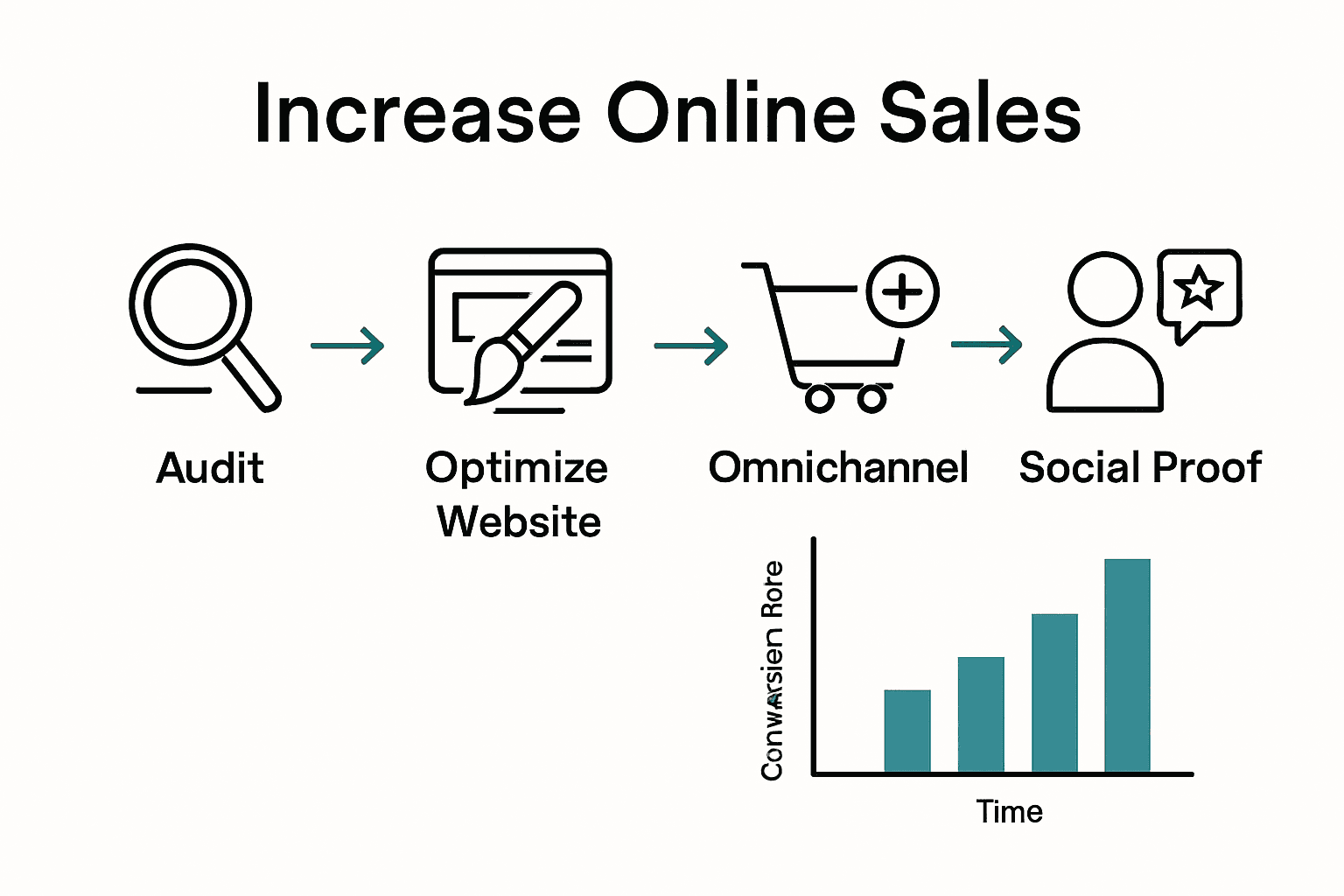
| 1. Assess Online Sales Channels | Conduct a thorough audit of all sales platforms to identify strengths and weaknesses in performance and conversion rates. |
| 2. Optimise Website for Conversions | Enhance user experience through site speed, navigation, and effective calls to action to boost conversion rates. |
| 3. Implement Omnichannel Marketing | Create a unified customer experience by mapping interactions across various platforms and personalising marketing efforts. |
| 4. Leverage Social Proof Effectively | Use authentic customer testimonials and trust signals to build credibility and trust with potential customers. |
| 5. Track Results and Adapt Strategies | Regularly analyse performance metrics and adjust marketing strategies based on data insights for continuous improvement. |
Stage 1: Assess Current Online Sales Channels
Assessing your current online sales channels is a critical first step in developing a robust digital marketing strategy that drives revenue. According to research from diva-portal, optimising e-commerce conversion rates requires a quantitative approach using web analytics and human-computer interaction principles.
Start by performing a comprehensive audit of your existing online sales platforms. This means mapping out every digital touchpoint where customers can purchase from you, including your website, social media shops, online marketplaces, and any third-party sales platforms. Analyse the performance metrics for each channel track conversion rates, average order value, customer acquisition costs, and total revenue generated. Pay special attention to user experience, site speed, mobile responsiveness, and checkout process smoothness.
As you review your channels, look for patterns and opportunities. Some platforms might be dramatically outperforming others, while some could be underutilised or delivering poor return on investment. The goal is not just to identify weak points but to understand why certain channels work better than others. Consider factors like audience demographics, platform design, marketing strategies, and product presentation. By taking a strategic, data-driven approach to assessing your online sales channels, you can make informed decisions about where to focus your marketing efforts and resources.
Stage 2: Optimise Website for High Conversions
Optimising your website for high conversions is a strategic process that transforms your digital platform into a powerful sales engine. According to research from ppai, implementing targeted web optimization techniques can significantly boost your conversion rates through smart strategies like crafting SEO optimised content and using intelligent calls to action.
Begin by conducting a comprehensive website audit focusing on user experience and conversion potential. Analyse your site’s design, navigation, page load speeds, and mobile responsiveness. Identify potential friction points that might prevent visitors from completing purchases. This means examining your checkout process, streamlining forms, ensuring clear product descriptions, and implementing high quality images that showcase your offerings. Pay special attention to your calls to action using contrasting colours, clear messaging, and strategic placement to guide visitors towards making a purchase.
To drive conversions, leverage psychological principles of persuasion. Use social proof like customer testimonials, trust badges, and real user reviews prominently on your site. Implement urgency triggers such as limited time offers or stock countdown timers. Explore our ecommerce SEO package to further enhance your website’s performance and conversion potential. Remember that conversion optimization is an ongoing process requiring continuous testing, analysis, and refinement to stay ahead of changing user expectations and market trends.
Stage 3: Implement Targeted Omnichannel Marketing
Implementing a targeted omnichannel marketing strategy is crucial for creating a seamless and integrated customer experience across multiple platforms. According to research from lafilm, effective omnichannel marketing requires strategic integration of products and services across various digital platforms including the World Wide Web, mobile devices, and social media channels.
To develop a robust omnichannel approach, start by mapping your customer journey across all potential touchpoints. This means understanding how customers interact with your brand through different channels such as your website, social media platforms, email marketing, mobile apps, and physical stores if applicable. Explore our guide on marketing strategies to gain deeper insights into creating a cohesive marketing approach. Ensure consistent messaging, branding, and user experience across these channels. Utilise data analytics to track customer interactions, preferences, and behaviour patterns. This will help you personalise marketing messages and create targeted campaigns that resonate with specific audience segments.
The key to successful omnichannel marketing is integration and personalisation. Implement advanced tracking tools that allow you to create a unified customer profile across platforms. Use automation technologies to deliver personalised content, recommendations, and offers based on individual customer behaviour. Remember that an effective omnichannel strategy is not about being present on every platform, but about creating a seamless, interconnected experience that makes it easy for customers to engage with your brand regardless of the channel they choose.
Stage 4: Leverage Social Proof and Testimonials
Leveraging social proof and testimonials is a powerful strategy to build credibility and dramatically increase online sales conversion rates. According to research from onlinemarketinginstitute, adding customer testimonials can improve conversion rates by up to 35%, as they provide crucial social validation and build trust with potential customers.
To effectively implement social proof, collect and strategically display authentic customer experiences across multiple platforms. This means gathering detailed testimonials that highlight specific results and challenges your product or service helped solve. Explore our social media lead generation strategies to understand how to capture compelling customer stories. Showcase these testimonials prominently on your website, including video testimonials, written reviews, case studies, and success metrics. Consider creating dedicated sections that feature client transformations, complete with names, photos, and verifiable details to enhance credibility.
Remember that social proof extends beyond traditional testimonials. Incorporate trust signals like client logos, industry awards, media mentions, social media follower counts, and real time statistics about your service usage. Use these elements strategically to demonstrate your expertise and reliability. The goal is to create a narrative of trust that reassures potential customers and reduces their perceived risk of purchasing from your business. By systematically building and displaying social proof, you transform abstract marketing claims into tangible, believable evidence of your value proposition.

Stage 5: Track Results and Refine Strategies
Tracking results and refining your marketing strategies is a critical process for continuous business growth and improving online sales performance. According to Coursera, understanding conversion rates is fundamental in assessing the effectiveness of your digital marketing campaigns and making data driven decisions that drive business success.
Establish a comprehensive tracking system using advanced analytics tools that provide deep insights into your marketing performance. Monitor key performance indicators such as conversion rates, customer acquisition costs, average order value, and return on ad spend across all your digital channels. Learn more about our social selling strategies to understand how to interpret these metrics effectively. Implement regular review sessions where you analyse these metrics, identify trends, and develop targeted interventions to improve underperforming areas. Use A/B testing methodologies to experiment with different approaches, comparing their impact on your overall sales performance.
Remember that strategy refinement is an ongoing process. Create a culture of continuous improvement within your marketing team, where data insights drive decision making. Be prepared to pivot quickly, reallocate resources, and experiment with new approaches based on your analytical findings. The most successful businesses are those that remain agile, constantly learning from their data and adapting their strategies to changing market conditions and customer preferences.
Unlock Proven Strategies to Boost Your Online Sales Today
Struggling to increase your online sales despite multiple marketing efforts is a common challenge faced by many business owners. This article highlights key pain points such as optimising sales channels, enhancing website conversions, and leveraging social proof that can transform your digital presence and accelerate growth. If you want to move beyond guesswork and apply a tested approach to scale your business, the expert insights and innovative strategies like the Marketing Vortex Method used by Business Warriors can make all the difference.
Take control of your sales success by partnering with a results-driven digital marketing agency based in Perth that specialises in service-based businesses. Visit https://jarrodharman.com to explore how tailored SEO, targeted omnichannel marketing, and conversion optimisation can be integrated seamlessly for your specific needs. Discover more insights and success stories in the Uncategorized Archives – Jarrod Harman and begin your journey to consistent leads and profitable online sales now.
Frequently Asked Questions
How can I assess my current online sales channels effectively?
Assess your current online sales channels by conducting a comprehensive audit of all digital touchpoints where customers can purchase from you. Map out each platform and track metrics like conversion rates and customer acquisition costs to identify areas for improvement.
What strategies can I use to optimise my website for higher conversion rates?
To optimise your website for higher conversion rates, focus on enhancing user experience by simplifying navigation and ensuring fast load speeds. Streamline your checkout process and use persuasive calls to action to guide visitors to complete their purchases.
What is omnichannel marketing, and how can it boost online sales?
Omnichannel marketing integrates multiple platforms to create a seamless customer experience. Map your customer journey across all channels and ensure consistent branding, which will personalise your marketing efforts and lead to increased customer engagement and sales.
How important is social proof for increasing online sales?
Social proof is crucial as it builds trust and credibility with potential customers. Actively display customer testimonials and success stories on your site to reassure visitors and enhance their likelihood of making a purchase.
What metrics should I track to assess my online sales performance?
Track key performance indicators like conversion rates, customer acquisition costs, and average order value. Regularly reviewing these metrics will help you identify trends and underperforming areas, allowing you to optimise your strategies effectively.
How often should I refine my marketing strategies based on tracked results?
Refine your marketing strategies continuously based on tracked results. Conduct reviews at least monthly to identify areas for improvement and adapt your strategies to shifting market conditions.
Recommended
- ecommerce seo package: Boost Rankings and Drive Sales Fast – Jarrod Harman
- Complete Guide to Scaling Online Marketing – Jarrod Harman
- How to Generate Leads Online for Business Growth – Jarrod Harman
- Social Selling Explained: Strategies, Tools, and Benefits – Jarrod Harman
- Conversion Optimization Strategies to Boost Sales Fast – seo analytic
- Understanding Why Use Digital Marketing for Business Growth