24 June 2026
What is content strategy for social media: 2026 guide
Discover what is content strategy for social media in 2026. Learn how to enhance engagement and achieve business goals with a solid plan.
TL;DR:
- A social media content strategy is a documented plan that aligns content creation with specific business goals and measurable KPIs. It emphasizes the importance of audience understanding, content pillars, platform choice, and regular evaluation, while the content calendar executes this strategy through scheduled posts. Building an adaptive plan that integrates SEO and AI increases brand visibility and generates measurable leads in 2026.
A social media content strategy is a documented plan that defines what content you create, where you publish it, when you share it, and how you measure its impact against real business goals. Without this plan, social media posting is random, disconnected from any commercial objective. Brands that plan their content in advance see 40% higher engagement and are three times more likely to achieve positive ROI than those who post reactively. Tools like Sprout Social, Meta Business Suite, and Grammarly support the planning and execution process, but the strategy itself must come first. This guide breaks down every component you need to build one that works in 2026.
What are the essential components of an effective social media content strategy?
A social media content strategy connects every piece of content to business goals, ensuring purposeful publishing rather than guesswork. Six core components make this connection reliable and repeatable.
Goal alignment and KPIs
Every strategy starts with a business objective. That objective must translate into measurable KPIs. A salon owner targeting new bookings tracks appointment requests from social referrals. A law firm building authority tracks consultation enquiries. Vanity metrics like follower counts tell you nothing about commercial performance.
Audience identification
You need documented audience personas before you write a single post. These personas define the problems your audience faces, the platforms they use, and the content formats they prefer. A med spa targeting women aged 35–50 in Perth will produce very different content to an e-commerce brand targeting national buyers aged 18–30.

Content pillars
Content pillars must intersect audience interests, your business offerings, and your brand credibility. Three to five pillars is the recommended range. Fewer than three creates a monotonous feed. More than five fragments your brand identity. A beauty clinic might use education, results, behind the scenes, and client stories as its four pillars.
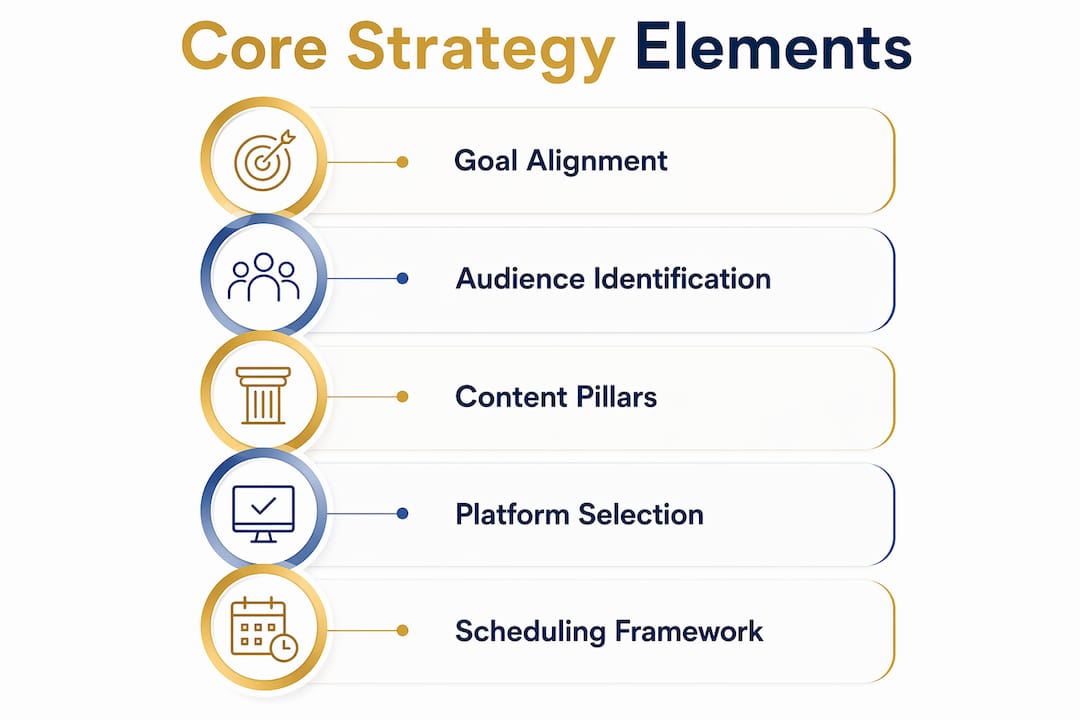
Platform selection
Not every platform suits every business. Instagram and TikTok reward short video and visual content. LinkedIn rewards long-form professional insight. Facebook remains the dominant platform for local service businesses running paid advertising through Meta Ads. Choose platforms based on where your audience spends time, not where you feel comfortable.
Scheduling framework
A rolling 30 to 90 day calendar gives you enough structure to maintain consistency without locking you into plans that become irrelevant. Experts recommend scheduling posts 1–4 weeks ahead, while reserving 10–20% of your content slots for reactive posts tied to trends, news, or platform algorithm shifts.
Measurement framework
Your measurement framework must focus on business outcomes, not activity. Track lead conversions, sales attributed to social, and engagement quality. Review performance monthly and refresh your full strategy every 90 days.
- Set KPIs before you create content, not after
- Define 3–5 content pillars that reflect your brand and audience
- Choose platforms based on audience behaviour, not personal preference
- Build a rolling 30–90 day calendar with reactive content slots
- Measure lead conversions and sales, not just likes
Pro Tip: Setting up a foundational social media content strategy takes approximately 3 hours initially, with monthly reviews at 45 minutes and a full 90-day refresh at 2 hours. Block these sessions in your calendar like client appointments.
How does a social media content strategy differ from a content calendar?
Confusing a content calendar with a content strategy is one of the most common failures in social media marketing. They are not the same thing. The strategy is the overarching plan. The calendar is the execution tool.
| Element | Content strategy | Content calendar |
|---|---|---|
| Purpose | Connects content to business goals | Schedules content for publication |
| Scope | Long-term, goal-driven | Short-term, date-driven |
| Contains | Goals, pillars, audience, KPIs | Dates, formats, captions, links |
| Review cadence | Quarterly | Weekly or monthly |
| Risk if skipped | Random, purposeless posting | Missed deadlines and inconsistency |
A business that builds a calendar without a strategy ends up with a perfectly organised schedule of posts that go nowhere. The calendar tells you what to post on Tuesday. The strategy tells you why Tuesday’s post should address a specific audience pain point, in a specific format, tied to a specific business goal.
The relationship works in one direction only. Strategy informs calendar. Calendar executes strategy. Reversing this order produces content that looks active but performs poorly.
A social media content plan template can help you document both layers in one place, keeping your team aligned on both the why and the when.
Pro Tip: Batch your content creation by producing all posts for a two-week period in a single session. Batching content creation doubles team throughput compared to daily spontaneous creation, and it dramatically reduces the mental load of maintaining consistency.
What are the best practices for building an adaptive strategy in 2026?
The most effective social media strategies in 2026 are built for change, not permanence. Algorithm updates on Instagram, TikTok, and LinkedIn happen frequently. Trends shift within days. Over-planning causes calendars to become obsolete quickly, which is why rolling 30 to 90 day windows outperform rigid annual plans every time.
Mixing content types for sustained engagement
Effective content rhythms mix educational, inspirational, entertaining, and promotional posts. This mix prevents audience fatigue and builds trust before you ask for a sale. A practical ratio for service businesses is roughly 60% value-driven content (educational and inspirational) and 40% promotional or conversion-focused content. A beauty clinic might post a skincare education reel on Monday, a client result on Wednesday, and a booking offer on Friday.
Integrating SEO and AI into your social media content
SEO and social media are no longer separate disciplines. Google indexes public social media content. AI tools like ChatGPT and Perplexity now surface brand mentions from social platforms in their responses. This means your social content contributes directly to your brand’s visibility in AI-generated search results, a practice known as GEO (Generative Engine Optimisation). Writing captions with keyword-rich language, using descriptive alt text on images, and publishing consistent content under a recognisable brand name all improve your chances of being cited by large language models.
Paid advertising on Meta and Google Ads amplifies this effect. A business running Google Ads alongside an active organic social presence builds brand recognition across multiple touchpoints simultaneously. Sprout Social’s analytics platform tracks cross-channel performance, helping you see which organic content supports paid conversion rates. For a broader view of how all digital marketing channels interact, mapping your social strategy within a full-funnel plan produces better results than treating social in isolation.
Balancing organic and paid social media
Organic content builds trust and long-term reach. Paid advertising on Meta Ads and Google Ads delivers immediate, targeted reach. The two work best together. Organic content that performs well becomes the strongest candidate for paid amplification because it already has proof of audience resonance. Boosting a post that has already generated genuine engagement costs less and converts better than boosting cold content.
- Use rolling 30–90 day planning windows, not annual calendars
- Mix educational, inspirational, entertaining, and promotional content
- Write captions with keyword-rich language to support SEO and GEO visibility
- Amplify high-performing organic posts with paid Meta or Google Ads spend
- Reserve 10–20% of content slots for reactive, trend-driven posts
For businesses building organic social media growth alongside paid campaigns, the compounding effect of consistent content over 6 to 12 months significantly reduces the cost per lead from paid channels.
Which metrics and tools should you use to measure strategy success?
Tracking metrics without intention is noise. The right measurement framework focuses on KPIs that map directly to business outcomes: lead conversions, sales enquiries, appointment bookings, and revenue attributed to social channels.
Business KPIs to prioritise
- Lead conversions from social referral traffic
- Cost per lead from paid social campaigns (Meta Ads, Google Ads)
- Appointment or enquiry volume linked to specific content pillars
- Engagement quality: saves, shares, and direct messages over passive likes
- Website sessions from social, tracked in Google Analytics 4
Tools that support measurement
Sprout Social provides cross-platform analytics with exportable reports suited to client-facing agencies and in-house marketing teams. Native platform insights on Instagram, Facebook, LinkedIn, and TikTok give real-time data on reach, impressions, and audience demographics. Google Analytics 4 tracks the downstream behaviour of social visitors on your website. For SEO performance tied to social content, tools like Semrush and Ahrefs show whether your brand is gaining organic search visibility alongside social growth.
AI-driven content performance tools are increasingly useful for identifying which content formats and topics generate the most qualified traffic. Integrating these tools into a monthly review process gives you the data needed to refine your content pillars and adjust your scheduling.
Pro Tip: Sustainable social media growth depends on measuring the right metrics. Set a monthly 45-minute review and a quarterly 2-hour strategy refresh. These sessions are where the real performance gains happen.
A strong measurement framework also feeds back into your SEO strategy. When you identify which social topics drive the most website traffic, those same topics become candidates for long-form blog content, Google Ads keyword targeting, and AI citation optimisation. The social media strategy tips that generate the most sales enquiries deserve the most investment across every channel.
Key takeaways
A social media content strategy is the documented plan that connects your content to business goals, and without it, every post is a missed commercial opportunity.
| Point | Details |
|---|---|
| Strategy before calendar | Build your goals, pillars, and audience personas before scheduling a single post. |
| Use 3–5 content pillars | Pillars must align audience interests, business offerings, and brand credibility for recognition. |
| Plan in rolling windows | Use 30–90 day rolling calendars and reserve 10–20% of slots for reactive content. |
| Measure business outcomes | Track lead conversions and sales, not likes. Review monthly and refresh quarterly. |
| Integrate SEO and AI | Keyword-rich captions and consistent branding improve visibility in Google and AI-generated results. |
What I have learned from watching businesses get this wrong
Most businesses I work with arrive with a content calendar and no strategy. They have a spreadsheet full of post dates and captions, but no documented goal, no defined audience, and no measurement framework. The calendar looks professional. The results are invisible.
The second most common mistake is treating content pillars as a creative exercise rather than a commercial one. Pillars only work when they sit at the intersection of what your audience needs, what your business offers, and what builds your credibility. A pillar that exists purely because it is “on trend” produces engagement from people who will never buy from you.
The SEO and AI angle is where I see the biggest untapped opportunity right now. Businesses that write keyword-rich social captions, maintain consistent brand naming across platforms, and publish regularly are already appearing in ChatGPT and Perplexity responses without any deliberate GEO effort. Imagine what happens when you make it deliberate. Your social content becomes a citation source for AI tools that millions of people use daily. That is a form of brand reach that no paid advertising budget can replicate directly.
The businesses winning on social media in 2026 are not the ones posting the most. They are the ones posting with the clearest purpose, measuring the right outcomes, and adapting their plans every 90 days based on real data.
, Business Warriors | Digital Marketing Agency
Ready to build a strategy that actually drives results?
A well-built social media content strategy does not exist in isolation. It works hardest when it connects to your SEO, your paid advertising on Google Ads and Meta, and your broader digital marketing plan.
Jarrodharman has helped service-based businesses, clinics, salons, law firms, and e-commerce brands across Australia build content strategies that generate real leads and measurable sales. The Marketing Vortex Method integrates social media content with SEO, Google Ads, and Meta advertising into one connected system. If you are ready to move beyond random posting and build a plan with commercial purpose, explore Jarrod’s digital marketing expertise and see how a structured approach changes your results.
FAQ
What is a social media content strategy?
A social media content strategy is a documented plan that connects your content to specific business goals, defining what you create, where you publish it, and how you measure success.
How is a content strategy different from a content calendar?
A content strategy sets your goals, audience, and content pillars. A content calendar schedules the execution. Strategy informs the calendar, not the other way around.
How many content pillars should a business use?
Three to five content pillars is the recommended range. Each pillar must align with audience interests, your business offerings, and your brand credibility to build recognition over time.
How often should you review your social media content strategy?
Review performance monthly in a 45-minute session and conduct a full strategy refresh every 90 days. Rolling 30 to 90 day planning windows outperform rigid annual plans in fast-moving social environments.
How does social media content affect SEO and AI visibility?
Keyword-rich captions and consistent brand naming on public social profiles contribute to Google indexing and AI-generated search results. This practice, known as GEO (Generative Engine Optimisation), means your social content can generate brand citations in tools like ChatGPT and Perplexity.