


TL;DR:
- Testimonials significantly boost conversion rates by providing social proof and building trust.
- Using varied formats like videos and detailed case studies enhances credibility and emotional connection.
- Regularly collecting, curating, and strategically displaying authentic testimonials maximizes their marketing impact.
Testimonials are far more than a polite nod from a happy client. They are one of the most powerful conversion tools available to service-based businesses in Australia, yet most owners treat them as an afterthought. Products with testimonials see 270% higher conversion rates, and 97% of consumers rely on reviews before making a decision. If you run a clinic, salon, consultancy, or any other service business, that number should stop you in your tracks. This article breaks down exactly how to collect, curate, and strategically display testimonials to build genuine credibility and attract more of the clients you actually want.
Table of Contents
- Why testimonials matter for service-based businesses
- Types of testimonials and how to use them
- How to collect and curate impactful testimonials
- Optimising and displaying testimonials to maximise results
- The truth about testimonials: what most guides miss
- How to amplify results with expert marketing strategy
- Frequently asked questions
Key Takeaways
| Point | Details |
|---|---|
| Trust multiplier | Testimonials drastically improve client trust and drive more conversions for service businesses. |
| Right formats matter | Mixing case studies, videos, and quotes yields stronger results than relying on one style. |
| Timing is crucial | Request testimonials promptly after success for the highest response rate and relevance. |
| Show with strategy | Display testimonials in visible spots, optimise for SEO, and regularly update for impact. |
| Balance with authenticity | Honest, specific testimonials work best, while faked or excessive ones risk losing client trust. |
Why testimonials matter for service-based businesses
When a potential client is weighing up whether to book your service, they face a fundamental challenge: they cannot test your work before they pay for it. Unlike buying a product they can return, hiring a service provider requires a leap of faith. Testimonials bridge that gap. They give prospects a window into what it actually feels like to work with you, and that matters enormously.
Social proof is the psychological mechanism at play here. When people are uncertain, they look to others for cues on what to do. 90% of buyers are influenced by social proof, and 97% rely on reviews when making purchasing decisions. For service businesses, this is not a nice-to-have. It is the difference between a full calendar and a quiet phone.
Here is what makes testimonials particularly powerful in the service sector:
- Specificity beats volume. A single detailed testimonial describing a real outcome outperforms a wall of five-star ratings with no context.
- Recency signals reliability. 92% of clients trust recent reviews more than older ones, so keeping your testimonials fresh is non-negotiable.
- Negative reviews handled well build trust. Responding to critical feedback thoughtfully can actually boost conversion by 16%, because it signals transparency.
- Testimonials reduce objections before they arise. A prospect reading about someone with the same problem you solved is far less likely to hesitate.
For Australian service businesses, understanding essential social proof strategies is the foundation of any serious client acquisition effort. The way you present client feedback shapes how potential buyers perceive your expertise before they ever speak to you.
“The best testimonial is not the most glowing one. It is the one that sounds exactly like the problem your next client is struggling with right now.”
Pro Tip: Ask clients to describe their situation before they worked with you, not just the result. That contrast is what resonates with prospects who are in that same “before” position.
Testimonials also play a significant role in social media’s impact on B2B trust, where credibility is built through consistent, authentic storytelling rather than polished advertising.
Types of testimonials and how to use them
Not all testimonials serve the same purpose, and using the wrong format in the wrong place can actually undermine your credibility. Understanding the strengths of each type helps you deploy them strategically throughout your marketing.
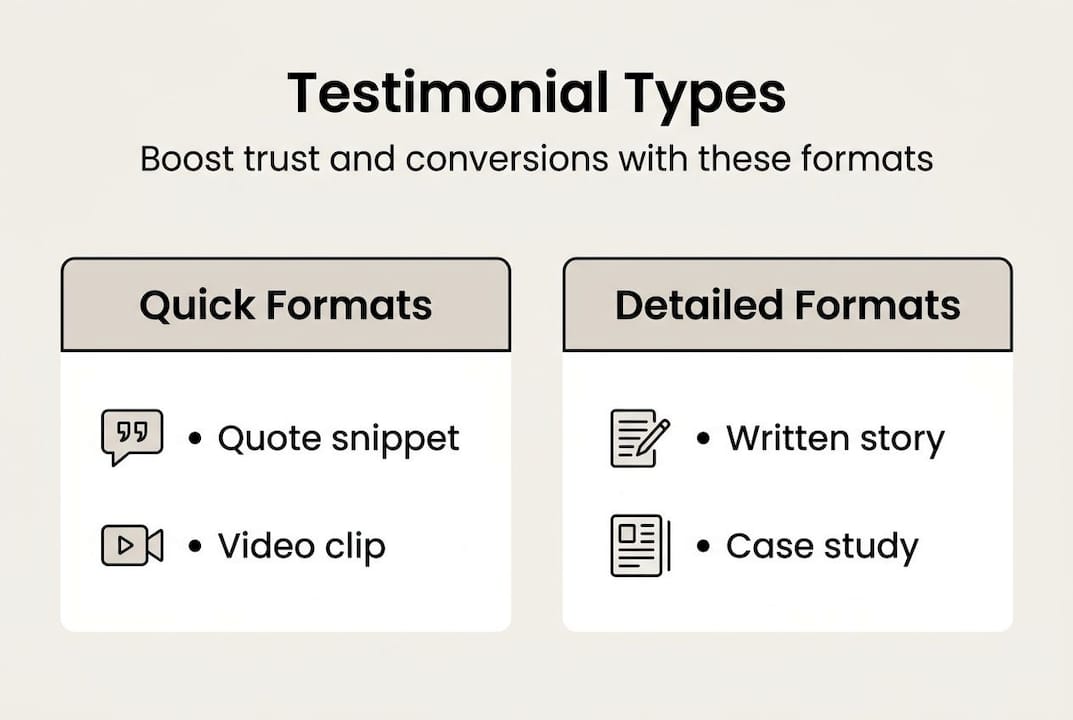
Quote snippets are short, punchy, and easy to scan. They work well on homepages, social media captions, and email signatures. The risk is that they can feel vague if they lack specifics. “Great service!” tells a prospect nothing useful.
Detailed written stories go deeper. They walk through a client’s journey, the challenge they faced, what changed, and the measurable result. These are ideal for proposal documents, landing pages, and case study sections of your website.

Video testimonials are the most persuasive format available. A real person speaking on camera, with genuine emotion, builds trust faster than any written word. Video testimonials boost trust more quickly, and case studies are the most effective format for B2B audiences, with 73% of marketers confirming their impact.
Case studies are long-form, data-rich narratives that show your process and results in detail. They are particularly effective for higher-ticket services where the buyer needs significant reassurance before committing.
| Format | Best placement | Ideal for |
|---|---|---|
| Quote snippet | Homepage, social media | Quick trust signals |
| Detailed story | Proposals, landing pages | Mid-funnel nurturing |
| Video testimonial | Website, ads, email | Emotional connection |
| Case study | Sales calls, blog, B2B | High-ticket decisions |
The smartest approach is to curate specific stories over vague praise and diversify across formats for maximum impact. A prospect who sees a quote on your homepage, watches a video on your social media, and reads a case study in your proposal has been exposed to three layers of social proof before they even contact you.
Explore video marketing for testimonials to see how service businesses are using short-form video to accelerate trust. And if you want to understand which lead-driving content types work best for Australian service providers, the research is clear: specificity and format variety win every time.
Pro Tip: Mix testimonial formats at every stage of your sales process. Use a quote to open curiosity, a video to build connection, and a case study to close the deal.
How to collect and curate impactful testimonials
Knowing you need great testimonials and actually getting them are two very different things. Most service businesses leave this entirely to chance, hoping a happy client will volunteer feedback. That approach produces inconsistent results. A systematic process changes everything.
Here is a step-by-step approach that works:
- Time your request perfectly. Ask immediately after a client experiences a win. That emotional high is when they are most motivated to share. 72% of clients comply when asked promptly and clearly.
- Make it easy. Send a short email with two or three guiding questions. Do not ask for a testimonial; ask them to describe their experience. The difference in response quality is significant.
- Use automation tools. Platforms like Dubsado, HubSpot, or even a simple Google Form linked in an automated follow-up email remove the manual burden from your team.
- Guide the structure. Ask clients to describe their situation before working with you, what changed, and the specific result they achieved. This before-after-results structure produces testimonials that are genuinely useful for marketing.
- Curate ruthlessly. Not every positive response belongs on your website. Prioritise testimonials that mention specific outcomes, name the service, and sound like your ideal client.
| Collection method | Response rate | Best use case |
|---|---|---|
| Automated email post-service | High | Ongoing, scalable |
| Personal phone follow-up | Very high | High-value clients |
| Survey form (2-3 questions) | Medium | Volume collection |
| Video request via email | Lower but high quality | Premium testimonials |
A strong social media strategy can also generate organic testimonials when clients tag you or share their results publicly. Encourage this behaviour by making it easy and rewarding to share.
For businesses focused on B2B lead generation, case study-style testimonials collected through structured interviews are the gold standard. They take more effort but deliver disproportionate results.
Pro Tip: Rotate and refresh your testimonials every quarter. Stale feedback from two years ago signals to prospects that your recent work may not be as strong. Fresh testimonials maintain momentum.
Optimising and displaying testimonials to maximise results
Collecting great testimonials is only half the job. Where and how you display them determines whether they actually convert browsers into buyers.
Here are the highest-impact placements for service businesses:
- Homepage hero section. Place a strong quote or video directly in the first screen a visitor sees. First impressions are formed in seconds.
- Service pages. Match testimonials to the specific service being described. A skin clinic client testimonial on the skin treatment page is far more relevant than a generic one.
- Proposal documents. Include two or three testimonials that mirror the prospect’s situation. This is one of the most underused placements in service businesses.
- Email nurture sequences. Weave testimonials into your follow-up emails as natural proof points, not as a hard sell.
- Social media. Repurpose testimonials as graphics, short video clips, or story posts consistently.
Products with testimonials see 270% higher conversion rates, which means every page without social proof is a missed opportunity. Think of testimonials as conversion infrastructure, not decoration.
From an SEO perspective, optimising testimonials with keywords and diversifying them across platforms strengthens your search visibility. When clients use natural language to describe their results, they often include the exact phrases your prospects are searching for. This is free, authentic keyword content.
Learn how SEO for testimonials can amplify your organic reach, and explore content marketing for trust to see how testimonials fit into a broader content strategy.
Pro Tip: A/B test different testimonial formats on your landing pages. Sometimes a short video outperforms a long case study, and sometimes the reverse is true. Let your data guide the decision.
The truth about testimonials: what most guides miss
Here is something most marketing content will not tell you: doing testimonials badly is worse than not having them at all. The industry has a problem with faked or exaggerated testimonials that erode trust the moment a savvy prospect senses something is off. Overly polished, suspiciously perfect feedback raises red flags, not confidence.
The most credible testimonials include a small imperfection or honest nuance. A client who says “it took a few weeks to see results, but the outcome was worth it” is far more believable than one who claims everything was flawless from day one. Authenticity is the currency that actually converts.
Testimonials also cannot carry your entire marketing strategy alone. They work best when they are part of a broader, integrated approach. Explore advanced B2B testimonial strategies to understand how social proof fits within a full marketing system rather than functioning as a standalone tactic. Testimonials amplify good marketing. They cannot rescue poor marketing.
How to amplify results with expert marketing strategy
If you are serious about turning client feedback into a consistent client acquisition engine, the strategy behind your testimonials matters as much as the testimonials themselves.
At Business Warriors, we help Australian service businesses build integrated marketing systems where testimonials, SEO, paid ads, and content work together seamlessly. Jarrod Harman’s marketing expertise is built around helping business owners like you convert trust into bookings at scale. Whether you are starting from scratch or refining what you already have, our proven strategies to attract more clients are designed for service businesses ready to grow. Discover how the 360° Marketing Vortex method can put your testimonials to work across every channel.
Frequently asked questions
How do testimonials help attract new clients?
Testimonials provide social proof that builds trust quickly, reducing hesitation and influencing decisions. 270% higher conversion rates are recorded for products and services that feature them prominently.
What type of testimonial is most effective for a service business?
Video testimonials and detailed case studies are the most persuasive formats. Case studies are most effective for B2B services, with 73% of marketers confirming their impact on conversions.
When is the best time to ask for a testimonial?
Ask immediately after a client achieves a successful result. 72% of clients comply when approached promptly with a clear, simple request.
Is there a risk to using too many or fake testimonials?
Yes. Faked testimonials erode trust significantly, and overuse can appear insincere. Authenticity and balance across your marketing mix are essential for sustained credibility.
How can I make my testimonials more discoverable online?
Use real client language that includes natural keywords, update your testimonials regularly, and diversify across platforms to maximise both SEO value and audience reach.