


TL;DR:
- Building a reliable digital sales system enhances lead generation and steady growth.
- Optimizing key elements like GBP, content, reviews, and ads creates interconnected, high-performing marketing.
- Focusing on systems rather than tactics ensures long-term success and market dominance.
You do not need a massive advertising budget to grow your service business online. What you need is a clear strategy, the right digital assets, and a system that works while you focus on delivering your craft. Many established female business owners in service industries already have the skills and the client base. The missing piece is a reliable digital sales engine that generates consistent leads without constant guesswork. This guide walks you through evidence-backed strategies tailored specifically for service businesses, so you can stop chasing tactics and start building something that compounds over time.
Table of Contents
- What is digital sales optimisation and why it matters
- Creating a high-converting digital sales foundation
- Amplifying reach: Social media and email strategies that work
- Converting traffic: Reviews, ads, and data-driven tweaks
- Why service business owners should focus on systems, not tactics
- Take the next step: Expert help for digital sales growth
- Frequently asked questions
Key Takeaways
| Point | Details |
|---|---|
| Start with the basics | Optimise your online profiles and website before trying advanced tactics. |
| Use targeted channels | Focus on email, LinkedIn, and Instagram to reach more ideal clients and nurture leads. |
| Measure and refine | Regularly monitor reviews, ad results, and analytics to fine-tune your digital sales system. |
| Think systems, not hacks | Sustainable success comes from building and refining reliable processes, not chasing trends. |
What is digital sales optimisation and why it matters
Digital sales optimisation means deliberately improving every online touchpoint that influences whether a potential client finds you, trusts you, and books with you. It is not about being everywhere at once. It is about being in the right places, with the right message, at the right moment in your client’s decision journey.
For service businesses, this matters more than ever. Unlike product-based businesses, you are selling trust, expertise, and outcomes. Your digital presence either builds that trust quickly or loses the lead to a competitor. Every second a potential client spends confused by your website or unable to find your reviews is a booking you never get.
The good news is that 61% of women-led small businesses use social media for promotion compared to 49% of men-led businesses. That means female founders are already ahead in many digital channels. The opportunity is to connect those efforts into a cohesive system that actually converts.
The seven core pillars of digital sales optimisation for service businesses are:
- Google Business Profile (GBP): Your free local visibility tool that puts your business in front of ready-to-book clients searching nearby
- Service-focused content: Blog posts, FAQs, and landing pages that answer your ideal client’s exact questions and build authority
- LinkedIn and Instagram: The two platforms most effective for service brands to build relationships and showcase expertise
- Email list building: A direct line to warm leads that you own, regardless of algorithm changes
- Mobile-first website: A fast, clear, conversion-ready site that works perfectly on any smartphone
- Review management: A consistent process for collecting and responding to client reviews across Google and other platforms
- Google Ads: Targeted paid search campaigns that put your service in front of clients actively looking for what you offer
These pillars, when combined, form what B2B sales best practices describe as an integrated approach. Each pillar supports the others. Strong content marketing best practices feed your SEO, which improves your GBP ranking, which drives more reviews, which boosts your Google Ads quality score. Understanding these connections is what separates businesses that grow steadily from those that plateau.
For boosting online visibility, the combination of these seven pillars is far more powerful than any single tactic alone. Core digital sales optimisation strategies for service businesses centre on GBP, content, email, ads, and review management working together.
Creating a high-converting digital sales foundation
Before you invest a single dollar in advertising, your digital foundation needs to be solid. Think of it like your shopfront. If the window is dirty and the door is hard to open, no amount of foot traffic will convert.
Here is how to build that foundation step by step:
- Claim and fully complete your Google Business Profile. Add your business category, services, hours, photos, and a keyword-rich description. Link it to your website and enable messaging.
- Create dedicated landing pages for each core service. A skin clinic should have separate pages for facials, injectables, and laser treatments, each written to answer the specific questions a client would ask before booking.
- Audit your website for mobile performance. Use Google’s free PageSpeed Insights tool to check load times and usability on mobile devices.
- Add clear calls to action on every page. Buttons like “Book a free consultation” or “Get a quote today” should appear above the fold on your homepage and service pages.
- Install a simple contact or booking form. Remove every unnecessary field. Name, email, phone, and preferred service is enough to start a conversation.
Businesses that optimise their Google Business Profile are 2.7 times more likely to be considered reputable by potential clients. That single action, done well, can shift how your business appears in local search results within weeks.
Here is a quick comparison of what works versus what wastes time at the foundation stage:
| Foundation element | High impact approach | Low impact approach |
|---|---|---|
| GBP listing | Fully completed with weekly posts | Claimed but left incomplete |
| Service pages | One page per service with clear copy | Single generic “services” page |
| Website speed | Under 3 seconds load time on mobile | Slow, image-heavy pages |
| Calls to action | Specific and repeated throughout | Vague or buried at the bottom |
For content marketing for Australian services, the best results come from writing content that mirrors the exact language your clients use when searching. Review your own client enquiries and use those phrases in your headings and page copy. See content marketing examples from Australian service businesses to understand what this looks like in practice.
Pro Tip: Update your Google Business Profile with a new photo or post at least once per week. Google rewards active profiles with higher visibility in local search results, and it takes less than five minutes.
Amplifying reach: Social media and email strategies that work
Once your digital foundation is solid, the next step is getting your business in front of more of the right people. Social media and email marketing are your two most cost-effective tools for this, and when used together, they create a powerful lead nurturing loop.

LinkedIn works best for service businesses targeting professionals, corporate clients, or referral partners. Instagram works best for visual service businesses like clinics, salons, spas, and wellness brands. You do not need both if your audience lives primarily on one platform. Focus your energy where your ideal client actually spends time.
The types of social content that consistently drive engagement for service businesses include:
- Before and after results (with client permission) that demonstrate real outcomes
- Behind-the-scenes content showing your process, team culture, and day-to-day expertise
- Client testimonials shared as short video clips or designed quote graphics
- Educational posts that answer common questions your clients ask before booking
- Personal stories that build connection and show the human behind the business
As 61% of women-led businesses use social media for promotion, the competition for attention is real. What separates accounts that grow from those that stagnate is consistency and specificity. Posting three times a week with content that speaks directly to your ideal client beats posting daily with generic content.
Email marketing is where the real return lives. Email marketing ROI averages $40 for every $1 spent, making it the highest-returning digital channel available to small service businesses.
“Your email list is the only digital audience you truly own. Social media platforms change their algorithms. Your list does not.”
Segmentation means dividing your list into groups based on behaviour or interest, such as new enquiries, past clients, or people who downloaded a resource. Automation means setting up email sequences that send the right message at the right time without you doing it manually. Together, they allow you to follow up with leads at scale without adding hours to your week. Explore content marketing tips and the role of email marketing to see how these strategies connect. You can also review marketing automation examples built specifically for service businesses.
Pro Tip: On LinkedIn, post one piece of thought leadership content per week that shares a genuine opinion or lesson from your work. This builds authority faster than promotional content and attracts referral partners as well as direct clients.
Converting traffic: Reviews, ads, and data-driven tweaks
Getting traffic to your website and social profiles is only half the job. Converting that traffic into actual bookings requires three more elements: a strong review presence, well-targeted ads, and a habit of reviewing your data.
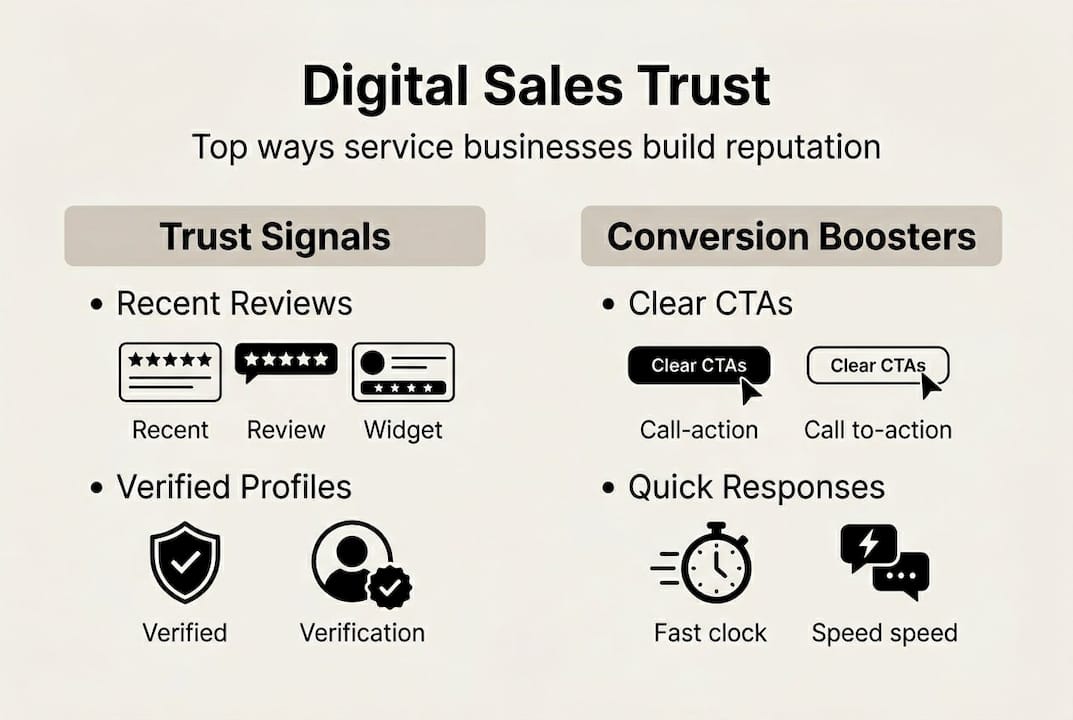
Online reviews are one of the most powerful trust signals a service business can have. A steady stream of recent, positive reviews on Google tells both potential clients and the Google algorithm that your business is active, reputable, and worth ranking. The key word is steady. Ten reviews from three years ago carry far less weight than two new reviews every month.
Google Ads allow you to appear at the top of search results for specific terms your ideal client is actively searching. For a service business, this means targeting phrases like “laser hair removal Perth” or “business lawyer Sydney” rather than broad terms. The more specific your targeting, the lower your cost per click and the higher your conversion rate. Review management, targeted Google Ads, and analytics are the essential levers that turn traffic into revenue.
| Action to optimise | Metric to track | Desired result |
|---|---|---|
| Google Ads campaigns | Cost per lead | Reduce over time with better targeting |
| Service page content | Bounce rate | Under 50% means content is relevant |
| Review collection process | Monthly new reviews | Minimum 2 to 4 new reviews per month |
| Email follow-up sequences | Open rate and click rate | Above 25% open rate is a strong benchmark |
Here are the steps to use data for ongoing improvement:
- Check Google Analytics weekly to see which pages bring the most traffic and which have the highest exit rates.
- Review your Google Ads performance every fortnight and pause any keywords with high spend and zero conversions.
- Ask every new client how they found you and record the answer. This qualitative data often reveals patterns your analytics miss.
- Survey past clients once a year with three simple questions about what they valued, what could improve, and what almost stopped them from booking.
For more on how to use social media strategy tips alongside your ads and review strategy, the combination creates a self-reinforcing cycle. You can also explore AI strategies in B2B sales to understand where automation is heading in 2026.
Why service business owners should focus on systems, not tactics
Here is something most marketing experts will not tell you: the reason most service businesses plateau is not because they are using the wrong tactics. It is because they have no system at all.
Tactics are seductive. A new Instagram trend, a viral reel format, a “secret” Google Ads hack. They promise quick wins and occasionally deliver them. But they also burn you out, create inconsistent results, and leave you starting from scratch every few months when the next shiny thing appears.
A system, by contrast, compounds. When your GBP, content, email, reviews, and ads all work together and are reviewed regularly, each improvement makes every other element stronger. Your SEO improves your ad quality score. Your reviews improve your conversion rate. Your email list reduces your dependence on paid traffic. Over time, the system does more work with less input from you.
Most of your competitors are chasing tactics. They will keep doing that. The businesses that build robust, interconnected digital sales systems are the ones that dominate their local market within 12 to 18 months and stay there. Explore the content marketing stages that align with each phase of your system’s growth.
Pro Tip: Block one hour per month in your calendar specifically to review your digital sales system. Look at what is working, what has dropped off, and what needs attention. Treat it like a board meeting for your marketing.
Take the next step: Expert help for digital sales growth
If you have read this far, you already understand more about digital sales optimisation than most of your competitors. The next step is putting it into practice without spending months figuring it out alone.
At Business Warriors, we built the Marketing Vortex Method specifically for service businesses that are ready to grow with a system, not just a series of disconnected tactics. It combines SEO, Google Ads, Meta advertising, email marketing, and social media into one integrated approach. Understanding the role of online marketing in Australia is the first step. Taking action with the right support is what accelerates results. Visit jarrodharman.com to explore how tailored digital marketing consulting can help your business generate consistent leads and sustainable growth.
Frequently asked questions
What is the best first step to optimise digital sales for my service business?
Start by fully completing your Google Business Profile and your website’s service pages. Businesses that do this are 2.7 times more likely to be considered reputable by new leads searching online.
How can email marketing help me get more consistent sales?
Email marketing lets you nurture leads and stay top of mind between bookings, with an average return of $40 for every $1 invested, making it the most cost-effective channel for service businesses.
Do I need to be on all social media channels?
No. Focus on the one or two platforms where your ideal clients are most active. For most service businesses, LinkedIn and Instagram deliver the best results, and 61% of women-led businesses already use social media effectively for promotion.