


TL;DR:
- A well-structured online sales funnel guides prospects from awareness to purchase, ensuring consistent leads.
- Effective funnels rely on alignment, automation, and trust signals like reviews and case studies.
- Tracking stage-specific metrics and benchmarks helps identify leaks and optimize conversion rates.
Most service business owners assume that getting more traffic will automatically bring more clients. It won’t. Traffic without structure is just noise. The real engine behind consistent leads is a well-built online sales funnel that guides your ideal prospect from first click to signed contract. In this article, we break down exactly what online sales funnels are, how each stage works for service-based businesses, what mechanics drive real conversions, and which benchmarks to measure against so you can grow with confidence rather than guesswork.
Table of Contents
- What is an online sales funnel?
- Key stages of the online sales funnel for services
- Sales funnel mechanics: How effective funnels convert leads
- Core metrics and benchmarks for Australian service funnels
- What most service businesses get wrong about funnels
- Take your sales funnel further with expert help
- Frequently asked questions
Key Takeaways
| Point | Details |
|---|---|
| Funnels systematise growth | Online sales funnels provide a structured path to qualify and convert leads step-by-step. |
| Stages drive clarity | Breaking down the funnel clarifies how to nurture and win clients for service businesses. |
| Benchmark your funnel | Knowing Australian conversion rates helps set realistic goals and spot gaps quickly. |
| Quality beats quantity | Focus on lead quality and process alignment for reliable, scalable results. |
What is an online sales funnel?
An online sales funnel is the structured path your prospect travels from the moment they first hear about you to the moment they become a paying client. Think of it like a physical funnel: wide at the top where many people enter, narrowing as only the most qualified prospects move through each stage.
According to Xero’s guide, an online sales funnel is a structured model representing the customer journey from initial awareness to purchase, narrowing as prospects qualify and advance through stages including Awareness (TOFU, or top of funnel), Interest and Consideration (MOFU, or middle of funnel), Evaluation and Intent (BOFU, or bottom of funnel), and Purchase or Close, with post-sale retention often included for service businesses.
For service businesses specifically, this journey is rarely a straight line. A prospect might find you on Google, read three blog posts, watch a video, then enquire weeks later. That non-linear behaviour is exactly why a funnel matters: it keeps you present and relevant at every touchpoint.
Here is a quick comparison of how the traditional linear funnel differs from the flywheel approach now favoured by many service businesses:
| Approach | Focus | Strength | Best for |
|---|---|---|---|
| Linear funnel | Awareness to close | Clear stages, easy to measure | New client acquisition |
| Flywheel model | Attract, engage, delight loop | Referrals and retention | Established service businesses |
| Hybrid model | Both acquisition and retention | Scalable and sustainable | Growing service businesses |
For most Australian service businesses, a hybrid approach works best. You need the structure of a funnel to acquire new clients and the ongoing delight loop to keep them referring others.
Key stages in plain language:
- Awareness: Your prospect discovers you exist
- Interest: They engage with your content or offer
- Consideration: They compare you with alternatives
- Intent: They signal they want to buy
- Purchase: They become a client
- Retention: They stay, refer, and return
“The funnel is not just a marketing tool. It is a mirror of how your clients actually make decisions.” To optimise sales funnels for leads, you need to understand each stage before you can improve it.
HubSpot’s breakdown of sales funnels reinforces that service businesses must map their funnel to real buyer behaviour rather than assuming a neat, predictable path.
Key stages of the online sales funnel for services
With the funnel structure defined, let’s dig deeper into each stage and what it looks like in a service-based business.
Each stage has a specific job. Mixing them up, or skipping one entirely, is one of the most common reasons service businesses struggle to convert enquiries into clients.
Stage-by-stage breakdown for service businesses:
- Awareness: Run Google Ads, publish SEO content, or post on social media to get in front of your ideal client. Your goal here is visibility, not selling.
- Interest: Offer something valuable in exchange for contact details. A free guide, checklist, or short video works well. These are your lead magnets.
- Consideration: Nurture your new lead with email sequences, case studies, and testimonials. Show them you understand their problem.
- Intent: The prospect books a discovery call or requests a quote. This signals serious buying intent.
- Purchase: Your consultation or proposal converts them into a paying client.
- Retention: Post-sale follow-up, check-ins, and referral requests keep the relationship alive and generate new leads organically.
The lead generation funnel mechanics involve defining customer pain points, creating lead magnet examples such as ebooks and webinars, qualifying leads via scoring or forms, nurturing with email sequences and case studies, and closing via calls or demos, with metrics tracked at each stage to identify bottlenecks.

For high-ticket services, the bottom of the funnel deserves extra attention. A strategy call or a live webinar can dramatically increase your close rate because they build personal trust before the client commits. Speed matters here too. Xero’s funnel guide notes that fast response times and persistent follow-up are critical at this stage.
If you want to understand how to generate digital leads at scale, mapping each stage to a specific tactic and measurable goal is the foundation.
| Funnel stage | Primary goal | Common tactic |
|---|---|---|
| Awareness | Reach new prospects | SEO, paid ads, social content |
| Interest | Capture contact details | Lead magnets, opt-in forms |
| Consideration | Build trust | Email sequences, case studies |
| Intent | Qualify and book | Discovery calls, quote requests |
| Purchase | Close the deal | Proposals, consultations |
| Retention | Retain and refer | Follow-ups, loyalty offers |
Pro Tip: Respond to new enquiries within one hour wherever possible. Studies consistently show that lead response time is one of the strongest predictors of conversion for service businesses.
Sales funnel mechanics: How effective funnels convert leads
Understanding each stage is only the start. Here’s how top service businesses ensure every part of their sales funnel is effective and measurable.
The mechanics of a high-converting funnel come down to three things: alignment, automation, and trust. Most service businesses are strong on one and weak on the other two.
Alignment means your marketing and sales teams (even if that’s just you and one other person) agree on what a qualified lead actually looks like. Without this shared definition, you waste time chasing prospects who were never going to buy.
Automation handles the follow-up so no lead falls through the cracks. An email sequence triggered by a form submission, a reminder SMS before a discovery call, or a re-engagement campaign for cold leads: these run without you lifting a finger.
Trust is the currency of service businesses. Before a prospect picks up the phone, they have already judged you based on your reviews, your case studies, and your online presence. Aligned sales and marketing teams see 67% better close rates, and businesses using inbound strategies report 208% more revenue than those relying on outbound alone.
Key trust signals to build into your funnel:
- Google reviews and star ratings displayed prominently on your website
- Before-and-after case studies that show real client outcomes
- Video testimonials from satisfied clients
- Credentials and certifications relevant to your industry
- Social proof numbers such as clients served or years in business
For deeper guidance on keeping leads warm between touchpoints, explore lead nurturing online strategies that work specifically for service businesses. Your personal branding guide also plays a direct role in how much trust you build before a prospect ever contacts you.
HubSpot’s funnel best practices recommend using lead scoring to prioritise your highest-intent prospects so your team focuses energy where it counts most.
Pro Tip: Set up a simple lead scoring system. Assign points for actions like opening emails, visiting your pricing page, or attending a webinar. Leads above a certain score get a personal follow-up call within 24 hours.
Core metrics and benchmarks for Australian service funnels
Once your funnel strategy is in play, you need to measure performance. Here’s what good looks like for Australian services.
Without numbers, you’re guessing. Tracking the right metrics at each funnel stage tells you exactly where prospects are dropping off and where to focus your improvement efforts.
Key metric definitions:
- MQL (Marketing Qualified Lead): A lead that meets your basic criteria and has shown genuine interest
- SAL (Sales Accepted Lead): A lead your sales process has reviewed and accepted as worth pursuing
- SQL (Sales Qualified Lead): A lead that has been directly assessed and is ready for a proposal or close
- Opportunity: An SQL that has entered a formal sales conversation
- Close rate: The percentage of opportunities that become paying clients
Australian B2B benchmarks show that visitor-to-MQL conversion sits at 5 to 10%, MQL to SAL at 20 to 30%, SAL to SQL at 10 to 20%, SQL to opportunity at 25 to 30%, and close rates ranging from 20 to 40%, with B2B win rates between 15 and 45% and sales cycles spanning 3 to 12 months.
| Funnel stage | Australian benchmark |
|---|---|
| Visitor to MQL | 5 to 10% |
| MQL to SAL | 20 to 30% |
| SAL to SQL | 10 to 20% |
| SQL to opportunity | 25 to 30% |
| Close rate | 20 to 40% |
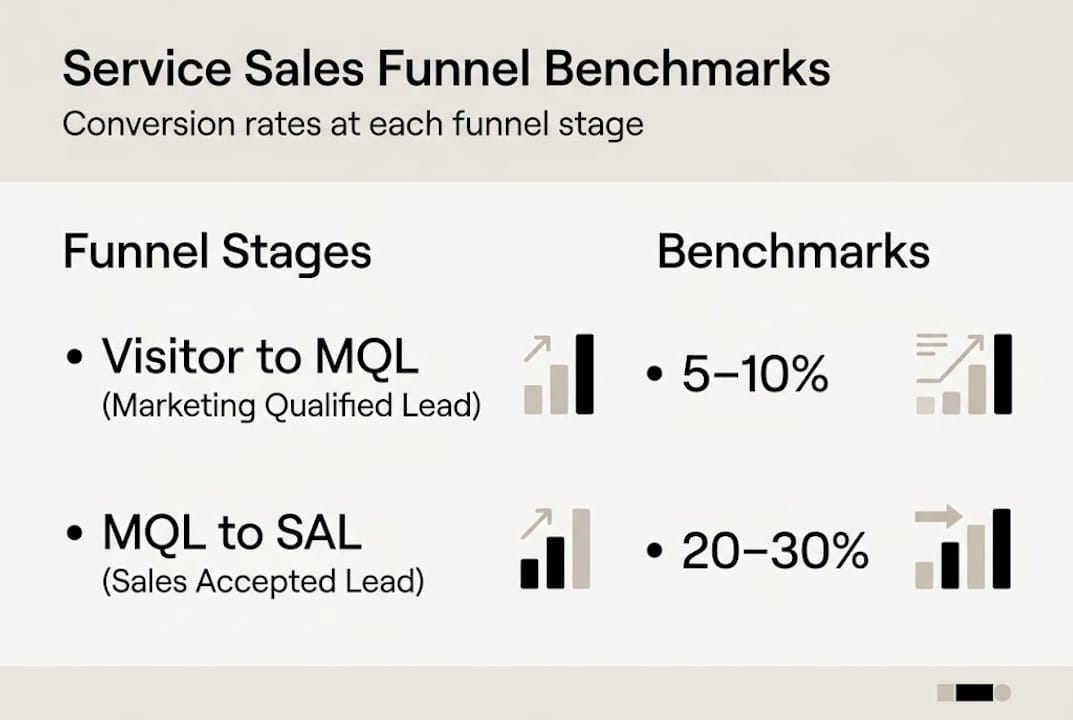
If your numbers fall below these ranges, you have a specific stage to fix rather than a vague “marketing problem.” That clarity is what makes measuring so powerful. For a deeper look at optimising sales funnels and improving these numbers, the process starts with honest tracking.
Your lead generation strategies should also be evaluated against these benchmarks regularly. What works in month one may plateau by month six, and the data will tell you before your revenue does. Review your sales funnel benchmarks quarterly and adjust your tactics accordingly.
What most service businesses get wrong about funnels
Here is the uncomfortable truth we see repeatedly at Business Warriors. Most service business owners obsess over getting more traffic and more leads while completely ignoring what happens after a lead enters the funnel. They pour budget into ads, generate enquiries, and then follow up once or twice before giving up.
The research backs this up. Prioritising lead quality over volume, aligning your sales and marketing definitions, automating nurturing and follow-up, and measuring stage-by-stage conversions is what drives predictable growth. The flywheel integration, where delighted clients refer new ones, boosts referrals far beyond what any ad campaign can achieve alone.
Volume is a vanity metric. Pipeline efficiency is what pays your bills. A step-by-step funnel guide will always outperform a spray-and-pray approach to lead generation. Over-invest in trust-building and post-sale delight. Those two habits alone will separate you from the majority of service businesses chasing their tails with inconsistent results.
Take your sales funnel further with expert help
Ready to put these concepts to work for your own business? A structured funnel is not a luxury. It is the difference between chasing leads and having them come to you consistently.
At Business Warriors, we build marketing funnels for consistent growth that are tailored to service businesses across Australia. Whether you’re just getting started or looking to sharpen what you already have, our team can audit your current funnel and identify exactly where leads are being lost. Explore our guide to scaling digital marketing or connect directly with Jarrod and the team at jarrodharman.com to take the next step toward predictable, scalable growth.
Frequently asked questions
How does an online sales funnel differ for service businesses vs. product businesses?
Service businesses rely far more on qualification calls, trust-building, and nurturing because buying decisions are higher-stakes and less impulsive. Funnels for services are often non-linear, with prospects researching across multiple channels before they ever make contact.
Why are lead magnets important for online sales funnels?
Lead magnets attract and qualify prospects by offering genuine value upfront, such as a free guide or webinar, which begins the relationship and gives you permission to follow up with nurturing content.
What are the typical conversion rates at each stage for Australian service funnels?
Expect 5 to 10% of website visitors to become leads, 20 to 30% of leads to become sales-accepted, and a close rate of 20 to 40% for fully qualified opportunities.
How do I know where my funnel is leaking leads?
Monitor conversion rates at every stage. A sharp drop between two stages points to a specific bottleneck, and tracking metrics at each stage is the only reliable way to find and fix those leaks.
Is the flywheel model better than a traditional sales funnel?
Neither is superior on its own. A hybrid funnel and flywheel approach works best for service businesses, combining structured acquisition with ongoing client delight that generates referrals and repeat business.
Recommended
- How to Create Sales Funnel for Consistent Lead Generation – Jarrod Harman
- How to Optimise Sales Funnels for More Online Leads – Jarrod Harman
- How to Build Marketing Funnels for Consistent Sales Growth – Jarrod Harman
- How to Generate Leads Online for Business Growth – Jarrod Harman
- 7 Essential Ways to Use AI for Lead Generation Success – BizDev Strategy