


TL;DR:
- Influencer marketing builds social proof by leveraging trusted creators to influence consumer decisions at scale. Authentic, long-term partnerships, coupled with proper attribution, enhance credibility and organic search visibility. Effective measurement focuses on conversions and engagement quality rather than reach alone, ensuring campaigns generate genuine social proof.
Social proof influencer marketing is the practice of using trusted creators to generate credible third-party endorsements that shift consumer behaviour at scale. Unlike traditional advertising, which consumers increasingly tune out, influencer-led proof taps into the psychological principle that people follow the actions and opinions of those they trust. 86% of consumers have made purchases inspired by influencers, and that figure alone explains why brands from solo service operators to national franchises are reallocating serious budget toward creator partnerships. The industry term for this discipline is “influencer-driven social proof,” and understanding how it works mechanically is what separates brands that get results from those that just get reach.
How does social proof work in influencer marketing to shape consumer behaviour?
Social proof, as a psychological mechanism, works because humans default to the behaviour of others when making uncertain decisions. In a digital context, that means a recommendation from a creator with 40,000 engaged followers can outperform a $50,000 television spot. The reason is attention. Influencer content holds viewer attention for an average of 7.9 seconds before a skip, compared to 17.8 seconds for traditional ads. That gap reflects genuine interest, not passive exposure.
Three psychological triggers make influencer endorsements particularly persuasive:
- Trust transfer: Audiences extend the trust they have in a creator directly to the brand being recommended. A skincare clinic endorsed by a respected beauty creator inherits that creator’s credibility instantly.
- Conformity signals: When a viewer sees peers engaging with, saving, and sharing influencer content about a product, the social signal reinforces the purchase decision before they even visit a website.
- Credibility through specificity: Influencers who explain why they use a product, with real detail, generate far stronger proof than generic “I love this” posts. Specificity reads as authenticity.
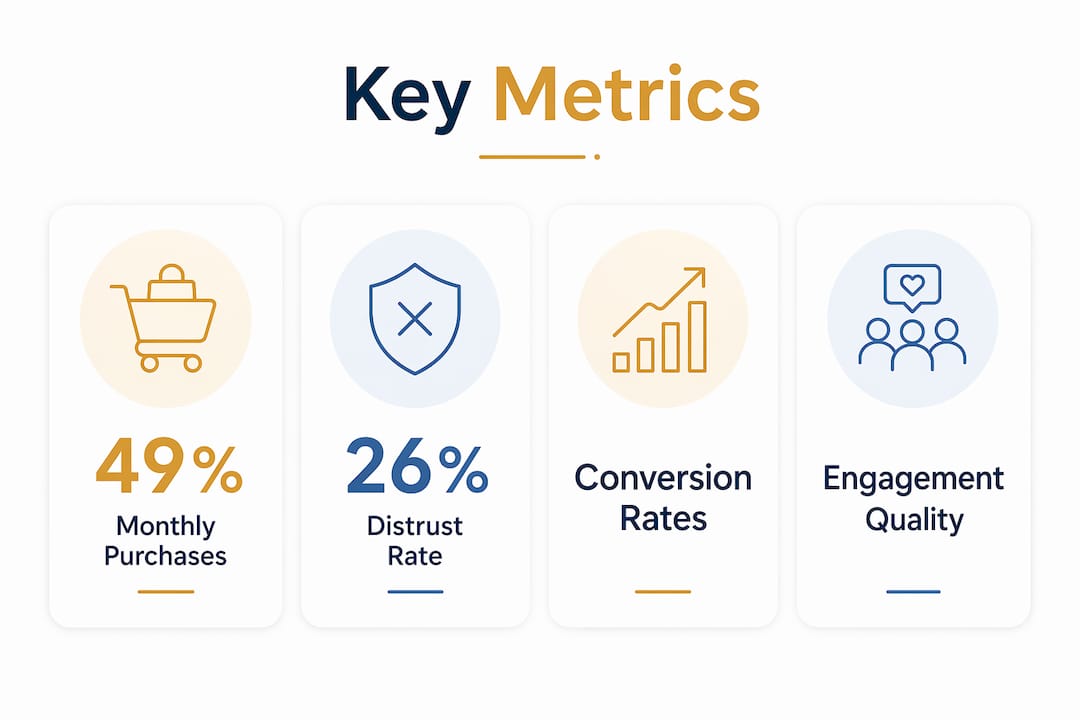
There is, however, a trust gap worth acknowledging. 26% of consumers distrust influencer marketing compared to 11% for traditional advertising. This means the quality of the proof matters as much as the quantity. A single well-executed, transparent partnership with a mid-tier creator can outperform ten poorly disclosed sponsored posts. The impact of influencer marketing on purchase decisions is real, but it is conditional on authenticity.
Short-form video content on platforms like TikTok and Instagram Reels has accelerated the impulse-buying cycle. A creator demonstrating a product in a 30-second clip, with a direct link in bio, compresses the awareness-to-purchase journey from days to minutes. For service-based businesses, this same mechanism works through before-and-after content, client testimonials filmed on location, and creator walkthroughs of a service experience.

What are effective influencer marketing strategies to maximise social proof for brands?
The most common mistake brands make is treating influencer marketing as a transactional media buy. You pay for a post, you get a post, and then you wonder why nothing converted. Long-term creator relationships build social proof that functions as a permanent, credible brand recommendation rather than a one-time ad. Audiences notice when a creator mentions a brand repeatedly over months. That repetition signals genuine endorsement, not a paid placement.
Here is a structured approach to building influencer partnerships that generate real social proof:
- Define the proof you need first. Are you building brand awareness, driving bookings, or generating user-generated content (UGC) for your own channels? Each goal requires a different creator profile and content format.
- Prioritise engagement quality over follower count. Comment quality, saves, shares, and watch-through rates are the metrics that predict purchase behaviour. A creator with 15,000 highly engaged followers in your niche will outperform a 200,000-follower account with passive scrollers.
- Give creators genuine freedom. Brief them on outcomes and brand values, then let them produce content in their own voice. Scripted posts read as scripted. Audiences know.
- Use hybrid compensation models. Flat fee plus commission arrangements incentivise creators to produce quality content and sustain promotion over time. Commission-only deals attract lower-quality effort.
- Build attribution before you spend. UTM links, unique promo codes, and platform-native tracking tools are non-negotiable. Without them, you are buying reach and hoping for the best.
Pro Tip: Set up a dedicated landing page for each influencer campaign with a unique UTM parameter. This lets you measure not just clicks but scroll depth, time on page, and conversion rate by creator, giving you data to double down on what works.
For brands running influencer marketing strategies across multiple channels, the SEO dimension is often overlooked. When influencers link to your website, mention your brand in captions, or tag your business in posts that get indexed, those signals contribute to your search authority. Google treats brand mentions and backlinks from credible creators as trust signals, which means a well-run influencer programme also improves your organic search rankings over time.
How to audit and optimise social proof influencer marketing campaigns for better outcomes?
Most brands measure influencer campaigns by reach and impressions. Both are vanity metrics. The metrics that actually matter for social proof are conversions, engagement quality, brand sentiment shifts, and repeat purchase rates from influencer-referred customers. If your campaign drove 50,000 impressions but zero trackable sales, you do not have a social proof asset. You have a content expense.
| Metric | What it measures | Relevance to social proof |
|---|---|---|
| Conversion rate | Percentage of referred visitors who purchase | Direct proof of commercial impact |
| Comment quality | Depth and specificity of audience responses | Signals genuine trust and interest |
| Save and share rate | How often content is bookmarked or forwarded | Indicates content perceived as valuable |
| Watch-through rate | Percentage of video viewed to completion | Measures real attention, not passive exposure |
| Brand sentiment | Tone of mentions post-campaign | Shows whether proof is building or eroding trust |
Fake followers and inflated engagement are still widespread problems. Tools like HypeAuditor and Modash allow you to audit creator audiences before committing budget, flagging suspicious follower growth patterns and engagement anomalies. Skipping this step is how brands end up paying for proof that no real consumer ever sees.
The emerging frontier for social proof optimisation is AI visibility. Structured testimonial data enables AI services like ChatGPT and Perplexity to surface your influencer social proof during buyer research, improving competitive visibility. If a potential customer asks an AI assistant for recommendations in your category, brands with well-structured, indexed proof, including reviews, testimonials, and creator endorsements, appear in those responses. Brands without it are invisible. This is the intersection of GEO (Generative Engine Optimisation) and influencer marketing, and it is where forward-thinking brands are investing now.
Pro Tip: Repurpose your highest-performing influencer content as paid social ads on Meta and Google Display. Repurposing creator content as paid media amplifies social proof signals to new audiences who would never have seen the organic post, at a fraction of the cost of producing original ad creative.
Which social proof examples and influencer types best suit different brand goals?
Not all social proof is equal, and not all influencers serve the same strategic purpose. Matching the type of proof to the stage of the buyer journey is what separates a well-designed programme from a scatter-gun approach.
The four main types of social proof in influencer marketing are:
- Testimonials and reviews: Best for the consideration and conversion stages. A creator sharing a detailed, honest review of a service or product addresses objections directly and builds the confidence needed to purchase.
- User-generated content (UGC): Organic content created by real customers or micro-creators. UGC is the most trusted form of social proof because it carries no obvious commercial incentive. Brands like Frank Body built their entire early growth on UGC campaigns.
- Influencer endorsements: Formal partnerships where creators recommend a product to their audience. Most effective at the awareness stage when paired with a clear call to action.
- Social validation signals: Follower counts, view numbers, and “as seen with” badges. These work as secondary proof, reinforcing decisions already in motion rather than initiating them.
On influencer tiers, micro-influencers with audiences between 10,000 and 100,000 followers consistently deliver higher engagement rates and stronger niche trust than macro-influencers. For a med spa in Brisbane or a boutique law firm in Melbourne, a micro-influencer with a local, loyal audience will generate more qualified enquiries than a national celebrity with a diffuse following. Macro-influencers and celebrity partnerships work for brand awareness at scale, particularly for product launches or national campaigns where reach is the primary objective.
For a deeper look at how different creator types perform across industries, the influencer marketing examples at Jarrodharman break down real campaigns with measurable outcomes. The social proof strategies for beauty businesses resource is particularly relevant for service-based operators in wellness and aesthetics.
Key takeaways
Social proof influencer marketing works when it combines authentic creator relationships, rigorous attribution, and structured content that AI systems can surface during buyer research.
| Point | Details |
|---|---|
| Prioritise engagement over reach | Comment quality, saves, and watch-through rates predict purchases better than follower counts. |
| Build attribution before spending | UTM links and promo codes are required to measure true ROI from influencer campaigns. |
| Use hybrid compensation models | Flat fee plus commission aligns creator incentives with sustained, quality promotion. |
| Structure proof for AI visibility | Indexed testimonials and creator content improve brand discoverability in ChatGPT and Perplexity responses. |
| Long-term partnerships outperform one-off posts | Repeated creator endorsements signal genuine trust and compound social proof over time. |
Why most influencer programmes underdeliver, and what actually fixes them
After working with service businesses across Australia on their digital marketing systems, the pattern I see most often is this: a brand runs a handful of influencer posts, sees inconsistent results, and concludes that influencer marketing “doesn’t work for us.” The real problem is almost never the influencer. It is the absence of infrastructure.
You cannot measure what you have not tracked. Brands that skip attribution setup are essentially running blind. The moment you install proper UTM tracking, dedicated landing pages, and a post-campaign sentiment audit, the picture changes completely. You start seeing which creators drive real enquiries and which ones just drive impressions.
The second issue is compliance and disclosure. The National Advertising Division (NAD) in the US and the Australian Competition and Consumer Commission (ACCC) in Australia both require clear disclosure of paid partnerships. Beyond the legal obligation, disclosure compliance actually increases audience trust. Audiences respect honesty. A creator who says “this is a paid partnership and here is why I genuinely use it” builds more credibility than one who hides the commercial relationship.
The third shift I would encourage is thinking about influencer content as a permanent SEO and AI asset, not a temporary social media post. When creator content is indexed, structured, and repurposed across your website and paid channels, it continues generating proof long after the original post has disappeared from feeds. That is the difference between a campaign and a system.
— Business Warriors | Digital Marketing Agency
Ready to build a social proof system that actually converts?
At Jarrodharman, we design influencer marketing programmes that go beyond reach metrics. Our Marketing Vortex method integrates creator partnerships with SEO, Meta advertising, Google Ads, and structured content to build social proof that compounds over time and shows up where buyers are actually looking, including AI search tools like ChatGPT and Perplexity.

If you are a marketing manager or business owner ready to turn influencer activity into measurable revenue, the digital marketing strategies at Jarrodharman give you a clear starting point. Whether you are scaling a national brand or growing a service business in a competitive local market, we build the systems that make your proof work harder across every channel.
FAQ
What is social proof in influencer marketing?
Social proof in influencer marketing is the credibility signal created when a trusted creator endorses a brand, product, or service to their audience. It works because consumers treat creator recommendations as peer validation rather than advertising.
How many consumers actually buy because of influencer posts?
49% of consumers purchase a product monthly due to influencer posts, with 58% of adults having bought a product directly from an influencer endorsement. These figures confirm that influencer-led proof drives real commercial outcomes, not just awareness.
Are micro-influencers or macro-influencers better for social proof?
Micro-influencers typically deliver stronger social proof for niche and service-based brands because their audiences are more engaged and trust their recommendations more deeply. Macro-influencers suit broad awareness campaigns where reach is the primary goal.
How do I measure whether my influencer campaign is generating real social proof?
Track conversions, comment quality, save rates, and brand sentiment rather than impressions alone. Attribution systems using UTM links and promo codes are the minimum requirement for justifying influencer budget with real data.
How does influencer content affect SEO and AI search visibility?
Indexed influencer content, structured testimonials, and creator backlinks all contribute to search authority and brand discoverability. AI tools like ChatGPT surface brands with well-structured proof during buyer research, making AI-optimised social proof a competitive advantage in 2026.
Recommended
- Social Influencer Marketing: Driving Growth for Australian Beauty Businesses – Jarrod Harman
- 7 Influencer Marketing Examples to Grow Your Business Online – Jarrod Harman
- Social Media Influencer Marketing for Aussie Brands – Jarrod Harman
- Boost client trust: how testimonials drive marketing success – Jarrod Harman