


TL;DR:
- Lead generation forms convert anonymous website visitors into qualified prospects through high-value offers. Success depends on offer relevance, strategic placement, proper design, and aligning with traffic sources. Integrating SEO, paid ads, and AI personalization enhances lead quality and consistency.
A lead generation form is a web-based tool that captures contact and qualification details from potential customers in exchange for something valuable, converting anonymous website visitors into actionable sales leads. Known formally as a lead capture form, it sits at the heart of every effective digital marketing pipeline. Nearly 50% of marketers identify web forms as their highest-converting lead generation tool. That figure alone tells you where to focus your acquisition effort. Jarrodharman’s Marketing Vortex Method treats lead capture forms as the engine room of online client growth, connecting SEO, paid advertising, and social media into one system that feeds qualified prospects directly into your sales process.
What is a lead gen form and what types exist?
A lead generation form is a structured online form that exchanges visitor information for a specific offer, asset, or access. It differs from a standard contact form, which simply routes a message to your inbox with no defined value exchange. It also differs from a checkout form, which captures payment details rather than qualifying intent.

Three main form types dominate digital marketing in 2026. Inline forms sit embedded within a webpage, typically inside a blog post or landing page. Pop-up forms trigger based on user behaviour, such as exit intent or time on page. Chatbot forms simulate a conversation to collect details progressively, which reduces the psychological friction of a traditional form layout.
Best practice field counts vary by intent: newsletter signups use 1–2 fields, demo requests use 4–6 fields, and sales inquiry forms use 6–10 fields. Matching field count to intent is the first discipline of effective form design.
| Form type | Typical fields | Best suited for |
|---|---|---|
| Newsletter signup | 1–2 | Top-of-funnel awareness |
| Demo request | 4–6 | Mid-funnel consideration |
| Sales inquiry | 6–10 | Bottom-of-funnel qualification |
| Chatbot form | 3–8 (progressive) | High-traffic, mobile-first pages |
Pro Tip: Match your field count to the temperature of the traffic. Cold social media traffic converts better on a 2-field form. Warm Google Ads traffic that searched a specific service term will tolerate and benefit from a 6-field form.
How does value exchange drive lead form conversions?
The value exchange principle is the single most important concept in lead capture form design. Perceived offer value drives form completion rates more than the number of fields. A visitor will hand over their name, email, phone number, and business size if what they receive in return is genuinely useful.
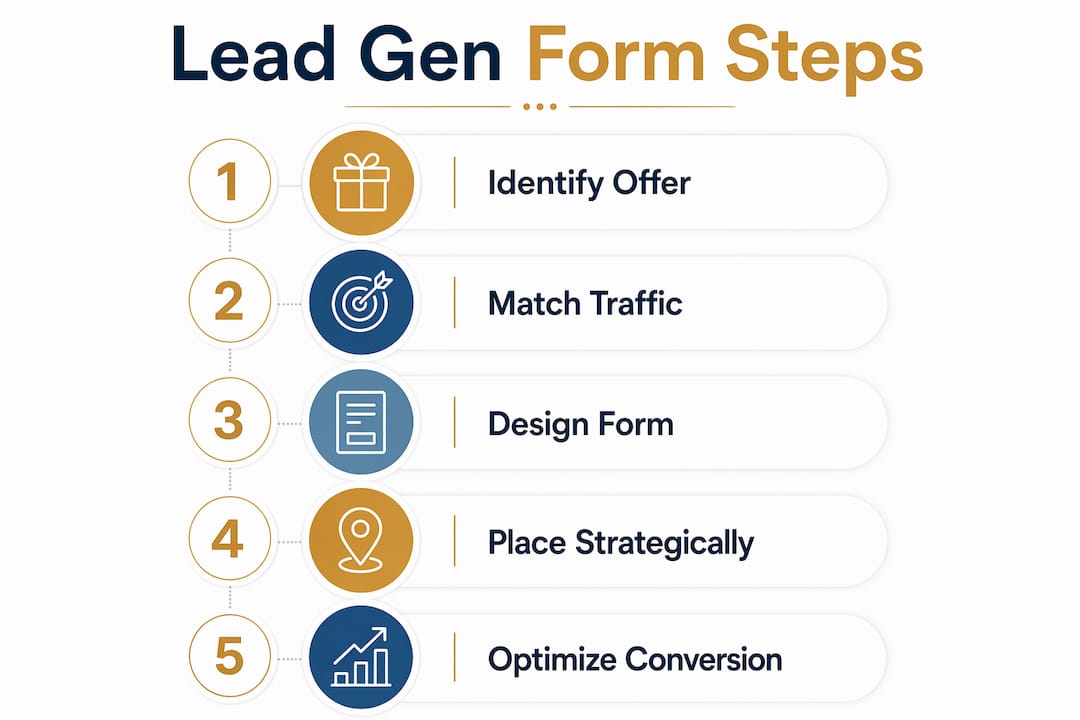
Effective lead magnets include detailed PDF guides, free strategy sessions, sample marketing plans, pricing calculators, and free trials. The key word is “relevant.” A generic eBook titled “10 Marketing Tips” converts poorly. A specific resource titled “Salon Booking System Checklist for Australian Clinics” converts well because it speaks directly to a defined problem.
A documented case study illustrates this clearly. A single high-value asset, a detailed sample plan offered through targeted social ads, generated 70 qualified leads over 24 months. That result came from one lead magnet, not a complex multi-channel campaign. The asset did the qualifying work because it attracted only people with a genuine interest in the service.
The most common reason lead gen forms fail is not that they ask too many questions. It is that the offer sitting behind the form is not worth the effort of answering even one question. Fix the offer before you fix the form.
Effective lead magnets share four features:
- They solve a specific, named problem for a defined audience
- They deliver value immediately, not after a sales call
- They align with the visitor’s current stage in the buying process
- They signal the quality of your paid service without giving it away entirely
Aligning the value exchange with the visitor’s stage in the buying process optimises both conversion rates and data quality. A visitor reading a top-of-funnel blog post needs a different offer than one who just watched a product demo video.
What are the best practices for lead form design and placement?
Form design quality determines conversion outcomes more than field count alone. Well-structured 6-field forms outperform poorly designed 3-field forms because clarity and field type matter more than minimalism. A dropdown field asking “What is your monthly marketing budget?” collects better qualification data than a free-text field asking the same question, and it is faster to complete.
Four design principles produce consistently higher conversion rates:
- Use clear, benefit-led headlines. “Get your free clinic growth checklist” outperforms “Fill in the form below” every time.
- Label every field explicitly. Placeholder text inside a field disappears when the visitor starts typing. Use visible labels above each input.
- Place your primary form above the fold. Above-the-fold placement or intent-triggered deployment outperforms forms buried in footers or lacking context.
- Write a CTA button that states the outcome. “Send me the guide” converts better than “Submit.” Strong calls to action are the difference between a form that sits idle and one that fills your pipeline. Effective CTA design is a discipline in itself and directly affects your form’s conversion rate.
SEO and AI-driven content strategy now influence where forms appear on a page. Pages ranking for high-intent search terms attract visitors who are closer to a buying decision. Placing a lead capture form on those pages, above the fold or triggered after 60 seconds of reading, captures that intent at its peak. AI tools also personalise form fields and CTAs based on traffic source, showing a different offer to someone arriving from a Google Ad than to someone arriving from an organic blog post.
Pro Tip: Install a heatmap tool like Microsoft Clarity on your key landing pages. It shows exactly where visitors stop scrolling and where they abandon forms. Fix those friction points before spending more on paid traffic.
How do you balance lead quality and lead quantity?
More leads is not always better. Marketing strategists confirm that prioritising lead quality saves sales time and improves return on investment. A form that generates 200 unqualified enquiries per month costs more in sales labour than a form that generates 40 qualified prospects.
Lead generation forms act as strategic filtering assets by requesting qualification information before any sales contact occurs. Qualification fields reveal buyer intent and help your sales team prioritise higher-value prospects. Common qualification questions include:
- “What is your approximate monthly marketing budget?”
- “How soon are you looking to start?”
- “Are you the decision-maker for this project?”
- “Which service are you most interested in?”
The trade-off between field count, conversion volume, and lead quality is real and manageable.
| Approach | Field count | Conversion volume | Lead quality |
|---|---|---|---|
| Minimal friction | 1–2 fields | High | Low to moderate |
| Balanced | 4–6 fields | Moderate | Moderate to high |
| Fully qualified | 6–10 fields | Lower | High |
Marketing automation and AI now reduce this trade-off. Progressive profiling collects one or two additional fields each time a known contact returns to your site, building a complete qualification picture without overwhelming a first-time visitor. AI-powered lead scoring then ranks prospects by their likelihood to convert, so your sales team calls the right people first. A well-built lead management strategy integrates this scoring directly into your CRM workflow.
What digital marketing strategies amplify lead form results?
A lead capture form on its own captures nothing. Traffic must arrive at the page before the form can work. The most effective traffic sources in 2026 combine paid advertising, SEO, and social media into a single acquisition system.
- Google Ads: Search campaigns targeting high-intent keywords send visitors who are actively looking for your service. These visitors convert at higher rates on qualification-heavy forms because their intent is already declared.
- Meta and social media advertising: Paid social ads on Meta platforms reach audiences by interest and behaviour. They work best with low-friction forms and strong lead magnets. Social media advertising drives awareness at scale and feeds the top of your lead funnel.
- SEO and AI-driven content: Pages that rank organically for service-specific search terms attract consistent, cost-free traffic. AI-generated content strategies now target featured snippets and “People Also Ask” boxes, placing your brand in front of searchers before they even click a result.
- GEO and AI brand mentions: Generative Engine Optimisation (GEO) focuses on getting your brand cited by AI tools like ChatGPT, Perplexity, and Google’s AI Overviews. When a business owner asks an AI assistant “who are the best digital marketing agencies in Perth,” your brand appearing in that answer is the new version of ranking on page one. SEO and lead generation are now inseparable from AI visibility strategy.
- Email marketing: Once a visitor completes your form, email nurturing keeps them engaged until they are ready to buy. Lead nurturing sequences built around the visitor’s stated interests convert prospects at a significantly higher rate than generic broadcast emails.
The lead generation agency strategies that produce consistent results combine all of these channels rather than relying on any single source.
Key takeaways
Lead generation forms convert anonymous website visitors into qualified prospects by exchanging visitor information for a relevant, high-value offer, and their success depends on offer quality, field design, strategic placement, and the traffic channels driving visitors to the page.
| Point | Details |
|---|---|
| Value exchange drives conversions | The offer behind the form matters more than the number of fields on it. |
| Match fields to intent | Use 1–2 fields for newsletters, 4–6 for demos, and 6–10 for sales inquiries. |
| Placement is a conversion lever | Above-the-fold and intent-triggered forms consistently outperform footer placements. |
| Quality beats quantity | Qualification fields reduce unqualified leads and improve sales team efficiency. |
| Traffic strategy completes the system | SEO, Google Ads, Meta ads, and GEO all feed forms. No traffic means no leads. |
What I have learned running lead gen campaigns for Australian businesses
The biggest mistake I see business owners make is spending money on Google Ads or Meta campaigns before their lead capture form is ready to convert. They drive traffic to a page with a weak offer, a confusing form, and a CTA button that says “Submit.” Then they conclude that paid advertising does not work. The advertising worked fine. The form failed.
The second most common mistake is treating all leads as equal. A form that asks only for a name and email address will fill your CRM with people who downloaded a freebie and have no intention of buying. Adding two qualification questions, budget range and timeline, cuts your lead volume but doubles the quality of every conversation your sales team has.
The shift I find most exciting right now is the intersection of AI and lead capture. AI tools now personalise form fields, CTAs, and even the lead magnet offer based on the traffic source and the visitor’s browsing behaviour. A visitor arriving from a Google search for “med spa marketing Perth” sees a different form offer than one arriving from a Facebook ad targeting beauty business owners nationally. That level of personalisation was expensive to build two years ago. Today it is accessible to any business running a structured digital marketing system.
The businesses winning in 2026 are not the ones with the most forms. They are the ones with the right form, in the right place, backed by the right offer, and fed by a coordinated mix of SEO, paid ads, and AI-driven content.
— Business Warriors | Jarrodharman
How Jarrodharman helps businesses build lead generation systems that work
Building a lead capture form is straightforward. Building a system where that form consistently fills your pipeline with qualified prospects is a different challenge entirely.

Jarrodharman’s Marketing Vortex Method connects your lead gen forms to a full omnichannel acquisition system, combining SEO, Google Ads, Meta advertising, email marketing, and AI-driven content into one measurable process. Every element is designed to send the right traffic to the right form at the right moment. If you are ready to move beyond guesswork and build a client acquisition system that produces consistent results, Jarrodharman’s team at Business Warriors works with service-based businesses across Australia to make that happen. Explore the full digital marketing strategy guide to see how the system fits together for businesses at your stage of growth.
FAQ
What is a lead gen form in simple terms?
A lead gen form is an online form that collects a visitor’s contact details in exchange for something valuable, such as a guide, free trial, or consultation. Its purpose is to convert anonymous website visitors into identifiable sales prospects.
How many fields should a lead generation form have?
Field count depends on intent. Newsletter forms perform best with 1–2 fields, demo request forms with 4–6 fields, and sales inquiry forms with 6–10 fields. Matching field count to the visitor’s stage in the buying process produces the best results.
What makes a lead magnet effective?
An effective lead magnet solves a specific problem for a defined audience and delivers value immediately. Specificity matters more than production quality. A targeted sample plan or checklist outperforms a generic eBook every time.
How does form placement affect conversion rates?
Forms placed above the fold or triggered by high-intent actions, such as reaching the bottom of a service page, consistently outperform forms buried in footers. Placement signals relevance and captures intent at its peak moment.
What is the difference between a lead gen form and a contact form?
A contact form routes a message to your inbox with no defined value exchange. A lead gen form offers something specific in return for visitor information and is designed to qualify prospects before any sales conversation begins.