15 July 2026
What is content creation in marketing: 2026 guide
Discover what is content creation in marketing and how to leverage it effectively. Learn strategies to attract, engage, and convert your audience.
TL;DR:
- Content creation in marketing involves producing valuable media to attract and convert audiences through a strategic, six-stage process. It emphasizes building topical authority, balancing AI with human insight, and investing equally in distribution and measurement to generate long-term growth. Successful systems treat content as a product with clear goals, plans, and performance tracking to achieve consistent results.
Content creation in marketing is defined as the end-to-end strategic process of researching, planning, producing, and distributing valuable, relevant media to attract and retain a defined audience and drive profitable customer action. The industry term for this discipline is content marketing, and the global creator economy now exceeds $250 billion with 207 million content creators active in 2026. That scale signals one thing clearly: content is no longer a supporting tactic. It is the primary mechanism through which brands build authority, generate leads, and convert prospects across SEO, social media, paid advertising, and AI-driven search. For marketing professionals and business owners, understanding this process is the difference between a content programme that compounds over time and one that burns budget without results.
What is content creation in marketing and how does it work?
Content creation in marketing is the deliberate production of media designed to move a defined audience from awareness to action. It differs from general publishing because every asset serves a measurable business goal, whether that is ranking on Google, generating leads through Meta Ads, or building brand authority in AI-driven search results like ChatGPT and Perplexity.

The definition of content marketing from Business LibreTexts frames this shift precisely: content marketing transforms marketers from advertisers who buy audiences into publishers who attract and retain them. That distinction matters because modern audiences actively avoid interruptive advertising. They search, scroll, and ask AI assistants for answers. Brands that produce genuinely useful content appear in those moments. Brands that do not, stay invisible.
What is digital content creation in practice? It is the combination of strategy, creativity, and data analysis applied across written, video, audio, and visual formats. A single well-planned content asset can rank on Google, be repurposed into short-form video for Instagram Reels, amplified through Google Ads, and cited by AI language models. That multi-channel reach is why the content marketing process deserves the same rigour as any other business system.
What is the content creation process in digital marketing?
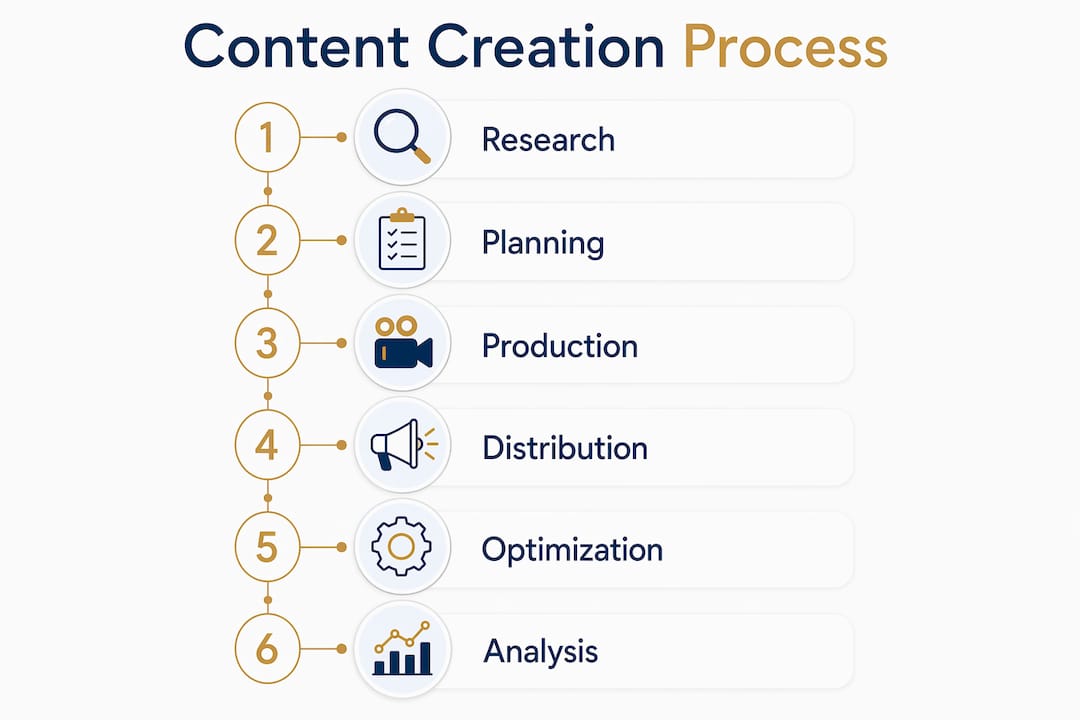
Effective content creation follows a six-stage lifecycle that separates professional marketing operations from ad hoc publishing. Each stage builds on the last, and skipping any one of them reduces the return on every stage that follows.
- Strategy and planning. Define your audience, business goals, keyword targets, and content pillars. This stage produces a content brief and style guide that align every contributor to the same voice and objectives.
- Ideation. Generate topic ideas based on keyword research, audience questions, competitor gaps, and trending search queries. AI tools like ChatGPT accelerate this phase significantly.
- Production. Write, film, record, or design the asset. This is where most teams over-invest their time relative to the stages that follow.
- Review and approval. Check for accuracy, brand voice consistency, SEO on-page requirements, and legal compliance before publishing.
- Publishing and distribution. Publish the asset and promote it across every relevant channel: organic search, email, social media, paid advertising, and outreach.
- Analysis and optimisation. Measure performance against goals, identify what worked, and feed those insights back into the next planning cycle.
A content brief is the collaboration tool that translates high-level strategy into specific guidance for writers, designers, and videographers. Without it, teams produce inconsistent work that dilutes brand authority. The content marketing workflow guide from Jarrodharman covers each of these stages in detail for teams ready to build a repeatable system.
Pro Tip: Batch your production phase. Record or write multiple assets in a single session, then schedule distribution over several weeks. This keeps your publishing calendar consistent without requiring daily creative effort.
Why is content creation important in marketing?
Content creation is the primary driver of organic growth, brand authority, and long-term lead generation. Unlike paid advertising, which stops the moment you stop spending, well-produced content compounds. A blog post that ranks on page one of Google continues generating traffic and leads for years without additional spend.
The strategic importance of content creation rests on three pillars:
- Topical authority. Search engines reward brands that publish content clusters built around pillar pages and supporting articles. This signals expertise and improves rankings across an entire subject area, not just individual keywords.
- AI and GEO visibility. Generative Engine Optimisation (GEO) is the practice of structuring content so that AI tools like ChatGPT, Perplexity, and Google’s AI Overviews cite your brand. Brands with strong content authority get mentioned in AI responses. Brands without it do not appear at all.
- Lead generation and conversion. Content that answers specific buyer questions at each stage of the funnel moves prospects toward a decision. A well-placed case study, FAQ page, or comparison article can convert a reader who would never have clicked a paid ad.
“Content marketing is the only marketing left. All other marketing is just advertising. Content marketing shifts the marketer’s role from interrupting audiences to genuinely serving them with information they actually want.”
The importance of content creation also extends to paid advertising. Strong organic content improves Quality Scores in Google Ads, reduces cost-per-click, and provides the landing page assets that make Meta advertising campaigns convert. Content and paid channels are not separate strategies. They reinforce each other.
What types of content are created in marketing?
Content creation has expanded well beyond blog posts to include video, podcasts, infographics, and interactive tools. Each format has unique production, distribution, and measurement demands. Choosing the right format depends on your audience, platform, and business goal.
| Content type | Primary platform | Primary goal |
|---|---|---|
| Long-form blog posts | Google Search | SEO rankings and topical authority |
| Short-form video | Instagram, TikTok, YouTube Shorts | Brand awareness and social engagement |
| Long-form video | YouTube | Authority building and search visibility |
| Podcasts | Spotify, Apple Podcasts | Audience retention and brand trust |
| Infographics | Pinterest, LinkedIn | Referral traffic and shareability |
| Email newsletters | Direct inbox | Lead nurturing and repeat conversions |
| Paid ad creative | Google Ads, Meta Ads | Direct response and lead generation |
Platform strategy shapes format decisions. LinkedIn rewards long-form written posts and professional case studies. Instagram and TikTok reward short, high-energy video. Google rewards structured, expert-level written content with clear headings and internal linking. YouTube rewards consistent, well-titled video content that answers specific search queries. Understanding the role of social media marketing across these platforms is critical before committing production resources to any single format.
Pro Tip: Repurpose every major asset. A 2,000-word blog post becomes a YouTube script, five LinkedIn posts, ten short-form social clips, and an email sequence. One production effort, multiple distribution channels.
How can you optimise content creation using SEO, AI, and distribution?
Content optimisation is the process of improving an asset’s performance after publication through SEO refinement, distribution expansion, and data-driven iteration. Most businesses treat content as a one-off task. The ones that grow treat it as a product with a lifecycle.
SEO and topical authority
Keyword research is the foundation of every effective content strategy. Start with a primary keyword, then map related terms into a content cluster. A pillar page covers the broad topic. Supporting articles cover specific subtopics and link back to the pillar. This structure signals topical authority to Google and improves rankings across the entire cluster. Content cluster strategy is now one of the strongest levers available for organic growth in competitive markets.
AI in content creation
AI tools accelerate ideation and outline generation but cannot replace the human expertise needed for authentic, high-ranking content. Google actively downranks generic AI content that lacks original insight or real experience. The correct approach is to use AI for research, structure, and first drafts, then apply human expertise to add original perspective, case studies, and specific data. The role of AI in content strategy is to speed up the process, not to replace the thinking behind it.
Distribution and promotion
- Allocate at least 40% of your content effort to distribution and promotion, not just production.
- Many teams spend 90% of their effort on production and only 10% on promotion, which severely limits reach and ROI.
- Batch and schedule social media clips, email sequences, and paid ad creative at the same time you produce the primary asset.
- Use Google Ads and Meta Ads to amplify high-performing organic content to new audiences.
- Build an internal linking structure that passes authority between related pages on your website.
Measurement and feedback loops
The analysis phase is the weakest link in most content programmes. Without a feedback loop, content marketing becomes guesswork rather than a data-informed growth system. Track organic traffic, keyword rankings, time on page, lead conversions, and paid ad performance for every asset. Use that data to decide what to update, repurpose, or retire. The content marketing best practices guide from Jarrodharman covers measurement frameworks that connect content performance directly to revenue.
Key takeaways
Content creation in marketing is a six-stage system combining SEO, AI-assisted production, multi-channel distribution, and data analysis to build audience trust and generate consistent leads.
| Point | Details |
|---|---|
| Define content marketing correctly | Content creation is a strategic process, not just publishing. Every asset must serve a measurable business goal. |
| Follow the six-stage lifecycle | Strategy, ideation, production, review, distribution, and analysis form a repeatable system that compounds over time. |
| Build topical authority through clusters | Pillar pages supported by linked articles signal expertise to Google and improve rankings across entire subject areas. |
| Balance AI with human expertise | Use AI to accelerate ideation and drafting, then add original insight to avoid Google’s generic content penalties. |
| Invest in distribution, not just production | Spending 90% of effort on production and 10% on promotion is the most common reason content programmes underperform. |
What I have learned from building content systems that actually work
Most businesses approach content creation backwards. They produce first and plan second. The result is a library of assets that nobody finds, because there was no keyword strategy, no distribution plan, and no measurement framework attached to them from the start.
The single biggest shift I have seen in client results comes from treating content like a product. Every asset gets a brief, a distribution plan, and a performance target before a single word is written or a single frame is filmed. That discipline feels slow at the start. It compounds fast.
The other pattern I see constantly is over-reliance on AI without the human layer that makes content worth reading and worth ranking. AI can produce a technically correct article in minutes. Google can detect generic AI content and deprioritises it. The businesses winning in search and in AI-generated answers like Perplexity and ChatGPT are the ones producing content with genuine experience, specific data, and a clear point of view. That is not something you can automate.
Distribution is where most content budgets are wasted through neglect. A well-produced video that gets posted once and forgotten is not a content strategy. Batching, scheduling, repurposing across platforms, and amplifying with paid advertising turns one asset into a month of consistent presence. That is what builds brand authority at scale.
The content strategy for social media matters as much as the content itself. Platform-specific formatting, posting cadence, and audience targeting determine whether your content reaches the right people or disappears into the feed.
, Business Warriors | Digital Marketing Agency
How Jarrodharman helps businesses build content systems that generate leads
Content creation without a system behind it produces inconsistent results. Jarrodharman works with service-based businesses, e-commerce brands, and enterprises across Australia to build digital marketing strategies that connect content creation directly to lead generation and revenue growth.

The Marketing Vortex Method integrates SEO, Google Ads, Meta advertising, email marketing, and social media content into a single omnichannel system. Every content asset is planned with distribution and measurement built in from day one. If your content programme is producing traffic without conversions, or producing nothing at all, the digital marketing strategy guide is the right starting point. Reach out to Jarrodharman to discuss a content and marketing system built around your specific business goals.
FAQ
What is content creation in marketing?
Content creation in marketing is the strategic process of producing and distributing valuable media to attract a defined audience and drive profitable customer action. It includes blog posts, video, social media, email, and paid ad creative, all planned around specific business goals.
What is the difference between content creation and content marketing?
Content creation refers to producing individual assets. Content marketing is the broader strategy that governs how those assets are planned, distributed, and measured to achieve business outcomes.
How does SEO relate to content creation?
SEO and content creation are inseparable. Keyword research informs what content to produce, content clusters build topical authority, and on-page optimisation determines how well each asset ranks in Google search results.
Can AI replace human content creators?
AI accelerates ideation and drafting but cannot replace human expertise. Google downranks generic AI content that lacks original insight, so human review and perspective remain necessary for content that ranks and converts.
How often should businesses publish new content?
Consistency matters more than volume. A well-planned content cluster published monthly outperforms daily posts with no strategic structure. Prioritise quality, distribution, and measurement over raw publishing frequency.