


How digital marketing drives business growth
Digital marketing is the single most direct path between your business and the customers who are actively looking for what you sell. It combines SEO, Google Ads, Meta advertising, social media platforms, and email marketing into a system that puts your brand in front of the right people at the right moment, and then tracks every dollar of the result.
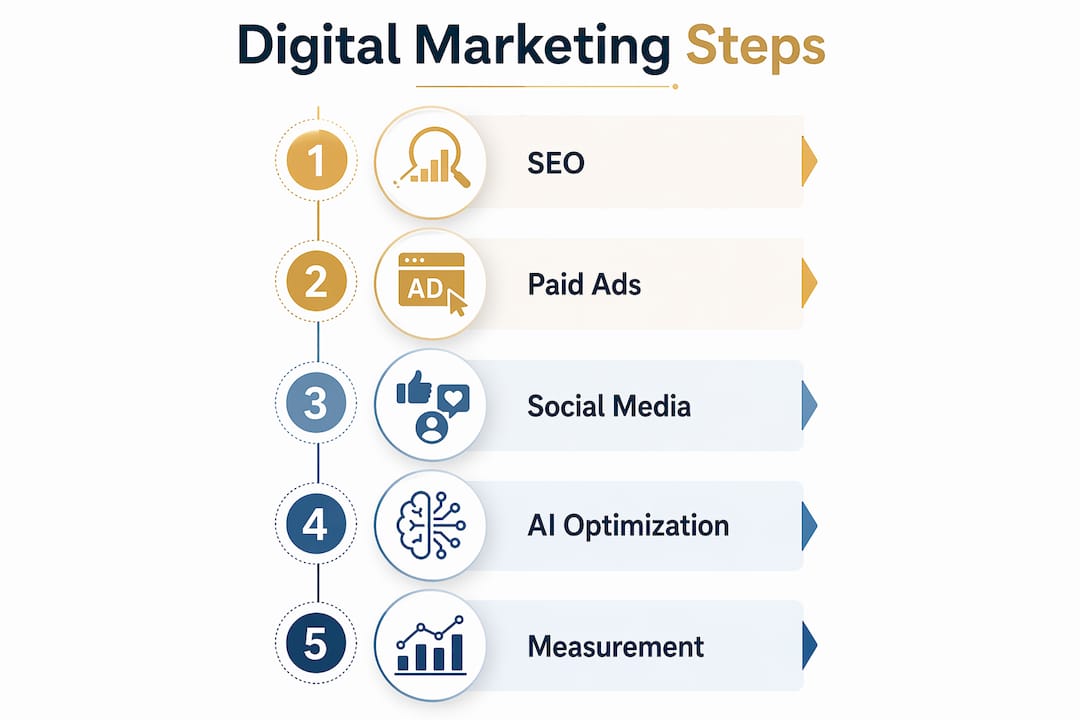
The channels doing the heaviest lifting right now:
- SEO builds long-term organic visibility so your business appears when people search for your services
- Google Ads captures high-intent buyers the moment they type a query
- Meta advertising (Facebook and Instagram) targets audiences by behaviour, interest, and demographics
- Email marketing nurtures leads and converts existing contacts into repeat buyers
- Social media builds community, trust, and brand recall across platforms your customers already use
The numbers behind these channels are shifting fast. AI Overviews now appear on approximately 48% of Google queries as of mid-2026, which means the old game of chasing a blue-link ranking is no longer enough on its own. Brands that earn citation inside those AI-generated answer boxes get 35% more organic clicks and 91% more paid clicks than brands that go uncited. That gap is only going to widen.
Generative Engine Optimisation (GEO) sits alongside traditional SEO as the discipline that gets your brand cited inside AI-synthesised answers, not just ranked on a results page. Businesses that understand both are the ones pulling ahead.
Why digital marketing matters more than ever for business expansion
Digital marketing covers every channel where your audience spends time online: search engines, social feeds, inboxes, video platforms, and now AI-powered conversational interfaces. It does not replace traditional marketing channels like print, radio, or outdoor advertising. It works alongside them, filling the gaps traditional channels cannot reach and providing the measurement those channels have never offered.
The advantages that make digital marketing worth prioritising:
- Precision targeting: you reach people based on location, search intent, age, income, and past behaviour rather than broadcasting to a general audience
- Real-time measurement: every click, conversion, and cost is tracked, so you know exactly what is working
- Cost control: budgets scale up or down daily, which suits businesses of any size
- Speed to market: a Google Ads campaign can be live within hours; an SEO content piece can rank within weeks
- Compounding returns: SEO and content assets keep generating traffic long after the initial investment
Pro Tip: Do not treat SEO and AI-driven techniques as separate workstreams. Google’s 2026 guidance confirms that generative AI features rely on the same core quality signals as traditional search. Build one high-quality content programme and it feeds both.
The businesses that grow fastest online are not the ones spending the most. They are the ones running the tightest integration between their channels, so every touchpoint reinforces the next.

Key digital marketing strategies that actually move the needle
SEO: the foundation everything else builds on
Search engine optimisation covers three distinct layers, and you need all three working together. Technical SEO ensures your site loads fast, uses server-side rendering where needed, and is structured so that both Google’s crawlers and AI engines can extract your content cleanly. On-page SEO aligns your content with the specific queries your customers type. Off-page SEO builds the authority signals, backlinks, and brand mentions that tell search engines your site deserves to rank.
GEO extends this further. Where traditional SEO ranks your pages, GEO gets your brand cited inside the synthesised answers that ChatGPT, Perplexity, Google Gemini, and Google AI Mode now deliver to billions of users. The role of digital marketing has expanded to include earning that citation authority, not just a page-one position.
Social media marketing: Instagram and Facebook
Instagram and Facebook remain the two platforms with the deepest targeting capability for Australian service businesses. Facebook’s audience tools let you target by postcode, life event, income bracket, and past purchase behaviour. Instagram’s visual format suits salons, clinics, spas, and retail brands particularly well, where before-and-after content and short video drive both engagement and direct bookings.
Influencer marketing on these platforms generates up to 11 times higher ROI than traditional digital advertising, which makes it one of the most cost-efficient channels for building awareness fast. Paid social and organic content work best when they run together: organic builds trust, paid amplifies reach.
Google Ads: paid search for immediate results
Google Ads puts your business at the top of search results for high-intent queries the moment someone is ready to buy. Unlike SEO, which builds over months, a well-structured Google Ads campaign generates leads from day one. The key is matching your ad copy and landing page to the exact intent behind each keyword group, so the click converts rather than bouncing.
| Strategy | Primary objective | Typical timeframe | Best suited for |
|---|---|---|---|
| Technical SEO | Crawlability and AI extraction | Ongoing | All business types |
| Content SEO | Organic rankings and GEO citations | — | Service and e-commerce brands |
| Google Ads | Immediate lead generation | Days | High-intent buyer capture |
| Meta advertising | Audience building and retargeting | Weeks | Visual and service brands |
| Email marketing | Lead nurture and retention | Weeks | Existing contact databases |
| Social media (organic) | Brand trust and community | Months | Consumer-facing businesses |
| GEO / AI SEO | AI citation and branded query lift | — | Brands targeting AI-mediated search |
Advantages of digital marketing for Australian businesses
Australia’s digital adoption rate is high, and consumer behaviour here reflects it. Australians research purchases online before committing, compare service providers through Google, and increasingly discover brands through social feeds and AI-generated answers. A business without a strong digital presence is invisible to a large portion of its potential market.
Key advantages specific to the Australian context:
- Geographic targeting: Google Ads and Meta advertising let you target by suburb, city, or state, which matters for service businesses with defined catchment areas
- Cost-effective reach: digital channels deliver measurable reach at a fraction of the cost of television or print, making them accessible for small and medium businesses
- Measurable outcomes: every campaign produces data you can act on, from cost per lead to booking conversion rate
- Scalability: a campaign that works in Perth can be scaled nationally without rebuilding from scratch
Australian businesses investing in online marketing consistently report that the combination of SEO and paid advertising produces the strongest return when run together rather than in isolation. The paid channel captures immediate demand; SEO builds the long-term asset.
Pro Tip: Integrate your digital campaigns with any traditional channels you run. A radio ad that drives branded searches will lift your SEO performance. A print campaign that includes a specific URL or QR code makes the offline spend measurable.
Small and service-based businesses benefit most from the precision targeting that digital channels offer. A beauty clinic in Brisbane does not need to reach all of Australia. It needs to reach women within 10 kilometres who are searching for specific treatments. Digital marketing makes that level of precision affordable.
How digital marketing builds your brand, not just your sales pipeline
Brand building through digital marketing works differently from direct response advertising. The goal is not an immediate click or booking. It is the accumulated recognition that makes your business the first name a potential customer thinks of when they need what you offer.
Tactics that build brand equity online:
- Consistent visual identity and tone of voice across every platform
- Regular, high-quality content that demonstrates expertise rather than just promoting services
- Active reputation management through Google Business Profile reviews and social proof
- Engagement on social media that treats comments and messages as conversations, not notifications
- Branded search volume growth, which signals to both Google and AI engines that people are actively looking for you by name
AI search engines prioritise brands with strong entity recognition, built through consistent branded searches and cross-site mentions. This means brand building is no longer just a marketing exercise. It directly affects your visibility inside AI-generated answers. The more people search for your brand by name, the stronger your entity signal becomes, and the more likely AI engines are to cite you.
Unlinked brand mentions correlate approximately three times more strongly with AI visibility than traditional backlinks. Getting your business mentioned in industry publications, podcasts, local media, and partner websites matters even when those mentions carry no link.

AI SEO and GEO: the digital marketing shift you cannot afford to ignore
Generative Engine Optimisation is the practice of structuring your content and brand signals so that AI engines cite your business inside their synthesised answers. Google AI Mode surpassed one billion monthly users by mid-2026. That is a billion people getting answers from an AI that pulls from a handful of trusted sources, not a list of ten blue links.
The practical difference between SEO and GEO: SEO ranks your pages, GEO gets your brand cited inside the answer itself. Both matter, and they share the same content quality foundation. What GEO adds is a focus on how your content is structured for AI extraction, how frequently your brand is mentioned across the web, and how strong your entity signals are.
AI-referred visitors convert at roughly 4.4 times the rate of traditional organic search visitors. The volume is still smaller than organic search, but the quality of that traffic is exceptional.
Pro Tip: Add cited statistics and named expert sources to your content. Research shows this approach improves AI visibility by 37–41%. Write in confident, direct prose, cover the full range of questions your audience asks, and keep content updated. These are the tactics with the strongest evidence behind them.
For a deeper look at how AI is reshaping client acquisition, Jarrodharman’s guide on AI in marketing covers the practical steps. The GEO strategy guide at Babylove Growth is also worth reading for its breakdown of how traditional SEO and GEO work together.
Key GEO tactics to implement now:
- Publish content that directly answers the questions your customers ask AI tools
- Build brand mentions across industry publications, directories, and partner sites
- Use schema markup and structured data so AI crawlers can extract your business information cleanly
- Track branded query volume in Google Search Console as a GEO performance indicator
- Monitor your citation frequency inside ChatGPT, Perplexity, and Google AI Overviews
Sustainable digital marketing growth relies on producing expert-verified, high-quality content rather than trying to game AI systems. The brands that will dominate AI-mediated search in 2027 are the ones building genuine authority now.
Australian businesses growing through digital marketing: what the results look like
The pattern across successful Australian digital marketing campaigns is consistent. Businesses that combine SEO with paid advertising and social media see compounding results that neither channel produces alone.
A service-based business running Google Ads alongside an active SEO programme typically sees the paid channel deliver immediate leads while the organic rankings build. Once the SEO gains traction, the cost per acquisition from paid drops because branded search volume increases and quality score improves. The two channels reinforce each other rather than competing for budget.
Beauty and wellness businesses in Australia have seen strong results from Meta advertising paired with Instagram content. The visual nature of these industries suits the format, and the targeting precision means spend goes to people within the right geography who have already shown interest in similar services. Booking platforms integrated directly with Instagram and Facebook remove friction from the conversion process.
For service businesses with longer sales cycles, such as law firms or consulting practices, email marketing plays a critical role. A contact who downloads a guide or attends a webinar enters a nurture sequence that builds trust over weeks before a sales conversation happens. The role of email marketing in these longer-cycle businesses is often underestimated relative to its actual contribution to revenue.
Businesses that integrate traditional channels with digital see an additional lift. A car dealership running radio ads alongside Google Ads and a local SEO programme captures both the passive awareness that radio builds and the active intent that search captures. The measurement sits in the digital layer, so the combined effect becomes visible in the data.
How to measure what your digital marketing is actually doing
Measurement is where most businesses fall short. They run campaigns, see some results, and assume the right things are working. The ones that grow consistently are tracking the specific metrics that connect marketing activity to revenue.
Core metrics to track:
- Cost per lead (CPL): what you pay to generate each enquiry across every channel
- Conversion rate: the percentage of leads that become paying customers
- Organic traffic: monthly sessions from search engines, segmented by landing page
- Branded query volume: how often people search for your business by name (tracked in Google Search Console)
- AI-referred traffic: sessions from ChatGPT, Perplexity, and Gemini (set up referrer filters in Google Analytics 4)
- Citation frequency: how often your brand appears inside AI-generated answers
- Return on ad spend (ROAS): revenue generated per dollar spent on paid advertising
Google Analytics 4 is the baseline tool for tracking website behaviour and campaign performance. Google Search Console shows you which queries drive organic traffic and how your branded search volume trends over time. Google Ads and Meta Ads Manager provide campaign-level data including impressions, clicks, and conversion events.
AI visibility metrics like citation frequency and branded query lift are now key performance indicators for any business serious about 2026 digital marketing. These are not vanity metrics. Citation frequency correlates directly with the AI-referred traffic that converts at 4.4 times the organic rate, as noted earlier.
The businesses that grow fastest set up their measurement before they scale their spend. Know your CPL target, your conversion rate, and your average client value before you increase a budget. That way, every dollar added to a campaign has a clear benchmark to beat.
Key takeaways
Digital marketing drives business growth by combining SEO, paid advertising, social media, and AI-optimised content into a system where every channel reinforces the others and every result is measurable.
| Point | Details |
|---|---|
| AI Overviews are reshaping search | 48% of Google queries now feature AI Overviews, making GEO as important as traditional SEO. |
| Cited brands win disproportionately | Brands cited in AI Overview boxes earn 35% more organic clicks and 91% more paid clicks. |
| AI-referred traffic converts at 4.4x | Visitors arriving from AI engines convert at roughly 4.4 times the rate of standard organic traffic. |
| Brand mentions outperform backlinks for AI | Unlinked brand mentions correlate 3x more strongly with AI visibility than traditional backlinks. |
| Measurement must include AI metrics | Track branded query volume, citation frequency, and AI-referred traffic alongside standard KPIs. |
Work with Jarrodharman to grow your business online
Jarrodharman and the Business Warriors team work with Australian service businesses, e-commerce brands, and enterprises to build the kind of integrated digital marketing systems that produce consistent, measurable growth. The Marketing Vortex method combines SEO, Google Ads, Meta advertising, email marketing, and social media into one connected system where each channel feeds the next.
If you want to understand exactly where your digital marketing stands right now and what it would take to grow, start with Jarrodharman’s SEO and digital marketing services based in Perth and serving clients across Australia.