


A marketing persona is a semi-fictional, research-based profile representing an ideal customer segment, built from real demographics, behavioural data, goals, and pain points. It is not a vague audience description. It is a named, detailed character your whole team can write for, design for, and sell to.
The industry term you will see used interchangeably is buyer persona, though customer persona and audience persona mean the same thing in practice. Gartner defines customer personas as archetypal representations of existing customer subsets who share similar goals, needs, expectations, and motivations. That framing matters because it positions personas as tools for understanding real people, not invented stereotypes.
Table of Contents
- What does a marketing persona actually include?
- Why marketing personas sharpen your targeting and cut wasted spend
- What are the main types of marketing personas?
- How to build and apply marketing personas that actually work
- Advanced persona strategies with AI, SEO, and digital advertising in 2026
- What do detailed marketing personas look like in practice?
- Common mistakes that undermine persona development
- Building personas for the Australian market specifically
- Key takeaways
What does a marketing persona actually include?
Every well-built persona combines five layers of information:
- Demographics: Age, location, job title, income band, and education level. For Australian businesses, this might mean specifying whether your persona lives in a capital city or a regional area, since channel preferences and purchasing behaviour differ considerably.
- Psychographics: Values, attitudes, lifestyle choices, and what the person cares about beyond their job. A 42-year-old clinic owner in Brisbane who values work-life balance responds to very different messaging than one who is purely growth-focused.
- Behavioural patterns: How they consume content, which platforms they use, what triggers a purchase decision, and how long their buying cycle runs.
- Goals and success metrics: What they are trying to achieve professionally and personally. These drive the “why” behind every purchase.
- Pain points and obstacles: The specific frustrations blocking them from their goals. These are the gaps your product or service fills.
Shopify describes personas as transforming vague audience segments into specific, actionable profiles that guide business decisions. The difference between a persona and a basic customer segment is exactly that: a segment tells you who is in the group; a persona tells you why they buy and how to reach them.
Why marketing personas sharpen your targeting and cut wasted spend
Personas improve targeting precision across SEO, paid advertising, and social media by identifying preferred content types and platforms, as explained in this detailed guide to audience targeting. That specificity has a direct effect on budget efficiency.
- Personas reveal which channels your audience actually uses, so you stop paying for placements they never see.
- They guide message personalisation, making email, social content, and ad copy feel relevant rather than generic.
- They help identify strong leads early, because your messaging attracts people who match the profile.
- They align marketing and sales around the same customer picture, which reduces friction when handing off leads.
- HubSpot reports that companies using personas are 2x more likely to exceed their revenue goals.
Pro Tip: Pull insights from your sales team and customer service records when building personas. The objections your sales team hears every week and the complaints your support team fields are more accurate than any internal assumption about what customers want.
What are the main types of marketing personas?
Wrike identifies four core persona types that cover the full customer journey:
- Buyer personas focus on decision-makers: the people who evaluate options, hold the budget, and sign off on purchases. These are the most common type and drive most campaign targeting decisions.
- User personas represent the people who interact with a product or service daily. In B2B contexts, the buyer and the user are often different people entirely. A marketing manager might approve a software purchase, but the team using it every day has completely different needs.
- Negative personas (sometimes called anti-personas) define who you are not targeting. Identifying them prevents wasted spend on audiences unlikely to convert or who generate high churn.
- Service personas focus on post-sale interactions, capturing what customers need from onboarding, support, and ongoing account management. These are particularly useful for service-based businesses where retention drives revenue.
Each type fits a different stage of the customer journey. Buyer personas drive acquisition campaigns; user personas inform product and UX decisions; service personas shape retention strategies.
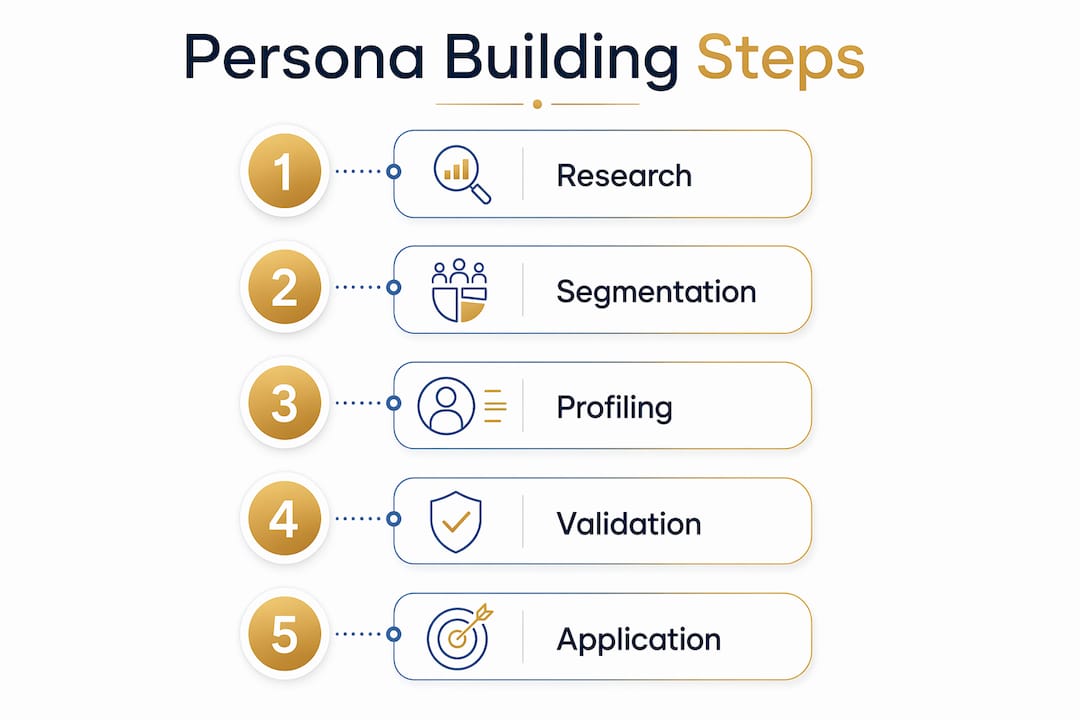
How to build and apply marketing personas that actually work

The most common failure in persona development is building them from internal assumptions rather than real customer data. The Decision Lab is direct on this point: personas must be based on interviews, surveys, and analytics, balancing specificity with usability.
A practical build process looks like this:
- Conduct qualitative interviews with existing customers, asking about their goals, frustrations, and how they found you. Ten to fifteen interviews surface patterns quickly.
- Run surveys to quantify what interviews surface. SurveyMonkey and Google Forms both work for this at scale.
- Analyse your analytics data from Google Analytics 4, Meta Ads Manager, and your CRM to identify behavioural patterns: which pages convert, which channels drive quality leads, and where people drop off.
- Map preferred channels and content formats for each persona. One persona might respond to long-form YouTube content; another converts from a single Instagram Reel.
- Document goals, pain points, and objections in plain language your whole team can use.
- Review and update personas every six months. Customer behaviour shifts, and a persona built in 2023 may not reflect how your audience behaves in 2026.
Cross-functional collaboration between marketing, sales, and product teams produces more accurate personas than any single team working alone. Sales knows the objections; product knows the usage patterns; marketing knows the acquisition channels.
Pro Tip: Once personas are documented, tag every piece of content and every campaign with the persona it targets. After 90 days, review which persona-tagged campaigns generated the best cost-per-lead. That data tells you where to shift budget.
Advanced persona strategies with AI, SEO, and digital advertising in 2026
Personas have moved well beyond campaign briefs. In 2026, they directly inform SEO architecture, AI search visibility, and paid advertising precision.
The shift to AI-driven search (Google’s AI Overviews, Perplexity, ChatGPT search) means your content now needs to match the exact vocabulary and intent patterns your personas use when they ask questions. If your persona is a 40-year-old med spa owner in Melbourne searching for “how to get more bookings without discounting,” your SEO content needs to answer that question in those words, not in the clinical language your internal team uses. This is how you appear in AI-generated summaries and large language model responses, a discipline increasingly called Generative Engine Optimisation (GEO).
Practical AI and SEO tactics for persona-based marketing:
- Use persona pain points as the seed for long-tail keyword research in Google Search Console and keyword tools.
- Write FAQ content in the exact phrasing your persona uses, since AI search tools pull from conversational, question-based content.
- Build topical authority clusters around each persona’s core concerns, so Google and AI models associate your site with those topics.
- For Google Ads, use persona-specific ad copy and match it to landing pages written for that persona’s vocabulary and objections.
- On Meta, use persona demographic and interest data to build Custom Audiences and Lookalike Audiences that mirror your best customers.
- For social media advertising, align creative format to persona platform preference: short-form video for younger audiences, carousel ads for product-heavy personas, and long-form content for B2B decision-makers.
Pro Tip: Feed your persona’s pain points and goals into an AI writing tool when drafting ad copy or blog briefs. The output will be closer to your persona’s natural language than copy written from a product-feature brief.
What do detailed marketing personas look like in practice?
Two examples illustrate how demographic, psychographic, and behavioural data combine into a usable profile.
Persona 1: “Clinic Claire”
Claire is 43, owns a med spa in Sydney’s inner suburbs, and employs six staff. She earns well but feels stretched managing both the clinical side and the business. Her goal is consistent bookings without relying on discounts. She consumes content on Instagram and listens to business podcasts during her commute. She makes purchasing decisions based on peer recommendations and case studies, not vendor websites. Her biggest frustration is spending money on ads that bring in one-off clients rather than loyal regulars. For personalised marketing in beauty businesses, this persona drives everything from ad creative to email subject lines.
Persona 2: “Growth-Mode Greg”
Greg is 38, runs a B2B services firm in Brisbane, and manages a team of twelve. He is the budget holder and the decision-maker. He reads LinkedIn content and industry newsletters, trusts data over testimonials, and needs to justify every marketing spend to his board. His pain point is proving ROI on digital campaigns. He evaluates vendors on transparency and reporting quality. A content and marketing strategy built for Greg leads with metrics, case studies, and clear reporting frameworks.
Both personas share a format: name, age, role, goals, pain points, preferred channels, and decision triggers. That consistency lets your team apply them without interpretation.
Common mistakes that undermine persona development
Most persona projects fail in predictable ways.
Building personas from internal opinions rather than customer interviews is the most common error. A team that has never spoken directly to customers will project their own assumptions onto the profile. The result is a persona that describes who the team thinks the customer is, not who they actually are.
Creating too many personas dilutes focus. Three to five well-researched personas serve most businesses better than twelve thin ones. Each additional persona requires dedicated content, campaigns, and channel strategies. If you cannot resource that, fewer personas used consistently outperform many personas used inconsistently.
Treating personas as a one-time exercise is another trap. Customer behaviour shifts with economic conditions, platform changes, and generational turnover. A persona that was accurate in 2022 may now be pointing your campaigns at the wrong channels entirely.
Finally, keeping personas inside the marketing team defeats their purpose. SurveyMonkey emphasises that personas align the entire organisation, from customer experience to product and sales. A persona locked in a marketing folder does not improve sales conversations or product decisions.
Building personas for the Australian market specifically
The Australian market has characteristics that generic persona templates do not account for.
Geographic spread matters more here than in most comparable markets. A persona based in metropolitan Sydney or Melbourne behaves differently from one in Perth, Darwin, or a regional Queensland town. Channel access, delivery expectations, and even price sensitivity vary by location. Build location as an active variable in your persona, not a footnote.
Australian consumers tend to be sceptical of overt sales pressure and respond better to transparency and social proof. Personas built for Australian audiences should weight trust signals, peer reviews, and honest communication higher than they might in US-market templates.
Platform usage patterns also differ. While Meta and Google dominate paid advertising in Australia as they do globally, TikTok adoption among 25–45 year olds is higher than many Australian business owners expect. LinkedIn performs strongly for B2B personas in professional services. For online marketing in Australia, validating platform assumptions with local analytics data rather than global benchmarks produces more accurate personas.
Finally, Australian privacy law under the Privacy Act 1988 governs how you collect and store the customer data that feeds persona research. Any survey, interview, or CRM data collection process needs to comply with the Australian Privacy Principles, particularly around consent and data handling.
If you want to put persona-driven marketing to work across SEO, Google Ads, Meta, and social media with a system built for the Australian market, Jarrodharman’s digital marketing strategy guide covers the full framework. The Marketing Vortex Method integrates persona targeting into every channel so your campaigns pull in the same direction.
Key takeaways
A marketing persona is only as useful as the real customer data behind it, and only as powerful as the consistency with which your team applies it across every channel.
| Point | Details |
|---|---|
| Personas go beyond demographics | They capture motivations, pain points, and behaviours, not just age and job title. |
| Four core persona types | Buyer, user, negative, and service personas each serve a different stage of the customer journey. |
| Real data beats assumptions | Interviews, surveys, and analytics produce accurate personas; internal opinions produce expensive mistakes. |
| AI and SEO integration | Persona vocabulary and intent patterns now directly inform long-tail keyword targeting and AI search visibility. |
| Australian market specifics | Geographic spread, consumer scepticism, local platform data, and Privacy Act compliance all shape Australian personas. |
Recommended
- Content marketing guide for Australian service businesses 2026 – Jarrod Harman
- Internet marketing for Australian service businesses in 2026 – Jarrod Harman
- Role of digital marketing in business growth: 2026 guide – Jarrod Harman
- 7 Game-Changing 2025 Marketing Trends for Aussie Businesses – Jarrod Harman