6 June 2026
B2C lead generation strategies that drive real sales
Discover powerful B2C lead generation strategies that boost sales. Learn proven techniques to attract and convert consumers into loyal customers.
TL;DR:
- Effective B2C lead generation relies on a continuous, integrated system combining SEO, paid ads, social media, CRM, and AI to attract high-quality prospects. Prioritizing fast follow-up, precise lead scoring, and AI-driven optimisation dramatically increases conversion rates and overall efficiency. Building interconnected processes and leveraging AI for content and intent scoring ensures sustained growth and market visibility in 2026.
B2C lead generation strategies are systematic, multi-channel processes that combine SEO, paid advertising, social media marketing, and AI-driven nurturing to attract consumers and convert them into paying customers. The most effective approach treats lead generation not as a one-off campaign but as a continuous, structured cycle of planning, execution, and optimisation. Business Warriors, the Perth-based digital marketing agency behind Jarrodharman, builds these systems daily for service-based businesses, salons, clinics, and ecommerce brands across Australia. The core tools in any serious B2C system include CRM platforms, Google Lead Intent Scores, behavioural popups, Meta Ads, and AI-powered chatbots. Get the architecture right and every channel you add multiplies your results rather than adding noise.
What are the proven B2C lead generation strategies?
Effective lead generation for B2C businesses runs on a multichannel architecture, not a single tactic. Organic SEO, Meta Ads, Google Ads, email marketing, and social media each play a distinct role in the funnel, and the brands winning in 2026 are the ones connecting all five into one coherent system.
The most reliable B2C marketing tactics for capturing leads include:
- Behavioural-triggered popups: Exit-intent and scroll-threshold popups are among the fastest and highest-converting capture tools available, catching users at the precise moment they are most engaged or about to leave.
- Native social lead forms: Meta, Instagram, and TikTok all offer in-platform lead forms that pre-fill user data, removing friction and lifting completion rates significantly.
- SEO-driven content: Blog posts, comparison pages, and how-to guides targeting high-intent keywords bring in organic traffic that is already searching for your solution.
- Landing pages with a single CTA: Dedicated pages built around one offer outperform homepages for conversion because they eliminate distraction.
- AI-powered chatbots: These qualify leads around the clock, asking the right questions and routing hot prospects directly to your sales team or booking system.
- Dynamic retargeting ads: Google Display and Meta retargeting re-engage visitors who did not convert on their first visit, often at a fraction of the cost of cold acquisition.
Content must be matched to funnel stage. Top-of-funnel content builds awareness through educational blog posts and short-form video. Mid-funnel content like case studies and comparison guides moves prospects toward a decision. Bottom-of-funnel offers such as free consultations, demos, or limited-time discounts close the gap between interest and purchase.
Pro Tip: Build your lead capture around two or three high-converting entry points first, such as a behavioural popup, a native social lead form, and an SEO landing page, before adding more channels. Depth beats breadth in the early stages.

How do data management and lead scoring improve B2C lead quality?
High form-fill volumes are misleading when the majority of those leads are low intent. Tracking downstream touchpoints and feeding that data back into your CRM is what separates businesses that scale from those that stay stuck chasing volume.
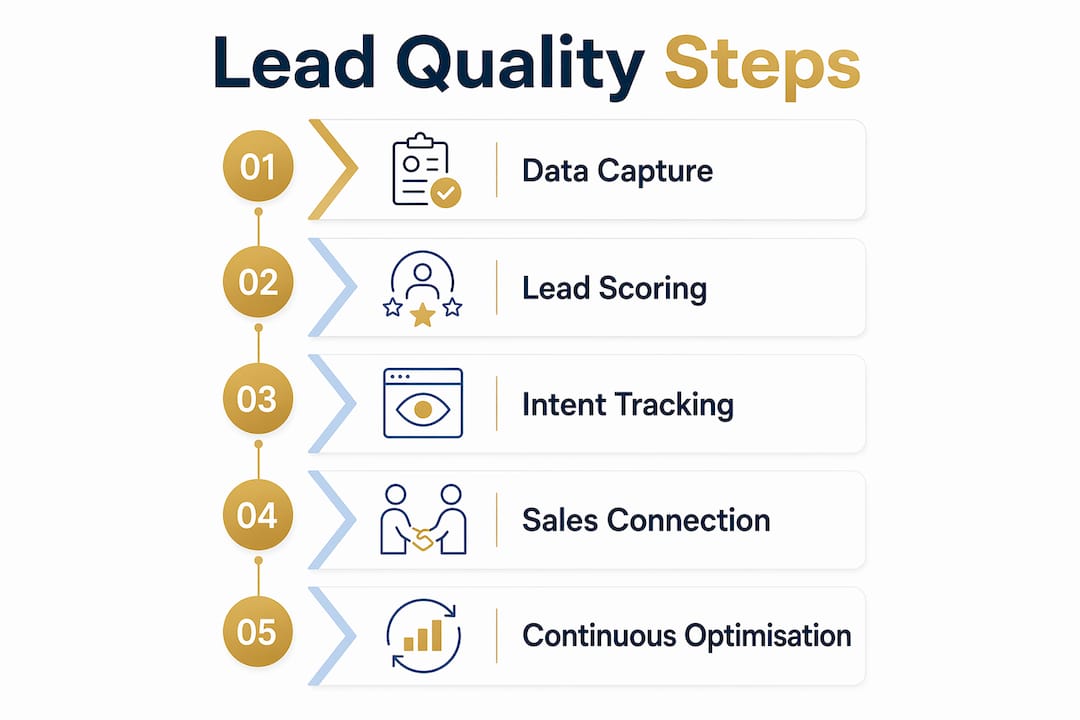
A well-structured CRM, whether that is Salesforce, HubSpot, or Zoho, centralises every lead interaction and creates a bi-directional sync between marketing and sales. Marketing sees which leads convert. Sales sees which campaigns produced them. That feedback loop is the foundation of any serious customer acquisition strategy.
Lead scoring frameworks typically combine three signals:
- Behavioural score: Pages visited, emails opened, videos watched, and time on site.
- Profile score: Job title, location, business type, and budget indicators.
- Intent score: Search behaviour, ad engagement, and recency of activity.
Google’s Lead Intent Scores take this further by using Google signals to categorise leads as high, medium, or low intent, allowing sales teams to prioritise their queue without manual vetting. This reshapes how sales workflows operate. High-intent leads get called within the hour. Low-intent leads enter an automated nurture sequence. The result is faster engagement with the prospects most likely to close, and far less wasted effort on tyre-kickers.
For service businesses in particular, connecting your lead management strategy to a scoring framework is the single fastest way to improve the quality of leads reaching your sales team.
What are the benchmark conversion rates for B2C funnels?
Typical B2C funnel conversion rates sit between 5% and 15% overall, with the visitor-to-lead transition averaging 2% to 5% depending on the acquisition channel. That gap between channels matters enormously for budget allocation.
| Channel | Visitor-to-lead rate | Lead-to-sale rate |
|---|---|---|
| Organic SEO | 3–5% | 8–15% |
| Paid social (Meta, TikTok) | 2–4% | 5–10% |
| Google Ads (search) | 2–4% | 6–12% |
| Email marketing | 5–8% | 10–18% |
| Referral or word of mouth | 6–10% | 15–25% |
SEO leads convert at nearly double the rate of paid search leads according to Kirro’s 2026 benchmarks. This means organic investment compounds over time in a way that paid channels cannot replicate on their own.
The most impactful optimisation levers for improving funnel performance are:
- Speed of follow-up. Responding within one hour can increase lead conversion by more than 50%. Most businesses follow up within 24 hours and lose the sale to whoever called first.
- Landing page design. Single-focus pages with clear headlines, social proof, and one call to action consistently outperform multi-offer pages.
- Removing checkout friction. Every additional form field, page load, or payment step reduces conversion. Audit your funnel for unnecessary steps quarterly.
- Social proof placement. Google reviews, before-and-after photos, and client testimonials placed near the CTA directly lift conversion rates.
Pro Tip: Connect your Google Ads account to offline conversion data so the algorithm optimises for actual sales, not just form fills. Google Ads measures the full purchase journey when you feed it the right signals, and that changes which campaigns it scales.
For a deeper look at optimising your sales funnel for more online leads, the Jarrodharman resource library covers the mechanics in detail.
How to implement social media-led B2C lead generation effectively?
Social media lead generation is the practice of capturing consumer contact details and intent signals directly within or immediately after a social platform interaction. In 2026, it is the dominant top-of-funnel channel for most B2C businesses because the audience is already there, already scrolling, and already open to discovery.
Social media lead gen workflows follow a clear sequence: define your ideal customer profile, build a focused offer, select your capture method, route leads into your CRM, and retarget non-converters. A/B testing at the offer and creative level, tracked by cost per lead and click-through rate, is what separates profitable campaigns from expensive experiments.
Platform selection matters as much as the offer itself:
| Platform | Strength | Best lead capture method |
|---|---|---|
| Meta (Facebook) | Community building, retargeting | Native lead forms, Messenger flows |
| Discovery, visual storytelling | DM automation, link-in-bio funnels | |
| TikTok | Fast reach, curiosity-driven traffic | Lightweight CTAs, short video hooks |
| X (Twitter) | Thought leadership, niche audiences | Link posts, conversational threads |
Meta excels at community and retargeting, Instagram at discovery and direct message flows, and TikTok generates fast curiosity but requires lightweight calls to action because the audience is in entertainment mode, not buying mode. Matching your offer format to the platform’s native behaviour is what makes the difference between a campaign that scales and one that burns budget.
Prompt follow-up is non-negotiable. A lead captured on a native Meta form at 7pm on a Tuesday needs a response within the hour, not the next business morning. Automated CRM workflows triggered by form submission handle this without requiring your team to be online around the clock.
For businesses wanting to compare platforms and services, the Jarrodharman social media growth service comparison breaks down the options for Australian markets specifically.
Which AI and automation tools can enhance B2C lead generation?
AI has moved from a novelty to a core operational layer in B2C lead generation. The practical applications in 2026 are specific and measurable, not theoretical.
- AI in SEO: Tools like Surfer SEO, Clearscope, and Google’s Search Generative Experience (SGE) shape how content ranks and how brands appear in AI-generated answers. Writing content that earns citations in large language models like ChatGPT, Perplexity, and Claude is now a legitimate SEO strategy, often called Generative Engine Optimisation (GEO). Brands that appear in AI answers gain visibility without a single paid click.
- AI-driven intent scoring: Lead intent scoring reshapes sales workflow queues by surfacing the hottest prospects automatically, reducing the time sales teams spend manually reviewing lead lists.
- AI chatbots: 24/7 lead qualification via AI chatbots means no lead goes unattended outside business hours. Platforms like Intercom and ManyChat integrate directly with CRM systems to log conversations and trigger follow-up sequences.
- Marketing automation: Tools like Klaviyo for ecommerce and ActiveCampaign for service businesses deliver personalised email sequences based on behaviour, not just list membership. A lead who viewed your pricing page gets a different email than one who only read a blog post.
- Retargeting automation: Google Performance Max and Meta Advantage+ campaigns use machine learning to find and re-engage high-probability converters without manual audience building.
Pro Tip: Feed offline sales data back into your ad platforms monthly. Enhancing B2C lead gen success comes more from refining lead quality measurement and connecting it to bidding tools than from simply adding new channels.
Key takeaways
Effective B2C lead generation requires a connected system of SEO, paid advertising, social media, CRM data, and AI-driven scoring working together, not as isolated campaigns.
| Point | Details |
|---|---|
| Treat lead gen as a cycle | Plan, execute, score, and optimise continuously rather than running one-off campaigns. |
| Prioritise lead quality over volume | Use CRM scoring and Google Lead Intent Scores to focus sales effort on high-intent prospects. |
| Match channel to funnel stage | SEO and social for top-of-funnel awareness, email and retargeting for mid-to-bottom conversion. |
| Speed of follow-up is a conversion lever | Responding within one hour can lift conversion rates by more than 50% according to Kirro benchmarks. |
| AI and GEO are now standard practice | Optimising for AI citations in ChatGPT and Perplexity builds brand visibility that paid ads cannot replicate. |
What I have learned building B2C lead systems for Australian businesses
Most business owners I speak with are not short on tactics. They have tried Meta Ads, dabbled in SEO, and sent a few email campaigns. What they are missing is the connective tissue between those efforts. A lead captured on Instagram that never enters a CRM, never gets scored, and never triggers a follow-up sequence is not a lead. It is a missed opportunity with a timestamp.
The businesses that scale their lead generation consistently are the ones that treat it as an interconnected system rather than a collection of campaigns. They know their cost per lead by channel, their lead-to-sale rate by source, and their average follow-up time to the minute. That level of visibility is not complicated to build. It just requires the discipline to set it up properly from the start.
The other thing I see consistently is businesses ignoring GEO, which is Generative Engine Optimisation. If your brand is not appearing in AI-generated answers on ChatGPT, Perplexity, or Google’s AI Overviews, you are invisible to a growing segment of your market. This is not a future problem. It is a current one, and the businesses building structured, entity-rich content now are the ones that will dominate AI citations over the next three years.
My honest advice: stop adding channels until the ones you have are properly connected, scored, and followed up on. Then add AI and automation to scale what is already working.
, Business Warriors | Jarrodharman
Ready to build a lead generation system that actually converts?
If you are a business owner or marketing manager in Australia looking to move beyond scattered tactics and build a system that consistently delivers quality leads, Jarrodharman and the Business Warriors team can help.
From SEO consulting and digital marketing strategy to full-service lead generation campaign management, the Business Warriors Marketing Vortex method integrates every channel into one measurable, optimised system. Whether you are running a salon, a med spa, an ecommerce store, or a multi-location service business, the approach is the same: attract the right people, capture them at the right moment, score them accurately, and follow up fast. That is what turns digital marketing spend into booked appointments and closed sales.
FAQ
What is B2C lead generation?
B2C lead generation is the process of attracting individual consumers and capturing their contact details or intent signals to move them toward a purchase. It differs from B2B lead generation in that decisions are faster, more emotional, and driven by personal benefit rather than organisational need.
Which B2C lead generation channel has the highest conversion rate?
Email marketing and referral traffic consistently produce the highest lead-to-sale conversion rates, often reaching 10% to 25%. Organic SEO leads also convert at nearly double the rate of paid search leads according to Kirro’s 2026 funnel benchmarks.
How quickly should you follow up with a B2C lead?
Follow up within one hour of capture. Research cited by Kirro indicates that responding within this window can increase lead conversion by more than 50%, making speed of response one of the highest-leverage optimisation tactics available.
What role does AI play in B2C lead generation in 2026?
AI powers intent scoring, chatbot qualification, personalised email sequences, and Generative Engine Optimisation (GEO). Brands that appear in AI-generated answers on platforms like ChatGPT and Perplexity gain organic visibility that paid advertising cannot replicate.
How do I improve the quality of leads from my paid ads?
Connect your Google Ads and Meta Ads accounts to offline conversion data so the platforms optimise for actual sales rather than form fills. Google’s own guidance stresses multi-touch attribution and data integration as the primary levers for improving qualified lead volume from paid campaigns.