


TL;DR:
- Most Australian service businesses rely on outdated marketing methods, missing significant online leads.
- Implementing structured digital strategies with content, SEO, and automation can significantly boost lead generation and conversions.
- Focusing on clarity, consistent messaging, and data-driven adjustments is more effective than simply increasing activity or channels.
If you’re running a service business in Australia and feel like your marketing is ticking along just fine, this guide might challenge that assumption. The reality is that most service business owners are leaving a significant amount of revenue on the table by relying on word of mouth, a basic website, or sporadic social media posts. Competition in 2026 is fierce, and the businesses pulling ahead are using structured, digital-first marketing systems that generate leads predictably, not accidentally. This guide walks you through the frameworks, tools, and practical strategies that are actually working for Australian service businesses right now.
Table of Contents
- Why modern marketing is essential for service businesses
- Core elements of a winning marketing strategy
- Frameworks and tools for generating consistent leads
- Measuring marketing success and refining your approach
- A fresh perspective on innovating your marketing
- Take the next step: drive growth in your service business
- Frequently asked questions
Key Takeaways
| Point | Details |
|---|---|
| Prioritise digital channels | Service businesses now win more clients and sales by focusing on online marketing strategies. |
| Build a structured plan | A clear, step-by-step marketing framework is essential for generating predictable leads. |
| Leverage automation and tools | Utilising the right platforms and automating processes can free up valuable owner time. |
| Review and refine regularly | Measuring outcomes and making adjustments each month keeps your marketing on track for growth. |
Why modern marketing is essential for service businesses
Not long ago, a solid reputation and a few local ads were enough to keep a service business busy. That world no longer exists. Clients search online before they call. They compare reviews, scroll through social media profiles, and check websites before making a single decision. If your business is not showing up where those searches happen, you are essentially invisible to a large portion of your potential market.
The shift from offline to online has not been gradual. It has been dramatic. Most new leads now come through online channels, and that trend is only accelerating. Service businesses that still depend on print directories, letterbox drops, or outdated referral networks are finding it increasingly difficult to maintain a consistent pipeline of new clients.
Consider the contrast between traditional and digital marketing outcomes for service businesses:
| Factor | Traditional marketing | Digital marketing |
|---|---|---|
| Reach | Local, limited audience | National and targeted audiences |
| Cost | High upfront, fixed costs | Flexible, scalable budgets |
| Tracking | Difficult to measure ROI | Real-time data and reporting |
| Lead quality | Broad, often unqualified | Highly targeted, intent-driven |
| Speed to results | Weeks to months | Days to weeks |
| Adaptability | Slow to change | Adjust campaigns instantly |
Studies confirm that the majority of new client enquiries for Australian service businesses now originate from digital sources, with online search and social media leading the way.
Beyond visibility, understanding the types of marketing strategies available gives you the power to choose the right mix for your audience and budget. Sticking with outdated methods not only costs you leads. It costs you credibility. Modern clients expect digital-savvy businesses, and if your online presence looks neglected, it sends exactly the wrong message. The communication skills in marketing you bring online determine whether a potential client stays or bounces. Following a solid content marketing checklist ensures your digital presence works consistently rather than in bursts.
Core elements of a winning marketing strategy
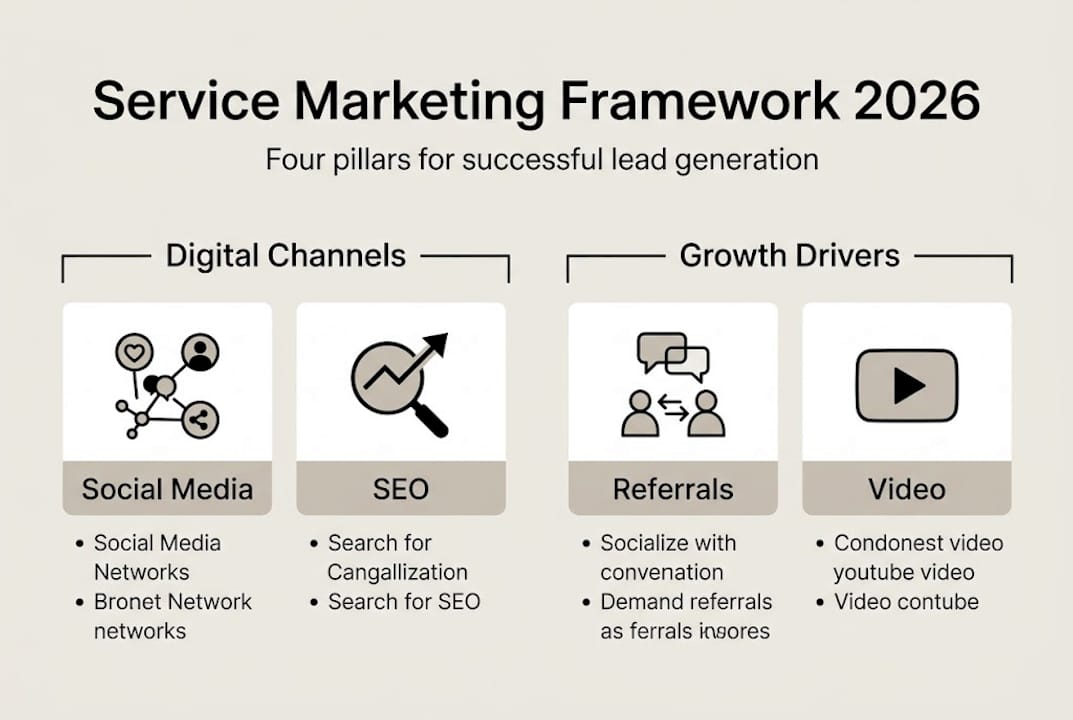
Once you accept that digital marketing is non-negotiable, the next question is where to focus. Not every channel will suit every business. But there are five core pillars that consistently drive results for Australian service businesses.
- Content marketing: Publishing useful, relevant content builds trust and attracts clients who are already looking for what you offer. Blog posts, videos, and guides answer the questions your ideal clients are typing into Google every day. Explore practical content marketing tips to get started.
- Social media: Platforms like Instagram, Facebook, and TikTok let you build an audience and nurture relationships over time. Consistency matters far more than perfection here.
- SEO (search engine optimisation): Getting found on Google when potential clients search for your services is one of the highest-value activities you can invest in. It compounds over time.
- Paid advertising: Google Ads and Meta Ads let you reach targeted audiences quickly. They are especially powerful when combined with strong landing pages and follow-up sequences.
- Referral strategies: A structured referral programme turns your existing clients into active advocates. It is one of the most cost-effective ways to generate warm, high-converting leads.
A structured digital strategy consistently boosts both lead generation and conversion rates when these pillars work together. The mistake most owners make is trying to do all five at once without a system behind any of them. Start with two or three pillars and build from there.

Pro Tip: Research shows that over 44% of service businesses never follow up with a lead after the first contact. A simple automated follow-up sequence can dramatically increase your conversion rate without generating a single extra lead.
One often-overlooked element is video. Clients want to see the person behind the business. Short, authentic videos build trust faster than any written content. If you have been avoiding the camera, consider how using video marketing can accelerate the relationship-building process with potential clients.
Frameworks and tools for generating consistent leads
Knowing what to do is one thing. Having a system that actually delivers leads while you are busy serving existing clients is another. This is where frameworks and tools become your biggest asset.
Here is a practical overview of the digital tools that support each stage of lead generation:
| Stage | Tool type | Examples |
|---|---|---|
| Awareness | Social media scheduling | Meta Business Suite, Later |
| Discovery | SEO and content | Google Search Console, Surfer SEO |
| Capture | Landing pages and forms | ClickFunnels, Leadpages |
| Nurture | Email marketing | ActiveCampaign, Mailchimp |
| Booking | Appointment software | Acuity Scheduling, Calendly |
| Retention | CRM systems | HubSpot, Zoho CRM |
Setting up an automated lead funnel does not have to be complicated. Follow these steps to get a basic system running:
- Define your ideal client and what problem you solve for them.
- Create a lead magnet such as a free guide, checklist, or consultation offer.
- Build a simple landing page that captures name and email in exchange for the lead magnet.
- Set up an email sequence that delivers value over five to seven days and invites prospects to book a call or appointment.
- Add a follow-up trigger so anyone who does not book within a set timeframe receives a gentle reminder.
- Track which source drives the most conversions and invest more there.
Automated lead generation frameworks free up your time while simultaneously improving lead quality, which means you spend less energy chasing unqualified prospects. For a deeper look at building this kind of system, the content marketing guide for Australian service businesses is a strong starting point.
Pro Tip: Do not underestimate referral systems. A formalised programme with a small incentive, like a discount or gift, can drive predictable growth without increasing your ad spend. For inspiration, referral marketing tips show how other businesses have made this work at scale. If you are just getting started, the free lead generation guide covers the fundamentals without requiring a large budget.
Measuring marketing success and refining your approach
Running marketing campaigns without tracking results is like driving without a dashboard. You might be moving, but you have no idea if you are heading in the right direction or burning through fuel unnecessarily.
The key metrics every service business should track include:
- Leads generated per month: How many new enquiries are coming in across all channels?
- Conversion rate: What percentage of those leads become paying clients?
- Cost per lead: How much are you spending to acquire each new enquiry?
- Client retention rate: Are your existing clients staying, or are you constantly replacing them?
- Revenue per client: Is your average transaction value growing over time?
- Channel performance: Which platforms and campaigns are delivering the best return?
Continuous optimisation of your marketing channels increases both lead volume and quality when you make decisions based on data rather than gut feeling. Review your results monthly. Set aside one hour to look at what is working and what is not, then make one or two adjustments. Small, consistent changes compound into significant improvements over six to twelve months.
Pro Tip: Your best source of insight is your existing clients. Ask them how they found you, what made them choose you, and what they wish you offered. Their language will show you exactly how to refine your messaging to attract more people just like them.
For a structured approach to this process, the digital marketing step-by-step guide outlines how to audit your campaigns and identify gaps. Understanding content marketing stages also helps you align your content with where your clients are in their decision-making journey, so you are not pushing sales messages to people who are still in the research phase.
A fresh perspective on innovating your marketing
Here is something most marketing guides will not tell you: doing more is rarely the answer. Service business owners often respond to slow lead flow by adding more channels, increasing their posting frequency, or throwing money at ads. In our experience working with businesses across Australia, the real problem is almost never a lack of activity.
It is a lack of clarity.
The businesses that truly stand out are not necessarily the ones with the biggest budgets or the most platforms. They are the ones who know exactly who they serve, what makes them different, and how to communicate that consistently. When you understand why content marketing matters beyond just generating clicks, you start creating content that actually builds trust rather than just filling a content calendar.
Focus beats volume. A service business that shows up consistently on two channels with a clear, compelling message will outperform one that posts randomly across six. Pick your strengths, sharpen your message, and build depth before you build breadth. That is what separates truly innovative service businesses from those who are simply doing more marketing.
Take the next step: drive growth in your service business
The strategies covered in this guide form a proven path from inconsistent leads to a reliable, growing pipeline. But reading about them is only the beginning.
At Business Warriors, we specialise in helping Australian service businesses implement these exact systems through our 360° Marketing Vortex method, an omnichannel approach that combines SEO, paid ads, email, and social media into one integrated engine. If you are ready to move from guesswork to a system that delivers consistent lead generation month after month, we would love to show you how. Reach out to the Business Warriors team and let’s build something that actually works for your business.
Frequently asked questions
What is the most effective online marketing channel for Australian service businesses?
Content marketing and social media consistently rank as the leading channels for generating quality leads among Australian service providers. The most effective approach combines both into a single, coordinated strategy.
How much should I spend on marketing for a small service company?
Allocating 5 to 10% of gross revenue on marketing is widely considered industry best practice for small service businesses. Adjust this figure up or down based on your growth targets and how competitive your local market is.
How do I know if my marketing is working?
Track leads, conversions, and retention monthly to get a clear picture of whether your marketing is generating real business results. If any of those three metrics are declining, that is your signal to audit and adjust.
Are marketing agencies or DIY strategies better for service businesses?
Strategic frameworks and result monitoring matter more than whether you manage marketing in-house or with an agency. Owners who understand what is being done and why tend to get better outcomes regardless of who does the work.
Recommended
- 7 Game-Changing 2025 Marketing Trends for Aussie Businesses – Jarrod Harman
- Content marketing guide for Australian service businesses 2026 – Jarrod Harman
- Role of digital presence: grow your service business in 2026 – Jarrod Harman
- 7 B2B Marketing Ideas for Australian Service Businesses – Jarrod Harman