


TL;DR:
- Local SEO offers the highest return for service businesses, converting customers at three times the rate.
- Modern marketing uses omnichannel strategies, first-party data, and AI to create seamless customer experiences.
- Legal compliance with email, privacy, and advertising regulations builds trust and sustains growth.
Local SEO converts at 3x the organic rate for service businesses, yet most owners still pour their entire budget into paid ads and wonder why results plateau. Internet marketing is no longer just a support function. It is the engine driving client acquisition, brand trust, and revenue growth for service providers across Australia. This guide walks you through how the digital landscape has shifted, which channels deliver the strongest returns, how modern frameworks like omnichannel and AI are reshaping strategy, and what legal obligations you must meet to market online without risk.
Table of Contents
- How the internet reshaped marketing for Australian service businesses
- Core internet marketing channels: SEO, Google Ads, social media, and email
- Omnichannel strategies, data, and AI: Modern frameworks for client acquisition
- Regulations and compliance: Ensuring digital marketing is effective and legal
- Editorial perspective: Why community and authenticity will drive the next wave of internet marketing results
- Unlock proven strategies to boost your online client acquisition
- Frequently asked questions
Key Takeaways
| Point | Details |
|---|---|
| Local SEO leads conversions | Local search optimisation delivers the highest client conversion rates for Australian service businesses. |
| Channel stacking drives growth | Combining SEO, paid ads, social media, and email increases reach and delivers layered results. |
| Compliance is critical | Following Spam Act, Privacy Act, and ACCC guidelines protects your business and ensures effective online marketing. |
| Community and authenticity matter | Building online communities and maintaining genuine brand voice fuels client loyalty and outperforms pure paid tactics. |
How the internet reshaped marketing for Australian service businesses
Not long ago, a service business in Perth or Brisbane relied on word of mouth, Yellow Pages listings, and local newspaper ads to attract clients. Those channels still exist, but their influence has collapsed. Today, a potential client searches Google before they call anyone. They check reviews, scroll Instagram, and compare websites in minutes. If your business is not visible in that window, you simply do not exist to them.
The shift from mass-reach advertising to precision targeting has been the most significant change for service providers. The internet enables service-based businesses to target clients using SEO, Google Ads, social media, and email with a level of granularity that traditional media never could. You can now reach a 40-year-old woman in Sydney’s inner west who searched for a med spa treatment in the last 48 hours. That specificity was impossible a decade ago.
Here is what this digital transformation means in practical terms for service businesses:
- Local SEO places your clinic, salon, or consultancy in front of buyers who are actively searching in your area
- Google Ads captures high-intent traffic instantly, before organic rankings build
- Social media builds brand awareness and nurtures trust between a prospect’s first and second touchpoint
- Email marketing keeps warm leads engaged and converts past clients into repeat bookings
- Content marketing establishes authority and feeds every other channel with material prospects find valuable
“The businesses winning online right now are not the ones with the biggest budgets. They are the ones who understood that targeted relevance beats broad reach every single time.”
For B2B marketing ideas that align with this shift, the principle is the same: stop trying to reach everyone and start reaching the right person at the right moment. Service businesses that act on this see faster sales cycles and higher-quality leads. If you want a practical breakdown of improving your discoverability, these online visibility tips are a strong starting point.
Core internet marketing channels: SEO, Google Ads, social media, and email
Not all digital channels are equal for service businesses. Each has a distinct role, a different cost structure, and a different time horizon for results. Understanding how they compare helps you allocate budget intelligently rather than guessing.
| Channel | Avg. time to results | Cost model | Best for |
|---|---|---|---|
| Local SEO | 3 to 6 months | Monthly retainer | Long-term lead flow |
| Google Ads | Immediate | Cost per click | High-intent, fast conversion |
| Meta/Social Ads | 2 to 4 weeks | Cost per impression | Awareness and retargeting |
| Email marketing | 1 to 2 weeks | Flat fee or platform cost | Nurture and retention |
Australian SMEs allocate 7 to 18% of revenue to digital marketing, with Google Search delivering an average return on ad spend (ROAS) of 4 to 6 times. That is a significant return, but it depends heavily on campaign structure and targeting quality.
For service businesses specifically, here is the recommended channel priority order based on results:
- Local SEO for sustainable, compounding visibility in your service area
- Google Ads to capture demand that already exists while SEO builds
- Email marketing to convert and retain clients at low cost
- Social media advertising to build brand awareness and fill the top of the funnel
- Content marketing to fuel SEO and position your business as the obvious expert choice
Pro Tip: Do not treat these channels as separate campaigns. Stack them deliberately. A prospect might discover you through SEO lead generation, get retargeted via Meta Ads, receive a nurture email, and then book. That sequence is not accidental. It is engineered. Explore social media strategies and content marketing tips to build those layers properly.
Omnichannel strategies, data, and AI: Modern frameworks for client acquisition
Channel stacking is one thing. A true omnichannel strategy is something more considered. It means your client’s experience is seamless whether they find you on Google, see your Instagram Reel, open your email, or land on your website. Every touchpoint reinforces the same message, brand feel, and call to action.

Key methodologies now include omnichannel strategies, first-party data focus, and AI-driven personalisation. Each of these is reshaping how service businesses approach client acquisition in 2026.
First-party data refers to information you collect directly from your audience, such as email addresses, booking history, and website behaviour. With third-party cookies being phased out across browsers, businesses that rely on external data platforms are losing ground. If you are not actively building your own database through lead magnets, booking systems, and loyalty programmes, you are renting an audience that can disappear overnight.
Here is how these modern frameworks break down in practice:
- Omnichannel integration: Consistent messaging across Google, Meta, email, and your website creates a unified client journey
- First-party data collection: Use quizzes, consultations, and booking forms to gather consented data you own
- AI personalisation: Tools like dynamic email sequences and smart ad targeting adapt content to individual behaviour
- Automation with oversight: Chatbots and email automations handle volume, but human review keeps quality high
| Framework | Core benefit | Risk if ignored |
|---|---|---|
| Omnichannel | Seamless client experience | Fragmented brand perception |
| First-party data | Owned, durable audience | Loss of targeting capability |
| AI personalisation | Scalable, relevant content | Generic messaging that converts poorly |
Pro Tip: Automation is a tool, not a replacement for genuine connection. Use AI in marketing to handle repetitive tasks like follow-up sequences and audience segmentation, then let your actual voice and expertise shine in the content itself.
Regulations and compliance: Ensuring digital marketing is effective and legal
Marketing online in Australia is not a free-for-all. There are real legal obligations that service businesses must meet, and the cost of ignoring them is rising. Three key frameworks govern your digital marketing activity.
The Spam Act 2003 requires that all commercial emails and SMS messages obtain explicit consent before sending. You must identify yourself clearly, and every message must include a working unsubscribe option. Purchased lists are almost always non-compliant under this framework.
The Privacy Act 1988 controls how you collect, store, and use personal information. If you are capturing names, emails, phone numbers, or health-related data (particularly relevant for clinics and med spas), you need a clear privacy policy and secure data handling practices.
The ACCC (Australian Competition and Consumer Commission) enforces truth in advertising. Claims about results, pricing, and testimonials must be accurate and substantiated. ACCC priorities for 2026 to 2027 include cracking down on manipulative practices in digital markets, which means dark patterns like fake urgency countdowns and hidden fees are firmly in the regulator’s crosshairs.
Here is a practical compliance checklist for service businesses:
- Obtain explicit, documented consent before adding anyone to an email or SMS list
- Publish a clear privacy policy and link it from every data capture form
- Ensure all promotional claims are accurate and can be substantiated
- Avoid using countdown timers or scarcity language that is fabricated
- Review your ad copy for misleading comparisons or exaggerated outcome claims
- Train anyone who handles customer data on your internal privacy procedures
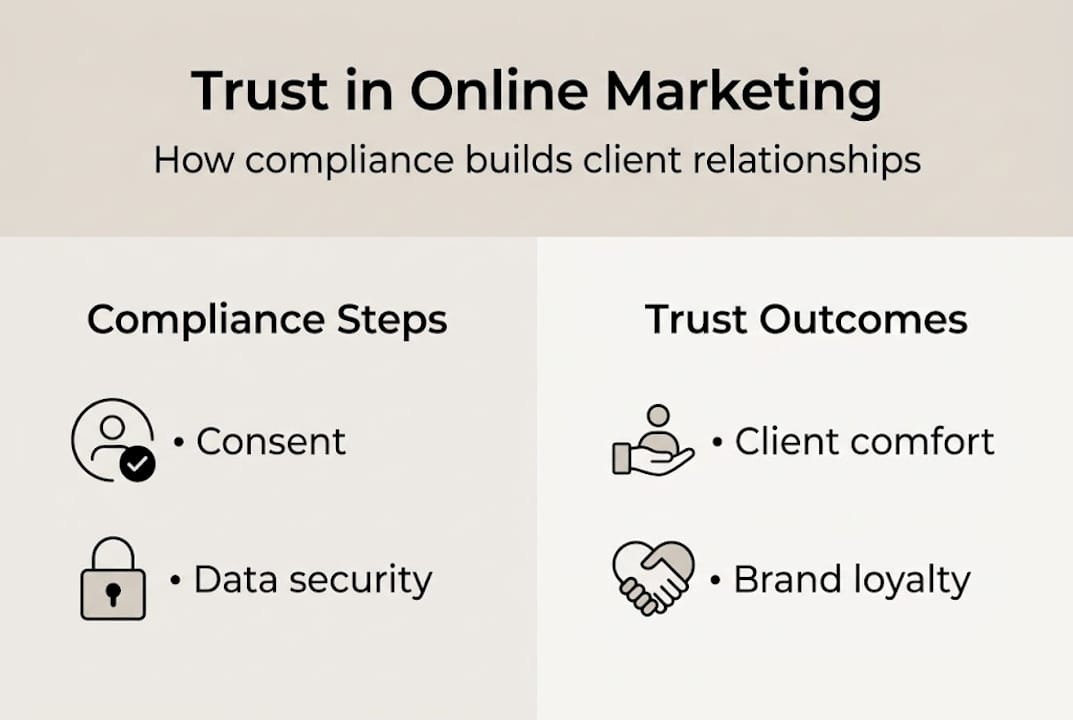
Compliance is not just about avoiding fines. It is about building the kind of trust that makes clients comfortable sharing their information with you in the first place. Pair this with business scaling strategies that are built on solid, legal foundations and you have a sustainable growth model.
Editorial perspective: Why community and authenticity will drive the next wave of internet marketing results
Paid acquisition has delivered strong results for service businesses over the past decade. But we are entering a period where pure performance marketing is running into a ceiling. Audiences are more sceptical. Ad fatigue is real. And with AI-generated content flooding every feed, the businesses that will win client trust are the ones who feel unmistakably human.
Research confirms that a brand plus performance hybrid outperforms pure performance marketing, and that AI aids reach but authenticity remains essential. We have seen this directly with service business clients. The ones generating the most durable growth are those building online communities, showing real faces, sharing real outcomes, and engaging rather than broadcasting.
For service providers, your personality and expertise are a competitive moat that no competitor can copy. Pairing that with strategic paid and organic activity creates compounding returns that neither approach achieves alone. Explore how a strong content strategist insight can help you bridge the gap between brand building and measurable performance. The next wave of internet marketing results will not go to the loudest spender. It will go to the most trusted voice.
Unlock proven strategies to boost your online client acquisition
If this guide has clarified how internet marketing can work for your service business, the next step is putting a structured system behind it. At Business Warriors, we have built the Marketing Vortex method specifically for service-based businesses ready to grow beyond guesswork.
Whether you are looking for practical client acquisition tips or want to see exactly how the marketing vortex method works in practice, the resources are ready for you. If you want to move faster, explore our proven sales strategies designed for service businesses with serious growth ambitions. Let’s build something that actually delivers.
Frequently asked questions
What is the most effective internet marketing channel for Australian service businesses?
Local SEO consistently delivers the strongest results for region-based service businesses because it targets buyers with active intent. Local SEO converts at three times the rate of standard organic traffic, making it the highest-priority channel for most service providers.
How much should you invest in digital marketing as a service business?
Australian SMEs typically invest 7 to 18% of revenue in digital marketing, with search advertising averaging a 5.2x ROAS. Start with performance channels and scale once your systems are producing consistent, measurable results.
What are the main legal requirements for marketing online in Australia?
You must comply with the Spam Act, obtain explicit consent for email and SMS, follow the Privacy Act for data handling, and ensure all marketing claims are accurate and not misleading under ACCC guidelines.
What role does AI play in service business marketing?
AI improves targeting, personalisation, and content efficiency at scale. However, as the post-AI content flood grows, human authenticity is what separates brands that build real client relationships from those that simply generate noise.
Recommended
- 7 B2B Marketing Ideas for Australian Service Businesses – Jarrod Harman
- Content marketing guide for Australian service businesses 2026 – Jarrod Harman
- 7 Game-Changing 2025 Marketing Trends for Aussie Businesses – Jarrod Harman
- Role of Online Marketing for Australian Businesses – Jarrod Harman
- Boost ROI With Smart Digital Marketing Strategies