


TL;DR:
- Building a scalable online business requires clear systems, a strong website, and quality content.
- Automation tools like AI chatbots and automated follow-ups significantly boost lead conversion and efficiency.
- Regularly tracking key metrics and refining strategies ensures sustained growth and effective scaling.
Running a service-based business in Australia takes real grit. You deliver excellent work, your clients love you, yet your lead flow looks more like a rollercoaster than a steady climb. One month you’re fully booked, the next you’re wondering where everyone went. This unpredictability is not a reflection of your talent. It’s a sign that your online growth strategy needs a solid, repeatable system behind it. This guide walks you through the exact mindsets, tools, foundations, automation systems, and tracking habits that female business owners across Australia are using right now to scale confidently and generate consistent leads online.
Table of Contents
- Get ready for growth: mindsets, assets, and tools
- Build your scalable online foundation
- Scale with automation and smart marketing systems
- Track, adapt, and refine for consistent growth
- Why most small business owners overcomplicate online scaling
- Next steps: expert strategies for your scaling journey
- Frequently asked questions
Key Takeaways
| Point | Details |
|---|---|
| Automate for growth | AI chatbots free your time and deliver more leads by automating routine tasks. |
| Lay solid foundations | A conversion-focused website and clear content set the stage for online scaling. |
| Systemise and track | Marketing systems and regular tracking are essential for consistent, predictable growth. |
| Progress over perfection | Focus on executing core steps well rather than chasing every digital trend. |
Get ready for growth: mindsets, assets, and tools
Scaling your business online is not simply about spending more on ads or posting more content. Before you invest another dollar or hour into marketing, you need to honestly assess where you stand. The businesses that grow fastest are not the ones with the biggest budgets. They’re the ones with the clearest picture of their current position and the discipline to build on it.
Start with your mindset. Growth at scale requires you to think like a systems builder, not just a service provider. That means shifting from doing everything yourself to designing processes that run without you. It means being willing to test, fail fast, and adjust without taking it personally. Many business owners stall here because they’re attached to the way things have always been done. If that sounds familiar, know that this is the most common and most fixable growth barrier.
Next, audit what you already have. Pull up your website, check your social media profiles, open your CRM (customer relationship management software) and look at your email list. Ask yourself these questions honestly:
- Is my website mobile-friendly and loading in under three seconds?
- Are my social media profiles consistently branded and recently updated?
- Do I have a CRM that tracks every enquiry, follow-up, and sale?
- Is my email list segmented, or is it just one big pile of contacts?
- Am I capturing leads from every channel, or am I letting potential clients slip away?
This audit tells you exactly where energy and money are leaking from your business before you scale. Fixing leaks first means every dollar you invest in growth goes further.
Now look at your tools. Here’s a quick overview of the must-have platforms for any service-based business ready to grow:
| Tool category | What it does | Example platforms |
|---|---|---|
| CRM | Tracks leads, clients, and follow-ups | HubSpot, ActiveCampaign, Keap |
| Marketing automation | Sends emails and follow-ups automatically | Klaviyo, Mailchimp, ActiveCampaign |
| Analytics | Shows what’s working and what isn’t | Google Analytics 4, Meta Insights |
| AI chatbot | Handles enquiries and bookings 24/7 | ManyChat, Tidio, Intercom |
| Social scheduling | Plans and posts content consistently | Buffer, Later, Hootsuite |
You don’t need all of these at once. Pick one from each category, learn it properly, and build from there. For inspiration on where to begin, explore digital marketing ideas that are already working for service businesses like yours.
Pro Tip: AI chatbots can automate 80% of enquiries, handling repetitive questions around the clock and freeing you to focus on high-value conversations. Set one up before you start running ads, and you’ll convert far more of the traffic you’re already getting.
Once your tools are selected and your audit is complete, you’re ready to build. The goal now is to create a digital foundation solid enough to support serious growth. If you’re thinking about scaling digital marketing across multiple channels, having these fundamentals in place makes every future decision cleaner and faster.
Build your scalable online foundation
With your assets and tools in place, it’s time to ensure your digital foundation is truly built for growth. Think of this as the shopfront, the reception area, and the booking system of your online presence. If any of these elements let you down, the best ad campaign in the world won’t save you.
Your website is your most important digital asset. Before you spend a cent on driving traffic, make sure it can actually convert visitors into enquiries. A conversion-ready website is not just pretty. It is purposeful. Here’s what that looks like in practice:

Strong website vs weak website at a glance:
| Feature | Conversion-ready site | Common mistake |
|---|---|---|
| Mobile experience | Fast, clean, tap-friendly | Clunky layout, tiny text |
| Page load speed | Under 3 seconds | Slow images, heavy plugins |
| Call to action (CTA) | Clear, visible, repeated | Buried or missing entirely |
| Social proof | Testimonials, case studies, reviews | No proof at all |
| Contact options | Multiple (form, phone, chat) | Single option only |
Content is the next building block. Good content does three things: it educates your audience, it builds trust, and it moves people closer to booking with you. The most effective content for service businesses is not promotional. It answers the real questions your clients are already searching for online. A beauty clinic might write about what to expect at a first appointment. A law firm might explain common misconceptions about family mediation. This kind of content works while you sleep.
Here are the steps to build your content foundation properly:
- Write down the ten most common questions your clients ask before booking.
- Create one piece of content (blog post, video, or FAQ page) answering each question.
- Publish all ten pieces over six to eight weeks, consistently.
- Add a clear CTA at the end of each piece, directing readers to book, enquire, or download something valuable.
- Repurpose each piece across your social media channels and email list.
Social proof deserves its own focus. Reviews, testimonials, and case studies do more selling than any advertisement. Clients want to see that someone just like them had a great experience. If you’re not actively collecting and showcasing testimonials, you’re leaving trust on the table. Ask every happy client for a Google review. Screenshot and share positive messages. Feature a detailed case study on your website at least once per quarter.
Before running any paid traffic, these foundations need to be tight. The good news is that increasing online sales becomes dramatically more achievable once your website and content are doing their job. And once you understand the principles of optimising sales funnels, you’ll see how each piece connects to form a system that works continuously in the background.
Pro Tip: Update and refresh your website copy before investing in paid advertising. Many businesses send paid traffic to a site that isn’t ready to convert. Fix the foundation first and your ad spend will go significantly further.
Scale with automation and smart marketing systems
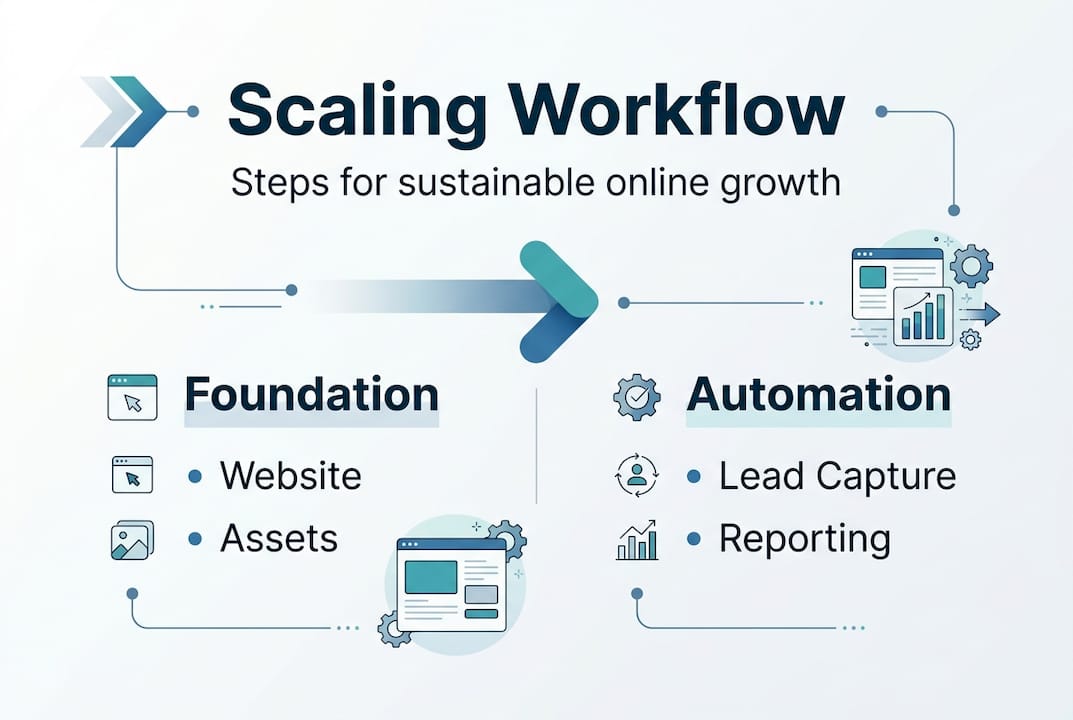
Once your online foundation is ready, the next step is scaling with automation and marketing systems. This is where the real leverage lives. Done correctly, automation lets you market to hundreds or thousands of potential clients simultaneously, without adding hours to your working week.
The key is knowing which tasks to automate. Not everything should be handed to a machine. Automation works best for repetitive, time-sensitive, or volume-heavy tasks that follow a predictable pattern. Here’s where to start:
- Lead enquiry responses: Automatically send a personalised reply within minutes of someone submitting a form. Speed matters enormously here. Prospects who receive a fast response are far more likely to convert.
- Follow-up sequences: Set up a series of emails that nurtures leads over seven to fourteen days, sharing useful content and gently encouraging them to book.
- Appointment reminders: Automated SMS or email reminders reduce no-shows significantly, saving you time and lost revenue.
- After-hours chat: An AI chatbot on your website handles questions and bookings when you’re unavailable, so you never miss a lead because it arrived at 10pm on a Sunday.
- Review requests: Automatically send a review request link to every client after their appointment or project is completed.
Did you know? AI chatbots can handle 80% of routine enquiries, including after-hours booking requests, without any human involvement. That’s not a future possibility. It’s happening in Australian service businesses right now.
The after-hours angle is particularly powerful for service-based businesses. Think about how many potential clients search for your type of service in the evening, after work, when you’re not available to pick up the phone. Without an automated response system, those enquiries often go cold before morning. With a chatbot or automated email responder, they receive an immediate, helpful reply and are guided towards booking.
If you want to see how other service businesses are using this in practice, the marketing automation examples page breaks it down with real scenarios. Understanding the benefits of marketing automation for your specific industry is a great first step before choosing your platform.
Pro Tip: Start by automating the single most repetitive task in your client communication process. For most service businesses, that’s the initial enquiry reply. Get that one sequence running smoothly, then build from there.
Track, adapt, and refine for consistent growth
Implementing systems is powerful, but verification and adjustment are what sustain momentum. Many business owners set up their marketing, press go, and then check back three months later wondering why growth has plateaued. The businesses that scale consistently are the ones watching their numbers weekly and making small, deliberate adjustments.
There are three core numbers every service business owner should know at all times:
- Leads generated: How many new enquiries or contacts entered your pipeline this week or month?
- Conversion rate: Of those leads, how many became paying clients? If you’re tracking this, you’ll quickly spot where the process is breaking down.
- Customer lifetime value (CLV): How much is an average client worth to you over the full duration of your relationship? This number changes how you think about your ad spend entirely.
Once you know these three figures, you can make informed decisions rather than emotional ones. You’ll stop guessing and start improving.
“Without data, you’re just another person with an opinion.” Decisions backed by real numbers lead to real, repeatable growth.
Here are the numbered steps to make data-driven improvements each month:
- Pull your lead numbers from your CRM and compare them to the previous month.
- Calculate your conversion rate by dividing booked clients by total enquiries.
- Identify the one stage in your funnel where the most leads are dropping off.
- Make one specific change to address that drop-off point.
- Give that change four weeks before evaluating the result.
- Document what worked, roll it out permanently, and move to the next improvement.
This process sounds simple because it is. Complexity is not your friend here. The businesses that track fewer metrics but act on them consistently outperform those that track everything and act on nothing. For a guided approach to building these habits, the measuring marketing growth resource covers a practical, step-by-step progression.
Building a simple monthly reporting habit, even if it’s just a 30-minute review in your calendar on the first Monday of every month, will compound into significant clarity over time. You’ll know your business better, make smarter spending decisions, and spot opportunities faster than competitors who are still operating on gut feel.
Why most small business owners overcomplicate online scaling
Here’s what we see repeatedly at Business Warriors. Business owners who struggle to scale are often not doing too little. They’re doing too much. They’re trying every new platform, following every trend, and jumping between strategies before any single one has had time to produce results. The chaos feels like action, but it produces very little forward movement.
The truth is that online scaling comes down to three things done consistently: a clear lead generation system, an automated follow-up process, and a simple way to measure whether it’s working. That’s it. When you strip away the noise, every successful growth strategy we’ve built for clients comes back to these three fundamentals.
Trend-hopping is the enemy of compounding results. One piece of content published consistently every week for a year will outperform ten viral posts created in a panic. One well-tuned ad campaign running for six months will outperform five campaigns switched out monthly chasing the latest format. For digital marketing insights grounded in what actually works for Australian service businesses, the pattern is always the same: focus, consistency, and data.
Progress through discipline, not perfection. Start before you feel ready. Improve as you go.
Next steps: expert strategies for your scaling journey
If you’ve worked through this guide and you’re ready to move from strategy to implementation, the path forward is clearer than you might think. Business Warriors has helped service-based businesses across Australia turn exactly these principles into real, measurable growth.
The Marketing Vortex method brings together SEO, paid advertising, email marketing, automation, and social media into one integrated system designed to generate consistent leads without the guesswork. If you want to understand how the Marketing Vortex generates leads for businesses just like yours, that’s the place to start. And for those serious about going deeper, the scaling online marketing guide gives you a detailed roadmap to follow at your own pace or with expert support alongside you.
Frequently asked questions
What is the most effective first step to scaling my small business online?
The most effective first step is setting up automated enquiry handling, which can handle 80% of repetitive enquiries and free your time for higher-value work like client delivery and strategy.
How can AI chatbots help service-based businesses grow?
AI chatbots automate up to 80% of customer enquiries and can capture after-hours bookings that would otherwise go unanswered, directly increasing your revenue without adding to your workload.
What online assets do I need before scaling?
You’ll need a professional, mobile-ready website with clear calls to action, an optimised sales funnel that captures and nurtures leads, and at least one automated enquiry response tool in place.
How do I know if my scaling efforts are working?
Track your leads generated, sales conversion rate, and customer lifetime value monthly. A consistent upward trend in these three numbers confirms your strategy is gaining traction.
Can marketing automation replace human interaction in my business?
Automation handles routine, repetitive tasks extremely well, but your personal touch remains essential for complex enquiries, high-value proposals, and relationship-building moments that turn clients into loyal advocates.