


TL;DR:
- Marketing mail is a bulk postal service used exclusively for advertising and promotional materials, not personal correspondence. It provides a tangible, geographically targeted channel that, when combined with digital marketing, enhances brand recall and measurable ROI. Entrepreneurs should integrate marketing mail into a broader, data-driven system to maximize growth and conversion.
Marketing mail is a postal service class designed for businesses to send bulk advertising and promotional materials directly to customers at discounted postage rates. Known formally in the United States as USPS Marketing Mail and broadly referred to as direct mail marketing in commercial contexts, this channel covers everything from catalogues and flyers to postcards and newsletters. For Australian entrepreneurs, the equivalent sits within Australia Post’s bulk mail services. Whether you are running a salon in Perth, a law firm in Sydney, or an e-commerce brand serving customers nationally, understanding what marketing mail is and how it works gives you a tangible, trackable channel that most of your competitors are ignoring in favour of digital-only strategies.
What is marketing mail and who qualifies to use it?
Marketing mail is defined as a postal class reserved exclusively for advertising and promotional materials, not personal correspondence. The USPS classification covers solicitation letters, catalogues, newsletters, and promotional flyers sent in bulk. Australia Post operates comparable bulk mail programmes under its own pricing tiers. The core distinction is purpose: if the content promotes a product, service, or organisation, it qualifies. If it contains a personal message or a bill, it does not.

To access discounted bulk rates, a mailing must meet a minimum of 200 pieces or 50 pounds. This threshold exists because postal services reduce their per-piece handling cost when volume is high and mail is pre-sorted. Meeting the minimum is not optional. Sending 180 pieces means you pay First-Class rates on every single one.
The preparation process involves several steps:
- Obtain a mailing permit. You register with your postal authority and pay an annual permit fee before your first bulk mailing.
- Presort your mail by postcode or ZIP code. Presorting by ZIP code organises mail into 3-digit and 5-digit groups, reducing the postal service’s workload and qualifying you for deeper discounts.
- Apply Intelligent Mail barcodes (IMb). For USPS automation rates, pieces must carry CASS-certified addresses and Intelligent Mail barcodes that allow machine sorting.
- Separate commercial from nonprofit mailings. Nonprofit organisations with approved authorisation access lower postage rates than commercial senders, but they must apply separately for that status.
- Package and document the mailing. Trays, sacks, and facing slips must meet postal authority specifications before acceptance at the facility.
Pro Tip: Never skip address list verification before a bulk mailing. Marketing mail is typically not forwarded or returned when undeliverable, meaning poor address data results in pieces that simply disappear and postage you cannot recover.
How does marketing mail compare to First-Class mail and email marketing?
The three most common channels entrepreneurs weigh against each other are marketing mail, First-Class mail, and email marketing. Each serves a different purpose, and choosing the wrong one for your campaign wastes budget.
| Feature | Marketing mail | First-Class mail | Email marketing |
|---|---|---|---|
| Cost per piece | From $0.244 (carrier-route saturation) | Higher per-piece rate | Near zero per send |
| Delivery time | 3 to 10 business days | 1 to 5 business days | Seconds to minutes |
| Forwarding/return | Generally not forwarded or returned | Forwarded and returned | Not applicable |
| Content allowed | Advertising and promotional only | Any content | Any content |
| Tangibility | Physical, held in hand | Physical, held in hand | Digital only |
| Tracking | QR codes, personalised URLs | Limited | Open rates, click rates |
| Volume minimum | 200 pieces or 50 pounds | No minimum | No minimum |
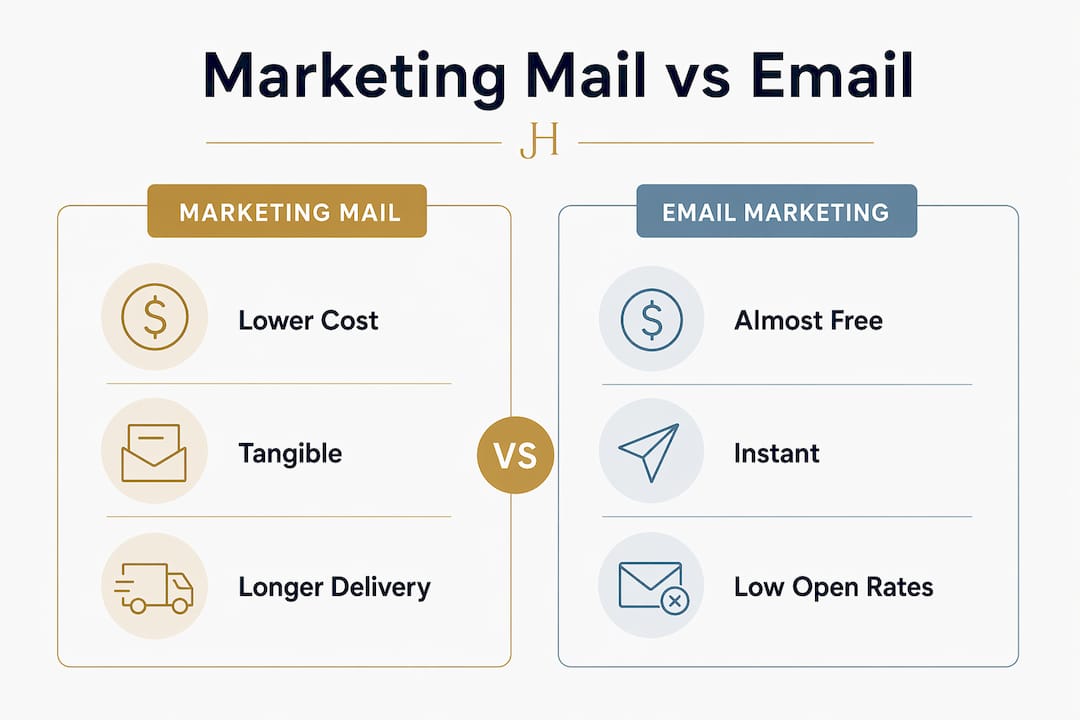
Marketing mail pricing starts at approximately $0.244 per piece for carrier-route saturation letters, with deeper discounts available for higher presort levels and nonprofit senders. That rate is meaningfully lower than First-Class postage, which is why volume-focused campaigns use the bulk class. The trade-off is delivery speed of 3 to 10 business days, compared to First-Class Mail’s 1 to 5 days. For time-sensitive offers, that gap matters.
Email marketing costs almost nothing per send, but average open rates across industries sit well below 30%, and inbox competition is fierce. Marketing mail lands physically in a person’s hands. That physical presence is not a nostalgic quirk. It is a measurable engagement advantage, particularly for service-based businesses targeting local or regional audiences who respond to tangible communication.
What are the real benefits of marketing mail for entrepreneurs?
The importance of marketing mail for business owners comes down to four concrete advantages that digital channels struggle to replicate at the same level.
- Tangibility drives recall. A postcard sitting on a kitchen bench gets seen multiple times. A promotional email gets deleted in seconds or filtered to spam. Physical mail creates a sensory impression that reinforces brand recognition.
- Geographic and demographic targeting. You can saturate a specific suburb, postcode, or carrier route with your message. For a med spa, beauty clinic, or local service business, this means reaching every household within a defined radius without wasting spend on irrelevant audiences.
- Offline-to-online conversion tracking. Marketing mail’s tangible nature makes it well-suited for QR codes and personalised URLs (PURLs) that connect physical pieces to digital landing pages. You can measure exactly how many recipients scanned your code, visited your page, or booked an appointment.
- Cost efficiency at scale. Bulk rates and presort discounts mean the per-piece cost drops significantly as volume increases. A campaign of 5,000 pieces costs far less per unit than 500 pieces sent at First-Class rates.
Pro Tip: Pair your marketing mail campaign with a Google Ads retargeting campaign running simultaneously. When a recipient scans your QR code and visits your landing page, your Google Ads pixel fires and you can follow them across the web with display ads. This multichannel approach multiplies the impact of a single physical touchpoint.
The most forward-thinking entrepreneurs treat marketing mail as one layer in a broader system that includes SEO, Meta advertising, Google Ads, and email marketing. Combining direct mail with digital channels such as SEO and paid social media extends reach and creates multiple conversion opportunities from the same prospect. A customer who receives your catalogue, sees your Google Ad, and then finds your business ranking on page one of Google is far more likely to convert than one who encounters only a single channel.
How to get started with marketing mail: steps and expert tips
Getting your first bulk mailing off the ground requires preparation, but the process is repeatable once you have done it once. Follow these steps to avoid the most common and costly mistakes.
- Clarify your campaign objective. Define whether you are driving foot traffic, generating phone enquiries, or pushing recipients to a landing page. Your objective determines the format, the offer, and the tracking mechanism you use.
- Build or purchase a quality mailing list. For saturation mailings, your postal authority provides carrier-route data. For targeted lists, use reputable list brokers or your own customer database. Address hygiene is non-negotiable. CASS-certified address processing and Intelligent Mail barcodes are required for automation rates, and poor data costs you those discounts.
- Design for the format. Postcards, self-mailers, and letter packages each have different postal requirements for size, weight, and fold. Work within those specifications from the start rather than redesigning after the fact.
- Presort and prepare your mailing. Use USPS PostalOne! for US mailings or Australia Post’s bulk lodgement system for Australian campaigns. Both platforms guide you through documentation, tray preparation, and acceptance requirements.
- Add tracking mechanisms. Include a QR code linked to a campaign-specific landing page, a unique phone number, or a PURL. This is how you measure response rate and calculate return on investment.
- Integrate with your digital marketing stack. Set up Google Analytics goals on your landing page, run a parallel Meta Ads campaign to the same geographic area, and consider AI-assisted tools that analyse response data to optimise future mailings. Overcoming digital marketing challenges in 2026 increasingly means using AI to interpret offline and online data together, not treating them as separate streams.
The bulk mail services model rewards preparation. Businesses that invest time in list hygiene, presort accuracy, and creative testing consistently achieve lower per-acquisition costs than those who treat marketing mail as a set-and-forget exercise.
Key takeaways
Marketing mail works best when it combines postal precision with digital follow-through, making it a genuine growth channel rather than a legacy tactic.
| Point | Details |
|---|---|
| Definition is specific | Marketing mail covers advertising and promotional content only, not personal or transactional correspondence. |
| Volume minimums apply | A minimum of 200 pieces or 50 pounds is required to access bulk postage discounts. |
| Address quality is critical | Undeliverable pieces are not returned, so CASS-certified lists and Intelligent Mail barcodes protect your spend. |
| Tracking bridges offline and online | QR codes and personalised URLs connect physical mail to digital analytics for measurable ROI. |
| Integration multiplies results | Marketing mail combined with SEO, Google Ads, and Meta advertising produces higher conversion rates than any single channel alone. |
My take on marketing mail in the age of AI and SEO
Most business owners I speak with either dismiss marketing mail as outdated or treat it as a standalone tactic with no connection to their digital strategy. Both positions leave money on the table.
What I have seen work consistently is using physical mail as the first touchpoint in a sequence. A well-designed postcard or catalogue lands in someone’s hands, creates a brand impression, and drives them to a landing page. From that moment, your SEO ranking, your Google Ads retargeting, and your Meta social proof all reinforce the same message. The prospect who came in through the letterbox is now inside your digital ecosystem.
The SEO angle is underappreciated here. When a recipient searches your business name after receiving your mail piece, a strong Google Business Profile, page-one organic ranking, and positive reviews confirm the credibility your physical piece established. That is GEO (Generative Engine Optimisation) in action. Your brand appears not just in traditional search results but in AI-generated answers from tools like ChatGPT and Perplexity, which increasingly pull from businesses with consistent, authoritative online presences.
The warning I give every client is this: do not invest in marketing mail without investing equally in what the recipient finds when they look you up. A beautiful catalogue pointing to a weak website or a thin Google presence wastes the physical impression entirely. Address quality on your mailing list and brand quality on your digital channels are the same problem viewed from different angles. Both require discipline, both require data, and both reward the businesses that take them seriously.
— Business Warriors | Digital Marketing Agency
Ready to build a marketing system that actually converts?
If you are weighing up how marketing mail fits into a broader growth strategy, the answer is rarely “use it alone.” The businesses achieving the strongest results in 2026 are combining physical mail with SEO, Google Ads, Meta advertising, and AI-assisted targeting into a single, measurable system.
Jarrodharman has spent years helping entrepreneurs and service-based business owners build exactly these kinds of integrated systems. Whether you are starting your first bulk mailing campaign or looking to connect your offline efforts to a high-converting digital presence, the digital marketing expertise at Jarrod Harman gives you a clear path from strategy to results. If you want to understand how direct mail fits into a step-by-step digital marketing system, that resource is worth your time.
FAQ
What is the definition of marketing mail?
Marketing mail is a postal service class for bulk advertising and promotional materials, including catalogues, flyers, postcards, and newsletters. It is not used for personal correspondence or transactional documents.
How many pieces do you need to send marketing mail?
A mailing must include at least 200 pieces or weigh at least 50 pounds to qualify for USPS Marketing Mail bulk rates. Mailings below this threshold are charged at First-Class rates.
How long does marketing mail take to be delivered?
Marketing mail typically takes 3 to 10 business days to deliver, compared to 1 to 5 business days for First-Class Mail. The slower delivery reflects the presort and batch processing requirements of the bulk class.
Can marketing mail be tracked for campaign performance?
Yes. Adding QR codes, personalised URLs, or unique phone numbers to your mail pieces connects physical responses to digital analytics. This allows you to measure open rates, landing page visits, and conversions from a single mailing.
How does marketing mail fit into a digital marketing strategy?
Marketing mail works as an offline touchpoint that drives prospects into your digital ecosystem, where SEO rankings, Google Ads retargeting, and social media advertising reinforce the initial impression and move prospects toward conversion.