


TL;DR:
- Digital content marketing involves creating valuable, audience-focused content to build trust and generate long-term organic growth. It offers durable assets that outperform paid advertising by providing sustained traffic and authority over time. Combining content marketing with paid strategies amplifies growth and maximizes return on investment for service-based businesses.
Digital content marketing is defined as the strategic creation and distribution of valuable, relevant content to attract and retain a clearly defined audience, with the goal of driving profitable customer action rather than immediate sales. Unlike paid advertising, which stops the moment your budget runs out, content marketing builds durable digital assets that compound in value over time. Tools like HubSpot, Semrush, and Google Search Console are central to measuring and scaling this approach. For business owners and marketing managers in Australia, understanding what digital content marketing actually is, and how it differs from broader online marketing, is the foundation of any serious growth strategy.
What is digital content marketing and how does it work?
Digital content marketing is a specialised discipline within the broader field of online marketing. It operates on a simple but powerful principle: solve problems to build trust, and trust converts to sales over time. Rather than interrupting potential customers with ads, content marketing pulls them in by answering the questions they are already searching for.

The mechanics are straightforward. A business publishes a blog post, video, podcast episode, or social media series that addresses a specific pain point. Search engines like Google index that content. Potential customers find it organically, engage with the brand, and move through a buying journey without a single dollar spent on paid placement. This is what separates content marketing from pay-per-click advertising or Meta Ads, where visibility is entirely budget-dependent.
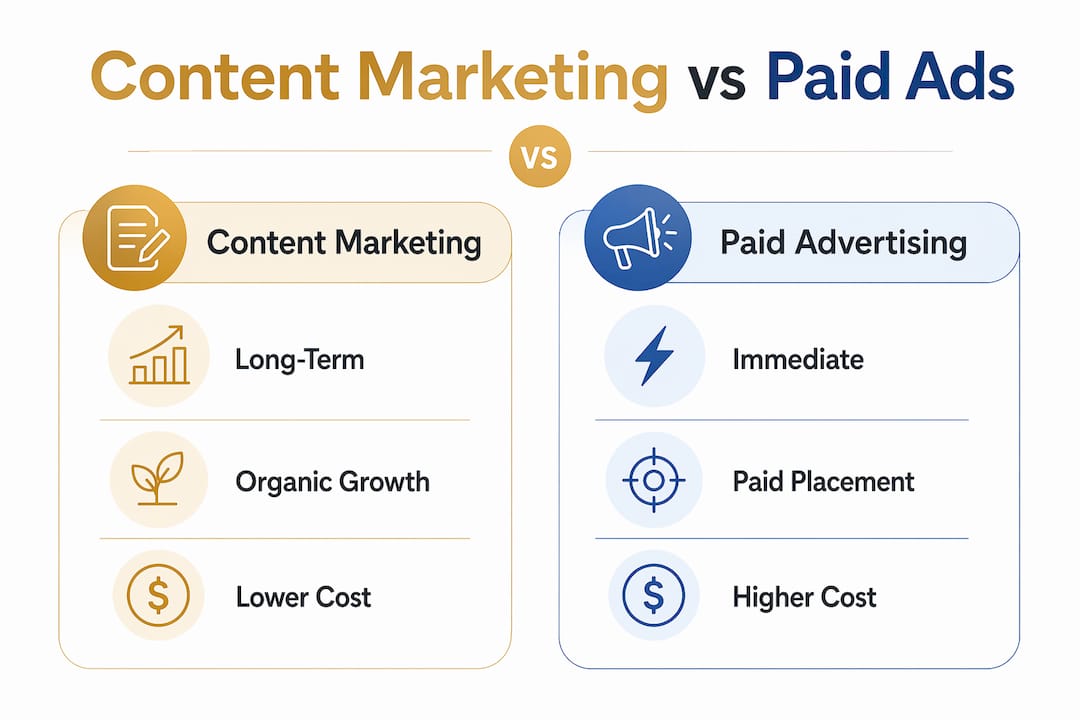
Content marketing is a type of digital marketing, but it sits in its own category because of its intent and timeline. Where Google Ads deliver traffic on day one, a well-optimised content hub can deliver traffic for five years. That distinction matters enormously when you are planning a digital content strategy with a finite budget and a long-term growth target.
Pro Tip: Start your content marketing by mapping the top five questions your customers ask before they buy. Each question is a content brief.
How does content marketing differ from other digital marketing channels?
Understanding digital marketing basics means recognising that digital marketing is an umbrella term. It covers SEO, pay-per-click advertising, email marketing, social media outreach, affiliate marketing, and content marketing. Each channel serves a different function and operates on a different timeline.
| Channel | Primary function | Timeline | Cost structure |
|---|---|---|---|
| Google Ads | Immediate paid visibility | Days | Ongoing spend required |
| Meta Ads | Paid audience targeting | Days | Ongoing spend required |
| SEO | Organic search ranking | Months | Time and content investment |
| Content marketing | Trust and authority building | Months to years | Content creation costs |
| Email marketing | Nurture and retention | Weeks | Low ongoing cost |
Paid tactics provide immediate visibility, but content marketing builds durable, compounding assets. A Google Ad disappears the moment you pause the campaign. A well-researched article on your website keeps attracting visitors, generating leads, and building brand authority long after it was published. This is the compounding effect that makes content marketing one of the highest-ROI activities available to service-based businesses.
The strategic implication is clear: content marketing and paid advertising are not competitors. They work best together. Paid ads can amplify your best-performing content to new audiences, while organic content reduces your cost-per-acquisition over time. The businesses that treat these channels as an integrated system consistently outperform those that rely on one or the other.
Pro Tip: Allocate at least 30% of your digital marketing budget to content creation and SEO. The compounding returns outperform paid-only strategies within 12 to 18 months for most service businesses.
What types of digital content drive the most engagement?
Diversifying content formats increases reach and retention across every stage of the buyer journey. Audiences consume information differently. Some prefer reading long-form articles. Others watch short-form video on Instagram Reels or YouTube Shorts. Others subscribe to podcasts during their commute. A single-format strategy leaves significant audience segments untouched.
The most effective types of digital content for Australian service businesses include:
- Blog articles and long-form guides: These are the backbone of SEO strategy. A 2,000-word article targeting a specific keyword builds topical authority and attracts organic search traffic consistently.
- Short-form video: Platforms like TikTok, Instagram Reels, and YouTube Shorts reward consistent posting with organic reach that paid placements cannot replicate at the same cost.
- Podcasts: Tim Ferriss built a media empire through his podcast, The Tim Ferriss Show, demonstrating that audio content creates deep audience loyalty and positions the host as an authority.
- eBooks and downloadable guides: These serve as lead magnets, exchanging valuable content for an email address and moving prospects into a nurture sequence.
- Email newsletters: Once you own the list, you own the channel. Email marketing through platforms like Mailchimp or Klaviyo delivers content directly to subscribers without algorithm interference.
- Social media content series: Consistent, themed social media posts build brand recognition and keep your business visible between purchase cycles.
The key is not to produce content in every format simultaneously. Start with two or three formats that align with where your audience spends time, then expand as your content operation matures. A content strategy for digital channels should map each format to a specific stage of the customer journey, from awareness through to conversion and retention.
How do SEO, AI, and data shape modern content marketing?
SEO and content marketing are inseparable in 2026. Every piece of content you publish is either optimised for search or it is not. The difference between those two outcomes is the difference between content that generates leads for years and content that nobody finds. Topical authority and deep content clusters improve search engine ranking far more effectively than high volumes of generic, surface-level content.
Topical authority means owning a subject area completely in the eyes of Google. Instead of publishing one article about “digital marketing,” a business builds a cluster of 15 to 20 interconnected articles covering every sub-topic within that subject. Google recognises the depth and rewards the site with higher rankings across the entire cluster. This is the architecture behind the most successful content marketing programmes in 2026.
Artificial intelligence has changed how content is created, optimised, and discovered. Tools like ChatGPT, Claude, and Google Gemini assist with research, drafting, and ideation. But the more significant shift is in how AI systems surface content to users. AI-powered search tools like Perplexity and Google’s AI Overviews now answer user queries directly, pulling from authoritative sources. Getting your brand mentioned in these AI responses, a practice known as GEO (Generative Engine Optimisation), is the next frontier of SEO strategy. Businesses that build genuine topical authority and earn citations from credible sources are the ones appearing in AI-generated answers.
Performance metrics guide content investment for better engagement. Google Analytics 4, Search Console, and tools like Ahrefs or Semrush reveal which content drives traffic, which pages convert, and where audiences drop off. Data-driven content marketing means publishing less but publishing better. It means doubling down on what works and cutting what does not. Avoid adopting AI tools blindly. Use them to accelerate production, but let audience data and search intent drive every content decision.
Engaging content directly impacts SEO through metrics like bounce rate and time on page. Content that holds attention signals quality to search engines, which reinforces rankings and organic reach in a self-reinforcing cycle.
Is content marketing cost-effective for growing businesses?
Content marketing costs significantly less than traditional advertising channels like television commercials or print billboards, making it accessible for service-based businesses without enterprise-level budgets. A single well-researched article can generate organic traffic for years. A TV commercial runs for the duration of the media buy and then disappears.
The long-term ROI of content marketing comes from asset ownership. Content keeps delivering traffic and engagement long after publication, improving return on investment over time. Paid ads require continuous spending to maintain visibility. Owned content does not. This distinction is critical for businesses that want to reduce their dependence on paid channels and build a more resilient marketing system.
Content marketing also compounds across channels. Well-researched content serves as the foundation for cross-channel promotion. A single pillar article can be repurposed into a YouTube video, a podcast episode, a social media series, an email newsletter, and a paid ad creative. This multiplier effect means the cost per piece of content is spread across multiple channels and audience touchpoints, dramatically improving overall marketing efficiency.
For businesses running Google Ads or Meta Ads alongside their content strategy, the combination produces compounded results. Paid ads drive immediate traffic to high-quality content, which builds trust and converts at a higher rate than a cold ad landing page. The all digital marketing channels approach, where content, SEO, and paid advertising operate as a unified system, consistently outperforms any single-channel strategy.
Key takeaways
Digital content marketing builds compounding brand authority and organic traffic through valuable, audience-focused content, making it the highest long-term ROI channel available to service-based businesses.
| Point | Details |
|---|---|
| Core definition | Content marketing attracts customers by solving problems, not by interrupting them with ads. |
| SEO is non-negotiable | Topical authority and content clusters drive organic rankings far better than high-volume generic publishing. |
| AI and GEO matter now | Getting brand mentions in AI tools like Perplexity and Google AI Overviews is the next SEO frontier. |
| Owned assets outperform paid | Content keeps generating traffic and leads long after publication, unlike ads that stop when budgets stop. |
| Integration multiplies results | Combining content marketing with Google Ads and Meta Ads produces compounding returns across channels. |
Why most businesses are doing content marketing backwards
After working with service businesses across Australia, the pattern is consistent. Most businesses treat content marketing as a volume exercise. They publish frequently, cover broad topics, and wonder why organic traffic never materialises. The problem is not the quantity. It is the architecture.
The businesses that win with content marketing build depth before breadth. They pick three to five core topics that matter to their ideal client, then publish exhaustively on each one. They answer every sub-question, address every objection, and cover every angle. Google rewards that depth with rankings. Audiences reward it with trust. That trust is what converts a reader into a client.
The second mistake I see constantly is treating content marketing and paid advertising as either-or decisions. They are not. Content marketing without paid amplification grows slowly. Paid advertising without strong content converts poorly. The combination, where your best content is amplified through Google Ads and Meta Ads to cold audiences, is where the real growth happens. This is the core of the Marketing Vortex approach that Business Warriors uses with clients across Perth and nationally.
The third issue is ignoring AI entirely. In 2026, your content needs to be structured for both human readers and AI systems. That means clear definitions, named entities, authoritative claims, and citations. If your content is not being surfaced in AI-generated answers on Perplexity or Google’s AI Overviews, you are invisible to a growing segment of search behaviour. Building for digital content marketing management in 2026 means understanding that SEO, GEO, and content strategy are now one discipline.
— Business Warriors | Digital Marketing Agency
Ready to build a content marketing system that actually grows your business?
Understanding what digital content marketing is gives you the foundation. Implementing it effectively, across SEO, Google Ads, Meta Ads, social media, and email, is where most businesses need a strategic partner.
At Jarrodharman, we help business owners and marketing managers build integrated digital marketing systems that generate consistent leads and sales. From content strategy and SEO through to paid advertising and social media management, the Marketing Vortex method is designed to compound your results over time. If you are ready to stop guessing and start growing, explore digital marketing ideas tailored to your business and discover what a structured content and digital marketing strategy can do for your bottom line.
FAQ
What is digital content marketing in simple terms?
Digital content marketing is the practice of creating and publishing valuable content online, such as articles, videos, and social media posts, to attract and convert customers without relying solely on paid advertising. It builds trust and brand authority over time.
How is content marketing different from digital marketing?
Digital marketing is an umbrella term covering all online marketing activities including paid ads, email, and SEO, while content marketing is a specific strategy within that umbrella focused on organic growth through valuable content.
What types of content work best for Australian service businesses?
Blog articles, short-form video on Instagram Reels and YouTube Shorts, email newsletters, and downloadable guides are the most effective formats for service businesses. The right mix depends on where your audience spends time online.
How does SEO relate to content marketing?
SEO and content marketing work together directly. Well-optimised content targeting specific search queries builds topical authority, which improves organic rankings and drives sustained traffic without ongoing ad spend.
How long does content marketing take to show results?
Content marketing typically produces measurable organic traffic growth within three to six months, with compounding returns building significantly over 12 to 18 months. Combining it with paid advertising accelerates early results while the organic assets mature.