


TL;DR:
- Influencer marketing builds trust by partnering with trusted individuals who have established audiences. It significantly influences consumer purchases, especially through micro-influencers with focused and loyal followers. Integrating influencer content across multiple channels enhances brand visibility and campaign effectiveness.
Influencer marketing is the practice of partnering with trusted individuals who have established audiences to promote your brand, products, or services authentically. The global market reached over $32 billion in 2025, with US spending forecast to grow 15.7% in 2026. That scale reflects one core truth: audiences trust people more than they trust brands. When a creator on Instagram, TikTok, or YouTube recommends your product, it carries the weight of a personal referral. For marketing professionals and business owners, understanding what influencer marketing delivers, and how to use it well, is now a non-negotiable part of any serious digital marketing strategy.
How does influencer marketing impact consumer behaviour and brand performance?
58% of consumers aged 18 and over have made a purchase based on an influencer endorsement as of early 2026. That figure alone separates influencer marketing from most other paid channels. The purchase decision happens because the recommendation feels personal, not promotional.

The engagement data reinforces this. Audiences watch influencer ads for an average of 17.8 seconds before skipping, compared to just 7.9 seconds for traditional branded content. That extra attention is not accidental. Creators build context, tell stories, and connect products to real moments in their lives. Traditional ads rarely achieve that.
Micro-influencers deliver the strongest campaign results according to 47% of marketers, and 64% of marketers have already worked with them. The reason is straightforward: smaller audiences tend to be more focused, more loyal, and more likely to act on a recommendation. A beauty clinic in Perth will often see better results from a local creator with 15,000 followers than from a celebrity with 2 million.
Key performance advantages of social media influencer marketing include:
- Higher purchase intent: Consumers who follow a creator already trust their taste and judgement.
- Longer content engagement: Influencer content holds attention far longer than standard display or video ads.
- Community amplification: Comments, shares, and saves extend reach beyond the original audience.
- Niche targeting: Creators attract specific demographics that broad media buys cannot replicate.
What are the different influencer tiers and how do costs vary in 2026?
Influencer tiers are defined by follower count, and each tier carries a different cost structure and engagement profile. Understanding these tiers is the foundation of smart campaign budgeting.
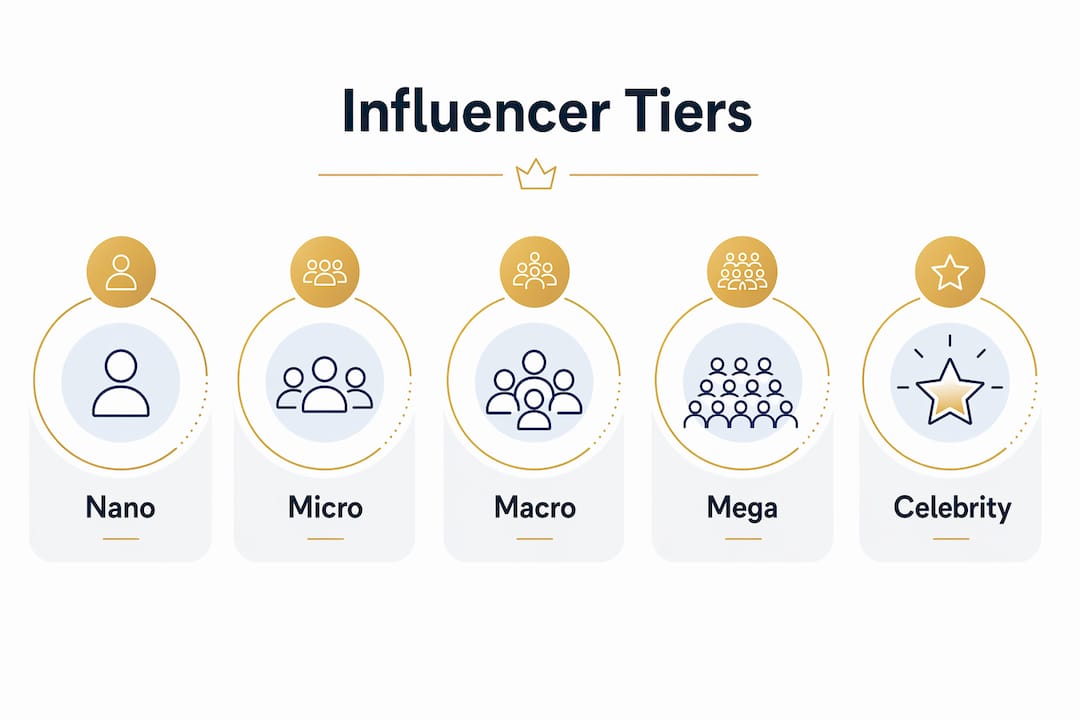
| Tier | Follower range | Typical cost per post | Best suited for |
|---|---|---|---|
| Nano | 1,000–10,000 | Product gifting plus shipping | Local awareness, trial campaigns |
| Micro | 10,000–100,000 | $100–$1,000 | Niche engagement, service businesses |
| Macro | 100,000–1,000,000 | $1,000–$5,000+ | Brand reach, product launches |
| Mega/Celebrity | 1,000,000+ | $5,000 to $100,000+ | Mass awareness, national campaigns |
Nano-influencers can run campaigns for the cost of product samples plus shipping. That makes them the most accessible entry point for small and medium businesses. Micro-influencer posts range from $100 to $1,000 on Instagram, while macro-influencers exceed $5,000 before usage rights are factored in.
Compensation models vary beyond flat fees. Brands use gifting, flat fees, performance-based commissions, and hybrid arrangements. Affiliate commission models work particularly well for direct-to-consumer brands because payment is tied directly to sales. Influencer marketing returns an average of $5.78 for every $1 spent, with nano and micro campaigns frequently exceeding this figure.
Pro Tip: Negotiate content usage rights upfront. Securing the right to repurpose influencer content across your paid ads, website, and email campaigns dramatically reduces your cost per impression over time and extends the life of every piece of content you commission.
Why is authenticity the deciding factor in influencer marketing?
Authenticity is not a soft concept in influencer marketing. It is the mechanism that makes the channel work, and the absence of it is what makes campaigns fail. 96% of sponsored posts fail to disclose partnerships properly, which actively damages brand trust. Audiences notice. They talk about it. And they stop buying.
26% of consumers distrust influencer marketing compared to 11% for traditional advertising. That gap exists because undisclosed or over-scripted content feels deceptive. When a creator reads from a brand script word for word, the audience disengages immediately.
The fix is not complicated, but it requires a mindset shift. Brands that treat influencers as partners rather than media placements consistently outperform those that do not. This means:
- Sharing your brand story and values before briefing the campaign.
- Giving creators genuine creative freedom within clear brand guidelines.
- Choosing influencers whose personal values align with your brand, not just their follower count.
- Disclosing all paid partnerships clearly, every time, without exception.
- Building ongoing relationships rather than one-off transactional posts.
“Consumers crave authenticity and respond negatively to scripted influencer content. Creative freedom is the key to genuine engagement.” — Hootsuite, 2026
AI-driven virtual influencers are also entering the mix. These computer-generated creators offer brands on-demand content and total message control. The trade-off is significant: audiences are increasingly sceptical of virtual personas, and the ethical questions around disclosure are still being worked out. For most Australian businesses, real human creators remain the stronger choice.
Pro Tip: Before signing any influencer agreement, audit their last 20 posts for comment quality. Genuine engagement looks like specific, conversational replies. Fake engagement looks like emoji-only comments and generic praise.
How to integrate influencer marketing with your broader digital strategy
Social influencer marketing delivers its best results when it feeds into a wider channel mix, not when it operates in isolation. Brands using influencer content as an integrated channel across organic, paid, SEO, and email see stronger measurable ROI and brand impact. The content itself is the asset. How you distribute it determines the return.
A practical integration framework works like this:
- Commission content with multi-channel use in mind. Brief influencers to create content that works as a standalone social post and as a paid ad creative. Negotiate usage rights before the shoot.
- Feed influencer content into Meta and Google Ads. Creator-style video consistently outperforms polished brand video in paid social. Use it in your Facebook and Instagram ad sets immediately after organic posting.
- Use influencer mentions to build SEO and AI search visibility. When creators mention your brand name, product, or service in posts, captions, and blogs, those mentions signal relevance to search engines and large language models like ChatGPT and Google Gemini. This is the foundation of GEO (Generative Engine Optimisation), where brand mentions in AI-generated answers depend on how frequently and credibly your brand appears across the web.
- Repurpose content into email marketing sequences. A creator’s honest product review becomes a compelling testimonial in a nurture email. It carries more weight than anything your copywriter produces.
- Build a content library for ongoing SEO. Influencer-generated content published on your website, with proper attribution, adds fresh, authentic pages that search engines reward. Pair this with a structured digital marketing strategy to maximise organic reach.
The brands winning in 2026 are those treating influencer content as a production asset, not a social media moment. Every piece of creator content should have a planned life across at least three channels before the campaign launches.
What are the best practices for launching influencer campaigns in 2026?
Launching a successful campaign starts well before you contact a single creator. The groundwork you lay determines whether the campaign delivers measurable results or just generates impressions.
- Define your goal first. Brand awareness, website traffic, bookings, and product sales each require different influencer types, content formats, and measurement frameworks. A med spa wanting new bookings needs a different approach than an ecommerce brand chasing reach.
- Vet influencers beyond follower count. Check audience demographics, engagement rate, past brand partnerships, and comment quality. A creator with 20,000 highly engaged local followers is worth more to an Australian service business than one with 200,000 passive international followers.
- Write a clear brief, then step back. Your brief should cover brand values, key messages, mandatory disclosures, and any hard restrictions. Beyond that, let the creator do their job. Over-scripting kills the authenticity that makes the channel work.
- Set KPIs before the campaign launches. Reach, engagement rate, click-through rate, conversion rate, and cost per acquisition are all valid metrics depending on your goal. Agree on them upfront so there is no ambiguity at reporting time.
- Avoid mismatched targeting. A luxury skincare brand partnering with a budget lifestyle creator will confuse both audiences. Alignment between brand positioning and creator audience is non-negotiable.
You can follow a structured influencer campaign checklist to make sure nothing falls through the gaps before launch. Measurement does not end at the campaign. Track results for 30 days post-publication, because influencer content often drives delayed conversions as audiences revisit posts and make decisions over time.
Pro Tip: Ask your influencer to post a story or reel 24 hours before the main feed post. This primes their audience and increases the engagement rate on the primary piece of content.
Key takeaways
Influencer marketing works because it transfers trust from a credible individual to your brand, and that trust drives purchase decisions at a scale traditional advertising cannot match.
| Point | Details |
|---|---|
| Market size and growth | The global influencer marketing market exceeded $32 billion in 2025, with strong growth continuing in 2026. |
| Consumer purchase influence | 58% of consumers have bought a product based on an influencer recommendation, making it a direct sales channel. |
| Micro-influencers outperform | 47% of marketers say micro-influencers deliver the strongest results, combining niche reach with high engagement. |
| Authenticity drives results | Undisclosed sponsorships and scripted content damage trust; creative freedom and transparency are the foundation of effective campaigns. |
| Integration multiplies ROI | Repurposing influencer content across paid ads, SEO, email, and AI search channels significantly extends campaign value. |
What I have learned running influencer campaigns for Australian businesses
The biggest mistake I see business owners make is treating influencer marketing as a one-off media buy. They pay for a post, watch the metrics for a week, and declare it a success or failure. That is not how the channel works.
The campaigns that consistently deliver results are built on relationships. A beauty clinic that works with the same three local creators over six months builds something a single sponsored post never can: genuine social proof that compounds over time. Audiences see repeated, natural mentions of a brand and start to believe it belongs in their lives.
The authenticity challenge is real, and it is getting harder. As more brands flood into the space, audiences are becoming sharper at detecting paid content. The brands that win are the ones that give creators room to tell their own story. That requires confidence in your brand and trust in the creator. Both are earned, not assumed.
On the AI front, I pay close attention to how influencer content affects brand visibility in tools like ChatGPT and Perplexity. When creators mention your brand in posts, reviews, and videos, those mentions feed into the data that large language models draw on. This is not theoretical. It is already affecting which brands appear in AI-generated recommendations. If your influencer strategy is not thinking about AI search visibility, you are leaving a growing channel completely unaddressed.
The future of social influencer marketing is performance-driven and relationship-led. Brands that measure everything and invest in genuine creator partnerships will outpace those chasing follower counts and viral moments.
— Business Warriors | Digital Marketing Agency
How Jarrodharman supports your influencer marketing strategy
Influencer marketing does not exist in a vacuum. It works best when it connects to your SEO, paid advertising, and social media systems. Jarrodharman’s Marketing Vortex method is built exactly for this, combining influencer strategy with Google Ads, Meta advertising, SEO, and email marketing into one integrated system.

If you are a business owner or marketing professional ready to build a campaign that actually converts, Jarrodharman’s digital marketing expertise covers everything from influencer vetting and content strategy to paid media amplification and AI search visibility. The goal is not just reach. It is measurable growth across every channel that matters to your business.
FAQ
What is influencer marketing in simple terms?
Influencer marketing is a strategy where brands partner with trusted individuals who have established social media audiences to promote products or services. The goal is to reach new customers through a voice they already trust.
How much does influencer marketing cost in 2026?
Costs range from product gifting for nano-influencers to over $5,000 per post for macro-influencers on Instagram. Micro-influencer posts typically cost between $100 and $1,000, making them the most accessible tier for small and medium businesses.
What is social media influencer marketing vs traditional advertising?
Social media influencer marketing uses creator-led content on platforms like Instagram, TikTok, and YouTube to drive purchase decisions. Audiences watch influencer ads for an average of 17.8 seconds versus 7.9 seconds for traditional branded content, making it significantly more engaging.
Which influencer tier delivers the best ROI?
Micro-influencers deliver the strongest campaign results according to 47% of marketers. Their audiences are niche, engaged, and more likely to act on recommendations than the broader audiences of macro or celebrity-tier creators.
How does influencer marketing affect SEO and AI search?
Brand mentions generated through influencer content signal relevance to search engines and feed into the data that AI tools like ChatGPT and Google Gemini use for recommendations. Consistent, credible mentions across creator content directly support both traditional SEO and Generative Engine Optimisation.